

Haircuts, Teeth Brushing and Nail Cutting for Autistic Children
By Mobile Occupational Therapist • 23 September 2026 • 15 min read
If your autistic child screams at the sight of clippers, clamps their mouth shut at the toothbrush or hides when the nail scissors come out, you are not doing it wrong and your child is not being difficult. Haircuts, teeth brushing and nail cutting are three of the self-care tasks autistic and sensory-sensitive children find hardest, and there are clear reasons why. They involve touch on the most sensitive parts of the body, noise and vibration close to the head, sensations that arrive without warning, and having to keep still while someone else is in charge.
The short answer to what helps: make the task predictable, give your child as much control as you can, reduce the sensations that hurt (noise, light touch, strong tastes), use firm pressure rather than light touch, and break the job into small pieces you can stop between. It is slower than getting it done in one go. It also works far better than battling, which tends to make every next attempt harder. Below is the practical detail for each task, and when to bring in an occupational therapist, a dentist or your GP.
Why these three tasks are so hard
It helps to know what your child may be experiencing, because the fixes follow from the cause. Not every child has all of these, and the mix often changes as they grow.
Touch
Many autistic children process touch differently. Light, unexpected touch can feel prickly, ticklish or genuinely painful: hair falling on the neck, a comb dragging on the scalp, bristles on the gums, someone holding a finger lightly. The head, face, mouth, hands and feet are among the most sensitive areas of the body, which is exactly where these jobs happen. If this sounds familiar, our guide to tactile defensiveness explains it in more depth.
Sound and vibration
Clippers buzz right next to the ear and vibrate through the skull. Electric toothbrushes do the same inside the mouth. Hairdryers roar. Some children hear the snip of scissors or the click of nail clippers as sharp and alarming. For a child who is sensitive to noise, it can be overwhelming before anything has even touched them.
Unpredictability
Your child often cannot see what is happening behind their head or inside their mouth. They may not know how long it will last or when the next touch is coming. Uncertainty raises anxiety, and anxiety turns up the volume on every sensation.
Interoception and pain
Interoception is the sense of what is happening inside the body. Some children find it hard to tell pressure from discomfort from pain, or cannot explain what hurts. Others had a nail cut too short or a nick from scissors once and now expect pain every time. Our guide to interoception explains how this affects everyday life.
Keeping still and handing over control
All three tasks ask a child to sit still and let someone else do something to their body. For children who need to move to stay calm, or who find demands hard to tolerate, that alone can tip things over.
Preparation: making it predictable
Use a visual schedule
A simple picture sequence showing the steps (sit down, cape on, comb, cut the front, cut the sides, brush off, finished) tells your child what comes next and, crucially, when it ends. Point to each step as you go. A now and next board works well for children who find a whole sequence too much: now teeth, next tablet. Our guide to visual timetables and now and next boards shows how to make and use them.
Explain it with a short story
A short, personalised story with photos or simple drawings can describe what happens at the barber's or the dentist, what it might feel like, and what your child can do if it gets too much. Keep it factual and calm. Read it a few times in the days before, not just in the car on the way there.
Practise when nothing is at stake
Practise the pieces in short, low-pressure moments. Play hairdressers with a doll, or let your child be the hairdresser and you the customer. Let them hold the clippers switched off, then switched on away from their body, then resting against their hand. Comb their hair while they watch something they enjoy. Play a game of counting teeth with a finger. Keep each practice short, stop before it goes wrong, and make a fuss of the bit that went well.
Visit first
If you are going to a barber or dentist, ask whether you can pop in beforehand to look around, sit in the chair and meet the person, with nothing else happening. Take photos for your story while you are there.
Approaches that help with all three
Firm pressure before and during
Deep, firm pressure calms many children, while light touch tends to alert and irritate. Before a haircut, try a firm head massage with flat palms or a brisk towel rub. Before nail cutting, firmly squeeze and rub each hand and finger. Before brushing, try firm pressure on the cheeks or along the gums with a clean finger. During the task, one firm, steady hand on the head is often easier to bear than lots of light, fluttery touches. Watch your child's reaction: some do not like pressure either, and that is useful information too.
Cut the noise
Ear defenders or earplugs can make clippers and hairdryers bearable. Quieter cordless clippers help some children; scissors only helps others. Skip the hairdryer and towel-dry instead. Familiar music or a favourite programme can mask sounds and give the brain something else to focus on.
Give choice and control
Offer real choices: which chair, which towel, which toothbrush, which hand first, mirror or no mirror. Let your child hold the mirror, put their hand on yours while you use the clippers, or brush your teeth before you brush theirs. Agree a stop signal, such as a hand up or a card, and always honour it. Then count down: ten more brushes, three more snips, and actually stop when you reach zero. Trust built this way carries over to the next time.
Pick your moment
Choose a time when your child is fed, rested and calm, not straight after school or late in the evening. Some children cope better after active play such as jumping, swinging or pushing heavy things. Nails are easiest after a bath. If haircuts are stressful, avoid doing them right before something else that is demanding.
Break it into small pieces
One hand today, the other tomorrow. The fringe this week, the back next week. While you are building up tolerance, a short brush that reaches some teeth is better than a fight that reaches none. Little and often usually beats a big event every few months, because the task never gets long enough to become a mountain.
Haircuts
Finding a sensory-friendly barber or hairdresser
Some barbers and hairdressers now offer autism-friendly or quiet appointments. Ask other parents, your child's school or a local autism support group who they use. Useful questions to ask:
- Can we have the first or last appointment of the day, when it is quietest?
- Can we wait outside or in the car until you are ready, so there is no waiting room?
- Can my child sit on my lap, on a different chair or even on the floor?
- Can you use scissors only, or switch off the hairdryer?
- Is it fine to stop, take a break and come back, or finish another day?
- Do you do home visits?
Under the Equality Act 2010, businesses offering services to the public are expected to make reasonable adjustments for disabled people. In practice, most good barbers simply need to be told what helps and given a bit of time.
Cutting at home
Many families find home far easier: familiar room, no strangers, no waiting, and you can stop whenever you need to. A few things make it work better:
- Choose a forgiving style that does not need precision and grows out evenly.
- Use proper hairdressing scissors with rounded tips rather than kitchen scissors.
- Trim little and often, a few minutes at a time.
- Put an old T-shirt on back to front, or a cape, so cut hair does not touch the skin. Some children prefer to cut hair just before a bath and wash it all off straight away.
- Let your child sit where they are comfortable, such as in front of the television.
- Brush loose hair away with a firm stroke of a soft brush or towel, not light flicks.
If your child moves suddenly or becomes upset, put the scissors down. Never cut close to the eyes or ears while your child is distressed.
Scissors or clippers?
There is no single right answer. Scissors are quiet and do not vibrate, but they take longer and need your child to keep their head still near a blade. Clippers are faster and the guard keeps the blade away from the skin, but they buzz and vibrate. Some children cannot bear that; others find the deep vibration oddly soothing once they are used to it. Try the clippers running against their hand or arm first, so the sensation is familiar before it goes anywhere near the head. If a water spray bottle is a problem, use a damp comb instead.
Teeth brushing
Choosing a brush
A small head and soft bristles suit most children. Beyond that, it is worth trying a few types, because children differ so much:
- Extra-soft or silicone bristles for children who find bristles painful.
- Three-sided brushes that clean several surfaces at once, so fewer strokes are needed.
- Finger brushes for younger children who tolerate your finger better than a handle.
- Electric brushes: some children love the vibration, others cannot stand it. Some start by using one switched off.
Running the brush under warm water first softens the bristles. Letting your child choose the brush and its colour gives them some ownership.
Taste, texture and foam
Strong mint is a common problem. Milder-flavoured, unflavoured and low-foaming toothpastes are available. Before changing, ask your dentist which strength of fluoride toothpaste and how much is right for your child's age, especially if your child swallows toothpaste or you are thinking about a fluoride-free one. The NHS has age-based guidance on children's toothpaste, but your dentist can advise for your child specifically, including whether preventive treatments such as fluoride varnish would help.
Making brushing easier
- Try different positions. Standing behind your child with their head resting against you, or having them lie on a bed or your lap with their head supported, gives you a better view and some children feel calmer lying down.
- Brush in the same order every time so your child can predict what comes next.
- Use a timer, a song or counting so they know exactly when it ends.
- Let them have a go first, then you finish off.
- Avoid the back of the tongue if your child gags easily.
- Move rooms if the bathroom is echoey, bright or cold. Brushing in the bedroom is fine.
Dentists and reasonable adjustments
Tell the practice when you book that your child is autistic and what helps. Reasonable adjustments might include the first appointment of the day, waiting in the car until called, dimmed lights or sunglasses, ear defenders, a show-then-do approach where the dentist demonstrates each tool first, short visits just to get used to the chair, and seeing the same dentist each time. If your child cannot manage a high street practice, ask your dentist or GP about a referral to the community dental service, which in many areas sees children with additional needs. Keep up regular check-ups even when brushing is a struggle, so small problems are caught early.
Nail cutting
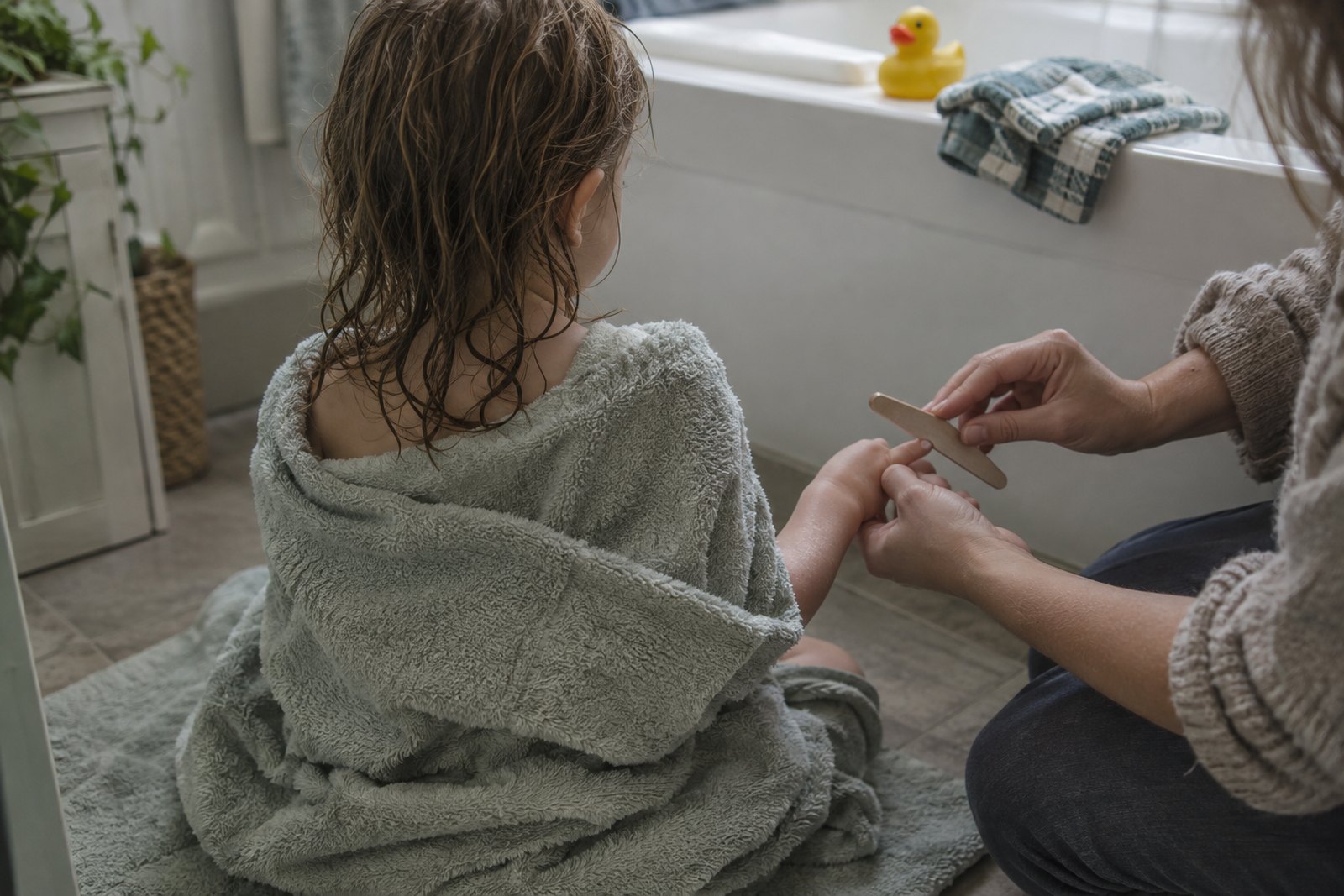
- Do it after a bath or shower, when nails are softer and less likely to split or snap.
- Hold firmly. Hold the finger or toe with firm, steady pressure rather than a light grip.
- Work in small sections. One nail, then a break. One hand a day if that is what works.
- Try filing instead of cutting. An emery board or glass nail file has no click and no sudden sensation, and many children tolerate it far better. File little and often so nails never get long.
- Use rounded-tip nail scissors or small clippers and leave a thin white edge rather than cutting short.
- Cut toenails straight across to reduce the risk of ingrown toenails.
- Involve your child. Count fingers together in a song, let them press the clippers with your hand around theirs, or let older children file their own.
Some parents trim a younger child's nails while they sleep. It can work, but if your child wakes up startled it may make bedtime harder, so weigh it up. If a nail is red, swollen, painful or looks infected, see your GP or pharmacist. A podiatrist can help with ongoing toenail problems.
Never force or restrain
When a haircut is long overdue or you are worried about teeth, holding your child still can start to feel like the only option. It is a false shortcut. Being held down during something that already feels frightening can make every future attempt much harder, damages trust, and risks injury from scissors, clippers or a struggling child. If you have reached that point, it is the moment to step back and get help, not push on.
It is fine to let hair grow longer or pick a style that needs less cutting. If there is tooth decay, dental pain or a nail problem that needs treatment, talk to your dentist or GP about the options, which may include treatment in a specialist setting.
Where an occupational therapist fits
An occupational therapist looks at why the task is hard for your particular child and builds a plan around that. A paediatric occupational therapist can assess how your child processes touch, sound, vibration and body signals, watch the actual routine at home, suggest tools, positions and timings to try, and write a gradual plan that breaks each task into steps your child can manage. They may also suggest a daily sensory plan, sometimes called a sensory diet, to help your child stay calmer generally, which makes care tasks easier. Our guide to occupational therapy for autistic children explains what this involves, and our children's occupational therapy page covers home visits.
A private occupational therapist visiting at home sees the real bathroom, the real chair and the real routine, which is often where the useful detail is. They can also write reports for school, or as evidence for an education, health and care plan in England (or the equivalent support plan in Wales, Scotland or Northern Ireland), if self-care is affecting daily life more widely.
Other professionals lead on some things. Your dentist leads on teeth, decay and fluoride. Your GP should see any skin problems, infections, ingrown nails, or pain your child cannot explain. A podiatrist deals with ongoing foot and toenail problems. If difficulties with the mouth extend to eating, chewing, swallowing or a very restricted diet, ask your GP about a speech and language therapist or your child's paediatric team.
Frequently asked questions
How long should I help my child brush their teeth?
NHS guidance is to supervise children's brushing until they are at least 7 or 8. Many autistic children need help for longer because brushing thoroughly takes coordination and tolerance. A good middle step is letting them brush first and you finishing off.
My child will only use an electric toothbrush switched off. Is that okay?
As a stepping stone, yes. A manual brushing action with a switched-off electric brush still cleans teeth. You can build up slowly, perhaps switching it on for a few seconds at the end, but do not rush it. Ask your dentist whether the brushing you are managing is enough.
Should I tell the barber my child is autistic?
Usually yes, if your child is comfortable with that. It lets the barber plan the appointment, slow down and make adjustments. You might prefer to explain on the phone beforehand rather than in front of your child.
Could my child's reaction be something other than sensory?
Yes, sometimes. A child who suddenly resists brushing may have toothache. Scalp soreness, eczema or an infected nail can make touch genuinely painful. If the reaction is new, much worse than usual, or your child seems unwell, see your dentist or GP before assuming it is sensory.
Can I get occupational therapy for this on the NHS?
NHS children's occupational therapy is available in many areas, usually by referral from your GP, health visitor, school or paediatrician. What is offered and how long it takes varies by area, and some services focus on particular needs. Ask your GP or school what is available locally.
What if my child still cannot tolerate any of it?
Keep the basics safe, keep hair short or easy, file nails rather than cut, and keep seeing the dentist. Then get help: an occupational therapist for the sensory side, and your dentist or GP for anything medical that cannot wait.
Next steps
See our children's occupational therapy and sensory needs pages, or current guide prices, and choose your area below.
Talk to an occupational therapist near you
This guide is general information. For advice about your own situation - or someone you look after - a local occupational therapist can visit you at home and see it for themselves.
Choose your area: