

Sleep and Autism: What Helps an Autistic Child Who Won't Sleep
By Mobile Occupational Therapist • 4 October 2026 • 13 min read
If your autistic child will not settle, wakes for hours in the night or is up for the day at 4am, you are far from alone. Sleep problems are widely recognised as common in autistic children, and they are rarely caused by bad parenting. They usually come from a mix of things: a body clock that runs differently, senses that find the bedroom too bright, loud or scratchy, a mind that cannot switch off, and sometimes a health problem nobody has spotted yet.
The good news is that a lot of what helps is practical and can start tonight. A predictable routine shown in pictures, a bedroom set up for how your child actually experiences light, sound and touch, a clear plan for night waking, and a GP visit if anything sounds medical. This guide takes each of those in turn, explains when melatonin comes into it (in the UK it is a prescribed medicine for children, only through a doctor), and where an occupational therapist fits.
Why sleep is often harder for autistic children
It helps to know what you are dealing with, because the fix depends on the cause. Most children have more than one of these going on.
The senses
Many autistic children experience sensory input more intensely, or less intensely, than other people. A streetlight through the curtains, the hum of a fridge, a label in pyjamas or a duvet that feels too light can be enough to keep a child awake. Others seek out strong input and find it hard to settle without movement or deep pressure.
Anxiety and a busy mind
Bedtime is quiet, dark and separates your child from you. For a child who has held it together all day at school, it can be the moment worries arrive. Uncertainty about tomorrow is a common trigger.
The body clock
Melatonin is the hormone that tells the body it is night. Research suggests some autistic people produce or time it differently, which may explain why some children are wide awake at bedtime however tired they look, or wake very early. This is a biological difference, not defiance.
Not noticing tiredness
Interoception is the sense that tells us what is happening inside our body: hunger, thirst, needing the toilet, feeling tired. Many autistic children find these signals faint or confusing. A child may not recognise they are sleepy, or may wake because they need a wee without understanding why.
Routines and transitions
Moving from one activity to another is often hard. Bedtime is a big transition, from screens or play to bath, to bed, to lights off. If the steps change from night to night, every one becomes a potential battle.
Health problems hiding in plain sight
Pain keeps anyone awake, and a child who communicates differently may not tell you. Constipation, reflux, eczema, toothache, ear infections and breathing problems at night are all worth ruling out before you assume the problem is behavioural.
Start with a sleep diary
Before you change anything, keep a simple diary for two weeks. Note when your child went to bed, when they fell asleep, every waking and how long it lasted, when they woke for the day, any naps, what they ate and drank in the evening, screen time, and what kind of day it was. Patterns jump out that you would never notice when exhausted, such as worse nights after PE or after a late snack. A diary is also exactly what a GP, paediatrician or occupational therapist will ask for, so it is never wasted effort.
A calm, predictable bedtime routine
A routine works because it takes the guesswork out of the evening. The aim is the same steps, in the same order, at roughly the same time, every night, including weekends as far as you can manage.
- Keep it short. Thirty to forty-five minutes is plenty. A routine that takes two hours becomes a burden for everyone.
- Make the last steps happen in the bedroom. Story, music or a calm activity in bed links the room with settling.
- Wind down the input. Lower lights and quieter voices as the routine goes on. Save rough play for earlier.
- Warn before transitions. A visual timer or a calm countdown helps children who find stopping hard.
- Fix the wake-up time. A consistent time to get up in the morning often does more for the body clock than a strict bedtime.
Using a visual schedule
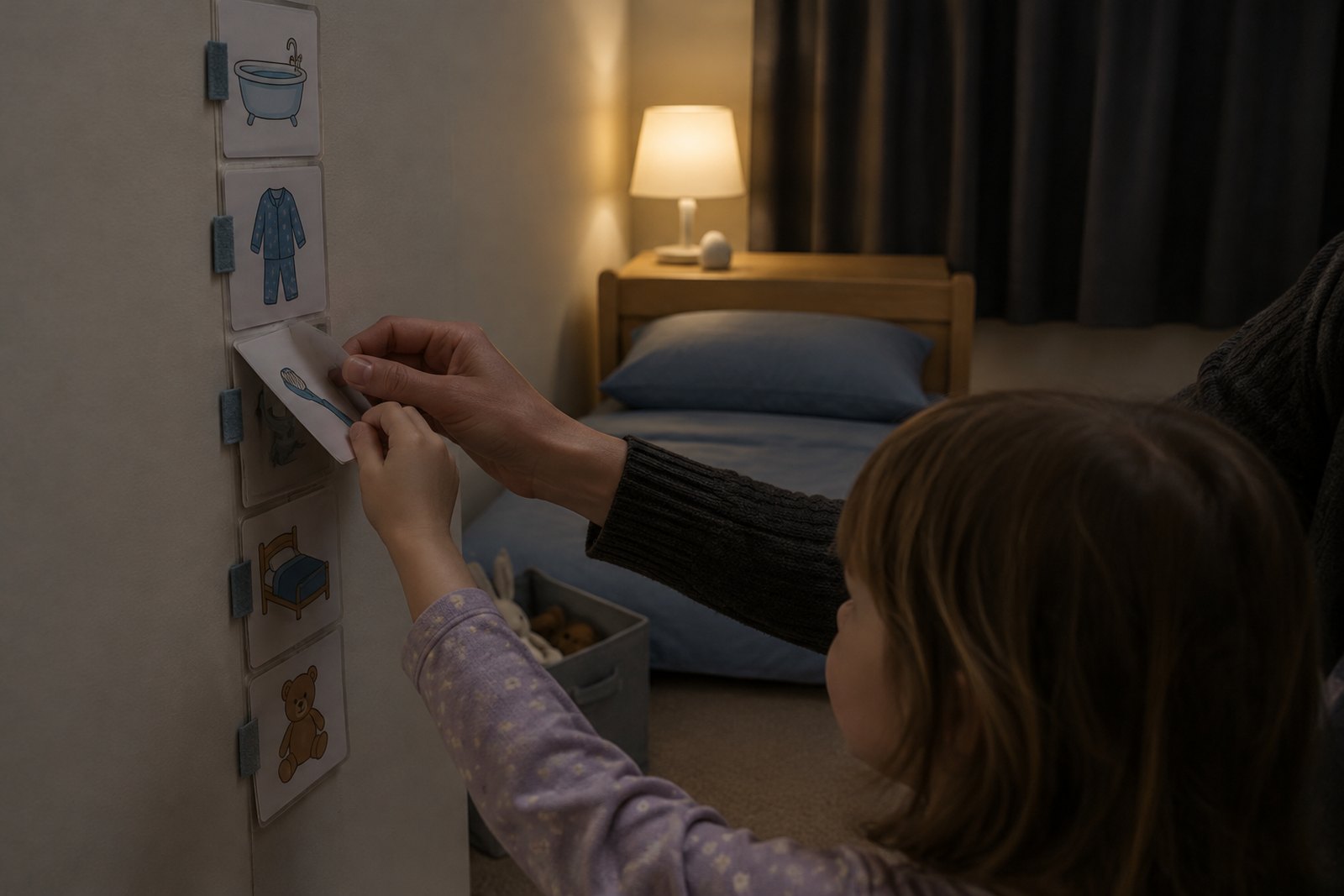
Many autistic children process pictures more easily than spoken instructions, especially when tired. A visual schedule is a strip of pictures or photos showing each step: tea, bath, pyjamas, teeth, toilet, story, bed. Your child can move or turn over each card as it is done. Use photos of your actual bathroom and their actual toothbrush if symbols do not work. A picture for tomorrow morning at the end can reassure a child who worries about what comes next.
Some families add a simple social story about bedtime and night time, written in calm, positive language. Keep it short and read it at the same point each evening.
The bedroom through your child's senses
Try lying in your child's bed at night and noticing what they notice. It is often surprising.
- Light. Blackout blinds or lined curtains help with streetlights and summer evenings. Some children need total darkness; others are frightened of it and do better with a dim, warm-coloured night light. Cover or remove blinking standby lights.
- Sound. Some children wake at every creak. Steady background sound such as a fan or quiet white noise can mask it. Others find any sound unbearable and are happier with soft ear defenders while falling asleep, if they find them comfortable.
- Touch. Cut out labels, try seamless or inside-out pyjamas, and let your child choose fabrics. Some like tight-fitting pyjamas or a snug sleeping bag for the feeling of pressure. Some hate a duvet that moves around; others want heavy layers.
- Temperature. A cool room usually helps, but children who do not notice being cold may kick off covers and wake chilly. Layers they can adjust work better than one thick duvet.
- Smell. Strong washing powder or air freshener can bother sensitive children. Keep it plain.
- Clutter. A busy room full of toys can be stimulating. Store favourite things out of sight, or behind a curtain, at night.
Weighted blankets are popular and some children find the pressure calming, but they are not right for everyone and there are clear safety rules about age, weight and the child being able to remove it themselves. Read our guide to weighted blankets for children before buying one.
What happens during the day matters
- Daylight in the morning. Getting outside early in the day helps set the body clock.
- Movement. Plenty of physical activity during the day often helps, especially for children who seek movement. Bouncing, swinging, climbing, swimming and carrying heavy things all count. A planned set of these activities is sometimes called a sensory diet, and it can make evenings calmer.
- Naps. For older children, late afternoon naps can push bedtime later. If your child falls asleep in the car on the way home from school, a small change of routine may help.
- Caffeine. Cola, tea and chocolate all contain caffeine, so avoid them from the afternoon. Energy drinks are not suitable for children at any time of day.
- The school day. A child who masks or copes all day may arrive home overloaded. Quiet recovery time after school can stop that spilling into bedtime, and may reduce evening meltdowns.
Screens: the honest version
Screens are a lifeline in many autistic households and nobody is going to remove them entirely. But tablets and games before bed tend to keep children alert, partly from the light and mostly from the content. Games are designed to be hard to stop.
What usually works better than a battle is a predictable screen finish time, shown on the visual schedule, around an hour before bed. Give a warning, then swap to something calming your child genuinely likes. If screens must be part of settling, choose slow, familiar content on a dimmed device, and keep devices out of the bedroom overnight. A child who wakes at 2am with a tablet within reach is unlikely to go back to sleep.
A plan for night waking
Night waking is where most exhausted parents give in, because anything that gets everyone back to sleep feels like a win. That is understandable. But a written plan, agreed in daylight, helps you respond the same way each time.
- Check quickly for a reason. Toilet, too hot or cold, pain, wet bed, a noise. Deal with it calmly and with as little light and talk as possible.
- Keep it boring. Night time is for sleeping. Same few words each time, low voice, no screens, no lights on full.
- Use a cue for morning. A clock that changes colour when it is time to get up can help children who cannot tell the time or who wake very early. Show it on the visual schedule too.
- Have a quiet option. For children who are wide awake for long periods, a basket of calm, safe, quiet activities in the bedroom can be better than a fight.
- Make gradual changes. If your child currently needs you lying with them, move a little further away every few nights rather than stopping suddenly.
- Share the nights. If there are two adults, take turns. Whether you are on your own or not, you can ask your council for an assessment of your needs as a parent carer (in England this is called a parent carer's needs assessment).
Keeping your child safe at night
Some autistic children wander at night, climb, open doors or windows, or have little sense of danger. Safety comes before everything else in this guide.
- Fit restrictors to upstairs windows so they only open a small amount.
- Consider a stair gate at the top of the stairs if your child is young enough for one to be safe, or door alarms or a chime so you know when the bedroom door opens.
- Keep outside doors locked with keys stored safely but somewhere every adult can reach quickly in a fire.
- Remove or secure anything climbable near windows, and fix tall furniture to the wall.
- Lock away medicines, cleaning products and sharp objects.
- A baby monitor or sound monitor can give you warning without you having to stay awake listening.
Specialist safety beds and enclosed sleep spaces exist for children at serious risk, but they should only be used after a proper assessment by a professional, usually through your NHS or council children's services, because they raise safety and wellbeing questions of their own. Do not improvise anything that restricts your child's movement in bed.
When to see the GP, and when to call 999
Book a GP appointment if your child:
- snores loudly most nights, gasps, or seems to stop breathing for a moment while asleep
- has unusual jerks, stiffening, staring or movements at night that could be seizures
- sleeps very little, or the problem is getting steadily worse despite a good routine
- is very sleepy during the day, or their behaviour, learning or mood has changed noticeably
- may be in pain, constipated, scratching at night or showing signs of reflux
Take your sleep diary, and a short video on your phone if you can capture snoring, breathing pauses or night-time movements. If you are worried and cannot get a GP appointment, call NHS 111. Call 999 if your child is struggling to breathe, has a seizure for the first time, or has a seizure lasting more than five minutes.
Melatonin: what parents need to know
In the UK, melatonin is a prescribed medicine for children. It is not sold over the counter here, and it should only be given to your child if a doctor has prescribed it. It is usually started by a specialist such as a paediatrician, and sometimes then continued by a GP. Doctors will normally want to see that routine and environment changes have been tried first.
Melatonin sold online or abroad is not regulated in the same way and the dose can be very different from what the label says. Do not buy it for your child. If you think it might help, talk to your GP or paediatrician. You can read more on the NHS melatonin page listed in the sources.
Where an occupational therapist fits
An occupational therapist looks at how your child manages everyday life, and sleep is one of the biggest parts of that. A paediatric occupational therapist can:
- assess your child's sensory preferences and how they affect settling and night waking
- look at the bedroom with you and suggest changes to light, sound, bedding and layout
- help build a bedtime routine and visual schedule that suits your child and your household
- plan daytime sensory and movement activities to help evenings go better
- advise on night-time safety and appropriate equipment
- write a report that can support an EHCP, a council assessment or a housing application
An occupational therapist does not diagnose sleep apnoea, epilepsy or other medical problems, and cannot prescribe melatonin. Those belong with your GP and paediatrician, who may refer to an NHS sleep clinic. The National Autistic Society and Cerebra both offer sleep advice for families, and some NHS areas have specialist sleep practitioners. You can read more about occupational therapy for autistic children and our sensory needs service.
Frequently asked questions
Is it normal for an autistic child not to sleep?
Sleep problems are very common in autistic children, so you are not unusual. Common does not mean you have to put up with it, though. Most families see some improvement once the causes are worked out, and very little sleep is always worth raising with a GP.
Will my child grow out of sleep problems?
Some children's sleep improves as they get older and others continue to struggle into adulthood. It is better to work on it now than to wait, because poor sleep affects mood, learning and the whole family.
Can I buy melatonin for my child?
No. In the UK it is a prescription medicine for children and should only be given if a doctor prescribes it. Products bought online can contain very different amounts from the label. Speak to your GP or paediatrician.
Should I let my child sleep in my bed?
There is no single right answer. If co-sleeping works for your family and everyone sleeps, that is your choice. If it is not working, move away from it gradually, a small step every few nights, with the change shown on the visual schedule.
Does a weighted blanket help with sleep and autism?
Some children find it calming and some do not. It must suit their age and size, and they must be able to remove it easily themselves. Read the safety rules before buying one, and ask an occupational therapist if unsure.
Can I get an occupational therapist for sleep on the NHS?
It depends on your area. Some NHS children's occupational therapy teams will help with sleep and sensory needs, others will not, and waiting lists vary. Ask your GP, health visitor, school nurse or paediatrician what is available locally. Many families also use a private occupational therapist who visits at home.
Next steps
If you would like help with your child's sleep, routine or bedroom, see our paediatric occupational therapy page, or current guide prices, and choose your area below.

Talk to an occupational therapist near you
This guide is general information. For advice about your own situation - or someone you look after - a local occupational therapist can visit you at home and see it for themselves.
Choose your area: