

Shower Over the Bath: Getting In and Out Safely
By Mobile Occupational Therapist • 18 October 2026 • 14 min read
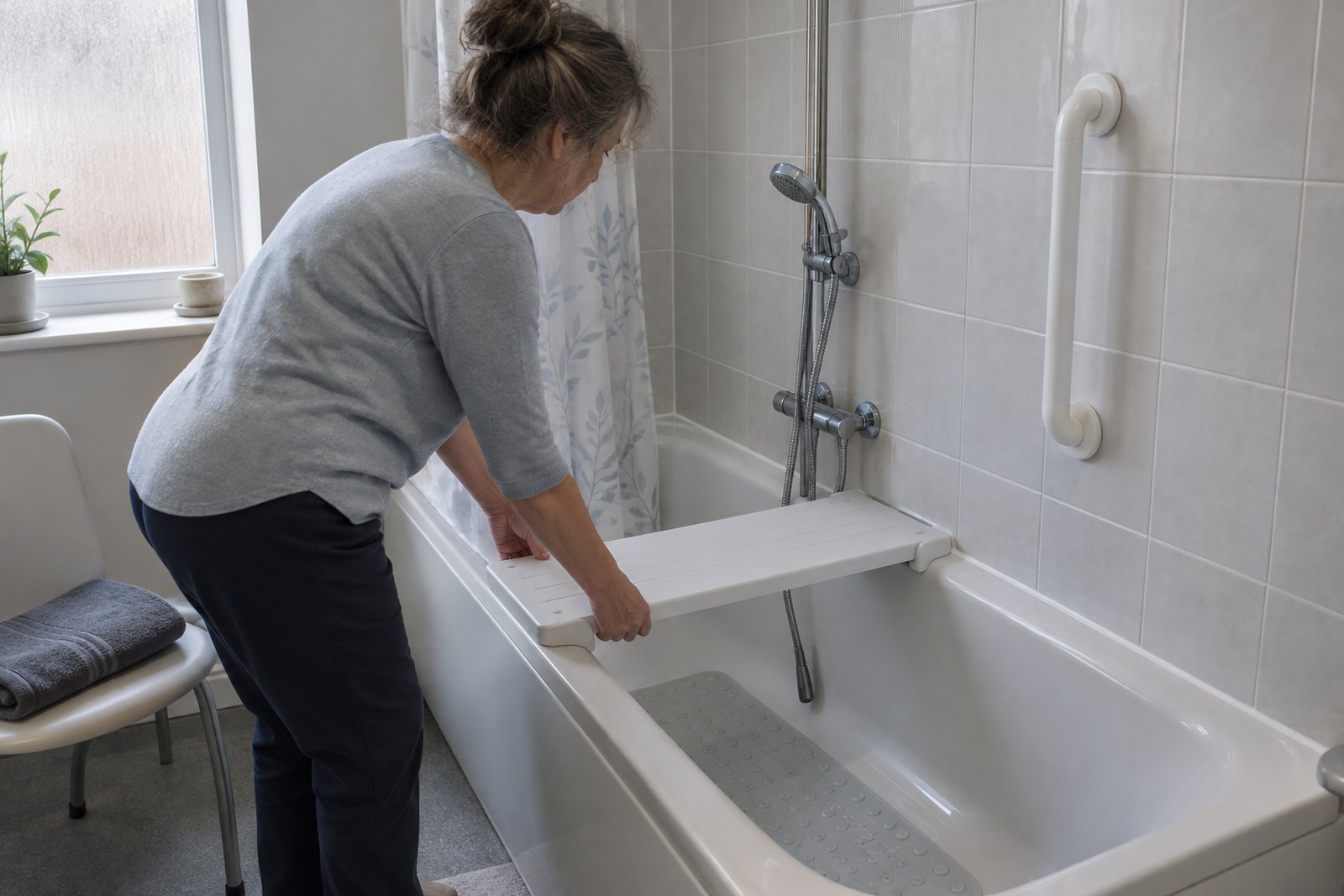
If your balance is not what it was, a shower over the bath is one of the riskiest set-ups in the house. You have to lift one leg high over the rim while standing on the other, land on a narrow, curved, wet surface, stand there with soap in your eyes, and then do it all again in reverse when you are tired, cold and slippery. Many bathroom falls happen while getting in or out, rather than during the wash itself.
The good news is that you rarely need to rip the bathroom out straight away. For many people the safest change is simple: stop standing to shower and sit down instead, using a bath board, a non-slip mat, a hand-held shower you can reach while seated, and grab rails fixed where you actually need them. If even that is too much, it may be time to think about a level-access shower. This guide walks through each step, what to do today, and who can help.
Why a shower over the bath is harder than it looks
It is worth understanding exactly where the risk sits, because it tells you what to fix.
- The step over the rim. Most bath sides come up to around knee height or above. Lifting a leg that high means balancing on one foot for a second or two. With weak hips, a stiff knee, a recent operation or a wobble from medication, that is exactly when people go over.
- The landing. The bottom of a bath is curved, narrow and often already wet. Many baths are acrylic, which can be very slippery with soap on it.
- Standing still with your eyes shut. Washing your hair means tipping your head back and closing your eyes. Balance relies heavily on vision, so this is when many people sway.
- Turning round. Shuffling round to rinse your back in a space the width of a bath is awkward.
- Getting out. You are warm, perhaps a little light-headed from the heat, and the floor outside the bath may be wet. Hot water can make blood pressure drop, which is why some people feel dizzy as they step out.
If any of that sounds familiar, you are not being dramatic. It is a genuinely hard manoeuvre, and it gets harder gradually enough that people often do not notice until they have a near miss.
Never hold on to these
When people feel themselves wobble, they grab whatever is nearest. In a bathroom, almost none of it is designed to take a person's weight. Please do not use any of the following for support, even briefly:
- The shower screen. Glass bath screens are hinged and fixed for splashes, not for an adult pulling on them. They can swing, come away from the wall or crack.
- A towel rail or heated towel rail. These are usually held by small fixings into plaster or tile. Heated ones can also be hot enough to burn.
- The shower riser rail or hose. It looks like a grab rail. It is not.
- Taps, soap dishes, shelves and toilet roll holders.
- The shower curtain or curtain pole.
- The edge of the basin. Basins can pull away from the wall, and some are only supported by brackets.
- Suction-cup grab handles. They can lose grip without warning, especially on textured tiles. Do not trust one with your full weight.
If you find yourself reaching for any of these, that is a sign you need a proper rail, fixed properly. More on that below.
The safer set-up: what actually helps
These are the pieces that usually make the biggest difference. Not everyone needs all of them, and the right combination depends on your bath, your bathroom and your body.
A bath board, so you sit to shower
A bath board is a sturdy plastic board that rests across the top of the bath, from one long rim to the other, with grips underneath that sit inside the rim to stop it sliding. You sit on the edge of it from outside the bath, swing your legs over, and then shower sitting down. You never have to stand in the bath at all.
For many people this one change removes most of the risk. It does mean you will not be able to lie down in the water, but if you have been showering anyway, that is no loss.
Bath boards are not right for everyone. You need to be able to sit steadily without a backrest, lift your legs over the rim while seated (or have help to), and the board must fit your bath width properly. Some corner baths, roll-top baths and baths with sloping or very narrow rims are not suitable. Our guide to bath boards and when they are not safe goes into this in detail.
A non-slip mat inside the bath
Even if you sit, your feet will be on the bath base, and you may need to press through them to shuffle along the board. A non-slip mat with suction cups on the underside helps. A few practical points:
- Press it down firmly before each use and check it has gripped.
- Lift it out to dry afterwards. Mould and soap scum underneath make it slip and stop it sticking.
- Some baths have a built-in textured surface that suction mats will not stick to. Check before you buy.
- Put a mat with a rubber backing on the floor outside the bath as well, so you are not stepping onto wet lino or tiles.
Grab rails in the right places
A properly fixed grab rail gives you something safe to hold as you sit down, turn and stand up. Common positions are a vertical rail on the wall at the end or side of the bath for getting in and out, and a horizontal or angled rail along the wall side for steadying yourself while seated. There are also rails that clamp onto the bath rim itself, which can help when there is no suitable wall.
Position matters more than the rail. A rail fitted where a builder thought looked tidy can be useless to the person who actually uses it. Fixings matter too: tiles over plasterboard need the right fixings or the rail can pull out. See our guide to grab rails and where they go.
A bath step, if you still step in standing
A bath step is a low, wide platform with non-slip feet that sits on the floor outside the bath. It reduces how high you have to lift your leg. It can suit someone who is fairly steady and just finds the rim a bit high, but it is not a fix for poor balance. You still have to stand on one leg, and the step itself becomes something to trip over when you get out. Read about bath steps and how to use one safely before you buy one.
A hand-held shower on a riser rail
A fixed overhead shower forces you to stand. A hand-held shower head on a slide rail lets you set the height so you can reach it easily while sitting, and point the water where you want it instead of turning your body. Make sure the hose is long enough to reach you comfortably on the board, and that the head clips back where you can reach it without stretching. A plumber can advise on hose length and fittings.
Thermostatic control to prevent scalds
When you are sitting down, you cannot jump out of the way quickly if the water suddenly runs hot, which can happen when someone flushes a toilet or runs a tap elsewhere. A thermostatic shower or thermostatic mixing valve holds the temperature steady and limits how hot it can get. This matters even more for anyone with reduced feeling in their skin, for example after a stroke or with nerve damage from diabetes, because they may not notice the water is too hot until they are burned.
If you are not sure whether your shower is thermostatic, ask a plumber or check the manual. In the meantime, test the water with a hand that has normal feeling before it touches anyone's body.
The small things
- Put your towel, dressing gown and clean clothes within reach of where you will sit to dry, not on the other side of the room.
- Dry and dress sitting down. A chair or stool next to the bath helps.
- Keep a long-handled sponge on the board so you can reach your feet and back without bending or twisting.
- Keep the bathroom warm and well lit, and leave the door unlocked if someone else is in the house.
- If you live alone, shower when you know someone is around or will call, and keep a personal alarm on if you have one.
How to get in and out sitting down
This is the usual method with a bath board. If an occupational therapist has shown you something different for your situation, follow their advice.
Getting in
- Check the board is sitting squarely, with the grips snug inside the rim, and the non-slip mat is down.
- Stand with your back to the bath, so the backs of your legs are touching the side, near the middle of the board.
- Reach back with one hand for the board or a grab rail. Lower yourself slowly onto the board. Do not drop down.
- Shuffle your bottom back a little so you are well onto the board, not perched on the edge.
- Lift one leg over the rim and into the bath, then the other. If your legs are heavy or stiff, you can lift them with your hands under the thigh, use a leg lifter strap, or have someone help.
- Turn to face the taps or the shower, keeping one hand on the rail.
- Test the water temperature, then shower sitting down.
Getting out
- Turn off the water. Dry your legs and feet as much as you can while still sitting.
- Turn back to face out of the bath, holding the rail.
- Lift one leg out, then the other, and place both feet flat on the non-slip mat outside.
- Shuffle to the front of the board, feet slightly apart and tucked back a little.
- Lean forward, push up from the board with one hand and hold the rail with the other, and stand.
- Pause. Count to five before you walk anywhere. If you feel dizzy, sit back down.
Practise once with the bath dry and fully dressed before you try it for real. It feels clumsy the first time and becomes routine quickly.
When it is time to move to a level-access shower
Aids buy time, sometimes many years. But there comes a point for some people where getting legs over a rim, even sitting down, is no longer realistic or safe. Signs that point that way include:
- You cannot lift your legs over the rim even when sitting, or need a lot of help to.
- You cannot sit safely without a backrest.
- You use a wheelchair or need a hoist for other transfers.
- The person caring for you is straining their back every time.
- Your condition is expected to progress.
- You are avoiding washing because it feels too risky.
At that point a level-access shower or wet room, where you walk or wheel straight in with no step, usually makes more sense than more equipment. Our guide to wet rooms and level-access showers explains the options, including shower seats and shower commode chairs that go with them.
Getting it assessed and paid for
You do not have to work this out alone, and you may not have to pay for all of it.
- Council adult social care. You can ask your local council for a needs assessment. If you are assessed as needing equipment such as a bath board, it is often lent free through the community equipment service. In England, councils should not charge for minor adaptations, such as grab rails, costing under a set amount when you have an assessed eligible need. Ask your council how this works locally.
- Disabled Facilities Grant. Larger changes, like replacing a bath with a level-access shower, may be covered by a Disabled Facilities Grant from the council. It is means-tested for adults, and an occupational therapist's assessment is usually part of the process. Our guide to the Disabled Facilities Grant explains how it works, and GOV.UK has the official rules. Arrangements differ in Scotland, Wales and Northern Ireland, so check with your council, or in Northern Ireland with the Housing Executive and your local Health and Social Care Trust.
- Tenants. If you rent from a council or housing association, contact them too. Many have their own adaptations process.
Waits for council assessments vary a lot. If you are struggling now, say so clearly when you call, and use the safer techniques above while you wait.
Where an occupational therapist fits
An occupational therapist looks at you, your bath and your bathroom together, and works out the safest way for you to wash. That includes watching how you actually get in and out, measuring the bath and rim, checking whether a board will fit and grip, marking exactly where rails should go, and showing you and any carer the technique. They can also tell you honestly when equipment will not be enough and a level-access shower is the better answer, and write that up in a way the council can use.
A private occupational therapist visiting at home can usually see you sooner than a council waiting list. Be aware that a council may still want its own assessment before agreeing a grant, so ask them first how they treat private reports.
An occupational therapist is not the right person for everything. If you are getting dizzy or falling more often, see your GP, as there may be a medical cause such as blood pressure or medication that needs checking. If balance goes suddenly, especially with face drooping, arm or leg weakness, slurred speech, sudden vision loss or a severe headache, call 999 straight away. A physiotherapist is often the right person for strength and balance work. If someone falls and is hurt, cannot get up, hits their head or is confused afterwards, call 999.
Frequently asked questions
Is a shower over the bath safe for an elderly person?
It can be, with the right set-up. Standing to shower over a bath is risky for anyone with poor balance, weak legs or dizziness. Sitting on a bath board, with a non-slip mat, a hand-held shower and properly fixed rails, is much safer for many older people.
Can I put a shower stool in the bath instead?
Ordinary shower stools are made for flat shower trays. The base of a bath is narrow and curved, so the legs may not sit level, and getting up from that low down is hard. A bath board is usually a safer choice. If you are unsure, ask an occupational therapist.
Can I get a bath board free?
Often, yes. If your council assesses you as needing one, it is usually lent through the community equipment service at no charge. Contact your council's adult social care team to ask for an assessment.
What if I cannot lift my legs over the side, even sitting?
Some people manage with a leg lifter strap or a little help. If that is still too hard, a bath board is probably not the answer. A bath lift may work for some people, and our honest guide to walk-in baths and bath lifts covers that. For others, a level-access shower is the better route.
Should I take the shower screen off?
Not necessarily, but a fixed or hinged screen can get in the way of a bath board and is a tempting thing to grab. Many people find a shower curtain, tucked inside the bath, works better with a board. Whatever you have, never use the screen for support.
Do grab rails need to be fitted by a professional?
They need to be fixed into a wall that can take a person's full weight, with fixings that suit the wall. If you are not confident about that, get someone qualified to fit them. A rail that pulls out is worse than no rail.
Next steps
If washing has started to feel risky, an assessment can sort out the right set-up for your bath and your body. See our equipment and aids or home adaptations pages, or current guide prices, and choose your area below.
Talk to an occupational therapist near you
This guide is general information. For advice about your own situation - or someone you look after - a local occupational therapist can visit you at home and see it for themselves.
Choose your area: