

Bath Steps: Who They Suit and How to Use One Safely
By Mobile Occupational Therapist • 30 September 2026 • 13 min read
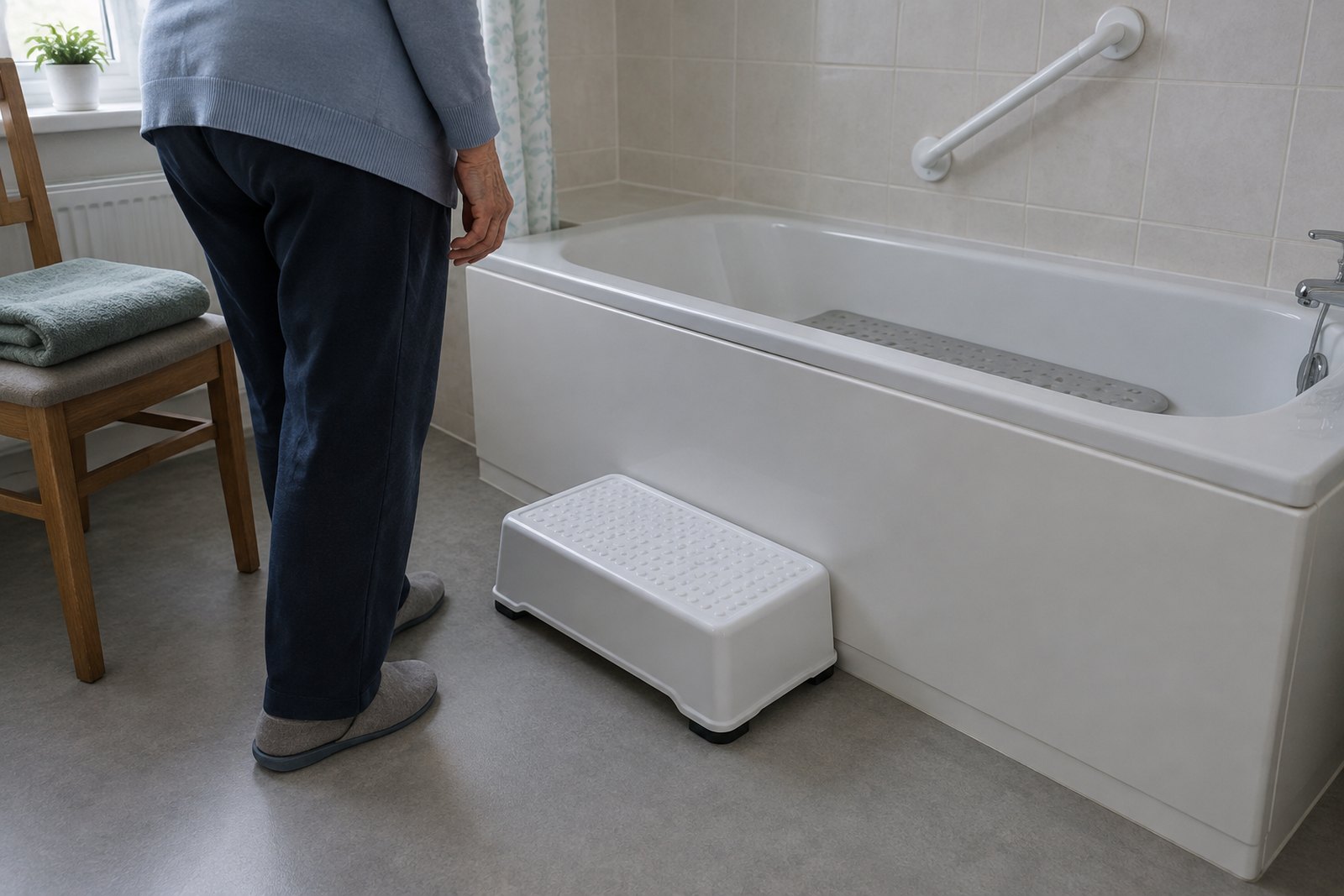
A bath step is a low, sturdy platform that sits on the floor beside the bath. It raises you a few inches, so the bath rim is less of a leg lift to get over. For someone who can still step and balance well but finds the side of the bath awkwardly high, it can make getting in for a shower noticeably easier.
There is a catch. A bath step only helps with one thing: stepping over the rim. It does not help you sit down in the bath or stand up from the bottom of it, and it makes the drop on the inside slightly bigger. Bath steps suit people with steady balance who have a firmly fixed grab rail to hold. They do not suit people with poor balance, weakness down one side, dizziness or confusion, and nobody should use one without a rail. If that sounds like you or your mum or dad, the better options are further down.
What a bath step actually is
Most bath steps are made of moulded plastic and look like a wide, shallow box. The top is textured for grip and the underneath has rubber or non-slip feet so it does not skid on the floor. Many are modular. You start with one unit and, if you need more height, click a second matching unit on top. Some versions come with a handle attached, though a handle on the step is not a substitute for a rail fixed to the wall.
A bath step is not the same as a perching stool, a bath board or a bath seat. It is for standing on, briefly, while you step over. It is not for sitting on and it never goes inside the bath.
Who a bath step suits
A bath step tends to work well for people who:
- are steady on their feet and can stand on one leg for a moment while holding something firm
- find the bath side a bit high, perhaps because they are shorter, have stiff hips or knees, or have a deep bath
- shower standing up in the bath rather than sitting down in the water
- have a grab rail fixed to the wall that they can hold the whole time they are stepping over
- can see the step clearly and feel it properly under their feet
In practice this is often someone who is managing fine but has noticed that lifting a leg over the rim has started to feel like hard work, or that they wobble slightly at the top of the movement. A step takes a little height out of that lift. It does not add balance you do not already have.
Who should not use a bath step
This is the part that matters most. A bath step adds a second level to negotiate in the most slippery room in the house. For some people it swaps one risk for a bigger one. Get advice before buying one if any of these apply.
Poor balance or recent falls
Stepping over a bath rim means standing on one leg, on a raised surface, then lowering your foot onto a wet, curved bath floor. If you have fallen recently, feel unsteady when you turn, or hold on to furniture to get round the house, adding a step is likely to make the movement harder rather than easier.
Weakness on one side
After a stroke, or with some neurological conditions, one leg may not lift reliably or may not take your weight well. Stepping up onto a platform and over a rim relies on each leg doing its job in turn. A seated method, such as a bath board, is usually the safer starting point.
Confusion, memory problems or dementia
A step left on the bathroom floor is a trip hazard for anyone who may not remember it is there, especially at night. Using it also involves a sequence - hold the rail, step up, lift one leg, lower it, bring the other over - which can be hard to follow when thinking or memory is affected.
Dizziness, fainting or numb feet
Warm water and steam can make some people lightheaded when they stand. If you get dizzy on standing, have fainted before, or cannot feel your feet well, being raised up on a small step at the moment you get out is a poor combination. Mention dizziness or blackouts to your GP anyway, because they can have causes worth checking.
Recent hip or knee surgery
If you have recently had a joint replaced or other leg surgery, follow the advice of your surgical team or hospital therapists about stepping over a bath. Some people are advised not to get into the bath at all for a while.
Anyone without a rail to hold
Never stand on a bath step to get into or out of the bath unless there is a firmly fixed grab rail within easy reach. The edge of the bath, a towel rail, the basin, a shower screen and the taps are not the same thing. They were not designed to take your weight and they can move, break or slip out of a wet hand.
Setting up a bath step safely
- Check the floor. The step needs a hard, level, dry floor. Do not put it on a bath mat, a rug, deep carpet or across a join between two types of flooring. Press down on each corner. If it rocks at all, it is not safe where it is.
- Check the feet. All the non-slip feet should be present, clean and not worn smooth. Soap, talc and dust all reduce grip, so wipe the feet and the floor underneath now and then.
- Push it right up against the bath. There should be no gap between the step and the bath panel for a foot to slip into. Place it where you naturally step in, directly below your grab rail.
- Get the height right. The aim is to make the rim manageable, not to make it disappear. The higher the step, the bigger the drop down onto the slippery bath floor on the other side. Many people find one unit is enough. If you stack units, use ones made to lock together and check they are firmly clicked in place. Never build a step from boxes, books, crates, an upturned bucket or a kitchen stool.
- Sort out the inside of the bath. A bath with a smooth base needs a non-slip mat inside. Make sure it grips properly before you put your weight on it.
- Have everything within reach. Put your towel and dressing gown where you can get them without stretching while you are standing on the step.
- Think about the night. If you or anyone else uses the bathroom at night, the step is something to trip over in the dark. Good lighting helps. If you move the step out of the way between uses, check it is back in exactly the right place every time.
How to use a bath step
Everyone moves differently, and an occupational therapist or physiotherapist can show you the method that suits your body, including which leg to lead with. As a general pattern:
Getting in
- Take hold of the grab rail before you step onto the step, and keep hold throughout.
- Step up onto the step with both feet and pause until you feel steady.
- Lift one leg over the rim and place that foot flat on the mat in the bath.
- Bring the other leg over.
- Only let go of the rail when both feet are flat and you feel settled.
Getting out
Getting out is usually the riskier direction. You are wet and warm, possibly a bit tired, and you are stepping down onto a small target rather than a whole floor.
- Turn the shower off and let the water drain away.
- Dry your feet and lower legs as well as you can while still holding the rail. Wet feet on a plastic step are asking for trouble.
- Stand still for a moment before moving, especially if you feel warm or lightheaded.
- Holding the rail, lift one leg over and place the foot squarely in the middle of the step. Bring the other leg over, then step down to the floor.
- If you feel faint at any point, do not try to push on. It is safer to lower yourself carefully to sit in the empty bath and call for help than to keep going.
What a bath step will not do
A bath step does nothing to help you lower yourself to sit in the water or get back up from the bottom of the bath. That is a different and much harder movement, and it is the one that leaves people stuck. If you want to soak rather than shower, a step is not the answer. A bath lift or a different washing arrangement is more likely to be.
Pairing a bath step with a rail and a bath board
The grab rail is not optional. It needs to be fixed securely into the wall, at the right height and angle for you and for the way you move. Rails that attach with suction cups are generally not recommended for taking your weight, and certainly not something to rely on while you are standing on a step. Our guide to where grab rails go and what not to grab covers placement and fixing in more detail.
If standing to step over feels like too much, a bath board is often the better next move. You sit on the board from outside the bath, lift your legs over one at a time, then shower sitting down. Because you are not stepping over while standing, most people using a board this way do not need a step at all. Boards are not right for everyone either, so read our guide on bath boards and when they are not safe before choosing one.
Alternatives worth considering
A bath step is one small piece of equipment among many. Depending on what is actually difficult, these may suit better:
- A grab rail on its own. Sometimes a well-placed rail is all that is needed, and the step adds nothing.
- A bath board. For seated showering over the bath when stepping over is no longer safe.
- A bath lift. A powered seat that lowers you into the water and raises you back up, for people who want to sit in the bath but cannot get down or up.
- A level-access shower or wet room. Removing the bath altogether, so there is nothing to step over. It is a bigger job, but for many people it is the long-term answer. Our guide to wet rooms and level-access showers explains what is involved. Some people can get help with the cost of adaptations like this, such as a Disabled Facilities Grant in England, Wales and Northern Ireland. The rules, including any means test, differ between the UK nations, so check with your council (or the Housing Executive in Northern Ireland) before you plan any work.
- Washing at the basin for a while. Particularly after illness or surgery, a good strip wash can be a perfectly sensible stopgap.
For a wider look at what exists, see our plain guide to bath and shower aids for older adults.
Where an occupational therapist fits
Bath steps are cheap and easy to buy, which is exactly why people end up with the wrong thing. The useful question is not "would a step help?" but "what is actually hard about getting in and out of this bath, and what is the safest fix?" That is what an occupational therapist assesses.
An occupational therapist can watch you get in and out of your own bath, look at your balance, strength, sight and confidence, measure the bath and the room, and work out where a rail needs to go. They can tell you whether a step will help, whether a bath board or bath lift is safer, or whether it is time to think about a shower instead. They can also show you and your family a safe method, which matters as much as the equipment.
You can ask your council's adult social care team for an assessment, which is free, though waiting times vary by area. Some people choose a private occupational therapist visiting at home, often because they want things sorted sooner or want a written report to support a grant application.
An occupational therapist is not the right person for everything. If balance or leg strength is the main problem, a physiotherapist leads on exercises to improve it. If you have had falls, blackouts or dizzy spells, see your GP first, as there may be a medical cause to look into, and your GP can refer you to a local falls service if one exists in your area.
Frequently asked questions
Are bath steps safe for elderly people?
They can be, for older people who are steady on their feet and have a fixed grab rail to hold. Age alone is not the issue. Balance, strength, eyesight, dizziness and memory are. If any of those are a concern, a seated option is usually safer.
Can I get a bath step from the council?
Councils and their community equipment services do provide small bathing equipment after an assessment, but what is offered and how it works varies from area to area. Contact your council's adult social care team and ask for an assessment of your bathing needs, rather than asking only for a specific item.
What height should a bath step be?
There is no single right height. It depends on your bath, your height and how you move. The aim is to make the rim manageable without creating a big drop on the other side. Many people find one unit is enough, and an occupational therapist can advise on your own bath.
Can I hold the side of the bath instead of a grab rail?
No. The rim of a bath is curved, often wet, and not designed to be gripped while you step. Towel rails, basins, taps and shower screens are not designed to take your weight either. Use a properly fixed grab rail.
Should I use a bath step and a bath board together?
Usually not. A board is for people who sit down and swing their legs over, so a step is not normally needed. If you are short and struggle to reach a board, ask an occupational therapist rather than combining the two by guesswork.
What should I do if I fall getting in or out of the bath?
Do not rush to get up. Check whether you are hurt, keep warm with a towel, and call for help if you can. If you are injured, cannot get up, or hit your head, call 999. Afterwards, tell your GP about the fall, even if you felt fine.
Next steps
If you are not sure a bath step is the right answer, an assessment in your own bathroom will settle it quickly. See our equipment and aids page, or current guide prices, and choose your area below.

Talk to an occupational therapist near you
This guide is general information. For advice about your own situation - or someone you look after - a local occupational therapist can visit you at home and see it for themselves.
Choose your area: