

Sensory Swings: Who They Help and How to Fit One Safely
By Mobile Occupational Therapist • 28 October 2026 • 12 min read
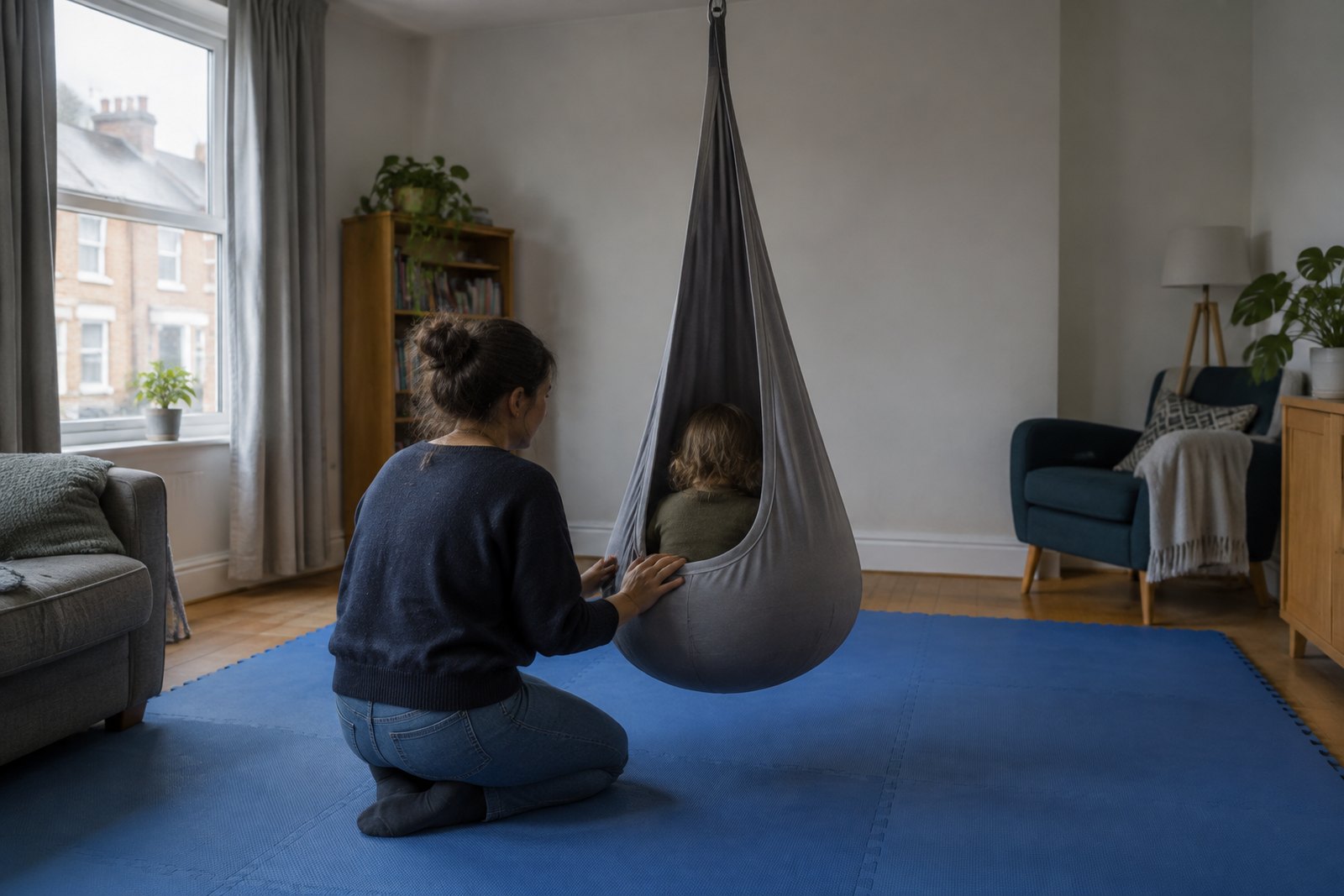
A sensory swing is a swing designed to give a child (or adult) controlled movement and, often, firm all-round pressure. The common types are stretchy lycra pods, flat platform swings, fabric hammocks and disc swings. They can help some children who crave movement, struggle to settle or find the world overwhelming. They are not a treatment in themselves, and they do not suit everyone.
The bigger question for most families is not which swing to buy but how to hang it. A swinging child puts far more force on a fixing than the same child sitting still, and the serious accidents with home swings tend to come from the wrong fixing, too little space or loose cords. This guide covers what each type does, who tends to benefit, how to fit one properly, and the signs that a child has had too much.
What a sensory swing actually does
Swinging works mainly through two senses. The first is the vestibular sense, the balance system in the inner ear that tells the brain which way is up and how fast you are moving. Our guide to the vestibular system explains it in more detail. The second is proprioception, the body's sense of where its own parts are, which comes from muscles and joints. A pod that hugs the body, or a swing that makes a child grip and push, gives a lot of this. Our page on proprioception and body awareness covers it.
As a rough rule of thumb that many therapists use:
- Slow, rhythmic, front-to-back swinging tends to be calming and organising.
- Fast, irregular or jerky movement tends to be alerting.
- Spinning and twisting is the most intense input of all and the most likely to tip a child into feeling sick or overwhelmed, sometimes well after they have stopped.
Every child is different, which is why watching your own child matters more than any general rule.
The main types of sensory swing
Lycra pod or cocoon swing
A tube or bag of stretchy fabric hung from a single point. The child climbs in and the fabric wraps around them, often closing over the head. It gives firm, even pressure all over the body plus gentle movement, and many children use it as a calm hiding place. It is the type most often bought for home. Because a child can be completely enclosed, it needs the closest supervision of all.
Platform swing
A flat, usually padded board, hung from four ropes or from a single point. A child can sit, kneel or lie on their tummy, which makes it versatile and is why you see them in therapy rooms. Single-point platforms move in every direction and spin easily, so the input can be very strong. At home, a four-point platform that mainly moves forward and back is easier to control.
Hammock swing
A fabric sling the child lies back in, either an open hammock or a deeper chair-style one. It gives gentle rocking and some pressure from the fabric, and tends to suit children who want to wind down rather than burn off energy.
Disc swing
A small round seat on a single rope, sat astride with the rope between the legs. The child has to grip with hands and knees and hold their own balance, so it is active, alerting and hard work for the arms and trunk. It suits older children with reasonable balance and grip, and is more often found in gardens than indoors.
Who might benefit
Swings are most often suggested for children with sensory processing differences, including many autistic children and children with ADHD or dyspraxia. In practice the children who seem to get most from them are:
- Children who seek movement all day - spinning, climbing, rocking, jumping off furniture. Our guide to sensory seeking behaviour explains why this happens.
- Children who get overwhelmed by noise, people or school and need somewhere enclosed to recover.
- Children who struggle to settle in the evening and calm with slow rhythmic movement.
- Children with low muscle tone or poor body awareness, for whom holding on and pushing is useful work.
It is worth being honest about the limits. The research on sensory-based approaches is mixed, and a swing will not change an underlying condition. What it can do, for the right child, is help them feel calmer, more alert or more comfortable in their body for a while, which makes the next part of the day easier. Some children love swings. Others hate them, and a few are genuinely frightened when their feet leave the ground. That fear is real and should not be pushed through.
A swing works best as one part of a planned set of activities across the day rather than a standalone fix. Our guide to building a sensory diet at home shows how it can fit in.
Check with a doctor first if...
Movement input is powerful. Before a child or adult uses a swing, get advice from their GP, consultant or specialist nurse if they have:
- Epilepsy or a history of seizures. Intense movement and overstimulation can be a concern for some people, and a seizure in a swing carries an obvious fall risk.
- A heart condition, or any condition that causes fainting or problems with blood pressure.
- Neck instability or a neck problem. Some children with Down's syndrome, some connective tissue conditions, and anyone who has had neck or spinal surgery may need specific advice.
- A recent head injury or concussion, a shunt, an inner ear problem, dizziness, recent surgery or a fracture.
This is not a complete list. If your child has a significant health condition and you are unsure, ask before you buy.
How to fit a sensory swing safely
This is where most of the risk lies, so take it slowly.
Use the right fixing in the right place
A swing needs a fixing rated for dynamic loads - weight that moves, swings and bounces - not just a static weight. Vigorous swinging puts much more force through the fixing than a child sitting still, and repeated movement can work fixings loose over time.
- Fix into a structural timber joist or beam, through the centre of the joist, using a ceiling mount made for swings. Plasterboard, lath and plaster or a ceiling rose will not hold.
- Not every joist is strong enough. Ceiling joists under a loft can be lighter than joists that carry a floor. If you are not certain what is above your ceiling, get a competent builder or joiner to check, and a structural engineer if there is any doubt.
- Concrete ceilings, common in flats, need anchors designed for that material and for swinging loads. This is a job for a professional.
- Never use a door frame or pull-up bar, a tension rod, a plasterboard hook, a light fitting or a curtain pole. These are not designed for swinging and can twist out or pull away.
- If you rent, get your landlord's permission in writing before drilling into the ceiling.
Or use a proper frame
A free-standing swing frame avoids drilling altogether. Choose one designed and rated for swinging, with a wide, stable base, and follow the instructions exactly, including any weighting or anchoring. Outdoor frames should be anchored into the ground as the manufacturer specifies.
Respect every weight limit
The swing, the fixing, any connector or carabiner, any extension strap and the frame each have a maximum load. The lowest one is your real limit. Never let two people use a swing designed for one, and do not let an adult test a child's swing unless it is rated for them.
Clear space and soft flooring
- Push the empty swing to its fullest movement in every direction and make sure nothing is within reach: walls, furniture, radiators, windows, door edges or shelving.
- Put thick play mats or a crash mat underneath and around the swing. Carpet over a hard floor is not enough.
- Hang the swing low, so the child can put their feet down or would only fall a short distance onto a mat.
- Keep siblings and pets out of the swing's path while it is in use.
Cords, straps and strangulation risk
Swings come with ropes, adjustment straps, daisy chains and spare loops. Any loop or loose length that a child could get their head or neck through is a strangulation risk. Secure or remove excess strap as the instructions allow, never let children wrap ropes around themselves, and keep blind cords well away. When the swing is not in use, unclip it or loop it up out of reach, especially if younger children are in the house.
Check it regularly
Before each use, look at the fixing, connectors, ropes and fabric. Stop using it if you see fraying, torn or overstretched fabric, worn stitching, rust, cracks or a fixing that has moved.
Supervision and using it well
A child should always be supervised on a sensory swing by an adult who is in the room and watching. Lycra pods need particular care because the fabric can close over a child's face. Make sure their face is not pressed into the fabric and that they can get out easily, and never let a child sleep in a pod or hammock swing.
A few habits help:
- Let the child lead. Many children know what they need. Offer, do not force.
- Start short and gentle. A few minutes of slow swinging is a reasonable start. You can build up.
- Go easy on spinning. If you allow it, keep it slow and brief, and stop as soon as they seem unsettled.
- Finish calmly. End with slower movement or some heavy work such as pushing, pulling or carrying, rather than stopping straight after the most exciting bit.
- Think about timing. A lively session just before bed rarely helps.
Signs your child has had too much
Overload can appear quickly, or creep up and show itself later in the day. Stop and help your child off the swing if you see:
- Nausea, retching or saying they feel sick
- Going pale, clammy or sweaty
- Repeated yawning, hiccups or a change in breathing
- Dizziness, headache or unsteadiness once they are off
- Becoming wild and giggly, or suddenly quiet and glazed
- Distress, crying or a meltdown during or after the session
Let them lie down somewhere quiet, offer firm pressure if they like it, and give them a drink of water. Note what happened and keep the next session shorter and gentler.
If your child loses consciousness, has a seizure, hits their head and becomes drowsy or is sick repeatedly, or seems seriously unwell, call 999. If you are worried but it is not an emergency, call NHS 111 or speak to your GP.
Where an occupational therapist fits
An occupational therapist experienced in children's sensory needs can help you work out whether a swing is likely to help at all, which type, and how to use it: how long, what kind of movement, when in the day and what to pair it with. They can spot a child who is frightened of movement or easily overloaded and suggest alternatives, and they can build a swing into a wider sensory plan for home or school.
What an occupational therapist does not do is certify your ceiling. The fixing is a building question for a competent builder or structural engineer. Medical questions about epilepsy, heart conditions or neck stability belong with the GP or specialist team. If you are worried about your child's development, coordination or behaviour more broadly, the GP or health visitor is a good first step, and the school SENCO can advise on support in education. A physiotherapist may lead where the main issue is movement or muscle tone.
NHS children's occupational therapy is usually reached through a GP, health visitor, paediatrician or school, and waits vary by area. A private occupational therapist visiting at home can see the space you have, watch your child use any equipment you already own, and give advice specific to your house and your child.
Frequently asked questions
Can I hang a sensory swing from a door frame?
No. Door frame bars and pull-up bars are not designed for swinging loads and can twist, slip or pull away, dropping the child. Use a fixing into a structural joist, checked by a competent person, or a free-standing frame rated for swings.
How long should my child spend on a sensory swing?
There is no single right answer. Start with a few minutes of slow swinging and watch how your child is during the session and for the rest of the day. Some children do well with short bursts several times a day; others manage only a little. An occupational therapist can help you set a plan.
Can my child sleep in a pod swing?
No. A child should not sleep in a pod, cocoon or hammock swing. If they drift off, lift them out and put them to bed.
Are sensory swings good for autistic children?
Some autistic children find them calming or enjoyable, and others dislike or fear them. A swing is not a treatment for autism. It is one possible tool for helping a child feel settled, and it is worth trying one carefully before spending much money.
Can adults use a sensory swing?
Yes, and some adults with sensory differences find a hammock or pod genuinely helpful. Check every weight limit, including the fixing and connectors, and the same medical cautions apply.
Next steps
If you would like help working out whether a swing suits your child and how to use it, see our sensory needs or children's occupational therapy pages, or current guide prices, and choose your area below.
Talk to an occupational therapist near you
This guide is general information. For advice about your own situation - or someone you look after - a local occupational therapist can visit you at home and see it for themselves.
Choose your area: