

Interoception: How to Help a Child Notice Their Body Signals
By Mobile Occupational Therapist • 1 October 2026 • 13 min read
Interoception is the sense that tells you what is happening inside your body. It is how you know you are hungry, thirsty, need a wee, are too hot, are tired, or that your heart is pounding because you are scared. Most of us never think about it. The signal arrives, we notice it, we deal with it.
Some children do not get those signals clearly. They notice them too late, or not at all, or feel them so loudly that they are overwhelmed. That can look like toilet accidents at an age when you would not expect them, a child who never asks for food, or a meltdown that seems to come from nowhere. It is not naughtiness and it is not laziness. Awareness can often be built with patient, everyday practice, and there is a lot you can start at home today.
What interoception actually is
You may have been taught there are five senses. There are more, and interoception is one of the ones that matters most for daily life. Our guide to the 8 sensory systems explains the others. Interoception covers signals from your organs, muscles and skin about your internal state, including:
- hunger and fullness
- thirst
- a full bladder or bowel
- heart rate and breathing
- body temperature
- pain, itching and feeling sick
- tiredness
It also plays a big part in emotions. Fear, anger and excitement show up first as body sensations: a tight chest, a hot face, a churning tummy, shaky legs. A child who cannot read those sensations may not know they are getting anxious or cross until they are already completely overwhelmed.
How interoception difficulties show up in children
There is no single picture. Some children under-notice signals, some over-notice them, and some do both depending on the signal or the day. These are patterns parents commonly describe.
Toileting
Wetting or soiling well after other children their age have stopped. Leaving it to the very last second and then running. Not seeming to notice they are wet. Some children go the other way and ask for the toilet constantly because every small sensation feels urgent.
Eating and drinking
Never saying they are hungry, then becoming irritable or tearful just before meals. Forgetting to eat when absorbed in something. Eating until they feel sick because the full signal never quite arrives. Barely drinking all day and then getting headaches.
Temperature
Wearing a coat in a heatwave or shorts in the snow. Not noticing they are sweating or shivering.
Pain and illness
Not reacting to cuts, bumps or a burn, or saying nothing about an earache until it is quite bad. Other children react very strongly to small knocks or describe frequent tummy aches.
Emotions and meltdowns
Going from apparently fine to a full meltdown with no warning. Often the build-up was there, hunger, tiredness, a full bladder, rising worry, but the child could not feel it or name it. If meltdowns are a big part of your days, our guide to autistic meltdowns covers what helps in the moment.
Sleep
Not recognising tiredness and fighting sleep, or running on empty until they crash.
Interoception, autism and ADHD
Interoception has had a lot of attention in autism research, which is why so many people search for the two together. Many autistic people describe body signals as hard to notice, hard to make sense of, or overwhelmingly intense, and some find it hard to connect body sensations with emotions. Some people with ADHD describe similar difficulties, sometimes because their attention is so absorbed elsewhere that signals simply get missed.
It is worth being careful here. Not every autistic child or child with ADHD has interoception difficulties, and some children with neither do. Difficulty noticing body signals is not on its own a sign of autism or ADHD, and it is not something to diagnose from a checklist. If you are wondering about autism or ADHD, speak to your GP, health visitor or the school SENCO about an assessment. For a broader look at day-to-day support, see occupational therapy and ADHD.
Practical ways to help your child notice body signals
The aim is not to quiz your child all day. It is to make body signals a normal, low-pressure thing to talk about, and to put supports in place so daily life works while awareness grows. Think in weeks and months rather than days.
1. Narrate your own body
Children learn the language of sensations by hearing it. Say out loud what you notice and what you do about it: 'My tummy is rumbling and I feel a bit wobbly. I think I am hungry, so I will have a snack.' Or: 'My face is hot and my heart is going fast. I am feeling cross. I am going to take a few slow breaths.' It feels odd at first. Keep going.
2. Give them words for sensations, not just feelings
'How do you feel?' is a hard question if you genuinely do not know. Concrete words are easier: empty, full, tight, fizzy, heavy, buzzy, shaky, hot, cold, achy, squeezy. Younger children often do well pointing to a simple drawing of a body to show where something feels different. Later you can link sensations to emotions: 'Your tummy feels fizzy and your hands are shaky. That might be nervous.'
3. Short body check-ins at predictable times
Pick a few natural moments, such as waking up, before leaving the house, after school and before bed, and do a quick check-in of half a minute or so. Go from top to bottom: head, mouth (dry?), tummy (empty, full, needing a poo?), bladder, hands and feet (warm or cold?), muscles (tired, wriggly?). Keep it light and accept 'I don't know' as a perfectly good answer. The habit matters more than getting it right.
4. Make the signals louder so they are easier to notice
Some activities create strong, easy-to-feel sensations, which gives a child something clear to practise on. Try:
- star jumps or running on the spot, then putting a hand on their chest to feel their heart going fast, and noticing it slow down again
- a cold drink, noticing where they can feel the cold travel
- holding something cool and then something warm (never hot, and always checked by an adult first), and comparing
- squeezing their fists or shoulders tight for a few seconds, then letting go and noticing the difference
- blowing bubbles slowly, or blowing a feather across the table, to notice their breath
Make it a game, not a lesson. Many of these fit neatly into a sensory diet if you already use one.
5. Let routines do the work while awareness grows
If your child cannot yet rely on their body to tell them, let the clock do it for now. This is not giving up on awareness. It keeps them comfortable, dry and fed while they learn.
- Toilet: regular planned trips, for example on waking, after meals, before going out and before bed, sitting for a few relaxed minutes with feet supported on the floor or a step.
- Food: regular meals and snacks at set times, rather than waiting to be asked.
- Drinks: a water bottle with a few drinking times marked on it, or a drink offered at every change of activity.
- Temperature: a simple picture chart by the door showing what to wear for different weather, rather than asking 'are you cold?'
Each time, add a tiny moment of noticing: 'Before we eat, does your tummy feel empty?' or 'Did you feel your bladder was full before you went?'
6. Use visual prompts
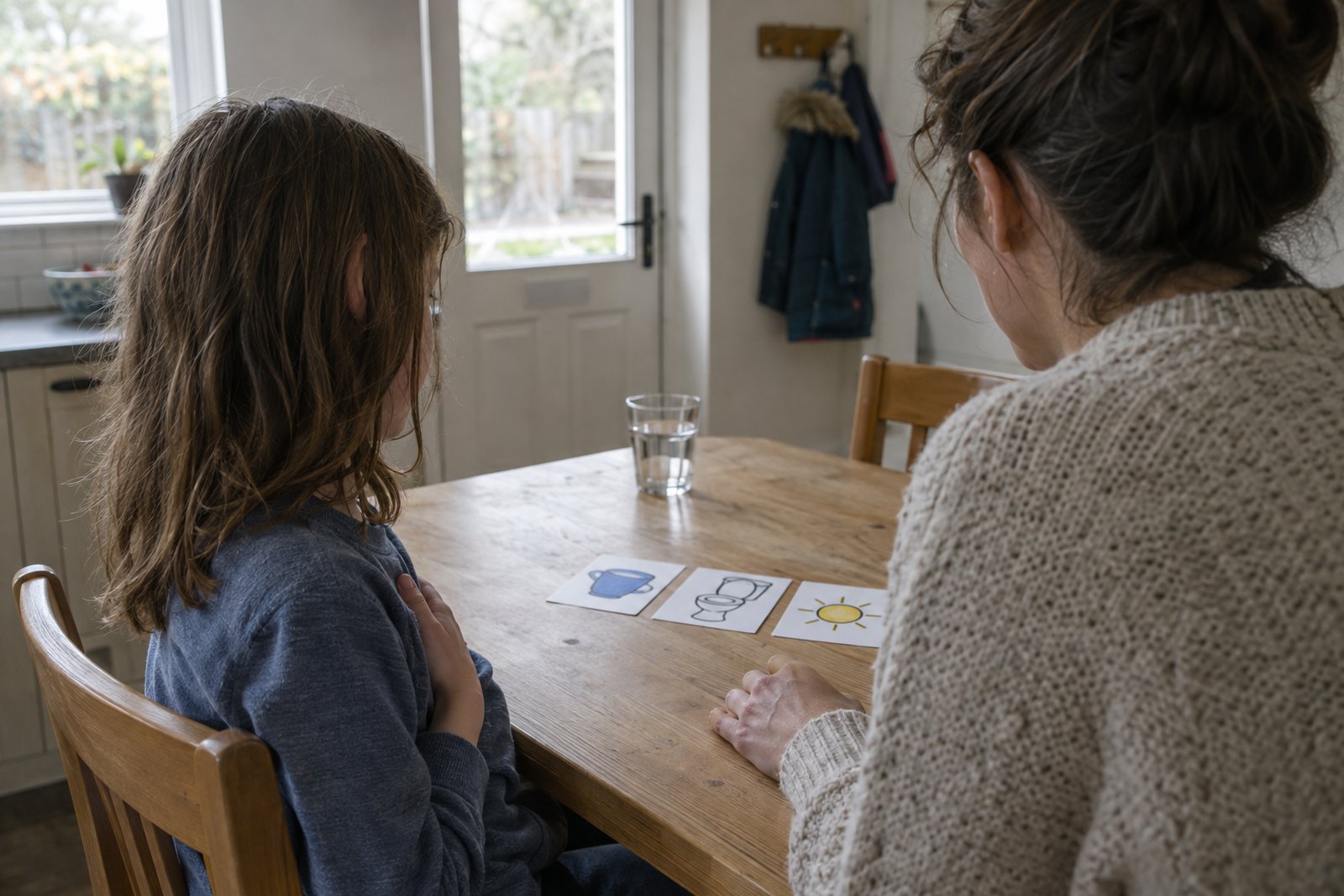
Picture cards on the fridge or in a school bag for hungry, thirsty, toilet, too hot, too cold, tired, hurt and need a break give a child a way to tell you without having to find words when they are struggling. A simple scale, say 1 for calm up to 5 for about to explode, with body clues drawn beside each number, helps a child spot the early stages before things boil over.
7. Link each signal to a plan
Noticing is only useful if the child knows what to do next. Pair signals with actions: thirsty means drink, hot means take off a layer, fizzy and tight means go to my calm spot or do my squeezes. Practise when everyone is calm, not in the middle of a meltdown.
8. Bring school in
Share what works with the class teacher and SENCO. Simple adjustments such as a toilet pass that does not need asking for, a water bottle on the desk, planned snack or movement breaks, and the same picture cards at school can make a real difference. If needs are significant, these can be written into a support plan.
What tends not to help
- Telling off or showing disappointment over accidents. The child usually genuinely did not feel it coming, and shame makes them less willing to talk about their body.
- Endless questions. Being asked 'do you need the toilet?' ten times a day often gets an automatic 'no'.
- Insisting they must feel what you think they feel. Accept what they tell you and keep gently offering words.
Safety: when signals get missed, adults need to watch
This is the part that matters most. A child who does not notice pain, thirst or illness may not tell you when something is wrong, and may not look unwell in the way you would expect. The adults around them have to be the early warning system.
- After a fall or knock, check properly even if they say they are fine. Look for swelling, limping, or not using a hand or arm normally.
- Use bath time or dressing to look for cuts, bruises, burns or skin changes they have not mentioned.
- Treat changes in behaviour as a possible pain signal: unusually quiet, more meltdowns, off their food, sleeping badly, or holding or protecting one part of the body.
- Watch for signs of not drinking enough, such as fewer wees, dark wee or headaches.
- Keep an eye on poos. Children who miss bowel signals can become constipated, and ongoing constipation can cause soiling that looks like an accident. Speak to your GP if you suspect it.
- Check their temperature with a thermometer if they seem off, rather than relying on them to say they feel hot.
Call 999 if your child is struggling to breathe, will not wake or is very hard to wake, has a seizure, or has a rash that does not fade when you roll a glass over it. Call NHS 111 if you are worried and unsure what to do. See your GP about ongoing tummy pain, wetting, soiling, eating very little or weight changes. Toileting problems always deserve a medical check first, so that constipation, infection or other causes are looked at before anything is put down to interoception.
Where an occupational therapist fits
Occupational therapists work on the everyday things people need and want to do. For children that includes toileting, eating, dressing, sleep, play, school and managing big feelings. Interoception sits right in the middle of all that, so it is an area many children's occupational therapists work in, usually as part of looking at sensory processing more widely. You can read more about paediatric occupational therapy.
A private occupational therapist visiting at home can:
- look at how your child notices and responds to body signals, using conversation, observation and questionnaires where appropriate
- see the whole sensory picture, because interoception rarely sits on its own
- build a practical plan around your real routines, including toileting, mealtimes and calming strategies, pitched at your child's age and understanding
- suggest visual supports and activities that suit your child's interests
- share strategies with school and write a report that can support requests for help, including an EHCP in England
It is just as important to know where others lead. An occupational therapist does not diagnose autism or ADHD. That is done by a specialist assessment team, usually reached through your GP or school. Medical causes of wetting, soiling, tummy pain or poor eating need your GP first, and many areas have a children's bladder and bowel service your GP or school nurse can tell you about. A speech and language therapist is the right person if your child struggles with language for feelings or with communication more broadly. If your child seems very anxious or low, or is restricting food, ask your GP about children's mental health services or a dietitian.
Frequently asked questions
Is interoception really a sense?
Yes. It is often described as the eighth sense, alongside sight, hearing, smell, taste, touch, balance and body position. It works quietly in the background, which is why it is so easy to overlook.
Does poor interoception mean my child is autistic?
Not on its own. Interoception differences are common in autistic people, but they can also be part of the picture for some children with ADHD or anxiety, and for some children with no diagnosis at all. If you have wider concerns, talk to your GP or the school SENCO about an assessment.
Can interoceptive awareness improve?
Often, yes. Research is still at an early stage, but many families and therapists find that regular, playful practice and supportive routines help. Progress is usually gradual and uneven, and some children will always need some outside prompts. That is fine. The goal is a child who is comfortable and can get their needs met, not a perfect score.
My child says they are never hungry. Should I worry?
Offer food at regular times rather than waiting to be asked, and keep an eye on their energy, mood and growth. If they are eating very little, losing weight, not growing as expected, or eating a very narrow range of foods, see your GP.
Can adults have interoception difficulties too?
Yes. Many adults, autistic and not, recognise these patterns in themselves, sometimes only after their child has been assessed. The same ideas of naming sensations, routines and visual prompts work for adults as well.
Do I need a referral to see an occupational therapist?
Not for a private occupational therapist, who you can contact directly. NHS children's occupational therapy usually needs a referral, often through your GP, health visitor or school, and criteria vary from area to area, so check with your local service.
Next steps
If your child is struggling with toileting, eating or sudden meltdowns and you would like a plan that fits your home and school, see our sensory needs page, or current guide prices, and choose your area below.

Talk to an occupational therapist near you
This guide is general information. For advice about your own situation - or someone you look after - a local occupational therapist can visit you at home and see it for themselves.
Choose your area: