

Scoliosis Brace: Daily Life Tips for Children and Teenagers
By Mobile Occupational Therapist • 23 September 2026 • 16 min read
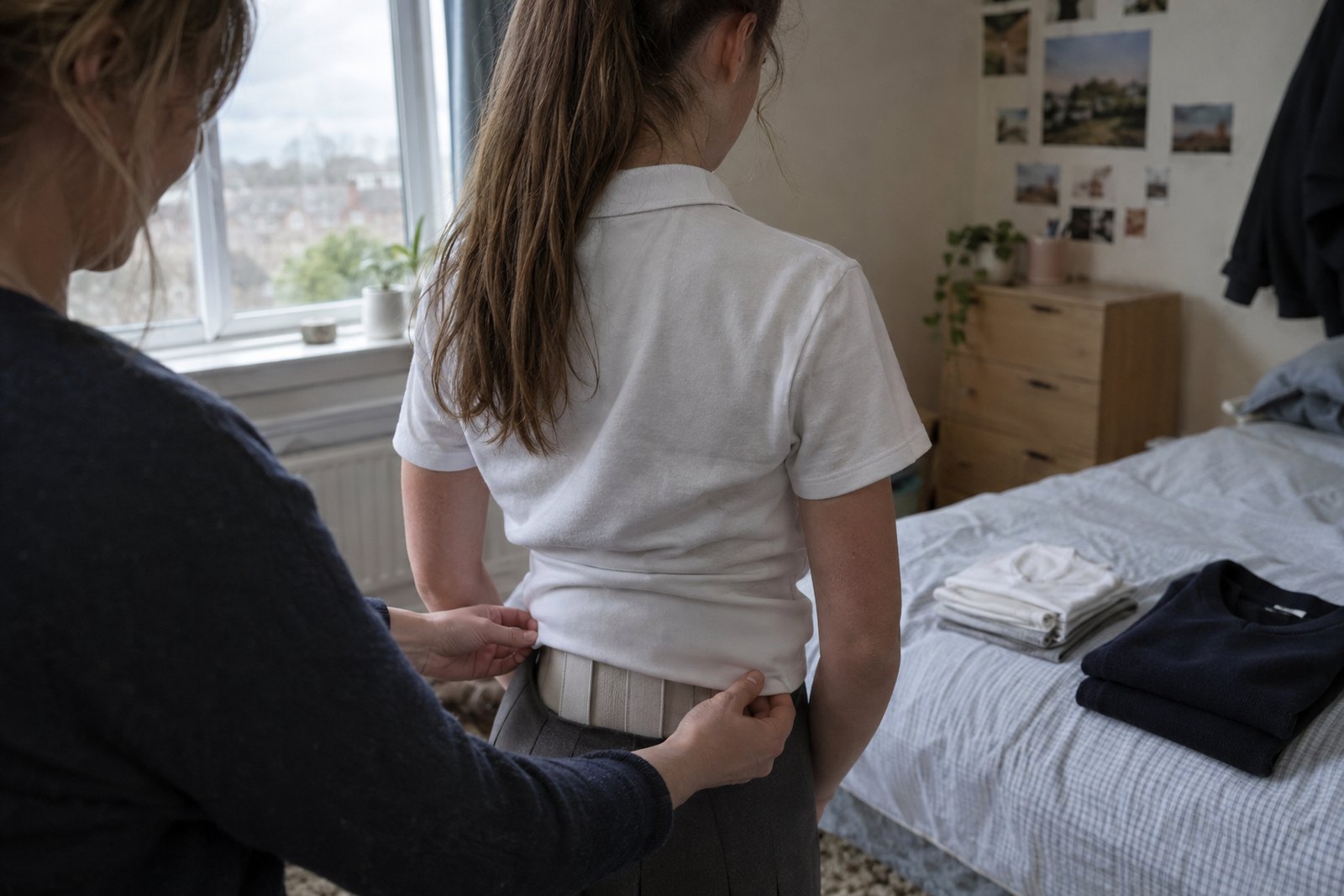
A scoliosis brace can feel like it has arrived in your life with a thud. One day you are watching appointments roll in and out. The next, your child is expected to wear a rigid plastic shell for hours a day, including at school, with all the practical and emotional knock on effects that come with it.
In general terms, a scoliosis brace is used while a child or teenager is still growing. The aim is usually to help stop the spinal curve getting worse during growth, not to straighten it permanently. The spinal team decides whether bracing is right, what type of brace, and how many hours it should be worn. Your job is to make daily life workable around that plan, and to flag problems early.
What a brace does and what it cannot do
It helps to be really clear about the purpose, because it makes the hard days feel less pointless.
Most bracing for scoliosis is about holding the spine in a more corrected position while your child grows, so the curve is less likely to progress. It is not usually presented as a cure. Even if the curve looks straighter in the brace, the goal is generally to influence how the spine grows, not to permanently push it straight there and then.
Bracing also tends to be a time limited phase. That does not make it easy, but it can help to remember that it is not forever. The spinal team will review progress, growth, comfort and fit, and adjust the plan.
If you are unsure what your child has been prescribed and why, ask the team to explain it in everyday language. Useful questions include:
- What is our target wear time, and does it include sleeping?
- Do we build up to that time gradually?
- When should the brace come off (for example for PE, showering, or certain sports)?
- Who do we contact about fit and rubbing (often the orthotist), and who do we contact about pain or symptoms (often the spinal nurse or consultant team)?
Getting used to wearing a brace (and actually hitting the hours)
Many children and teenagers need a settling in period. The brace changes how they sit, bend, breathe deeply and move quickly. It can feel hot, restrictive and unfair. Building tolerance is a skill, not a character test.
Follow the build up plan you are given
Some spinal teams recommend building up the hours over a number of days or weeks. Others start closer to the full prescription. Follow your team's advice, because it will be based on the curve, the brace, and your child's skin and comfort.
If you have not been given a clear build up plan, ask for one. It is much easier to succeed with a simple schedule than with a vague instruction like "as much as possible".
Make a predictable daily routine
Teenagers in particular do better when the day has a rhythm. Try to anchor brace time to things that already happen, for example:
- On straight after the morning wash and dress.
- Off for a set time after school to shower and decompress.
- Back on for homework, gaming, dinner and TV.
- Off again for a set bedtime routine (if the plan allows).
If your child is prescribed many hours a day, it often helps to avoid lots of short on off cycles. Each transition is a moment of negotiation. Fewer, planned transitions can reduce arguments and reduce the risk of forgetting.
Sort the "it doesn't feel right" problems early
There is a difference between "this is new and I don't like it" and "this is not fitting correctly". Trust your instincts. Common practical issues you can troubleshoot include:
- Positioning: is the brace sitting where the orthotist showed you, with the right alignment at the waist and hips?
- Straps: are they fastened to the level you were taught, and in the same order each time?
- Clothing underneath: is the layer smooth, with no creases?
If your child is getting pinching, sharp pain, numbness, or repeated rubbing in the same spot, contact the spinal team or orthotist rather than trying to push through.
Skin care under the brace (what matters and what to avoid)
Most families find skin care is where the "scoliosis brace" reality bites. A well fitted brace will still press firmly on certain areas. Skin may take a little time to adjust to the pressure, but it should not blister, break or become an open sore.
Use a thin cotton layer under the brace
Your team will advise what they want under the brace. Often it is a thin, close fitting cotton layer that:
- Has no bulky seams over pressure areas.
- Is long enough not to ride up.
- Can be pulled smooth so there are no wrinkles.
Having several of these makes life easier, because sweat happens and laundry piles up quickly.
Check the skin every day
Get into the habit early. When the brace comes off (often at bath or shower time), check the skin in good light. A hand mirror can help if your child is old enough and wants privacy.
Some redness over pressure points can be expected. What matters is how it behaves once the brace is off. Your team may give you a specific time to watch for. As a general rule, redness that fades is different from redness that stays angry, turns purple, blisters, or becomes broken skin.
Keep it clean and dry, and be cautious with creams
Wash and dry the skin as you normally would. If your child sweats a lot, an extra wash and full dry before the brace goes back on can help.
A common temptation is to use moisturisers, barrier creams or talc under the brace to reduce rubbing. Do not do this unless your spinal team has advised it. Some products can make skin more fragile under pressure, or affect the brace materials.
If skin is getting dry or irritated, ask the team what they recommend and where it can be applied (often this is when the brace is off, not right before it goes back on).
Clothes that fit over a scoliosis brace
Searching for "scoliosis brace clothes" is usually a sign that normal outfits have started to feel like a battle. Many children manage without specialist clothing, but some find purpose made brace vests or seamless tops more comfortable, so follow your orthotist or spinal team's advice. You need a few reliable rules and a bit of trial and error.
Start with comfort and function
Over a brace, clothes work best when they are:
- Slightly looser in the torso, so fabric does not cling and outline the brace.
- Soft and breathable, because braces trap heat.
- Easy to get on and off, especially for school toilets and changing rooms.
Some teenagers like fitted clothes over the brace because it holds everything stable and feels less "bulky". Others hate the feeling. Let your child lead where possible.
School uniform tips
Uniform can be the hardest part because there is less choice. Practical options to explore include:
- Tops: looser polo shirts, shirts sized to button comfortably over the brace, and jumpers or cardigans that are not tight at the waist.
- Blazers: some children find they need a slightly larger size. The aim is for the shoulders to sit properly without pulling.
- Bottoms: higher waists can sit awkwardly with some brace shapes. A different waistband style can make a big difference.
If uniform rules are strict, it can help to talk to the school early about small, sensible adjustments. This is about your child getting through the day, not about fashion.
Getting dressed without a daily argument
When a teenager is wearing a back brace, mornings can turn into a stand off. A few things that often help:
- Do a quick outfit test the night before, so there are no surprises at 8am.
- Keep a "safe outfit" ready for days when everything feels too much.
- Make sure there is time to cool down after putting the brace on, especially in summer.
If your child is struggling with fastening bras, tights, or shoes because the brace limits bending and twisting, tell the spinal team. There may be small technique changes that help.
Sleeping with a brace
Some children are prescribed brace wear overnight. Others wear it only in the day. Do what you have been told, and ask if you are unsure. Sleeping in a brace can be done, but it may take time.
Positioning ideas that often help
Comfort is individual, but many people do better with:
- Side lying with a pillow between the knees to keep hips comfortable.
- Back lying with a small pillow under the knees if the lower back feels strained.
- A clear routine before bed so the brace is not put on in a rush.
If your child wakes up with tingling, numbness, sharp pain, or they cannot get comfortable night after night, contact the team. Do not just accept it as "part of it".
Night time toilets and tired mornings
Braces can make it harder to move quickly. If your child needs the toilet at night, keep the route clear, add a night light, and think about what clothing is easiest to manage half asleep. Tiredness can build up when sleep is disrupted, and tired teenagers cope less well with everything else.
PE, sport and being active
Children and teenagers often worry that a brace means they have to stop doing what they love. In reality, the plan is usually more nuanced. Ask your team what is safe, because it depends on the type of brace, the curve, and what activity you mean.
Points to ask about include:
- Whether the brace should come off for PE and sport, and for how long.
- Whether there are any restrictions on contact sports.
- What to do about activities that involve lots of twisting, back bends, or falls.
It is also worth thinking about the practicalities. Changing rooms can be stressful. Some teenagers prefer to change in a toilet cubicle or a staff bathroom. Some want a quiet conversation with the PE teacher so they can arrive a minute early and leave a minute late to avoid the crush.
If your child has exercises from a physiotherapist, treat those as part of the plan. Physiotherapists lead on movement and strengthening. Occupational therapists can help with how to fit activity back into a real life week without everyone burning out.
School: seating, bags, toilets, lockers and telling people
School is where "wearing a back brace teenager" stops being a private family challenge and becomes a public one. A bit of planning can prevent a lot of misery.
Seating that does not make the day worse
Braces can change how your child sits and how much their ribs and hips can tolerate pressure. If your child is perching on the edge of the chair all day, or constantly asking to stand, it is worth looking at:
- Chair height and desk height (feet flat matters).
- Whether the chair digs into the brace at the back.
- Whether your child needs short movement breaks between lessons.
Some children do better with a different chair. Sometimes it is as simple as a footrest, or moving the chair away from the desk a fraction so the brace is not jammed forward.
Lockers, stairs and carrying heavy things
Carrying a heavy backpack over a brace is uncomfortable and can be risky if it changes balance. Ask the school about:
- A locker in a convenient place.
- Leaving a second set of books in classrooms where possible.
- Permission to use a lift if stairs are busy and your child feels unsteady.
- Extra time between lessons if corridors are crowded.
Toilets and changing
Toilets are often the hidden stress. Tight cubicles, awkward clothing, and fear of being noticed can make teenagers avoid drinking, avoid eating, or avoid going all day. That can create other health problems.
Ask the school what private options exist, and make a plan your child agrees with. They should not have to "just cope" with something that basic.
Telling friends, or not telling friends
Some teenagers want everyone to know. Some want nobody to know. Both are valid.
If your child wants a simple script, something like this can work: "It's a brace to stop my spine curve getting worse while I'm growing. It's annoying but it's temporary." That is usually enough. Real friends move on quickly.
If you are worried about bullying, involve the school sooner rather than later. Do not wait for it to escalate.
The emotional side: confidence, body image and constant frustration
Bracing is not just physical. It is a daily reminder of being different at an age when fitting in can feel like survival.
Things that can help, without pretending it is all fine:
- Let your child have control where they can. Choosing clothes, choosing who to tell, choosing how to track brace hours.
- Plan for flashpoint situations. Sleepovers, school trips, photos, hot weather, school discos. Talk about them ahead of time.
- Take complaints seriously. Not every complaint is a "teen being dramatic". Some are early warnings that something is rubbing, pinching, or getting too much.
- Watch for low mood. If your child is withdrawing, refusing school, not sleeping, or seems persistently low, speak to your GP. Mental health support is part of health care.
If you are the parent, it can grind you down too. You are doing admin, emotional support, laundry, and negotiations, on top of your normal life. Getting practical help with routines can lighten the load.
Warning signs: when to contact the spinal team or get urgent help
Contact your spinal team (or the orthotist, depending on local arrangements) if you notice:
- Sore skin that does not settle when the brace is off, worsening redness, blisters, broken skin, or a wound.
- Numbness, tingling, new weakness, or your child saying a limb "doesn't feel right".
- New pain that is sharp, persistent, or stops your child sleeping.
- The brace looks damaged, warped, or suddenly feels very different.
- Your child has outgrown the brace, for example it is clearly too short, too tight, or pinching in new places.
If your child has severe symptoms, is very unwell, or you are worried about sudden weakness, breathing problems, or loss of bladder or bowel control, seek urgent medical help. In the UK that may mean NHS 111 for urgent advice, or 999 in an emergency.
Where an occupational therapist fits
The spinal team leads on scoliosis management and the brace itself. An occupational therapist does not set brace hours or alter the brace. What an OT can do is help your child live their normal life while wearing it, especially at school and at home.
A private occupational therapist visiting at home can help with:
- Daily routines: getting dressed, managing hygiene, organising brace on and off times, and reducing morning battles.
- School practicalities: seating, moving around site, managing lockers and bags, toileting plans, and problem solving changing for PE. This often links closely with school staff. You can read more in our guide to occupational therapy in schools.
- Independence: helping your child do more for themselves in a way that feels realistic, not like another thing they are failing at.
- Sensory and comfort issues: some children find the brace sensation overwhelming. An OT can look at practical strategies to tolerate it better and reduce distress.
- Family set up: small changes at home so the brace does not dominate everything, and siblings are not pulled into the conflict.
If you are wondering what an OT actually does on a visit, see what an occupational therapist does on a home visit. If your child has broader needs, you may also find our overview of paediatric occupational therapy helpful.
For pain, strength, flexibility and exercise programmes, a physiotherapist is usually the right professional. For low mood or anxiety, start with your GP, and ask what mental health support is available locally.
Frequently asked questions
How long does it take to get used to a scoliosis brace?
It varies. Many children need days or weeks to get used to the feel, heat and restriction, especially if they are building up hours. If things are getting harder rather than easier, or you are seeing repeated pressure marks, contact your spinal team to check fit.
Will the brace straighten my child's spine?
In general, braces are used to help stop the curve getting worse while a child is growing. Some curves look straighter when the brace is on, but the usual aim is curve control over time. Your spinal team can explain the goal for your child's curve.
What should we put under the brace?
Follow the team's advice. Often it is a thin, close fitting cotton layer with minimal seams. The key is that it sits smooth with no creases, and the skin can be checked easily when the brace comes off.
Can my child do sport and PE in a back brace?
Many children can stay active, but whether the brace stays on for PE and sport depends on the prescription and the activity. Ask your spinal team for clear guidance for school PE and for any clubs your child attends.
My teenager is refusing to wear the brace. What do we do?
Start by asking why. It is often discomfort, heat, fear of being noticed, or feeling out of control. If you can, involve the spinal team early rather than trying to "win" at home. An OT can also help you redesign routines and school support so wearing the brace is actually doable.
When should we contact the spinal team about skin and pain?
Contact them if redness does not settle when the brace is off, if there are blisters or broken skin, or if your child has numbness, tingling, new weakness, or new pain that is worrying you. It is much easier to fix small problems early than to recover from skin breakdown later.
Next steps
See our paediatrics page or home assessments page, or current guide prices, and choose your area below.
Talk to an occupational therapist near you
This guide is general information. For advice about your own situation - or someone you look after - a local occupational therapist can visit you at home and see it for themselves.
Choose your area: