

Occupational Therapy in Schools: How It Works and How to Get It
By Mobile Occupational Therapist • 23 October 2026 • 13 min read
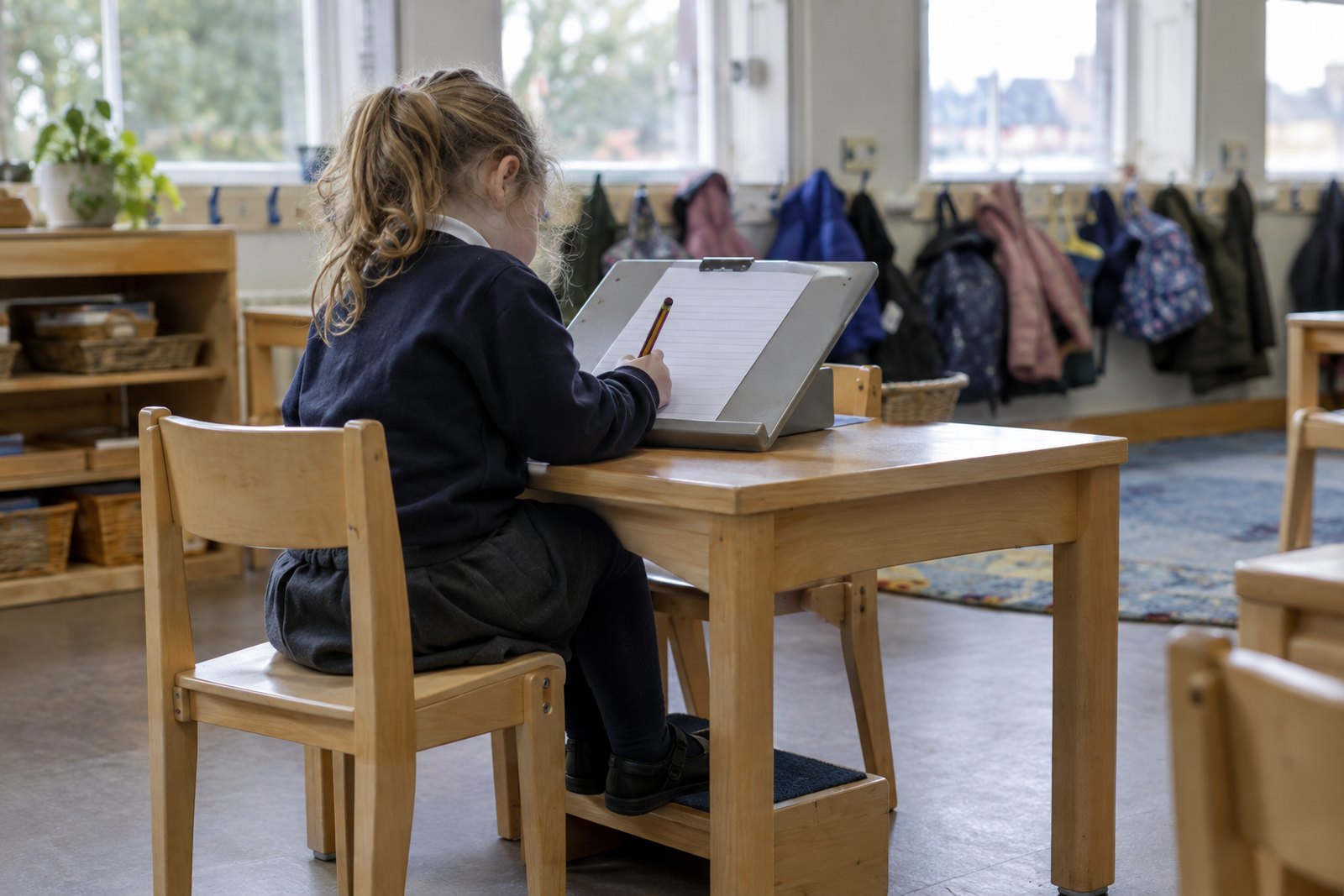
If your child needs occupational therapy at school in England, it usually reaches them in one of three ways. The most common route is a referral to your local NHS children's therapy service, made by the school, your GP or a health visitor. An occupational therapist assesses your child and then advises the school. Some schools also buy in occupational therapy directly. And some parents pay for a private occupational therapist, who can visit the school if the school agrees.
What school OT rarely looks like is a therapist arriving every week to work one-to-one with your child for a year. It is mostly assessment, advice and a programme that teachers and teaching assistants carry out day to day. That is not a fob-off. Done well, it means help happens every school day rather than once a fortnight. Whichever route you take, the place to start is a conversation with the school's SENCo (special educational needs co-ordinator).
What occupational therapy at school is actually for
Occupational therapists help people manage the everyday things they need to do. For a child at school, those everyday things are not small. They include sitting at a desk long enough to learn, holding a pencil and writing legibly, using scissors and a ruler, changing for PE, opening a lunchbox, managing the toilet, getting round the classroom without bumping into everything, and coping with the noise of the corridor and the dinner hall.
Children are usually referred because something on that list is getting in the way of learning or joining in. Common reasons include:
- handwriting that is slow, tiring or painful
- clumsiness and poor coordination, sometimes linked to dyspraxia (developmental coordination disorder)
- difficulty sitting still or staying upright on a chair or the carpet
- sensory differences, such as finding noise, touch or busy spaces overwhelming
- physical conditions such as cerebral palsy or hypermobility
- struggling with self-care, like dressing for PE or using the toilet independently
There is more on the wider picture in our guide to how occupational therapists help children.
How children usually get OT at school in England
NHS children's occupational therapy
Every part of England has NHS children's therapy services, but how they are organised varies a great deal. In many areas the service accepts referrals from the school (usually the SENCo), a GP, a health visitor, a school nurse or a paediatrician. Some areas let parents refer directly. Others only take referrals from professionals, and some ask the school to show it has already tried certain strategies first.
Most NHS services have criteria about who they see. Some focus on children whose difficulties have a significant effect on daily life at home and at school. Some do not see children for handwriting alone or for sensory differences alone, and instead send advice packs or train school staff. Waits can be long in some areas. The service's own website, or a phone call to its administrator, will tell you how referrals work where you live. If you do not know who runs it, the SENCo, your GP surgery or your council's local offer (the published information about SEND services in your area) should be able to tell you.
Once your child is accepted, they might be seen in a clinic, at school or both. The therapist then writes a report with recommendations, and often a programme for school and home.
Occupational therapy the school buys in
Some schools, academy trusts and local authorities pay for occupational therapy separately from the NHS. That might be a therapist who visits a few times a term, sees a handful of children, trains staff or sets up group programmes such as motor skills or handwriting groups. Special schools are more likely to have therapists on site. In a mainstream school it is often a small amount of time shared across many children, so ask the SENCo whether the school has any arrangement like this and how children are chosen for it.
A private occupational therapist visiting school
You can pay for a private children's occupational therapist yourself. Many will assess a child at home and, with the school's agreement, observe them in class and talk to their teacher. Schools do not have to let a private therapist in, so ask first, in writing, and explain what the visit is for. Most schools are far happier to agree once they know the therapist is HCPC-registered, has an enhanced DBS check and will share the report with them.
A private assessment can give you a detailed picture fairly quickly, with practical recommendations for school. It can also be used as evidence for SEN support or an EHC needs assessment. What it cannot do is force the school to follow every recommendation, although a good school will take a well written report seriously. If you are weighing up which route makes sense, our guide to NHS or private occupational therapy sets out the trade-offs.
What school-based OT actually looks like
Watching your child in class
The school observation is often the most useful part. The therapist watches your child doing ordinary things: copying from the board, sitting on the carpet, moving between activities, managing the lunch hall or the playground. They look at posture, how the chair and desk fit, pencil grip, how your child plans a task, how they cope with noise and busy spaces, and how quickly they tire. They may also do standardised tests of motor skills or visual perception, usually in a quiet room away from the class.
Advice for teachers and teaching assistants
Much of the difference comes from small changes the class team makes. Typical recommendations include:
- seating facing the board rather than twisted sideways, away from the busiest doorway
- a chair and desk at the right height, so feet rest flat and forearms rest comfortably
- shorter written tasks, or alternatives such as typing, a scribe or worksheets with more space
- extra time to change for PE, and clothes or shoes with easier fastenings
- planned movement breaks
- a quieter place to work or eat when needed
- a visual timetable so the day feels predictable
Programmes run by teaching assistants
Therapists often write a programme for a teaching assistant to run several times a week. That might be fine motor activities, handwriting practice, a short movement routine before lessons, or practising buttons and laces. The therapist sets it up, shows staff how to do it and reviews progress later.
This is where things succeed or fail. A programme that actually happens three times a week for a term usually achieves far more than an occasional therapy session. A programme that quietly stops when staffing gets tight achieves nothing. It is entirely reasonable to ask how often it is happening.
Equipment
School OTs often suggest simple, inexpensive items: a writing slope to improve posture and pencil control, pencil grips, paper with wider or raised lines, easy-grip or spring-loaded scissors, a footrest or box so feet are supported, or a seat cushion for children who slump or fidget. Who pays for small items varies, but the school often buys them. Children with more complex physical needs may need specialist seating, toilet support or other larger equipment, which is usually provided through NHS services or the local authority after a specialist assessment.
Sensory strategies
For children who find school overwhelming, or who seem to need constant movement, the therapist may suggest changes to the environment and the shape of the day. Examples include ear defenders for assemblies or the dinner hall, a quiet corner, a movement break before tasks that need concentration, heavy-work jobs such as carrying books or stacking chairs, and something quiet to fiddle with. These should be based on what the therapist has seen in your child, not copied from a generic list.
SEN support, EHCPs and where OT fits
In England, help for children with special educational needs comes at two broad levels, set out in the SEND Code of Practice.
SEN support is help the school arranges from its own resources. Schools are expected to follow a cycle of assess, plan, do and review. OT advice often sits here: the school builds the therapist's recommendations into your child's support plan and checks whether they are working. Many children with coordination or sensory difficulties are well supported at this level.
An education, health and care plan (EHCP) is a legal document from the local authority for children whose needs cannot be met through SEN support alone. Occupational therapy that educates or trains a child can be written into the plan as special educational provision. When it is, it should be specific about who provides it, how often and for how long, and the local authority then has a duty to make sure it happens. Vague wording such as "access to OT advice" is much harder to hold anyone to. You can ask the local authority for an EHC needs assessment yourself; it does not have to come from the school. Our guide to EHCPs and what an occupational therapy report adds goes into detail, and IPSEA publishes free guidance on the legal rules and timescales.
Wales, Scotland and Northern Ireland
The systems differ outside England: Wales uses Additional Learning Needs with Individual Development Plans, Scotland has Additional Support for Learning, and Northern Ireland has its own SEN framework, so check your own nation's official guidance, although the routes into NHS children's therapy are broadly similar.
How to ask the SENCo
Asking for a meeting is normal. You are not making a fuss, and a good SENCo would rather hear from you early. A few things make the conversation more useful:
- Write down what you see at home. Specific examples help more than general worry: "takes 20 minutes to put on school uniform", "cries about writing homework", "falls off chairs", "comes out of school exhausted and melts down".
- Ask what the teacher sees. Children often behave very differently at school. Some hold it together all day and fall apart at home.
- Ask direct questions. Is my child on SEN support? What is in their plan? Does the school have access to an occupational therapist? Will you refer to the NHS children's therapy service, or support a GP referral?
- Bring what you already have. Reports from a health visitor, paediatrician, nursery or previous school.
- Agree a review date so the conversation does not drift.
- Follow up by email summarising what was agreed. It keeps everyone clear and gives you a record.
If the school does not think a referral is needed and you disagree, ask your GP or health visitor, or check whether your local service accepts referrals from parents.
What to expect, realistically
It helps to go in with the right picture. NHS input is often a time-limited episode of care: assessment, advice, a programme, a review, then discharge back to the school. That does not mean the door is closed. If things change or new difficulties appear, your child can usually be referred again.
Progress tends to be steady rather than dramatic. Handwriting may stay untidy, but your child may write for longer without pain, type confidently, get changed for PE without being last every time, and come home less wrung out. Those are real gains. Judge success by whether your child can do more of their school day with less struggle, not by whether a difficulty has disappeared.
Check that recommendations are actually in place. Equipment sitting in a cupboard helps nobody. A polite question at parents' evening about whether the slope is used or the programme is running is fair. Home matters too: a short routine before school and an easier evening after a tiring day can make as much difference as anything in class.
Where an occupational therapist fits, and where they do not
An occupational therapist is the right person for the practical side of school life: writing and fine motor skills, posture and seating, self-care, coordination in everyday tasks, sensory differences and adapting the classroom. Some children need other professionals instead, or as well:
- Speech and language therapist for speech, understanding language, social communication, and eating, drinking or swallowing difficulties.
- Physiotherapist for walking, balance, muscle strength and larger movement difficulties, which overlap with OT.
- Educational psychologist for learning difficulties and how a child thinks and learns, usually arranged through the school or local authority.
- GP or paediatrician for diagnosis. Your GP can refer your child to a paediatrician or specialist team for assessment for dyspraxia, autism or ADHD through NHS pathways.
- Optician and hearing services, because undiagnosed eyesight or hearing problems can look like clumsiness or inattention. Eye tests are free on the NHS for children.
- NHS mental health services for children and young people if anxiety, low mood or school refusal are the main concern.
If your child is losing skills they used to have, has weakness or clumsiness that has come on suddenly, or has new headaches or seems unwell, see your GP promptly rather than waiting for a therapy referral. Call NHS 111 if you are unsure how urgent it is, and 999 in an emergency.
For a broader look at specialist help, our children's occupational therapy page explains what a private home and school visit can cover.
Frequently asked questions
Can I refer my child for occupational therapy myself?
It depends on your area. Some NHS children's therapy services accept referrals from parents; others need a referral from the school, GP, health visitor or paediatrician. Check your local service's website or your council's local offer. You can always choose to see a private occupational therapist without a referral.
Does the school have to let a private occupational therapist in?
No, but most schools agree when asked properly. Put the request in writing, explain the purpose, and confirm the therapist is HCPC-registered, DBS-checked and will share the report with the school.
Do you need a diagnosis to get OT at school?
Usually not. Occupational therapists work with what a child finds hard day to day, so a diagnosis is not normally needed for a referral or for SEN support. Some NHS services have their own criteria, so check locally.
How often will an occupational therapist see my child at school?
Often less than parents expect. Many children are seen for an assessment and a review or two, with a programme run by school staff in between. Regular direct sessions are more likely where they are specified in an EHCP or arranged privately.
Will a private OT report be accepted for an EHCP?
The local authority must consider evidence you provide during an EHC needs assessment, and a clear, specific private report can carry real weight. The authority will usually also seek its own advice, typically from NHS services, so expect both to be considered.
Who pays for equipment the OT recommends?
It varies. Schools often buy small items such as slopes, grips and cushions. Larger or specialist equipment is usually assessed for and provided by NHS services or the local authority. Ask the SENCo before buying anything yourself.
Next steps
See our children's occupational therapy and assessments and reports pages, or current guide prices, and choose your area below.
Talk to an occupational therapist near you
This guide is general information. For advice about your own situation - or someone you look after - a local occupational therapist can visit you at home and see it for themselves.
Choose your area: