

Sarcopenia: Muscle Loss With Age and What Actually Helps
By Mobile Occupational Therapist • 21 September 2026 • 14 min read
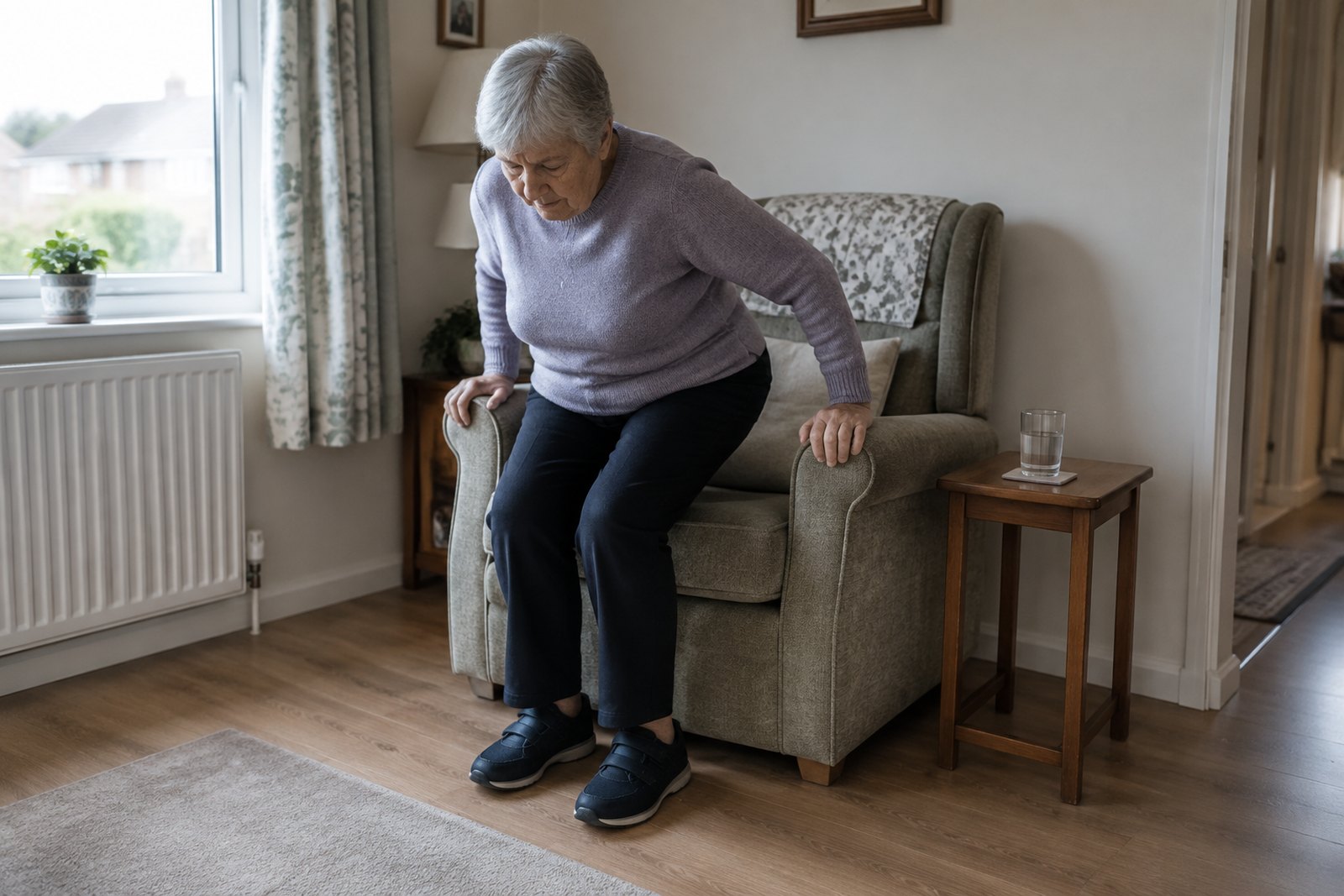
Sarcopenia is the medical term for the gradual loss of muscle strength and muscle mass with age. It is common, but it is not "just old age" in the sense that nothing can be done. Many people can slow it down and improve strength and confidence with the right kind of activity, enough food and protein, and a few sensible changes at home.
If you are noticing that you or your parent is struggling to get up from a chair, walking more slowly, finding stairs harder, avoiding outings, or falling more often, it is worth taking it seriously. Those are often the day to day signs that muscle strength has dipped. The good news is that the most effective help is usually quite practical and can start at home.
What sarcopenia is (and what it is not)
Sarcopenia means age related loss of muscle mass and strength. It tends to affect the big muscle groups that matter for everyday life: thighs and hips for standing and stairs, core muscles for balance, and shoulders and arms for carrying and reaching.
A few things sarcopenia is not:
- Not the same as being "unfit". Someone can look a normal weight and still have low muscle strength.
- Not inevitable at the same rate for everyone. Two people the same age can be miles apart in strength and confidence.
- Not only about muscle size. Strength, power and balance matter more for real life than how much muscle you can see.
- Not always the whole story. Breathlessness, pain, dizziness, low mood, poor sleep, nerve problems and medication side effects can all reduce activity and lead to muscle loss too.
You will also hear related terms like frailty and deconditioning. Frailty is a broader picture of reduced resilience. Deconditioning is what happens when you lose fitness and strength after a period of illness or bed rest. They overlap with sarcopenia, but they are not identical. If you want a plain English explanation of frailty and what helps, see frailty in older people: what it is and what helps at home.
Signs of muscle loss in older adults
Sarcopenia is often noticed through small, frustrating changes rather than one big event. Common signs include:
- Needing to push with both hands to stand up from a chair, or "rocking" to get up
- Taking longer to start walking after standing, or shuffling more
- Avoiding stairs, or taking them one step at a time
- Carrying less, for example a smaller shop, fewer pans, a lighter laundry basket
- More trips, stumbles or falls
- Feeling "wobbly" turning, stepping into the bath, or reaching into cupboards
- Doing less because everything feels like effort, then getting weaker because you are doing less
Some people also notice a change in posture, getting more stooped, or feeling less steady when looking up or down (for example in the kitchen or the garden).
Do not ignore sudden change. Sarcopenia is usually gradual. If weakness comes on quickly, is one-sided, or comes with new speech or face changes, treat it as urgent (more on this below).
Why sarcopenia matters
Muscle strength is one of the biggest "gatekeepers" for independence. When leg strength drops, everyday tasks quietly start to disappear: getting out of the front door, getting to the loo in time, stepping into a shower, carrying a kettle, getting up after kneeling, or walking far enough to do your own shopping.
That matters because:
- Falls risk goes up. Less strength and slower reactions make slips harder to recover from.
- Recovery gets harder. A small illness or a few days less active can lead to a bigger drop in function.
- Confidence shrinks. People start avoiding activity "just in case", which speeds up weakness.
- Care needs can increase. Often it is not one complex medical problem, it is several small daily tasks becoming unsafe.
There is also a knock on effect on mood and social life. When it is harder to get out, you see fewer people. When you see fewer people, it is harder to keep going with activity. It becomes a loop.
What actually helps: strength, balance and everyday activity
The core approach is simple: use your muscles on purpose, often enough, and in a way that is safe for you. The details matter, but you do not need a gym membership to start.
1) Strength work (not just walking)
Walking is great for health, but it does not always rebuild strength on its own. Strength work means making your muscles work against resistance. For many older adults, that can be bodyweight exercises, repeated sit to stands, or using household objects as light weights.
UK Chief Medical Officers advise that older adults should do activities to improve muscle strength on at least two days a week, and to include balance work if they are at risk of falls. You can check the current wording on GOV.UK.
Examples of simple strength exercises that relate directly to daily life:
- Sit to stand from a firm chair (stand up fully, sit down slowly)
- Supported mini-squats holding a worktop
- Heel raises holding on (rise up, lower down slowly)
- Step-ups on the bottom stair while holding the banister
- Wall push-ups for arms and shoulders
- Carrying practice carrying two light bags from room to room with good posture
If you only do one thing: practise standing up from a chair more often, with good technique and as little use of hands as is safe for you. It is one of the most transferable "life strength" skills there is.
2) Balance practice (the missing piece for many people)
Strength helps you generate force. Balance helps you control it. If you are unsteady, it is common to stop challenging balance at all, and that is when confidence really drops.
Safe, simple balance practice can include:
- Standing with feet hip-width apart and turning your head side to side, while holding a stable surface
- Weight shifting left to right, then forwards and back
- Marching on the spot behind a chair, hands hovering over the back
- Practising turns slowly rather than pivoting quickly
If you are very unsteady, do balance practice with someone nearby at first. The aim is "challenging but safe", not "white knuckle".
3) Keep moving on low energy days
People often think it has to be all or nothing. A full walk or nothing. A full class or nothing. In real life, consistency matters more than heroics.
On days when you are tired, keep a minimum baseline of movement. For example:
- Stand up and sit down five times, twice in the day
- Walk a lap of the home every hour or two
- Do ankle pumps and knee straightening in a chair
- Stand at the kitchen counter during the kettle boil rather than sitting
Seated movement can be a good bridge if standing feels too much. If you want ideas for starting gently, see chair yoga and seated exercise for older people: starting safely.
4) How to start safely at home
A few basic safety rules make it much more likely you will stick with it:
- Use a solid chair. Firm seat, ideally with arms, against a wall so it cannot slide.
- Wear proper footwear. A back on the heel and a non-slip sole is safer than socks or loose slippers.
- Clear the space. No rugs curling up, no pets underfoot, no trailing wires.
- Start smaller than you think. It is better to do 5 repetitions three times a week than 20 once then avoid it for a fortnight.
- Expect some muscle ache. Mild soreness the next day can be normal. Sharp pain is not. If you get chest pain, new severe breathlessness, fainting, or feel very unwell, stop and call 999. For other worrying symptoms such as dizziness or pain that does not settle, stop and seek medical advice.
If you have had a recent fall, a fracture, new joint swelling, chest symptoms, or you are unsure what is safe, ask your GP or physiotherapist before pushing on. A physiotherapist is usually the right professional to design an exercise programme for specific injuries or neurological conditions.
Food, protein and unplanned weight loss
Muscle needs use and it needs building blocks. If someone is not eating enough, or is losing weight without trying, it becomes much harder to maintain muscle.
Practical food points that often help:
- Aim for protein at each meal rather than "one big protein meal" once a day.
- Make breakfast count. Many people have toast and tea, then wonder why they feel weak by midday.
- Think "little and often" if appetite is poor.
- Check practical barriers. Is shopping hard? Is cooking tiring? Is chewing difficult? Are hands too painful to open packets? Is low mood reducing appetite?
This is also the point to be cautious about self-prescribing supplements. Some people do need prescribed nutritional support, but the safest route is to involve a clinician who can look at the whole picture.
Contact your GP if there is unplanned weight loss, persistent poor appetite, swallowing problems, ongoing nausea, changes in bowel habit, or if you suspect depression. A GP can check for treatable causes and refer to a dietitian if needed.
After illness, hospital or a fall: expect a dip and plan for it
One of the fastest ways to lose muscle is a period of doing much less, especially bed rest. This is why people often feel dramatically weaker after a hospital stay, even if the original illness is "sorted".
If you are supporting someone after illness or discharge, plan for rebuilding like you would plan for medication or wound care. Small steps, done often, beat one big push.
Helpful early priorities at home:
- Make essentials easy. Sleeping area, toilet access, drinks and simple food should be within safe reach.
- Build a routine of getting up. Even short periods sitting out of bed, then standing and walking little and often, if safe.
- Practise the key transfers. Bed to chair. Chair to toilet. In and out of the front door.
- Use supports early. Walking aids, rails and a perching stool can prevent "I tried and I nearly fell" becoming "I will not try again".
Hospital teams sometimes call this reconditioning, reablement or rehabilitation. If you are trying to make sense of discharge information and what should happen next, see coming home from hospital: a family's guide to discharge planning.
If weakness is worsening week by week rather than slowly improving, or if there are new symptoms (confusion, breathlessness, fever, worsening pain), speak to a GP or call NHS 111.
Make the home support your muscles, not fight them
If getting through the day feels like climbing a mountain, people naturally do less. The environment matters because it can either "spend" your strength or "save" it for what matters.
Start with the biggest pinch points
These are the places where reduced strength turns into a fall or a crisis:
- Getting up and down (bed, chair, toilet)
- Stairs (especially first step and last step)
- Bathroom (stepping over bath edge, wet floor, turning)
- Door thresholds and narrow spaces
- Carrying (laundry, meals, hot drinks)
Practical home changes that often help
- Chair height and firmness. Low, soft sofas are strength thieves. A firmer, higher chair can make standing possible again.
- Lighting. Good lighting reduces trips, especially on stairs and at night.
- Declutter walking routes. Create a clear path from bed to toilet and to the kitchen.
- Reduce rushing. Many falls happen when someone is hurrying to answer the door or get to the loo.
- Set up carrying solutions. A small bag on a walking aid, or doing two lighter trips instead of one heavy one, reduces risk.
Falls prevention is broader than exercise. Footwear, lighting, routines and layout all matter. For a practical room by room approach, see falls at home: practical prevention beyond exercise.
When to get medical advice
It is tempting to put everything down to ageing. Sometimes it is, and still worth addressing. Sometimes it is something treatable that needs checking.
Get urgent help for sudden weakness
If weakness comes on suddenly, is worse on one side, or comes with facial drooping, speech problems, severe dizziness, collapse, or new confusion, call 999. Do not wait to see if it passes. Those can be signs of stroke or another emergency.
Speak to a GP or call NHS 111 if
- Weakness is getting worse quickly over days or weeks
- There have been repeated falls, or any fall with a head injury. If there is loss of consciousness, worsening headache, vomiting, confusion, unusual drowsiness, seizures, or the person takes anticoagulants (blood thinners), go to A&E or call 999.
- There is new severe back pain, numbness around the genitals or bottom, or loss of bladder or bowel control. This needs urgent assessment. Call 999 or go to A&E.
- There is unplanned weight loss, poor appetite, or swallowing difficulties
- Breathlessness is stopping everyday activities
- Medication changes have coincided with new unsteadiness or fatigue
A GP can consider blood tests, medication review and referrals. A physiotherapist can assess strength, balance and walking and provide an exercise plan. If memory, vision or hearing problems are contributing, those need addressing too.
Where an occupational therapist fits
An occupational therapist (OT) focuses on helping someone do the everyday activities that matter to them, safely and with as much independence as possible. With sarcopenia, that often means turning "generally weaker" into specific, solvable problems.
A private occupational therapist visiting at home can help by:
- Assessing daily tasks in context - getting up from your own chair, using your own stairs, washing in your own bathroom, making a drink in your own kitchen
- Reducing falls risk through practical changes - layout, routines, appropriate equipment, and safer ways of doing tasks
- Matching the right support to the right moment - for example, choosing a chair height that makes standing possible so you can practise strength safely
- Planning a graded return to activity after illness, a fall or hospital stay, so confidence and strength rebuild together
- Supporting carers with safer assistance strategies, so helping does not turn into unsafe lifting or rushing
OTs do not replace physiotherapy. If you need a tailored strengthening programme for a specific condition or injury, physiotherapy usually leads. But OT and physio work very well together: physio builds capacity, OT makes daily life workable while you build it.
Frequently asked questions
Is sarcopenia the same as frailty?
No. Sarcopenia is specifically about muscle loss and weakness with age. Frailty is broader and includes reduced resilience, low energy, slower recovery and sometimes weight loss. They overlap a lot in real life, and the practical approach is often similar: build strength, reduce falls risk, and make daily life safer and more manageable.
Can you reverse sarcopenia?
Many people can improve strength and function, even in later life. Muscle responds to training at any age, but progress may be slower and needs to be realistic and consistent. The aim is usually better day to day ability and confidence, not a perfect "before and after".
Does walking help with muscle loss in elderly people?
Walking is excellent for general health and maintaining mobility, and it can support strength if it is challenging enough. But many people need specific strength work as well, especially for thighs and hips. Think of walking as the base, and strength exercises as the part that makes standing, stairs and balance easier.
What if my mum or dad is scared of falling so they will not exercise?
Start with exercises that feel safe and "close to normal", like repeated sit to stands from a firm chair, or marching on the spot while holding the kitchen counter. Remove time pressure (no rushing to the loo, no dashing to answer the door) and make the home safer. Confidence often improves when someone can practise without near misses.
Should older people take protein supplements for sarcopenia?
Some people may need prescribed nutritional supplements, but it depends on appetite, weight loss, medical conditions and swallowing safety. It is safer to start by improving protein in ordinary meals and snacks and speak to a GP if there is unplanned weight loss or ongoing poor appetite. A dietitian can give individual advice.
How do I know if weakness is "just ageing" or something serious?
Gradual change over months can fit sarcopenia, especially if activity has reduced. Sudden weakness, one-sided weakness, facial drooping, speech problems, severe dizziness or collapse is an emergency: call 999. For anything that is worsening quickly, accompanied by weight loss, repeated falls, severe pain or new numbness, contact a GP or NHS 111.
Next steps
If you want help making a practical plan at home - including safer ways to manage daily tasks, reduce falls risk and choose appropriate equipment - see our home assessment page or current guide prices, and choose your area below.

Talk to an occupational therapist near you
This guide is general information. For advice about your own situation - or someone you look after - a local occupational therapist can visit you at home and see it for themselves.
Choose your area: