

Chair Yoga for Seniors: Seated Exercise and Starting Safely
By Mobile Occupational Therapist • 8 October 2026 • 12 min read
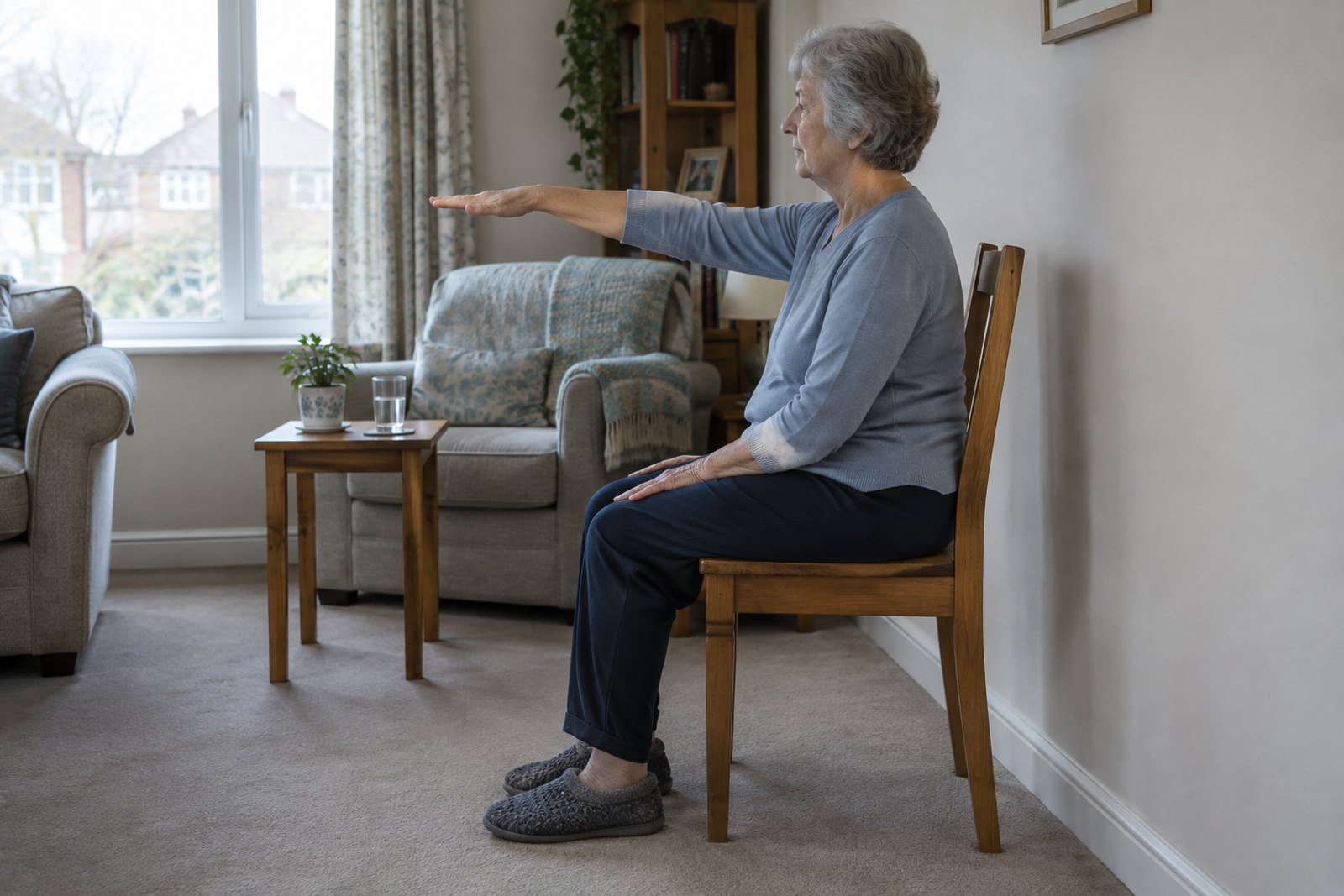
Chair yoga and seated exercise are a sensible way for older people to get moving, especially if standing exercise feels unsteady, painful or off-putting. Done gently, on a stable chair, with steady breathing and nothing pushed into pain, it can help keep joints moving, ease stiffness and give you more confidence in your own body. It is not a miracle and it will not do everything, but it is a real start.
Starting safely is simple. Use a sturdy chair without wheels and put it against a wall. Begin with five or ten minutes of easy movements. Stop if anything hurts or you feel dizzy, sick or more breathless than you expected. If you have had recent surgery, a heart or lung condition, or a recent fall, check with your GP, physiotherapist or surgical team first. Chest pain while exercising is a 999 call, not something to sit out.
What chair yoga can and cannot do
Chair yoga is mostly ordinary gentle movement, done sitting down, with some attention to breathing. Classes go by many names: seated exercise, armchair exercise, chair-based exercise, gentle movement. The name matters less than what you actually do.
In measured terms, regular seated exercise can help with:
- Mobility. Joints that are moved through their comfortable range tend to feel less stiff. That shows up in small ways: reaching into a cupboard, turning to look over your shoulder, getting a sock on.
- Confidence. Moving without the worry of falling lets you find out what your body can still do. For some people that is the first step back to more.
- Mood. Many people find a short routine gives shape to the day and leaves them feeling a little brighter. It is not a treatment for depression, but it often helps.
- Company. A class gets you out of the house and among people. For someone who lives alone, that can matter as much as the exercise.
What seated exercise will not do on its own is fully rebuild leg strength or balance. Balance improves mainly when you practise balance, usually standing, holding something sturdy, ideally with guidance at first. NHS guidance for adults aged 65 and over recommends being active every day and doing activities that improve strength, balance and flexibility on at least two days a week. The guidelines are on the NHS website if you want to check the details. Think of chair exercise as a good foundation and a good fallback on bad days, not the whole plan.
Choosing a safe chair
The chair matters more than the routine. A wobbly or wheeled chair turns a gentle stretch into a fall risk. Look for:
- No wheels and no swivel. Office chairs are out, even with the wheels locked.
- A firm, flat seat. A solid dining chair is usually ideal. A deep, soft sofa or armchair makes you slump and makes it harder to sit tall or get up.
- No arms, or arms that do not get in the way. An armless chair gives your elbows room for arm movements. Arms can help you get up afterwards, so if your chair has them, just check they do not stop you moving freely.
- The right height. Your feet should rest flat on the floor with your knees roughly level with your hips. If your feet dangle, put a firm, flat, non-slip block or step under them rather than a squashy cushion.
- Against a wall. Put the back of the chair against a wall so it cannot slide or tip backwards. Stand it on a firm floor, not on a loose rug.
Avoid folding chairs, rocking chairs, recliners, stools and anything you would not trust to hold you if you leaned to one side. Clear a little space around you so you will not knock anything over, and keep a glass of water and your phone within reach.
If getting up from the chair afterwards is the hard part, our guide to getting up from a chair and the right chair height is worth reading before you start.
Before you start
A few minutes of preparation saves a lot of bother.
- Wear loose, comfortable clothes and supportive shoes, or slippers with backs and a grippy sole. Loose backless slippers are a trip risk when you stand up.
- Leave an hour or so after a big meal.
- Pick a time of day when you usually feel at your best. For many people with stiff joints, that is not first thing.
- Have your glasses or hearing aids in if you are following a video or class.
It is sensible to speak to your GP or the team treating you before starting if you have had a heart attack, heart surgery, a stroke, recent joint surgery, a recent fall, unexplained dizziness or blackouts, chest pain on exertion, or breathlessness that is getting worse. That is not because seated exercise is dangerous. It is because they may want to tailor it to you.
A short sample routine
This takes about ten minutes. Move slowly, breathe normally throughout, and only go as far as feels comfortable. A mild stretching feeling is fine. Sharp or increasing pain is not.
- Settle and breathe. Sit towards the front of the seat, feet flat, hands resting on your thighs. Sit tall without stiffening. Breathe in gently through your nose, then let the breath out slowly, a little longer than the in-breath. Do this five times.
- Neck turns and tilts. Slowly turn your head to look over your right shoulder, back to the middle, then over your left. Then gently tip your right ear towards your right shoulder, back to the middle, and the same to the left. Three to five of each. Keep it small and smooth, and do not tip your head right back. If it makes you dizzy, stop.
- Shoulder rolls. Lift your shoulders up towards your ears, roll them back and down. Five times, then five rolling forwards.
- Ankle circles. Lift one foot a little off the floor and draw slow circles with your toes, five each way. Swap feet. If lifting the foot is hard, keep your heel on the floor and point your toes up and down instead.
- Seated marching. Holding the sides of the seat if you like, lift one knee a little, put it down, then the other. March gently for 30 seconds to a minute, then rest. Build up over the weeks.
- Gentle twists. With your feet flat and hands on your thighs, turn your upper body a little to the right, look over your shoulder, and come back to the middle. Then left. Three each way. Turn only as far as is easy and do not pull on the chair back to force it. Skip this one if you have had a hip replacement or spinal surgery until your team says it is fine.
- Arm raises. Lift one arm forwards and up to a comfortable height, then lower it slowly. Swap arms. Five each side. If you have shoulder pain, keep the movement lower, below shoulder height.
- Finish. Go back to the slow breathing for a minute. Then sit for a moment before you stand, so your blood pressure has time to catch up.
Little and often beats long and occasional. Most people do better with ten minutes most days than an hour once a week. Once this feels easy, you can add a few more repetitions, a second round, or a class that builds on it.
What to avoid
- Holding your breath. It is easy to do without noticing when you concentrate. Keep breathing steadily, or count out loud, which makes breath-holding impossible.
- Pushing into pain. No pain, no gain does not apply here. Ease off if a movement hurts and try a smaller version next time. Pain that lingers into the next day means you did too much.
- Ignoring surgical advice. After a hip replacement, some surgical teams ask you to avoid bending deeply, twisting or crossing your legs for a period. Their advice overrides any class or video. Our guide on life after a hip replacement covers this in more detail. The same goes for knee, shoulder and spinal surgery: follow your own programme first.
- Deep forward bends and strong twists if you have osteoporosis or back problems, unless a physiotherapist has shown you a safe version.
- Standing up quickly at the end. Sit, breathe, then stand slowly, with something solid to hold.
- Keeping up with the class. Your neighbour may stretch further. That is their body. Do what yours allows today.
When to stop and get help
Stop, sit quietly and rest if you feel dizzy, light-headed, sick, unusually breathless or unwell in any way.
Call 999 straight away if you or the person you are with has:
- Chest pain, tightness or pressure, especially if it spreads to the arm, neck, jaw or back, or comes with sweating, sickness or breathlessness
- Sudden weakness or drooping in the face, weakness in an arm, or slurred or muddled speech
- Severe breathlessness that does not settle with rest
- A collapse or blackout
Contact your GP or NHS 111 if you keep getting dizzy during or after exercise, if you are more breathless than usual, if your heart races or flutters, or if a joint becomes painful or swollen and stays that way. These need checking before you carry on.
Finding a class near you
Doing a few sessions with someone watching is the best way to learn. Places to look:
- Your council. Many councils and their leisure centres run chair-based exercise or active ageing sessions. Look on the council website or ask at the leisure centre.
- Age UK. Many local Age UK branches run or know about seated exercise and gentle movement groups.
- Libraries and community centres. Noticeboards are often the best directory of local groups, including those run in churches, village halls and sheltered housing schemes.
- Your GP practice. Ask whether there is a social prescribing link worker, who can point you to local activities.
It is fair to ask the instructor whether they are used to working with older people, how big the class is, whether chairs are provided, and whether you can go at your own pace. Online videos are fine once you know the basics, but nobody is watching your form, so keep everything gentle.
When a physiotherapist is the right person
If you need a programme built around your own body, a physiotherapist usually leads. That includes recovering from surgery or an injury, having had falls, managing a long-term condition such as arthritis or Parkinson's, or wanting proper strength and balance training. You can ask your GP for a referral, and in some areas you can refer yourself to NHS physiotherapy. Some areas also have falls prevention services with group strength and balance programmes. If you are not sure who does what, see our guide to the difference between an occupational therapist and a physiotherapist.
Where an occupational therapist fits
An occupational therapist is not usually the person who writes your exercise programme. Their angle is different: keeping you active through the things you do every day anyway, so movement is not one more job on the list.
That might mean practising standing up from your chair properly each time you get up, rather than as a separate exercise. Arranging the kitchen so you reach and bend a little, safely, rather than not at all. Turning getting dressed into a gentle stretch with the right technique and equipment. Pacing the day so you have the energy to go to that class. A private occupational therapist visiting at home can also check whether your chair is the right height, whether your home makes moving harder than it needs to be, and how to rebuild confidence after a fall or illness. Our older people's independence page explains more.
The honest answer is that many people need both: a physiotherapist for the exercise, and an occupational therapist for making daily life the exercise.
Frequently asked questions
How often should I do chair yoga?
Most days is a good aim, starting with five to ten minutes. Short and regular suits most older people better than long and occasional. Increase slowly over weeks, not days.
Will chair yoga improve my balance?
It can help with posture, body awareness and confidence, which all play a part. But balance mostly improves by practising balance, usually standing with support. If falls or unsteadiness are a worry, ask your GP about a physiotherapist or a local strength and balance programme.
Can I do seated exercise after a hip or knee replacement?
Often yes, and your team may give you seated exercises. But follow their programme and any movement restrictions first, especially around twisting and deep bending after a hip replacement. Check before adding anything new.
Is chair yoga suitable for someone with dementia?
Often it is, particularly in a small, calm group or one to one. Simple movements, demonstrated rather than explained, work best. Stay alongside them, keep the chair against a wall, and stop if they seem more confused than usual, distressed or unwell.
Do I need to see my GP before starting?
Not for gentle seated movement if you are generally well. Do check first if you have a heart or lung condition, recent surgery, a recent fall, chest pain on exertion, or unexplained dizziness or blackouts.
Can I do these exercises in a wheelchair?
Many can be done from a wheelchair with the brakes firmly on. Avoid leaning far forwards or sideways, which could tip the chair. A physiotherapist or your wheelchair service can advise what is safe for your particular chair.
Next steps
If you would like help staying active at home or making daily routines easier, see our home assessment page, or current guide prices, and choose your area below.
Talk to an occupational therapist near you
This guide is general information. For advice about your own situation - or someone you look after - a local occupational therapist can visit you at home and see it for themselves.
Choose your area: