

Routines for Autistic Children: Building Them and Handling Change
By Mobile Occupational Therapist • 10 October 2026 • 14 min read
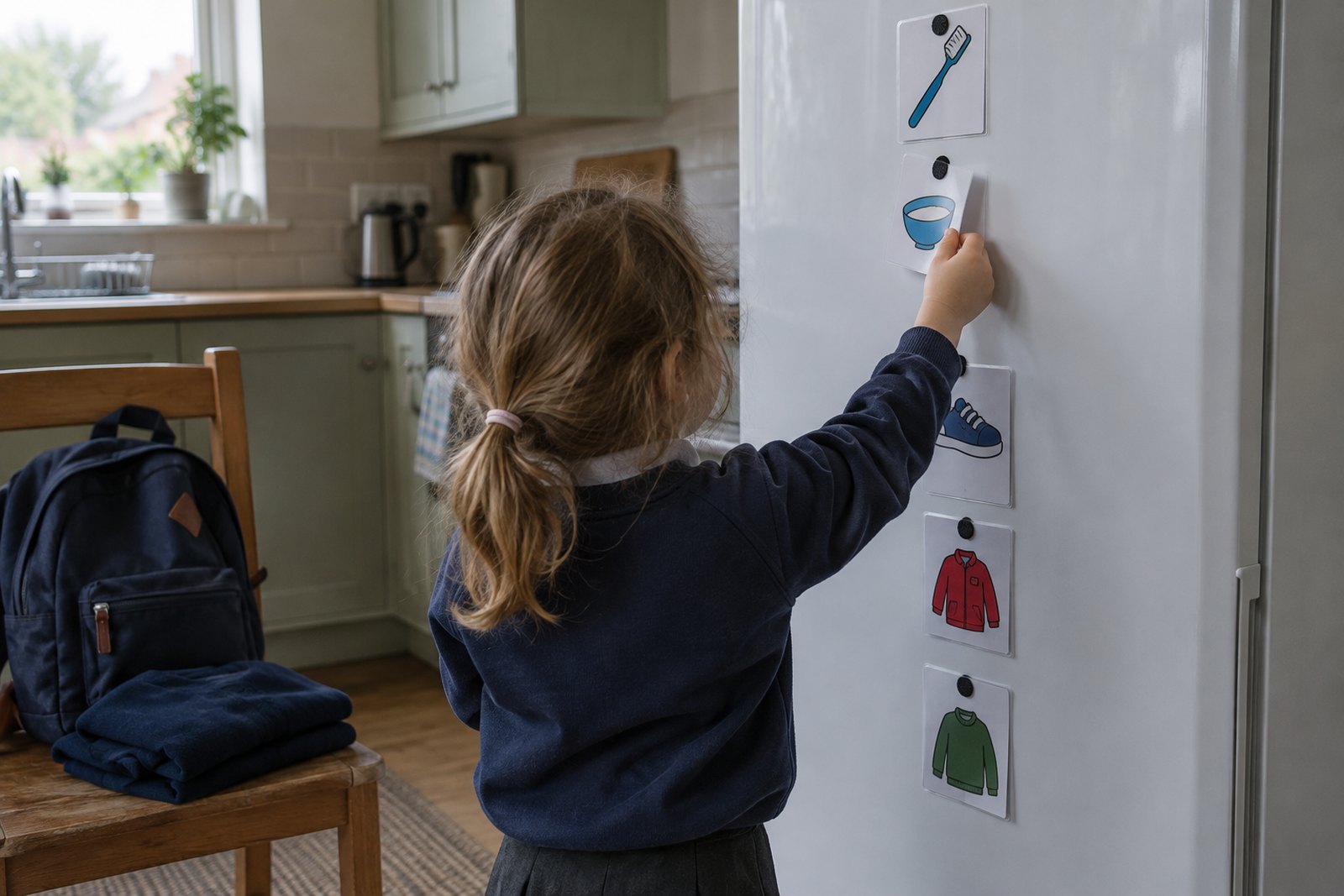
Most autistic children cope better when they know what is coming. A predictable routine cuts down the guessing they have to do each day. Less guessing usually means less anxiety, fewer meltdowns and more energy left for school, play and family life. That does not mean your household has to run like a railway timetable. It means building a few reliable anchors into the day, showing them in a way your child can understand, and preparing for change rather than springing it.
Change will still happen. Buses are late, teachers go off sick, Christmas arrives whether anyone is ready or not. The goal is not to remove change from your child's life but to make it survivable: clear warnings, countdowns, a way of signalling that something different is happening, and practice where you can manage it. If routines have become so rigid that small changes cause hours of distress, or your child seems driven to repeat things in a way that frightens them, that is worth a conversation with your GP. More on that below.
Why predictability matters so much
Many autistic children find it hard to predict what other people will do, to filter noise, light and touch, and to switch attention from one thing to the next. Each of those takes effort. An unpredictable day stacks them all up at once. A routine takes some of that load away, because the child already knows the answer to 'what happens now?'
So when your child insists on the same route to school or the same cup at breakfast, it is usually not stubbornness. It is a coping strategy, and quite a sensible one. The trouble comes when the strategy is the only one they have, or when it starts to control the whole family.
It also helps to know that transitions are often the hardest part of any day. Stopping something enjoyable, leaving the house, coming home, getting into the bath. Much of what follows is really about making those moments smoother.
Building a routine that works for your family
Do not try to routine everything at once. Start with the two or three points in the day that go wrong most often. For most families that is mornings, the hour after school and bedtime.
- Keep the order the same, even if the times move. Breakfast, then teeth, then shoes, then coat is often more important to a child than eating at exactly 7.30.
- Make it realistic for everyone. A routine that only works when one particular parent is home, or that ignores siblings, shift patterns and the school run for another child, will fall apart by Wednesday.
- Build in what helps your child feel settled. Movement, a quiet corner, a favourite snack, a set amount of screen time. These are not rewards to be withdrawn; they are part of what keeps the day working.
- Involve your child where you can. Letting them choose the order of two steps, or the picture used for a step, gives a sense of control that makes the rest easier to accept.
- Write it down for other adults. Grandparents, childminders and respite workers can follow the same pattern if it is on one sheet of paper.
Mornings
Mornings fail because there is a fixed deadline and lots of transitions packed together. Do whatever you can the night before: uniform laid out in the order it goes on, bag packed and by the door, breakfast choice decided. Keep the steps in the same sequence every school day. A visual checklist by the bed or bathroom door means you are pointing rather than nagging. If getting dressed is a daily fight, look at whether the clothes themselves are the problem. Labels, seams and stiff fabrics are common culprits.
After school
Many parents describe a child who holds it together all day at school and then falls apart the moment they get home. School can be exhausting for an autistic child, and home is where it is safe to let go. Plan for this rather than fighting it. Give a predictable decompression period after school: a snack, a quiet space, very few questions and no demands for a set time. Homework, chats about the day and clubs work better once your child has had a chance to recover.
Bedtime
A bedtime routine should run in the same order every night and gradually wind things down: a bath or wash, pyjamas, teeth, a story or quiet activity, lights low. Keep the last part of the evening calm and dim, and keep exciting activities earlier. Sleep difficulties are common in autistic children and sometimes need more than a good routine. Our guide to sleep problems in autistic children covers this in more detail, including when to talk to your GP.
Visual supports: showing, not just telling
Spoken words disappear the moment they are said. A picture stays put. For many autistic children, seeing the plan is far easier to process than hearing it, especially when they are anxious or tired.
- Visual timetables show the day, or part of it, as a row of pictures. Your child can remove or turn over each step when it is done, so they can see what is finished and what is left.
- Now and next boards show just two things: what is happening now, and what comes after. These suit younger children or anyone overwhelmed by a full day.
- Timers make 'five more minutes' something your child can see running down, rather than an adult promise that may or may not be kept.
- Social stories are short, personalised stories that explain a situation, what is likely to happen and what your child might do. They are especially useful for new or rare events.
Use whatever your child understands best. Some children need real photographs of their own toothbrush and their own school gate; others are fine with simple symbols or written lists. Keep the timetable where your child will actually see it, and use it every day, not only when things go wrong. Our guide to visual timetables and now and next boards explains how to make and use them step by step.
Preparing for change
The single most useful thing you can do with change is make sure it is not a surprise. Very few changes are truly last minute. Most are known about hours, days or weeks ahead, and that time can be used.
Give warnings, and make them concrete
'We're going to Nana's later' is vague. 'After lunch, we will get in the car and drive to Nana's. We will stay until tea, then come home for bath' is something a child can hold on to. Give the warning in the same way each time, ideally using the visual timetable too.
Use countdowns
For transitions within the day, count down: ten minutes, five minutes, two minutes, then a timer. For bigger events, a calendar where your child crosses off the days helps them see the change approaching rather than arriving out of nowhere.
Have a 'change' card
Many families use a particular card, colour or symbol that means 'something different is happening'. Put it on the timetable over the step that has changed, and show what replaces it. Over time, the card itself becomes familiar, so change starts to feel a bit more like part of the routine.
Practice visits and photos
For a new school, a new classroom, a hospital or dentist appointment, or a holiday destination, see if you can visit beforehand, even just to walk past. Many schools will arrange extra transition visits or provide photos of the building and staff if you ask. Where a visit is not possible, photos, maps and online images of the place can do a lot of the work. Look through them together several times before the day.
Plan the hard bit
Think through what will be most difficult and plan for it. Where will your child go if it gets too much? What can they hold or do? How will you leave if you need to? Having an exit plan often means you do not need to use it.
Holidays and school breaks
Holidays remove the biggest structure in your child's week: school. Lots of families find the first days of a break harder than term time, and the same again when school starts back.
- Keep a few anchors. Similar wake-up and bedtimes, regular meals, and a daily rhythm such as 'out in the morning, home in the afternoon'.
- Make a holiday calendar. Show the whole break, mark the special days, and clearly show the day school starts again.
- Introduce big events gradually. Put Christmas decorations up a few at a time rather than transforming the house overnight. Talk through visitors before they arrive, including who will sleep where.
- Protect quiet time. Busy days with family, parties and outings drain a child fast. Schedule recovery time the way you would schedule the outing itself.
- Practise the return. In the last few days of the break, shift bedtimes back, try on uniform, and walk or drive the school route.
Going away needs extra planning. Take familiar things from home: bedding, a favourite cup, comfort items. Show pictures of where you will stay and plan the journey step by step.
Balancing structure and flexibility
Routines are meant to support your child, not trap your family. Life will throw changes at your child forever, so it helps to build a little flexibility in while things are calm.
Try small, low-stakes changes on purpose, with warning: a different park, a new breakfast cereal alongside the usual one, a slightly different route home. Use the change card. Notice and praise how your child coped, even if it was wobbly. Some families add a 'surprise' or question mark card to the timetable now and then, which shows that not every step is known in advance and that this is all right.
Choose your moments. Do not practise flexibility on a day when your child is already tired, unwell or overloaded. And be honest about your own needs too. A routine that leaves a parent exhausted is not sustainable, and it is fine to adjust it.
Sensory needs within routines
A lot of what looks like a battle over routine is really a sensory problem. The toothbrush feels painful. The bathroom is echoey. Socks have a seam. The school hand dryer is unbearably loud. If one part of the routine always goes wrong, look at what your child is hearing, feeling, seeing or smelling at that moment.
You can also build sensory input into the day deliberately: heavy work such as carrying shopping or pushing a laundry basket before school, a movement break after school, quiet and dim lighting before bed. This kind of planned sensory activity is sometimes called a sensory diet. Our guide to building a sensory diet at home explains how to work out what your child needs and when.
When routines become rigid and distressing
Some insistence on sameness is part of being autistic. But it is worth getting help if you notice:
- distress over small changes that lasts for hours or is getting worse
- routines that keep growing longer or more complicated
- the whole family having to organise itself around your child's rules
- repetitive actions such as checking, washing, counting or arranging that seem to be about stopping something bad happening, rather than being enjoyable or calming
- your child seeming frightened or upset by their own need to repeat things
- routines affecting eating, sleep or getting to school
Anxiety is common in autistic children, and autism and obsessive compulsive disorder (OCD) can occur together. Telling them apart is not something to do at home, and it matters because the support is different. Book an appointment with your GP. They can talk it through and refer to the right service, which may be your local children's mental health service (CAMHS), the community paediatric team or the autism service. You can read about OCD on the NHS website.
If your child is hurting themselves, refusing all food or drink, or you are worried about their immediate safety, do not wait for a routine appointment. Call NHS 111 for urgent advice, or 999 in an emergency.
Where an occupational therapist fits
An occupational therapist looks at how your child manages everyday life: getting dressed, washing, eating, sleeping, playing, school and getting out of the house. For an autistic child, that often means looking closely at routines, transitions and sensory needs together.
An occupational therapist can:
- watch the routines that go wrong and work out what is getting in the way
- assess your child's sensory preferences and suggest practical changes at home and school
- help you design visual supports that suit your child's level of understanding
- break down self-care skills like dressing, teeth brushing or using the toilet into manageable steps
- help plan for a big change such as starting school or moving house
- write reports that can support school planning or an education, health and care plan
There are also things an occupational therapist does not lead on. A diagnosis of autism comes from a specialist assessment team, usually involving a paediatrician or psychologist. Anxiety and OCD are treated by mental health professionals such as those in CAMHS. A speech and language therapist is the right person for communication difficulties, including alternative ways to communicate. Sleep medication and other medical questions belong with your GP or paediatrician.
NHS occupational therapy for children is usually reached through your GP, school, health visitor or paediatrician, though access and waiting times vary by area. Some families choose a private occupational therapist visiting at home, either while they wait or alongside NHS support. Our guide to occupational therapy for autistic children explains what sessions usually involve.
Frequently asked questions
Am I making things worse by going along with my child's routines?
Not usually. Routines help many autistic children feel safe enough to cope with the rest of the day. The aim is to support them while slowly building some flexibility, not to strip routines away. If the routines are growing and causing distress, talk to your GP.
How much warning should I give before a change?
It depends on your child and the size of the change. For moving between activities, a countdown of a few minutes with a timer often works. For bigger events, days or weeks of preparation with a calendar and photos may help. Some children get more anxious if warned too early, so watch how yours responds and adjust.
My child is fine at school but falls apart at home. Why?
Many autistic children use enormous effort to cope at school and release it at home, where they feel safe. It does not mean home is the problem. A calm, low-demand period after school helps, and it is worth sharing what you see with school staff so they understand the whole picture.
Should weekends and holidays follow the same routine as school days?
Not exactly, but keep some anchors such as similar mealtimes and bedtimes. A visual plan for each weekend or holiday day helps replace the structure that school usually provides.
How do I know if it is autistic rigidity or OCD?
You cannot reliably tell at home, and the two can happen together. Repetitive behaviour that seems driven by fear, that your child finds upsetting, or that keeps escalating is a reason to see your GP, who can refer to the right specialist service.
Does my child need an autism diagnosis to see an occupational therapist?
No. An occupational therapist can help with daily routines, sensory needs and self-care whether or not your child has a diagnosis. NHS services may have their own referral criteria, so check with your GP or school.
Next steps
If routines and changes are taking over your family's days, a home visit can help you see what is really going on and what to try first. See our children's occupational therapy page, or current guide prices, and choose your area below.

Talk to an occupational therapist near you
This guide is general information. For advice about your own situation - or someone you look after - a local occupational therapist can visit you at home and see it for themselves.
Choose your area: