

Over-Bed Tables and Staying Comfortable When You Spend Time in Bed
By Mobile Occupational Therapist • 17 September 2026 • 7 min read
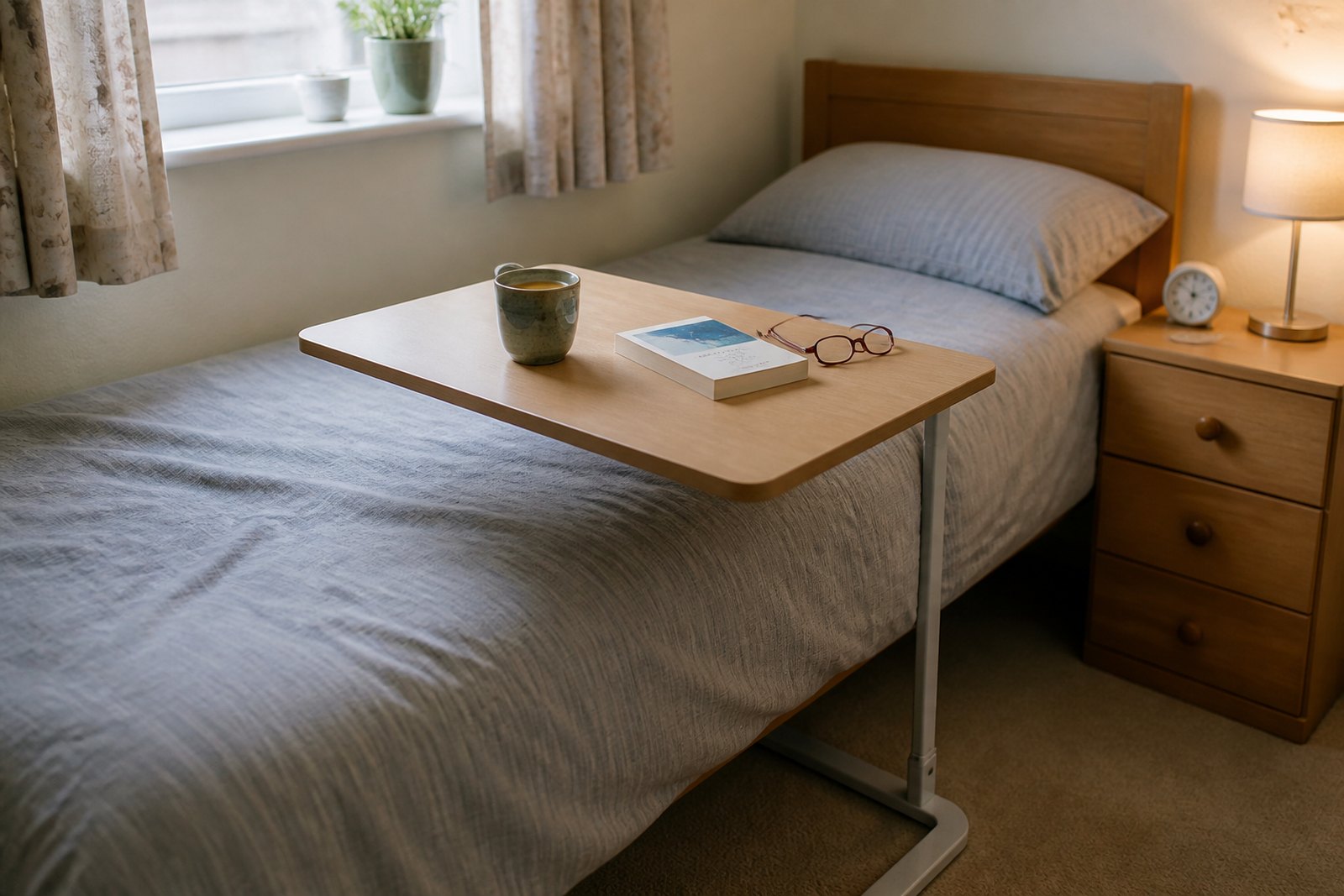
When somebody starts spending much of the day in or on their bed - through illness, recovery from surgery, or advancing frailty - the bedroom quietly becomes the main room of the house. Meals happen there, so do visitors, reading, television and everything else. An over-bed table is usually the first thing people buy, and it is a genuinely good purchase. But the table is only part of it: how the bed is set up, what is within reach, and how often the position changes all matter more to how somebody feels, and to their health, than any single item.
Choosing an over-bed table
An over-bed table has a base that slides underneath the bed and a top that cantilevers out over it, so the table can be brought across without moving the bed. Most adjust for height, and many have a tilting top. The details worth checking before buying:
- Will the base actually go under the bed? This is the commonest disappointment. Divan bases with drawers, beds with a low frame, and beds with castors or a solid plinth may leave nowhere for the table's base to slide. Measure the clear height under the bed before ordering.
- Height range. It needs to clear the mattress and the person's lap comfortably, and low enough to be usable when sitting in a bedside chair too if it will do double duty.
- Tilting or flat? A tilting top is excellent for reading, a tablet or a jigsaw. It is the wrong thing for a hot drink or a plate of dinner. The most useful designs have a section that tilts and a flat ledge that stays level - if you have to choose, choose flat, because food and drink happen every day and reading angles can be solved with a cushion.
- Castors and brakes. Wheels make it easy to move and easy to move at the wrong moment. Lockable castors matter if the person leans on the table at all - and many people do, without meaning to.
- Weight and stability. A light table is easy for a carer to reposition and easy to tip. Test that it does not tilt when weight is put on the far edge.
Do not use an over-bed table as a support for standing up. It moves, and it is not designed to take body weight - that is what a bed lever or a properly assessed rail is for.
Sitting up comfortably
Being propped upright with a pile of pillows works for an afternoon and stops working after that. Pillows slide, the person slumps sideways, and the position that started supportive ends up twisting the spine and squashing the chest. A few alternatives are worth knowing:
- A backrest - a rigid frame or wedge that sits against the headboard - holds a stable upright position without needing constant rebuilding.
- A wedge or V-pillow supports the upper back and arms, useful for breathing difficulties and reflux, and often more comfortable than stacked pillows.
- A knee wedge or a rolled towel under the knees stops the whole body sliding down the bed, which is the reason people end up half-lying and uncomfortable within twenty minutes.
If somebody needs to sleep sitting up regularly, or cannot reposition themselves at all, that is the point at which the bed itself is the answer rather than what is piled on it - see our guide to hospital beds at home and profiling beds, which raise the head and knee sections electrically at the press of a handset.
Arranging the bedside so nothing needs reaching for
Most bedroom accidents are reaching accidents. Somebody stretches for a glass, a phone or a dropped remote control, and either falls out of bed or tips something over. The fix is arrangement rather than equipment.
Put the things used most often on the side the person can reach best, at a height that needs no twisting: drink, glasses, phone or alarm, tissues, remote, a light within reach of the pillow. A small tray or caddy that hooks over the bed rail keeps them together. Anything that gets dropped regularly - a remote, a phone - can go on a cord or in a pocket caddy. And keep the floor beside the bed genuinely clear, because that is where feet land at three in the morning, which our guide to night-time safety covers in detail.
The risks of long spells in bed that people underestimate
This is the part that matters most, and it is why we would rather write about arranging the day than about tables. Long unbroken periods in one position carry real risks, and they build quietly.
- Pressure damage. Skin over the heels, the base of the spine, the hips and the elbows can break down surprisingly quickly when the same spots take the weight for hours. Any red area that does not fade when the pressure comes off needs a district nurse or GP promptly, not next week - our guide to pressure relief explains the warning signs.
- Joints stiffening. Hips, knees and ankles held in one position lose range fast, and a stiffened joint makes standing and walking harder later, which is how a temporary spell in bed becomes a permanent one.
- Chest problems. Lying flat for long periods makes it harder to clear the chest.
- Strength. Muscle is lost quickly through disuse and regained slowly, particularly in later life.
Changing position regularly matters more than any single piece of equipment - and getting out of bed, even briefly, even into a chair beside it, matters more still. If somebody is in bed because it feels safer rather than because they cannot get up, that is worth challenging gently, and it is exactly what our guide to rebuilding confidence after a fall is about.
Keeping it a bedroom
One last thing that is easy to dismiss and genuinely matters. As equipment arrives, a bedroom can turn into a ward - a hospital bed, a table on wheels, a commode, boxes of supplies. How a room feels affects how somebody feels in it, particularly if they are in it all day. Keep the photographs, the lamp, the view from the window if the bed can face it. Store supplies out of sight. Put the equipment where it is needed rather than where it fits. It costs nothing and it changes the experience of being there.
Frequently asked questions
How do I choose an over-bed table?
Measure the clear space under the bed first, because a base that will not slide underneath is the most common problem - divans with drawers and low frames often will not take one. Then check the height range, whether the top tilts and whether there is a flat ledge for drinks, whether the castors lock, and whether it stays stable when weight is put on the far edge. Never use one as a support for standing.
Is it bad to spend all day in bed?
Long unbroken spells in bed carry real risks - pressure damage to the skin, stiffening joints, chest problems and rapid loss of muscle strength. Changing position regularly, and getting out of bed even briefly into a chair, makes a substantial difference. If someone cannot reposition themselves independently, or has any red area of skin that does not fade, speak to a GP or district nurse.
When is a hospital bed at home the right answer?
When someone cannot change position in bed without help, needs to sleep sitting up, is at risk of pressure damage, or is being cared for by people who need the bed at a safe working height. A profiling bed adjusts the back and knee sections electrically and raises and lowers as a whole. For many people, though, a simpler backrest, a bed lever or a mattress elevator solves the actual problem far more cheaply.
Next steps
If someone is spending more time in bed than they used to, an occupational therapy home visit can look at the whole picture - the bed, the room, the routine and what would help them get out of it more often. Find your local occupational therapist via our areas we cover page, or see our prices page for current guide pricing.
Talk to an occupational therapist near you
This guide is general information. For advice about your own situation - or someone you look after - a local occupational therapist can visit you at home and see it for themselves.
Choose your area: