

Living With Osteoporosis: Daily Life, Home Safety and Falls
By Mobile Occupational Therapist • 3 November 2026 • 14 min read
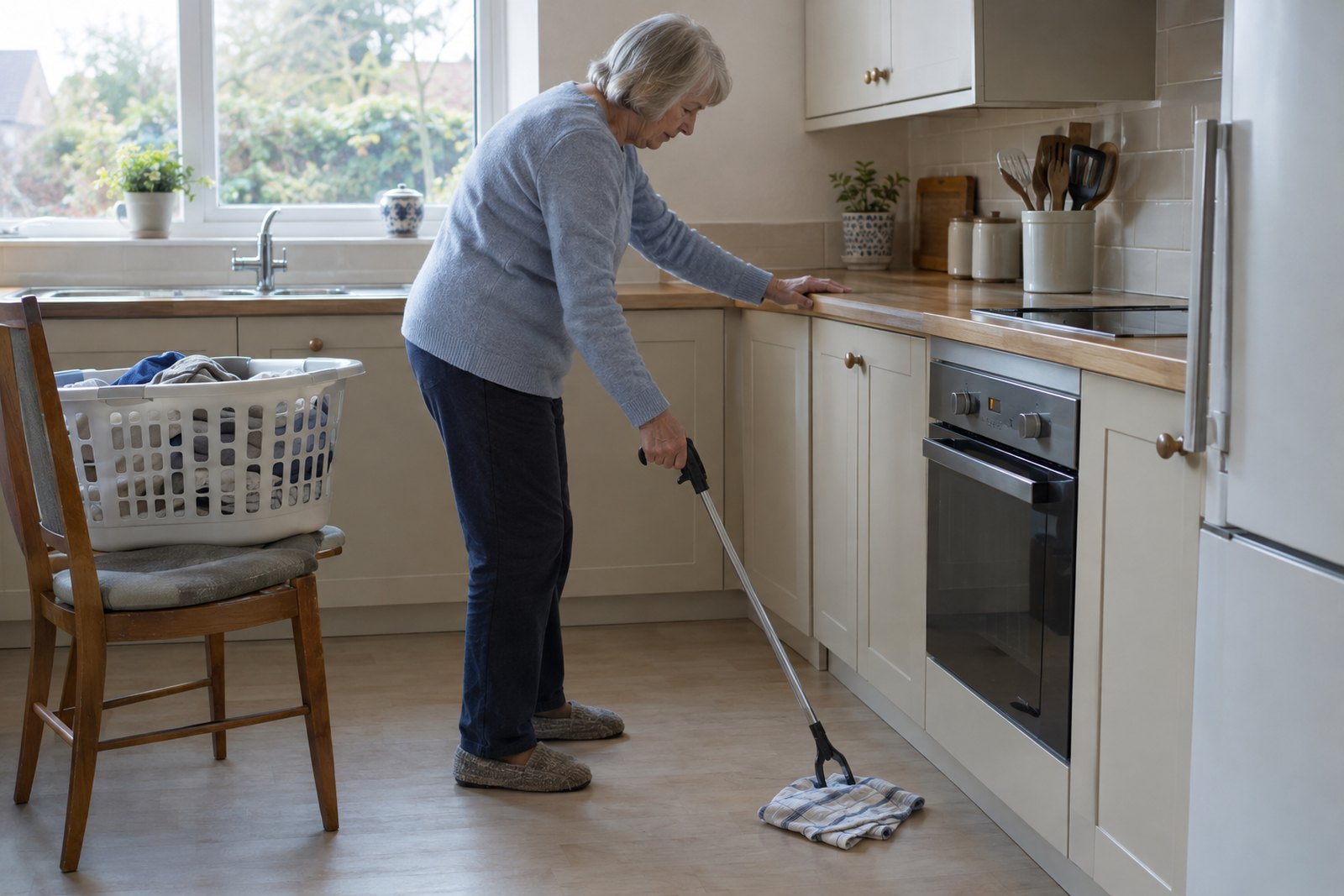
Living with osteoporosis mostly comes down to one thing day to day. Your bones break more easily than they should, so a fall or an awkward lift that once would have left a bruise can now cause a fracture. The bones themselves do not hurt. Osteoporosis has no symptoms until something breaks, which is why many people only find out after a broken wrist, a hip fracture or a crushed bone in the spine.
The practical answer is not to stop doing things. It is to keep moving and keep strong, to do the riskier tasks a little differently, and to take falls seriously, because a fall is what turns weak bones into broken ones. Medicines to strengthen bones are a conversation for your GP. This guide is about everything else: the stairs, the shopping, the laundry basket and the loose rug in the hall.
What osteoporosis means for everyday life
Osteoporosis is a condition where bones lose strength and density over time. It means a bone can break from a fall from standing height or less. When the spine is affected, a bone can sometimes break from something as ordinary as bending forward to lift a heavy bag. The breaks people most often hear about are the wrist, the hip and the bones of the spine.
For most people with osteoporosis, life carries on much as before. You can still walk, shop, garden, look after grandchildren and go on holiday. What changes is that you become a bit more thoughtful about three things: falls, bending forward while lifting, and posture. If you have already had a fracture, particularly in the spine, there may also be pain, tiredness and a period of working out a new way of doing things.
One thing is worth saying early. Fear causes its own damage. People told their bones are fragile often start doing less, sitting more and avoiding the stairs. Within months their legs are weaker and their balance is worse, which makes a fall more likely, not less. The Royal Osteoporosis Society is clear that staying active is good for bones and safe for most people with osteoporosis. Careful is good. Frozen is not.
Staying active without being reckless
The Royal Osteoporosis Society's guidance on exercise and moving with confidence boils down to three kinds of activity, in proportions that suit you: exercise that strengthens muscles, exercise that improves balance, and, where it is safe for you, some impact to help keep bones strong. NHS guidance for adults also recommends strengthening activities on at least two days a week. You do not need a gym. You need regularity.
Strength
Strong legs get you up from chairs, up stairs and out of trouble when you trip. Simple examples include standing up from a chair and sitting back down slowly several times, going up on your toes while holding the kitchen worktop, and step-ups on the bottom stair with the rail. Back muscles matter too, because they help you stay upright and protect the spine. Start with what feels manageable and build up gradually.
Balance
Balance is a skill that fades if you do not use it. Standing on one leg while holding the worktop, walking heel to toe along the hall, or a local tai chi or strength and balance class all count. Many NHS falls services and some councils run strength and balance programmes; your GP surgery can usually tell you what exists locally.
Impact, if it suits you
For many people, brisk walking, marching on the spot or gentle heel drops give bones a useful jolt. If you have had spinal fractures, are frail or have other health problems, lower-impact options may be more sensible. This is exactly the sort of thing a physiotherapist can tailor to you.
Moving with confidence
Some muscle ache the day after new exercise is normal. Sharp pain, or pain that is clearly worse and lasts beyond a day or two, is a sign to ease off and get advice. If you are unsure where to start, ask your GP for a referral to physiotherapy. A physiotherapist leads on exercise programmes; that is their territory.
Bending, lifting and carrying safely
The spine is most vulnerable when you bend forward and lift at the same time, especially with a twist thrown in. That describes a lot of housework. The aim is not to never bend, but to bend well and to lift less often from low down.
- Bend from your hips and knees. Keep your back fairly straight, get close to the object, and hold it near your body. Picture lowering your bottom rather than tipping your chest forward.
- Turn your feet, not your back. If you need to move something to one side, step round rather than twisting at the waist.
- Lift from higher up. Put the laundry basket on a chair or the worktop instead of the floor. Rest shopping on a table before unpacking. A washing machine on a raised plinth saves a lot of stooping.
- Split the load. Several light bags are better than one heavy one, and carrying one bag in each hand to balance the weight is better than carrying everything on one side. A shopping trolley on wheels or online delivery takes the weight out of it altogether.
- Rearrange the kitchen. Keep the things you use every day between waist and shoulder height. Heavy pans live on the worktop or a low-but-not-floor-level shelf, not in the bottom cupboard at the back.
- Use a reacher for small things on the floor. A long-handled reacher picks up post, socks and dropped tea towels without bending. Our guide to grabbers and reachers covers which type suits whom.
- Garden smarter. Raised beds, a kneeler with handles to push up from, long-handled tools and short sessions keep you gardening without long periods bent double.
- Hoover upright. A lighter vacuum cleaner, short bursts and walking with it rather than reaching and lunging all reduce strain.
- Lift grandchildren from a height. Sit down for cuddles, and lift from a sofa or changing surface rather than the floor.
Preventing falls at home
Most hip fractures happen after a fall, and many falls happen at home, often doing something ordinary. Exercise helps, but the home matters too. Our article on falls at home and practical prevention beyond exercise goes into detail; here are the essentials.
- Light the route. Night lights or plug-in lights on the way from bed to toilet, light switches at both the top and bottom of the stairs, and bulbs bright enough to see the edge of each step.
- Clear the floor. Loose rugs, trailing cables, piles of newspapers and shoes left at the bottom of the stairs are classic trip hazards. Remove rugs or fix them down firmly.
- Hold on in the risky places. A second stair rail, grab rails by the toilet and in the shower, and a non-slip mat in the bath or shower make a real difference.
- Sit to do the wobbly jobs. A shower seat, or sitting on the bed to put on socks and trousers, removes the moment of standing on one leg.
- Wear proper footwear. Slippers with a closed back and a grippy sole, not backless mules or socks on a hard floor.
- Stand up slowly. If you feel dizzy or light-headed when you get up, sit for a moment first and mention it to your GP.
- Ask about your medicines. Some medicines can cause drowsiness or dizziness. Your GP or pharmacist can review them; do not stop anything without their advice.
- Keep eyes and ears checked. Regular eye tests matter. Take off reading glasses before walking about.
- Never climb on chairs. Use a sturdy step with a handrail, or leave high jobs for someone else.
It also helps to plan for a fall before it happens. Keep a phone within reach or consider a personal alarm. Learn the safe way how to get up from the floor after a fall, but with one firm rule: if you have pain in your hip, groin, back or wrist after falling and think something may be broken, do not try to get up. Stay warm, call for help and call 999 if needed.
After a vertebral fracture
A vertebral fracture is when one of the bones in the spine is squashed or crushed. Some happen after a fall, some after lifting, and some with no obvious cause at all. Some cause sudden, severe back pain. Others go unnoticed and only show up later as lost height or a more curved upper back.
Pain
Pain after a new spinal fracture often eases over weeks to months, though some people are left with longer-term back pain. Your GP or pharmacist should advise on pain relief, and your GP can refer you on if pain is not settling. Alongside that, many people find it helps to change position often, take short rests lying down during the day to take the load off the spine, and use gentle warmth on sore muscles.
Posture and getting comfortable
Deep, soft sofas encourage slumping and are hard to get out of. A firmer chair at the right height, with a small cushion or rolled towel in the curve of the lower back, is usually more comfortable. To get out of bed with less strain, roll onto your side, let your legs drop over the edge, and push yourself up sideways with your arms, keeping your back fairly straight. Reverse it to lie down.
Equipment that often helps
After a spinal fracture, the aim is to cut down on bending and twisting while you recover. Things that commonly help include a raised toilet seat or toilet frame, chair raisers or a higher chair, a perching stool for kitchen tasks, a long-handled sponge and a sock aid for washing and dressing, a reacher, a bed lever to help you sit up, and a kitchen trolley so you are not carrying plates and drinks. Items such as bed levers, toilet frames and perching stools need to be the right type, height and fit for you and your bed or furniture, so it is best to have them assessed and fitted by an occupational therapist. Not everyone needs all of it. Some of it you will only need for a while.
Pacing
Pain and tiredness tend to push people into a pattern of doing everything on a good day and paying for it for the next three. Pacing breaks that cycle. Split jobs into smaller pieces, alternate standing and sitting tasks, rest before you are exhausted rather than after, and spread the heavy jobs across the week. It feels slow. It gets more done overall.
When to get help quickly
- Sudden, severe new back pain: contact your GP the same day or call NHS 111.
- Back pain with numbness around your bottom or genitals, weakness in your legs, or loss of control of your bladder or bowels: call 999 or go to A&E.
- A fall followed by pain in the hip or groin and being unable to stand or put weight on the leg: call 999.
- Back pain with a high temperature, unexplained weight loss, or a history of cancer: see your GP urgently.
Medicines, scans and the medical side
Bone density scans, fracture risk assessments, bone-strengthening medicines, and questions about calcium and vitamin D all belong with your GP, who may involve a specialist. If you are on treatment, do not stop or change it without talking to your GP or pharmacist first. If you have broken a bone after a minor fall and nobody has mentioned osteoporosis, it is reasonable to ask whether you should be checked. Some hospitals run fracture liaison services for exactly this. The Royal Osteoporosis Society also has a helpline with specialist nurses; check its website for current details.
Where an occupational therapist fits
An occupational therapist looks at how you manage everyday life in your own home and helps you do it more safely. For someone living with osteoporosis, that usually means:
- Watching how you actually do the risky tasks, such as getting in and out of the bath, putting on shoes, carrying laundry or reaching high cupboards, and suggesting easier ways that cut down bending, lifting and twisting.
- Looking at your home for fall hazards, including lighting, stairs, steps at the door, the bathroom and the route to the toilet at night.
- Recommending equipment and rails, and making sure they are the right height and in the right place.
- After a spinal fracture, helping with positioning, comfortable seating, getting in and out of bed, and pacing your day.
- Helping you rebuild confidence if fear of falling has started to shrink your life.
An occupational therapist does not prescribe medicines, diagnose fractures or lead a specialist exercise programme. Your GP handles the medical side. A physiotherapist leads on strength, balance and posture exercise and rehabilitation after a fracture. Your local NHS falls service, if there is one, can assess falls risk more widely. Council adult social care can provide an occupational therapy assessment free of charge if you meet their criteria, though there may be a wait. A private occupational therapist visiting at home is another option if you want help sooner or want a fuller look at the whole house; our home assessment page explains what that involves.
Frequently asked questions
Can I still exercise if I have osteoporosis?
For most people, yes, and it is one of the most useful things you can do. The Royal Osteoporosis Society encourages a mix of muscle strengthening, balance work and, where suitable, some impact. If you have had spinal fractures or other health problems, ask your GP about seeing a physiotherapist who can tailor a programme.
Should I avoid bending forward altogether?
No. Avoiding all bending tends to make you stiff and weak. The aim is to avoid bending forward while lifting something heavy, especially with a twist, and to avoid long periods stooped over. Bend from your hips and knees, keep things close to your body, and lift from a higher surface where you can.
Is it safe to do housework and gardening?
Usually, with some changes. Lighter loads, raised surfaces, long-handled tools, short sessions and sitting for jobs that can be done seated all reduce strain on the spine. If a particular task causes pain, that is worth talking through with an occupational therapist or physiotherapist.
What equipment helps after a spinal fracture?
Commonly a raised toilet seat or frame, a higher chair or chair raisers, a perching stool, a reacher, a long-handled sponge, a sock aid, a bed lever and a kitchen trolley. What you need depends on your pain, your home and what you find hard. Some equipment can be borrowed through council or NHS community equipment services after an assessment.
Do I need a walking stick or frame?
Only if your balance or walking means you need one. The wrong aid, or one at the wrong height, can make falls more likely rather than less. A physiotherapist or occupational therapist can check whether you need one and set it up properly.
Can I see an occupational therapist on the NHS for osteoporosis?
Possibly. You can ask your GP, contact your council's adult social care team for an assessment, or be referred after a fracture or hospital stay. Eligibility and waiting times vary by area. You can also choose to see a private occupational therapist at home.
Next steps
If you would like someone to look at your home and the everyday tasks that worry you, see our home assessment and equipment and aids pages, or current guide prices, and choose your area below.

Talk to an occupational therapist near you
This guide is general information. For advice about your own situation - or someone you look after - a local occupational therapist can visit you at home and see it for themselves.
Choose your area: