

Ankylosing Spondylitis: Posture, Sleep and Daily Life
By Mobile Occupational Therapist • 11 October 2026 • 14 min read
Ankylosing spondylitis (AS) is a long-term inflammatory arthritis that mainly affects the spine and the joints where the spine meets the pelvis. Doctors now often use the wider name axial spondyloarthritis, or axSpA, and keep "ankylosing spondylitis" for the form that shows changes on an X-ray. Whichever name is on your clinic letter, daily life looks much the same. You get back or neck pain and stiffness that is worst in the morning or after sitting still and eases once you get moving. Many people also have a tiredness that sleep does not fix.
Treatment is led by a rheumatologist, usually working with a physiotherapist, and exercise sits at the centre of it. This article is not about diagnosis or medicines. It covers everything else: getting going in the morning, sitting at a desk, sleeping, driving, fatigue, work, and what to do when it flares. None of these changes is dramatic on its own. Together they can make the difference between a day you get through and a day you actually live.
What is happening in your body, in plain terms
In axSpA the immune system causes inflammation where ligaments and tendons attach to bone, mostly in the spine and the sacroiliac joints at the base of the back. In some people, over years, the body lays down new bone in response, and parts of the spine can stiffen or fuse. This does not happen to everyone, and good treatment and regular exercise aim to keep you as flexible as possible.
It is not only a back condition. Some people get pain in the hips, shoulders, ribs, heels or other joints. It can also be linked with inflammation in the eye, the bowel or the skin. That is why the eye warning later in this article matters.
The most useful thing to understand is that inflammatory pain behaves the opposite way to the back pain most people know. Rest tends to make it stiffer and worse. Movement tends to make it better. Almost every practical tip below follows from that.
Who leads treatment, and why exercise is not optional
If you have been diagnosed, your rheumatology team decides on medical treatment and reviews how well the inflammation is controlled. National guidance from NICE recommends that people with axSpA are referred to a specialist physiotherapist for an individual, structured exercise programme. That programme is your most important daily tool. It usually includes stretches to keep the spine, hips and chest moving, strengthening, and something to keep your heart and lungs working.
The National Axial Spondyloarthritis Society (NASS) runs and lists supervised exercise and hydrotherapy groups in many areas, and has exercise guidance designed for this condition. Many people find a regular group makes it far easier to keep going than exercising alone in the living room.
If you have not been diagnosed but have had back pain for months that is worse in the morning, wakes you in the second half of the night and improves with movement, see your GP and describe it in exactly those words. That pattern is worth taking seriously.
Mornings: working with the stiffness, not against it
Morning stiffness is often the hardest part of the day. A few changes can shorten it.
- Move before you get up. Gentle stretches from your physio programme while still lying in bed, such as knees side to side or slowly drawing one knee up at a time, can take the edge off before you stand.
- Use heat early. A warm shower straight after getting up loosens many people enough to do their full morning stretches. Do the stretches while you are still warm.
- Set the alarm a little earlier. Rushing out of the door stiff is miserable. Giving yourself time to loosen up is not indulgence, it is part of managing the condition.
- Lay things out the night before. Clothes, work bag, breakfast things at counter height. Fewer decisions and less bending when you are at your stiffest.
- Sit to dress your lower half. A firm chair or the edge of the bed is safer than balancing on one leg. If bending to your feet is hard, a sock aid, a long-handled shoe horn and slip-on or elastic-laced shoes make a real difference.
- Do not book the hardest task for the first hour. Where you can, put demanding or fiddly jobs later in the morning when you have loosened up.
Posture through the day
Stiffness tends to pull the body forward, so the aim through the day is to avoid long periods hunched over. That does not mean holding a perfect military pose. It means setting things up so the easy position is also the upright one, and changing position often.
At a desk
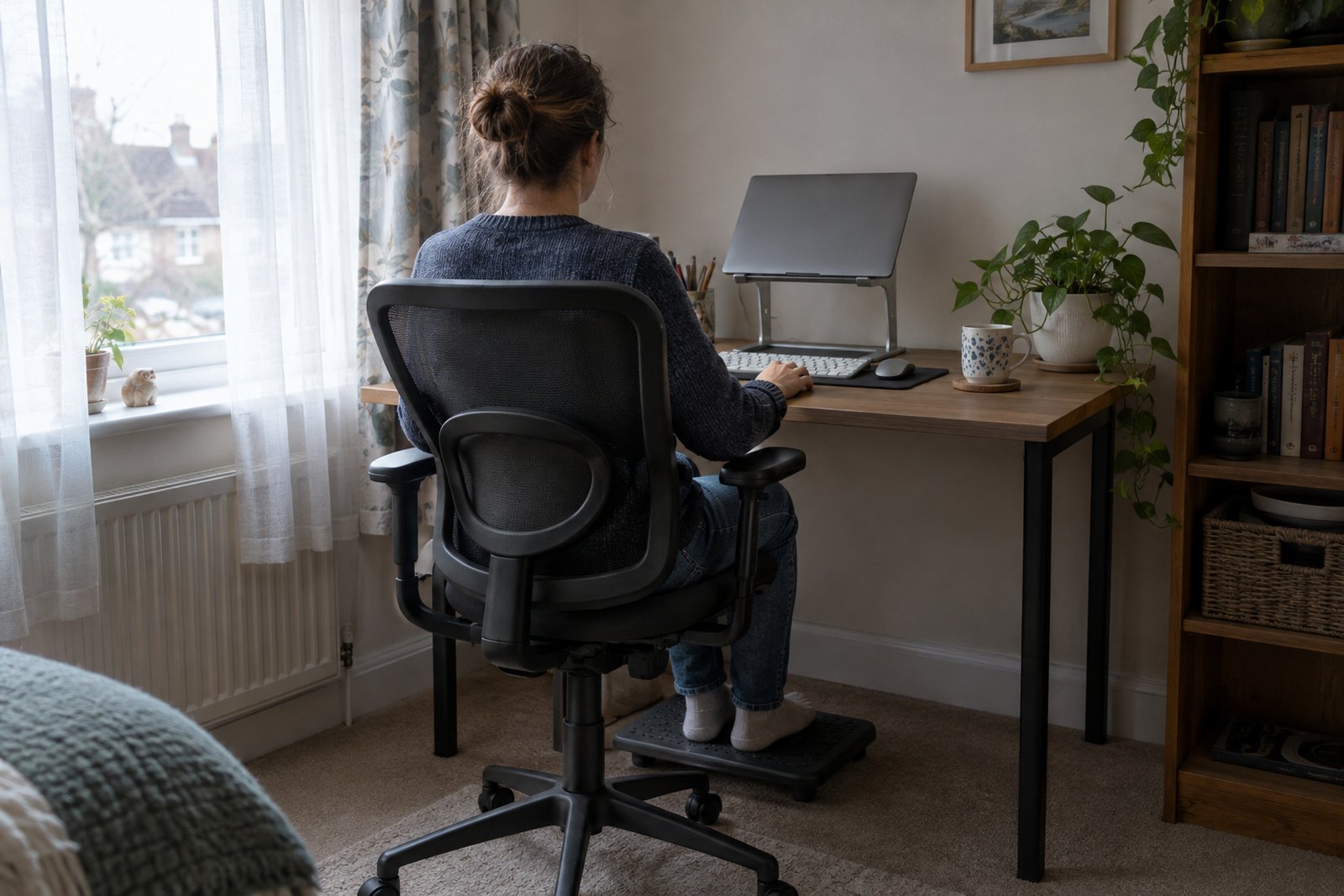
- Put the top of the screen at roughly eye level so you are not looking down. A laptop on its own almost always pulls you forward, so use a laptop stand with a separate keyboard and mouse.
- Choose a chair with adjustable height and good lower back support, with your feet flat on the floor or on a footrest.
- Get up and move regularly. Set a reminder if you get absorbed. A short walk to the kettle or a couple of stretches is enough.
- A sit-stand desk lets you alternate, which many people with AS find helpful. Standing all day is not the goal either.
Our guide to a DSE assessment and setting up your workstation goes through this step by step, and explains what your employer should be doing.
At home
- Sofas are often the worst seat in the house. Low, soft and deep seats encourage slumping and are hard to get out of. A firm upright chair with a good back, and armrests to push up from, is usually better for longer sitting.
- Bring things up to you. Raise the television, prop a book or tablet on a stand, and avoid long sessions looking down at a phone in your lap.
- Work at waist height. Prepare food at the counter rather than on a low table, and keep everyday items between hip and shoulder height.
- Use longer handles. Long-handled dustpans, mops and garden tools reduce bending. A reacher helps with things on the floor.
Keeping an eye on your posture
Some physiotherapists suggest lying flat on your front for a short time each day to stretch the front of the hips and spine, or standing with your back to a wall to check how upright you are. Only do these if your physio has shown you how and agreed they suit you, especially if your neck is already stiff.
Sleeping better
Night-time pain and stiffness are common, often waking people in the early hours. You cannot always prevent that, but you can make the bed work for you rather than against you.
- Mattress. Most people do best on a firm, supportive mattress that keeps the spine reasonably straight. That does not have to mean rock hard. If your mattress sags in the middle, it is likely making things worse.
- Pillows. Use as few as you need to keep your neck in line with your spine. Stacking pillows pushes the head forward, which is the opposite of what you want. If your neck has already stiffened in a forward position, you may genuinely need more height, so ask your physio.
- Position. Lying on your back, or on your front if comfortable, helps keep the spine straighter. Avoid sleeping curled up tight for long periods, and use a pillow between the knees if you lie on your side.
- If you wake stiff in the night, getting up for a short walk or a few gentle stretches and then going back to bed often helps more than lying there.
- Getting out of bed. Roll onto your side, drop your legs over the edge and push up with your arms. A bed at a height where your feet are flat on the floor when sitting on the edge makes this much easier.
If pain is waking you most nights, tell your rheumatology team. It can be a sign that the inflammation is not as well controlled as it could be.
Driving
Reduced neck and spine movement makes it harder to look over your shoulder, check blind spots and reverse. Practical changes include:
- Wide-angle rear-view and blind-spot mirrors on the door mirrors.
- Parking sensors or a reversing camera, if your car has them or can have them fitted.
- A seat with good lower back support, and a head restraint adjusted properly so it supports rather than pushes your head forward.
- Regular breaks on long journeys to get out, walk and stretch. Stiffness builds quickly when sitting still.
- A swivel cushion or sitting down first then bringing both legs in together, if getting in and out is hard.
If your condition affects your ability to drive safely, you may need to tell the DVLA. Check the GOV.UK page on ankylosing spondylitis and driving for the current rules. If you are unsure whether you are safe, or want advice on adaptations, a specialist driving assessment centre can assess you in a car. Driving Mobility lists accredited centres across the UK.
Fatigue
Fatigue in axSpA is real and not a sign that you are not trying. Inflammation itself causes it, and broken sleep, pain and low mood all add to it. It is also unpredictable, which is what makes it so hard to plan around.
Pacing is the main practical tool. In short:
- Keep a simple diary for a couple of weeks of what you did and how you felt, to spot patterns.
- Spread demanding tasks across the week rather than doing everything on a good day and paying for it after.
- Break big jobs into smaller pieces and stop before you are exhausted, not after.
- Plan rest, and treat it as part of the day rather than a failure.
- Keep up your exercise. It can feel backwards, but regular movement usually helps fatigue in the long run.
Our practical guide to fatigue management and pacing covers this in more detail. Tell your rheumatology team or GP if fatigue is severe or changing, as there can be other causes worth checking.
Work
Many people with AS work full careers, but most need some adjustments. Long-term conditions that have a substantial effect on daily life are often covered by the Equality Act 2010 in England, Scotland and Wales (the Disability Discrimination Act 1995 in Northern Ireland), which means employers have a duty to make reasonable adjustments. Check the details on GOV.UK or with Acas if you are unsure where you stand.
Adjustments that commonly help include:
- A later start, or flexible hours, so you are not commuting at your stiffest.
- A properly set-up workstation, an adjustable chair and a sit-stand desk.
- Permission to take short movement breaks and do stretches.
- Working from home on bad days, or a plan for flare days agreed in advance.
- A parking space near the entrance, or changes to heavy lifting, driving or long periods of standing.
Our guide to reasonable adjustments at work and how to ask for them explains how to make the request in a way that is more likely to get a yes.
Make a flare plan before you need one
Flares are much easier to manage if you decided what to do while you were well. Write it down and share it with whoever needs to know.
- Who to contact. Many rheumatology departments have an advice line. Note the number and when to use it.
- What helps you. Heat, a warm bath, adjusted gentler exercises from your physio, extra rest breaks.
- What to drop. Which tasks can wait, and who can take over shopping, school runs or cleaning for a few days.
- Work. What you have agreed with your manager about flare days.
- Kit kept ready. A sock aid, long-handled shoe horn, reacher or perching stool for the kitchen, even if you only need them now and then.
Keep moving gently during a flare unless your team has told you otherwise. Complete rest usually makes stiffness worse. If flares are becoming more frequent or lasting longer, tell your rheumatology team rather than putting up with it.
Warning signs that need help quickly
- A painful red eye, especially with sensitivity to light or blurred vision, can be a sign of eye inflammation (uveitis). This needs to be seen the same day. Contact your GP urgently, go to an urgent eye service if your area has one, or call NHS 111. Do not wait to see if it settles. Follow any specific instructions your rheumatology team has given you.
- New neck or back pain after a fall or knock. A spine that has stiffened can break more easily, even with a minor fall. Get urgent medical help, and call 999 if the pain is severe or you have new numbness or weakness.
- Numbness around your bottom or genitals, loss of bladder or bowel control, or weakness in both legs. Call 999 or go to A&E.
Where an occupational therapist fits
An occupational therapist does not lead treatment for axSpA. Your rheumatologist manages the inflammation, and your physiotherapist leads the exercise programme that protects your movement. An occupational therapist works on something different: how you get through the actual tasks of your day at home and at work.
A private occupational therapist visiting at home can:
- Look at your morning routine and suggest changes and equipment for washing, dressing and getting in and out of the bath or shower.
- Check bed, chair and toilet heights, which matter more if your hips are affected.
- Assess your workstation and write a report setting out adjustments for your employer.
- Help you build a realistic pacing plan around fatigue, work and family life.
- Help put together a flare plan and identify what equipment is worth having in reserve.
- Advise when a referral to a driving assessment centre makes sense.
A home assessment is often the most useful starting point because it sees the real stairs, bathroom and chairs you live with. You can also ask your GP or rheumatology team about NHS occupational therapy, though access varies by area.
Frequently asked questions
Is ankylosing spondylitis the same as axial spondyloarthritis?
Ankylosing spondylitis is one form of axial spondyloarthritis. Axial spondyloarthritis is the umbrella term. Ankylosing spondylitis is used when changes show on X-ray, and non-radiographic axSpA when they do not. Day-to-day symptoms and practical advice are largely the same.
What is the best sleeping position with ankylosing spondylitis?
Most people are advised to sleep as straight as is comfortable, on the back or front, on a firm, supportive mattress with as few pillows as you need. Avoid staying curled up for long periods. Your physio can advise if your neck needs a particular pillow height.
Can I still drive with ankylosing spondylitis?
Many people do, often with wider mirrors, parking aids and regular breaks. If your condition affects your ability to drive safely you may need to tell the DVLA, so check the current rules on GOV.UK. A specialist driving assessment centre can advise on adaptations.
Should I rest or exercise during a flare?
Usually gentle movement rather than complete rest, because stiffness gets worse when you stay still. Scale your exercises down rather than stopping, and ask your physio which ones to use on bad days. Rest breaks still matter, so balance the two.
Is ankylosing spondylitis classed as a disability at work?
It often meets the definition under the Equality Act 2010 if it has a substantial and long-term effect on your daily life, but this depends on your situation. GOV.UK and Acas explain the rules, and you can ask for reasonable adjustments either way.
Can an occupational therapist help if my physio already gives me exercises?
Yes, because they do different jobs. Your physio works on movement and strength. An occupational therapist looks at your routines, equipment, home set-up, workstation and energy so that daily tasks fit around the condition. The two work well together.
Next steps
If stiffness, fatigue or your work set-up are getting in the way, see our work and ergonomics page, or current guide prices, and choose your area below.

Talk to an occupational therapist near you
This guide is general information. For advice about your own situation - or someone you look after - a local occupational therapist can visit you at home and see it for themselves.
Choose your area: