

Life After a Stroke: Getting Back to Hobbies and Going Out
By Mobile Occupational Therapist • 27 September 2026 • 14 min read
Yes, most people can get back to many of the things they enjoyed before a stroke, and going out again is a realistic goal for most. It rarely looks exactly the same as before. Hobbies often need adapting, trips out need a bit more planning, and fatigue usually decides how much you can do in a day far more than strength does. But the things that make life feel like yours are not an optional extra once the "real" rehab is finished. They are part of the rehab.
This guide is about that part of recovery: the gardening, the cards, the choir, the pub quiz, the walk to the shops. It covers why it matters, how to adapt common hobbies, how to make going out less daunting, where to find stroke groups, and when an occupational therapist or another professional can help.
Why getting back to the things you enjoy matters
After a stroke, the focus in hospital is on getting you safe: walking, washing, swallowing, getting home. That is right. But many people find that once they are home, the days stretch out. The exercises are done by ten in the morning and then there is nothing much to do except notice what has changed.
Doing things that matter to you helps in several ways. It gives you a reason to practise movements without it feeling like practice. Shuffling cards, weeding a pot or turning pages all use the hand, the eyes and concentration together. It gives structure to the day. It keeps you connected to people. And it chips away at the feeling that the stroke has taken everything. Low mood after a stroke is common, and having nothing to look forward to makes it worse.
National stroke rehabilitation guidance in the UK reflects this: rehab is meant to include the activities that matter to the person, not just the basics. If no one has asked you what you used to enjoy, it is fair to raise it.
Start smaller than you think
The most common mistake is going back to a hobby at the level you left it. An afternoon in the garden, a full church service followed by coffee, a round of golf. Then you are wiped out for two days and conclude you cannot do it any more.
Post-stroke fatigue is not ordinary tiredness and it does not always respond to a good night's sleep. Our guide to fatigue after a stroke explains it in more detail, but the practical rules are these:
- Pick a starting amount you can manage on a bad day, not a good one. Fifteen minutes is a perfectly respectable start.
- Stop before you are tired, not when you are exhausted. This feels wrong. Do it anyway.
- Build up slowly, adding a little time or a little difficulty once the current level feels easy for a week or so.
- Count thinking as effort. A noisy café or a conversation in a group can tire you as much as a walk.
- Plan rest around outings, including the day after.
Adapting hobbies after a stroke
Many people have weakness on one side, problems with coordination, changes to vision, or difficulty with concentration and memory. The trick is to work out which part of the hobby is now hard, and change that part rather than giving up the whole thing.
Gardening
- Bring the garden up to you. Raised beds, large pots on a garden table or a potting bench mean less bending and kneeling.
- Use a kneeler with tall side handles if you still want to work at ground level. The handles help you push back up, but only if your balance and strength allow it.
- Long-handled, lightweight tools reduce reaching. Tools with thicker, padded handles are easier to grip with a weaker hand.
- Work one-handed where you can. A trug or bucket on a small trolley saves carrying. A cut-and-hold style of pruner lets you trim with one hand.
- Sit to work. A garden stool or a chair at the bench means you can garden for longer.
- Be careful with uneven paths, wet grass and hoses across the ground. Garden in shorter sessions and keep a phone in your pocket.
Cooking and baking
Cooking uses planning, sequencing and two hands, so it is often harder than people expect. Start with something you have made a hundred times. Get everything out before you start. Sit on a high stool at the worktop if standing is tiring. Non-slip matting under a bowl or chopping board stops it sliding when only one hand is working. A board with spikes or corner guards holds vegetables or bread still for one-handed cutting. Cook when someone else is home at first, and be honest with yourself about hot pans and kettles if your grip or balance is unreliable.
Reading
Reading can be affected by holding the book, by vision, or by language. Each has a different answer.
- If the problem is holding the book or turning pages, a book stand on the table or a cushioned lap stand frees your hands. Our guide to book holders and reading stands covers the options.
- If you lose your place or miss words on one side of the page, this may be a visual field problem. A bright ruler or a strip of card down the margin can act as an anchor. Ask for this to be checked properly by an orthoptist or eye specialist.
- If words do not make sense any more, that may be aphasia, a language difficulty. A speech and language therapist leads on this. Audiobooks, large print and short articles can keep you enjoying stories in the meantime.
Cards, board games and puzzles
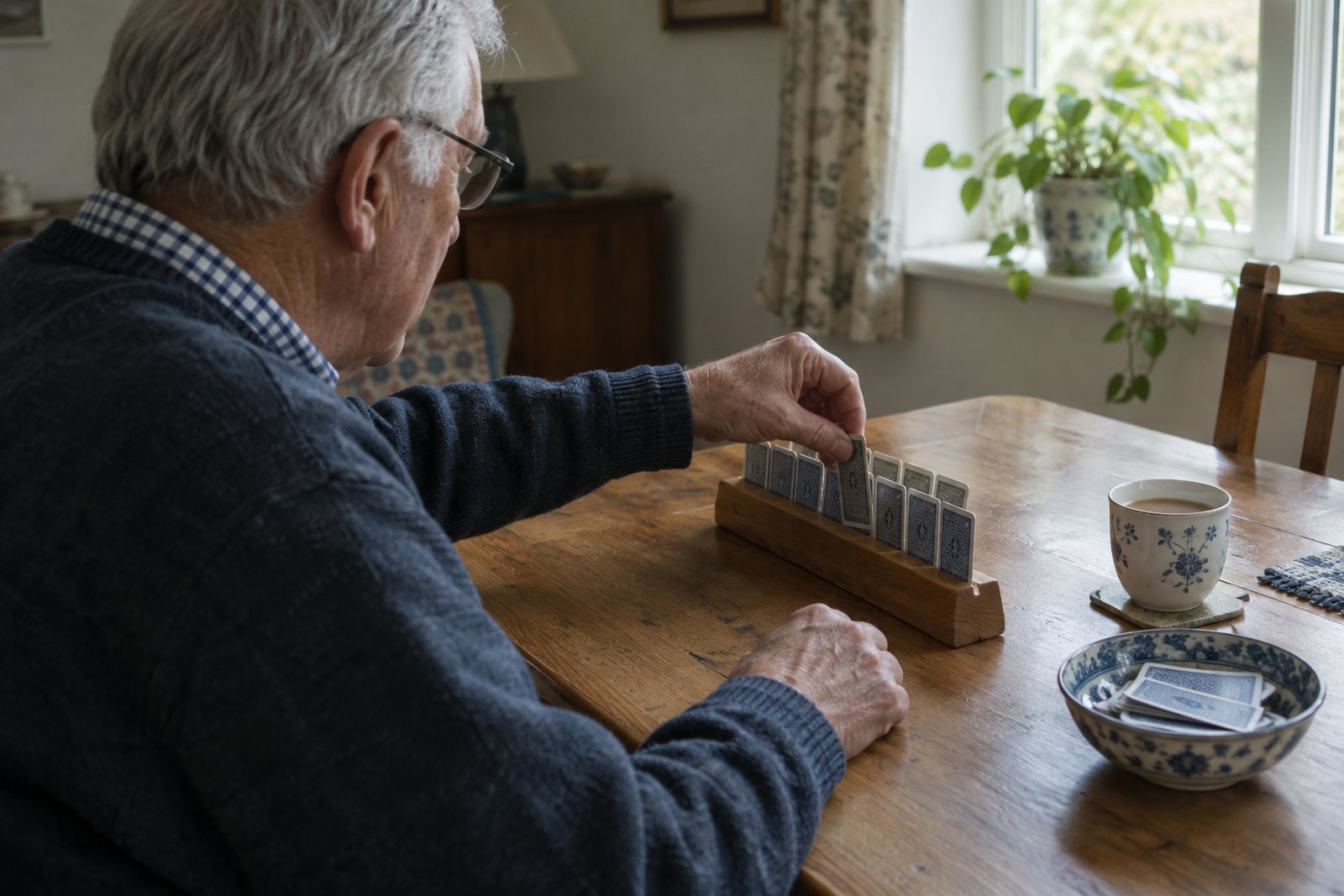
Card games are brilliant after a stroke: social, mentally demanding and good for hand practice. If you cannot hold a fan of cards, a card holder lets you stand them up on the table and pick them out one at a time. See our guide to playing card holders and hobby aids. A card shuffler or simply spreading cards face down and swirling them around also works. Jigsaws with larger pieces, dominoes and board games with chunky pieces are good starting points. If concentration is the issue, choose shorter games and play earlier in the day.
Crafts, knitting and painting
Two-handed crafts can be tricky, but not always impossible. Embroidery hoops can be clamped to a table so one hand does the stitching. Some people knit with one needle tucked under the arm or held in a clamp. Painting and drawing are often easier than expected with a sloped board and tape to hold the paper. If your dominant hand is affected, practising with the other hand is slow but many people get there, and some find a looser style they prefer.
Music
Listening to music is easy to return to and can help mood. Singing is worth trying even if speech is affected, as some people with aphasia find they can sing words they cannot say. Playing an instrument depends on which hand and which skills are affected. A music teacher willing to adapt pieces, or an instrument that can be played one-handed, can keep you involved.
When a hobby really cannot come back
Sometimes it cannot, at least not yet. It is worth asking what you got from it. If it was being outdoors, being part of a team, making something or simply having time to yourself, there may be another way to get that. A former footballer might coach or follow a local club. A keen walker might try shorter routes or accessible nature trails. Grieving the loss is normal. It does not mean you are failing.
Going out again
Building confidence
Many people feel nervous about going out after a stroke: worried about falling, getting tired, needing the toilet, or people staring. Start with short, predictable trips. Go to a familiar shop at a quiet time. Go with someone first, then try going alone with them nearby. Pick places with somewhere to sit. Each successful trip makes the next one easier.
Toilets
Worry about toilets keeps a lot of people at home. A few things help:
- A RADAR key opens locked accessible toilets across the UK that are part of the national key scheme.
- Changing Places toilets have more space, a height-adjustable bench and a hoist, for people who need help from one or two carers.
- Plan toilet stops before you set off and go before you leave.
- If urgency or leaks are a problem, mention it to your GP. Continence problems after a stroke are common and there is help.
Parking and transport
- Blue Badge. If walking is very difficult, you may qualify for a Blue Badge, which lets you park closer to where you need to go. You apply through your council, starting on GOV.UK. Our Blue Badge guide explains who qualifies.
- Buses. Free or concessionary bus passes are available to some disabled people and to older people across the UK, though the age and the organisation that issues them differ between England, Scotland, Wales and Northern Ireland. Check with your council or the relevant national scheme to see what applies where you live.
- Trains. Rail companies offer free assistance getting on and off trains, which you can book in advance. A disabled persons railcard reduces fares if you are eligible.
- Community transport. Many areas have dial-a-ride or volunteer car schemes. Your council or local stroke group will usually know.
- Driving. Do not assume you can drive again straight away. There are DVLA rules about when you must stop, how long for and when you must tell them. Check the current rules on GOV.UK and talk to your GP or stroke team before you get behind the wheel.
Crowds, noise and the walk itself
Busy places can be overwhelming after a stroke, especially if concentration or vision is affected. Visit at quiet times. Sit with your back to the wall in cafés so there is less going on around you. If you use a walking aid, take it, even if you feel you could manage without. If you miss things on one side, ask your companion to walk on that side, and take extra care crossing roads.
Clubs, faith groups and friends
Going back to a club, place of worship or regular social group can feel harder than going to a shop, because people knew you before. A few things make it easier:
- Let the organiser or a trusted friend know in advance what has changed and what would help, such as a seat near the door, a quieter spot or someone to help with steps.
- Go for part of it first. Arrive for the last half hour, or skip the social bit afterwards until you have more energy.
- Decide what you want to say if people ask. "I had a stroke, I'm getting there" is plenty.
- If communication is hard, a small card explaining that you have aphasia and need a little more time can save repeating yourself.
Most groups are glad to make adjustments. They just need to know.
Stroke groups and the Stroke Association
Talking to people who have been through a stroke can help in a way that well-meaning friends cannot. The Stroke Association runs a helpline, information and support services, and can point you towards local stroke groups. Groups vary: some are social, some are activity-based, some focus on communication. Many welcome carers too. Your stroke team, GP surgery or council may also know of local groups, including some aimed at younger stroke survivors.
Mood, emotions and fatigue
A stroke can change how you feel as well as how you move. Low mood, anxiety and frustration are common. Some people experience emotionalism, crying or laughing suddenly and out of proportion to what is happening. This is caused by the stroke itself and it often improves. It is worth explaining to friends so they are not alarmed.
See your GP if low mood or anxiety lasts more than a couple of weeks, stops you doing things, or you have lost interest in almost everything. If you have thoughts of harming yourself, contact your GP urgently or call NHS 111. If you are in immediate danger, call 999.
Fatigue and mood often feed each other. Doing too much leads to crashes, and crashes lead to low mood. Pacing is not just about energy. It protects your mood too.
If you are the carer
Carers often become the planner, the driver, the encourager and the person who notices when it is too much. A few honest points:
- Encourage, but let the person choose. Pushing someone back into a hobby they no longer want rarely works.
- Resist the urge to do things for them because it is quicker. Doing it together, slowly, is usually the point.
- Your own hobbies and friendships matter too. A carer who stops going out entirely is not helping either of you in the long run.
- You can ask your council for a carer's assessment, and the Stroke Association and local carers' services offer support for families.
Where an occupational therapist fits
Occupational therapy is about helping people do the everyday things that matter to them, so hobbies and going out are squarely in its territory. An occupational therapist can:
- Look at the specific activity you want to get back to and work out what is getting in the way: strength, coordination, vision, concentration, fatigue or confidence.
- Suggest ways to adapt the task, the equipment or the environment.
- Help you build a realistic plan for pacing and grading activity back up.
- Practise going out with you, such as getting to the bus stop or managing a shop.
- Advise on equipment for the home and garden, and whether adaptations would help.
NHS community stroke teams often include occupational therapists, but support may be time-limited and focused on essential tasks. A private occupational therapist visiting at home can spend time on the activities that matter to you, though it costs money and it is worth checking what NHS support you are still entitled to first.
Other professionals lead in some areas. A physiotherapist leads on walking, balance and movement. A speech and language therapist leads on communication and swallowing. Your GP or stroke team should be the first contact for new symptoms, mood problems or medical concerns. An orthoptist or eye specialist assesses vision changes.
Frequently asked questions
How long after a stroke can I go back to my hobbies?
There is no fixed timescale. Many people start with gentle, adapted versions of hobbies within weeks of getting home, while others take months. Start small, pace yourself and talk to your stroke team if you are unsure whether something is safe.
Is it normal to feel exhausted after a short trip out?
Yes. Post-stroke fatigue is very common and can be triggered by physical, mental or social effort. Plan rest before and after outings, keep trips short at first and build up slowly. If fatigue is severe or getting worse, mention it to your GP.
Can I still garden if one side is weak?
Often, yes. Raised beds, pots at table height, lightweight long-handled tools and sitting to work make a big difference. Take care with uneven ground and avoid heavy lifting until your balance and strength are reliable.
Where can I find a stroke support group near me?
The Stroke Association can point you to local groups and services. Your community stroke team, GP surgery or council may also know of groups in your area, including those for younger people or for people with communication difficulties.
Should I tell people at my club about my stroke?
It is your choice, but telling an organiser or friend in advance usually makes returning easier. They can save you a seat, find a quieter spot or help with steps. You do not have to explain more than you want to.
Can an occupational therapist help with hobbies, or just with washing and dressing?
An occupational therapist can help with any everyday activity that matters to you, including hobbies, social life and going out. NHS services may need to prioritise essential tasks, which is why some people choose private occupational therapy for this part of recovery.
Next steps
If you would like help getting back to the things you enjoy, see our neurological occupational therapy page, or current guide prices, and choose your area below.
Talk to an occupational therapist near you
This guide is general information. For advice about your own situation - or someone you look after - a local occupational therapist can visit you at home and see it for themselves.
Choose your area: