

Leg Elevation Pillows for Swollen Legs and After Surgery
By Mobile Occupational Therapist • 1 October 2026 • 13 min read
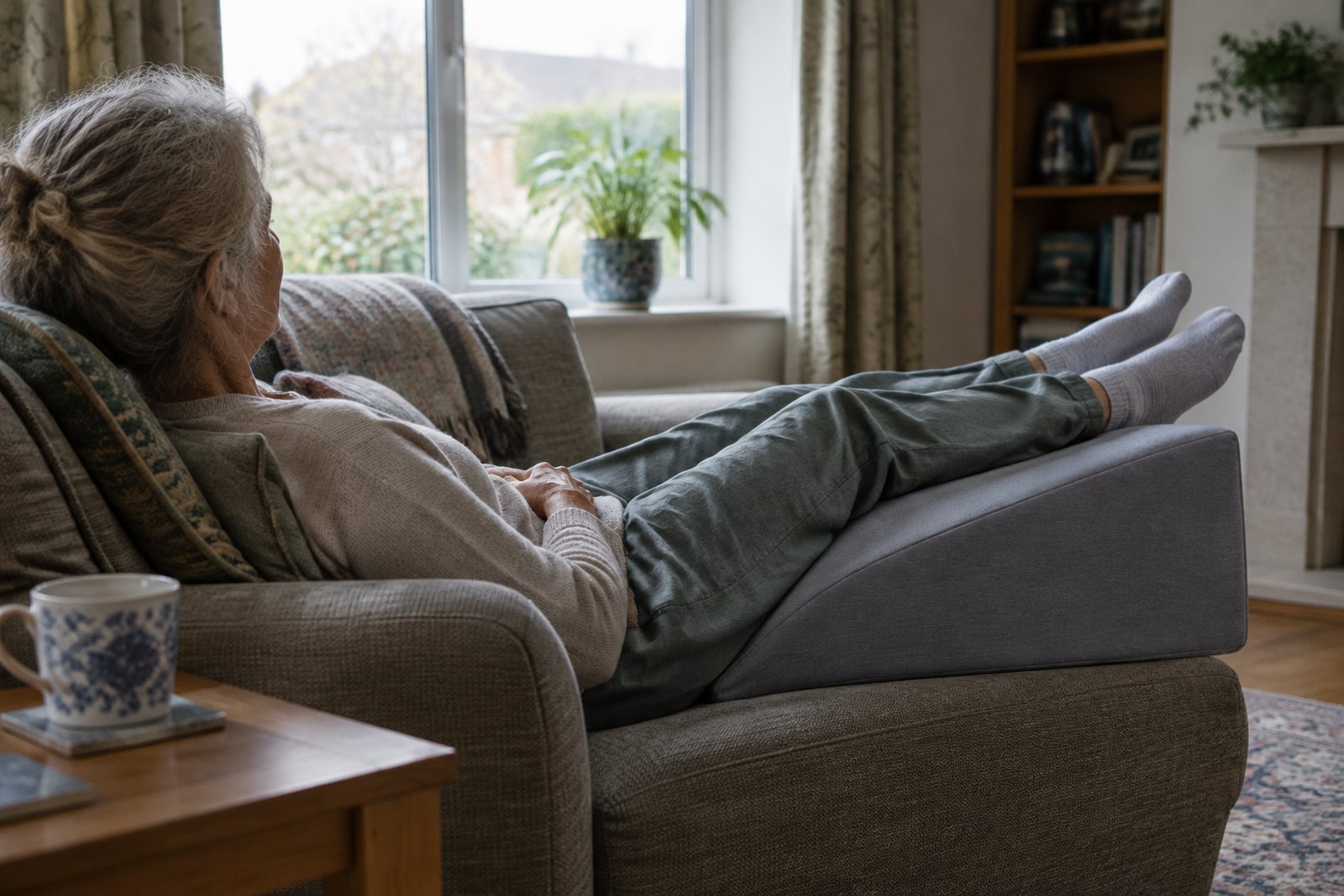
A leg elevation pillow is a firm foam wedge or ramp that props your legs up while you lie down. Raising your legs above the level of your heart lets gravity help fluid drain back out of your feet, ankles and lower legs, so it can ease some kinds of swelling. It is often recommended after leg, knee, hip or foot surgery, after a sprain or fracture, and for the everyday puffy ankles that build up after a long day on your feet or in a chair.
It is not right for everyone, and it does not fix the cause of swelling. If you have heart failure and get breathless lying flat, or you have problems with the arteries in your legs, check with your GP before you start. And if one leg is suddenly swollen, painful, warm or red, or you are breathless, that is not a job for a pillow: get urgent medical help, because it could be a blood clot. The rest of this guide covers how to use one properly, what to look for, and what to try instead.
Why raising your legs helps some swelling
Swelling in the legs (the medical word is oedema) is extra fluid sitting in the tissues. Your veins have to push blood uphill from your feet back to your heart, helped by the calf muscles squeezing as you walk. When you sit or stand still for a long time, or when an injury or operation has inflamed the area, fluid pools at the lowest point. That is why ankles look worst in the evening.
Raising your legs takes gravity out of the equation for a while, or turns it in your favour. The fluid drains back more easily, the skin feels less tight, and many people find the aching settles. The effect is temporary. Once you are up again, gravity goes back to work, which is why elevation is usually advised alongside moving about, not instead of it.
When a leg elevation pillow makes sense
After surgery or injury
This is the most common reason people buy one. After a knee or hip replacement, ankle surgery, a broken leg or a bad sprain, the hospital team or physiotherapist often tells you to keep the leg raised at intervals during the first weeks. A wedge makes this far easier and more comfortable than a stack of sliding pillows. Follow the instructions you were given, because they vary with the operation. If you have had a knee replacement, read the section below on knees before you do anything, and our guide to mistakes after knee replacement.
Everyday ankle and leg swelling
Mild swelling in both ankles that comes on after standing, sitting, hot weather or travel, and goes down overnight, often responds well to regular spells with the legs up, plus walking, ankle exercises and not sitting still for hours. The NHS advises seeing a GP if swelling has not improved after a few days of treating it at home, or if it keeps getting worse. Swelling can be a side effect of some medicines, or a sign of a heart, kidney, liver or vein problem, so it is worth getting checked rather than just living with it.
When it is less likely to be the whole answer
Some swelling does not drain away with elevation. Lymphoedema, where the lymphatic system is not clearing fluid properly, usually needs a specialist lymphoedema service, skin care and compression, with elevation playing a small part at most. Our guide to lymphoedema and everyday life covers this. Swelling caused by heart or kidney problems needs medical treatment of the cause. A pillow may make you more comfortable, but it is not the treatment.
How high, how long and how to lie
Getting your legs above your heart
For elevation to help drainage properly, your feet need to be higher than your heart. That generally means lying down, on a bed or sofa, with the wedge under your lower legs. Sitting in an armchair with your feet on a footstool is better than having them hanging down, but your feet are still below your heart, so it does less.
A simple check: lie back and look at the line from your hip to your heel. It should slope gently upwards towards your feet, with your whole lower leg supported. You do not need your legs pointing at the ceiling. A steady, comfortable incline is what you are after.
How long, and how often
Short, regular spells through the day tend to work better than one long session, and you still need to get up and move in between. If the hospital, physiotherapist or GP gave you a specific routine, stick to that. If not, ask them. Elevation is a supporting habit: walking, ankle pumps (pointing your feet up and down) and avoiding long periods of sitting with your legs dangling all matter too.
Some people are told to sleep with the legs raised; others are not. Overnight elevation suits some conditions and not others, so ask before you make it a nightly habit, especially if you have any heart or breathing problems.
Knees: a common mistake after knee surgery
After a knee replacement, it is tempting to put a pillow just under the knee because it feels comfortable. Many surgical teams advise against this, because resting with the knee bent for long periods can make it harder to get the knee fully straight again. The usual advice is to support the calf and ankle so the leg is raised but the knee stays as straight as you have been told. Check your discharge leaflet and ask your physiotherapist if you are unsure.
Whatever the reason for elevating, avoid a hard edge digging into the back of your knee. A pillow that supports the whole lower leg, rather than balancing your legs on a ridge, is more comfortable and kinder to your circulation.
Choosing a leg raise pillow
Leg elevation pillows come in a few shapes. None is right for everybody, so think about what you need it for.
- Simple wedge or ramp. A triangle of foam that rises from thigh to foot. Easy to use and good for straight-leg elevation.
- Raised platform. A slope that levels off into a flat top, so your calves and heels rest on a broad, even surface. Often more comfortable for longer spells.
- Contoured with a knee bend. Shaped so the knees are slightly bent and the lower legs flat. Many people find this restful, but check it suits you if you have had knee surgery.
- Inflatable versions. Lighter and easier to store or take away, though often less stable.
Things to check before you buy:
- Length. It should support your whole lower leg, from just below the knee to past the heel. Too short and your heels or ankles take all the weight.
- Firmness. Firm foam holds its shape. Very soft foam sinks and your legs slowly slide down.
- Width. Wide enough for both legs if you need both raised, or narrower if only one leg needs it and space is tight.
- Cover. A removable, washable cover matters if you have wounds, dressings or skin that weeps.
- Bed or sofa space. A big wedge on a small bed can leave you squashed against the edge. Measure first.
- Getting your legs on and off. If lifting your legs is hard, a high wedge can be a struggle. A lower slope may be more realistic.
Protecting heels and skin
Heels are one of the most common places for pressure sores to develop, especially in people who are older, thin, diabetic, recovering from surgery or spending a lot of time in bed. A wedge that leaves all the weight on your heels can make this worse.
- Spread the weight along the calves rather than resting on the heels alone.
- If you have been told to protect your heels, the aim is often to support the calf so the heel is just clear of the surface. Ask a nurse to show you if you are not sure.
- Check the heels, ankles and backs of the calves every day for redness that does not fade, blisters, dark patches or broken skin. Use a mirror or ask someone to look.
- Change position regularly and do not stay in one spot for hours.
- Keep skin clean and moisturised, and keep covers smooth with no creases or crumbs.
If you notice skin changes, tell your GP, practice nurse or district nurse promptly. Pressure damage can develop quickly. Our guide to pressure relief cushions and mattresses explains more about protecting skin.
When not to raise your legs without advice
Elevation sounds harmless, and for most people it is. But there are situations where it can cause problems.
- Heart failure or breathlessness lying flat. Raising the legs sends more fluid back towards the heart and lungs. If you have heart failure, or you already need extra pillows to breathe at night, ask your GP or heart failure nurse before using a leg elevation pillow, and stop if it makes you more breathless.
- Problems with the arteries in your legs. In peripheral arterial disease, the problem is getting enough blood into the legs, not out of them. Raising the legs can make pain worse, and some people find their legs ache when raised and feel better hanging down. If that sounds familiar, or you have been told you have poor circulation, speak to your GP before elevating.
- After surgery with specific instructions. Some operations come with rules about positions, bending or how you lie. Your surgical team's advice comes first.
- Compression. Do not add compression stockings or bandages on your own initiative alongside elevation. They need to be assessed and fitted, and they are not safe for everyone, particularly people with arterial problems.
Red flags: get urgent help
Do not try to manage these at home with a pillow.
- One leg suddenly swollen, painful, warm, red or darker than usual, or with hard, sore veins. This could be a deep vein thrombosis (DVT), a blood clot. The risk is higher after surgery, injury, long periods of immobility or a long journey. Contact NHS 111 or your GP urgently for a same-day assessment.
- Breathlessness, chest pain or coughing up blood, with or without leg symptoms. This could be a clot that has moved to the lungs (pulmonary embolism). Call 999 or go to A&E.
- Sudden swelling of both legs with breathlessness needs urgent help: call 999 if you are short of breath, find it hard to breathe, or your chest feels tight, heavy or painful. If the swelling is getting rapidly worse without these symptoms, contact NHS 111 or your GP the same day.
- Signs of infection around a wound or in the skin: spreading redness, heat, increasing pain, fluid or feeling feverish and unwell. Contact your GP, the ward you were discharged from, or NHS 111.
- In pregnancy, sudden swelling of the face, hands or feet, especially with a headache or problems with your vision, needs an urgent call to your midwife or maternity unit.
Alternatives to a wedge pillow
You may not need to buy anything.
- Ordinary pillows. Two or three firm pillows stacked to support the whole lower leg can work for short spells. They slip more than foam, so check they stay put and your heels are not taking the weight.
- A profiling bed. If you spend a lot of time in bed, a profiling bed with a leg section lifts your legs at the touch of a button, with no wrestling with pillows. See our guide to profiling beds.
- A riser recliner chair. A recliner with a footrest that rises and a back that tips back far enough can get your feet up during the day. Not every recliner raises your feet above your heart, so try before you buy. Our guide to choosing the right chair explains what to check.
- A footstool. Not true elevation, but better than sitting with your feet down all day, and handy between proper spells lying down.
Where an occupational therapist fits
An occupational therapist does not diagnose the cause of swelling or decide whether elevation is medically right for you. That is the job of your GP, surgeon, practice nurse or heart failure team. Physiotherapists lead on exercises and getting a knee or ankle moving after surgery. Specialist nurses lead on wounds, pressure damage and lymphoedema.
Where an occupational therapist helps is making the advice workable in your actual home. A private occupational therapist visiting at home can look at whether you can get your legs onto the bed or sofa safely, whether a wedge, a profiling bed or a recliner suits you best, how your chair and bed heights affect getting up again, and how to protect your skin if you are spending long periods resting. They can also advise on equipment for getting in and out of bed, washing and dressing while you recover. See our equipment and daily living aids page for more on this kind of visit.
Frequently asked questions
Can I sleep with a leg elevation pillow all night?
Some people are advised to, others are not. It depends on why your legs are swollen and on your heart and breathing. Ask your GP or the team treating you before making it a nightly habit, and stop if you feel breathless or your legs ache more.
Does a leg raise pillow help with varicose veins?
Raising your legs can ease the aching and swelling that often come with varicose veins, and the NHS lists it among things that may help. It will not make the veins go away. See your GP if they are painful, the skin around them changes, or they bleed.
Is sitting with my feet on a stool enough?
It is better than leaving your feet down, but your feet are still below your heart, so drainage is limited. For proper elevation you generally need to lie back with your legs raised.
Should I put the pillow under my knees after a knee replacement?
Usually not on its own. Many surgical teams advise supporting the calf and ankle so the knee stays straight, because long spells with the knee bent can make straightening it harder. Follow your own discharge instructions.
Why does only one of my legs swell?
Swelling in one leg can have simple causes, such as an injury, but it can also be a sign of a blood clot or infection. If it came on suddenly, or the leg is painful, warm or red, contact NHS 111 or your GP urgently. If you are breathless or have chest pain, call 999.
Can I get a leg elevation pillow on the NHS?
Sometimes a hospital or community team provides one after surgery or for pressure care, but it varies by area and need. Ask your ward, GP or community nursing team. Many people buy their own, as they are a relatively simple item.
Next steps
If you are struggling to rest with your legs up, get on and off the bed, or work out which equipment suits your home, see our equipment and aids or hospital discharge pages, or current guide prices, and choose your area below.
Talk to an occupational therapist near you
This guide is general information. For advice about your own situation - or someone you look after - a local occupational therapist can visit you at home and see it for themselves.
Choose your area: