

Learning Disability and Dementia: Early Signs and How to Help
By Mobile Occupational Therapist • 26 October 2026 • 13 min read
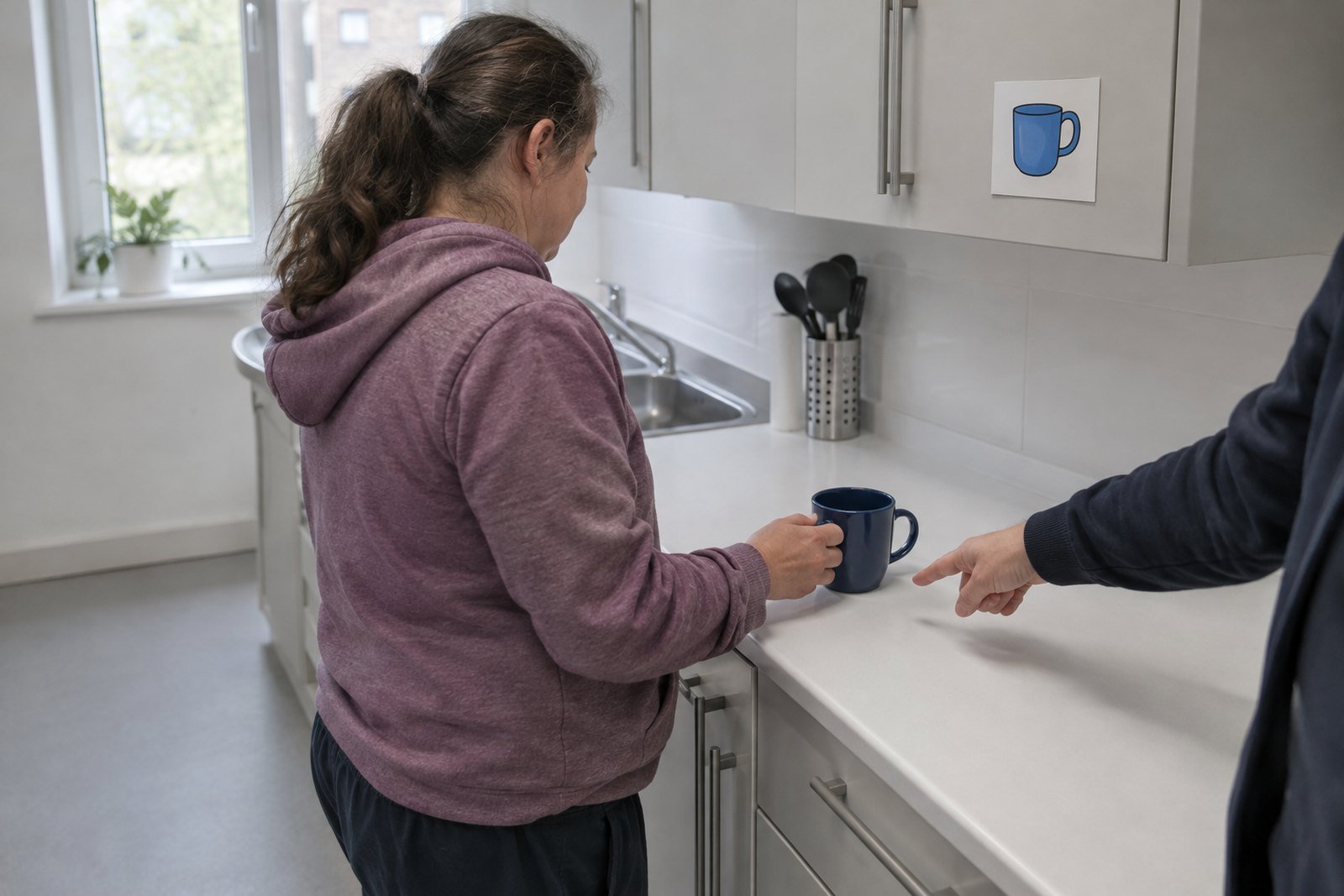
Yes, people with a learning disability can develop dementia, and for some it starts earlier than it does for most people. The clearest link is with Down syndrome. Adults with Down syndrome have a much higher chance of developing Alzheimer's disease, and when it happens it often begins in their 50s, sometimes earlier. People with other learning disabilities also appear to be at somewhat higher risk, though the picture is less clear-cut.
The early signs can look different from the forgetful older relative most people picture. You may see someone lose a skill they have had for years, become withdrawn or irritable, or have seizures for the first time as an adult. Before anyone uses the word dementia, though, other causes need ruling out. Hearing loss, sight problems, an underactive thyroid, depression and pain can all look very similar, and all of them can be treated. This guide is for families and support staff who have noticed something has changed and want to know what to do next.
Why dementia can start earlier for some people
People with Down syndrome have an extra copy of chromosome 21. That chromosome carries a gene involved in making amyloid, a protein that builds up in the brain in Alzheimer's disease. Having an extra copy means more of it, over a whole lifetime. This is why the link with Down syndrome is so strong.
It is not a certainty. Many people with Down syndrome live into later life without developing dementia, and nobody can predict who will. It is a reason to be watchful, not a reason to assume every change is the start of something.
For people with other learning disabilities, the reasons are more mixed. Some have other health conditions that affect the brain. Many have had poorer access to healthcare over the years. And there is a long-standing problem with new symptoms being put down to "just their learning disability" rather than investigated. That is the trap to avoid.
Early signs that may look different
Dementia tests designed for the general population often rely on reading, memory quizzes and knowing the date, which do not work for many people with a learning disability. What matters is change from that person's own usual self. Signs families and staff often notice first include:
- Losing everyday skills. Someone who has always made their own breakfast starts getting the order wrong, or stops altogether. Dressing, washing or using the toilet independently becomes harder.
- Changes in personality or behaviour. Becoming quieter, more stubborn, anxious, tearful or quick to anger. Losing interest in favourite activities, music or people.
- Slowing down. Taking much longer to answer, to move or to finish tasks.
- Difficulty with steps, kerbs and floors. Hesitating at stairs, stepping over dark rugs or shadows as if they were holes, or becoming unsteady.
- Getting lost or confused in familiar places, such as the day centre, the shop or even their own home.
- Changes in sleep, including sleeping much more in the day or being up at night.
- New continence problems in someone who was previously reliable.
- New seizures in adulthood, particularly in people with Down syndrome.
In people with Down syndrome, changes in behaviour, personality and practical skills are often noticed before obvious memory problems. So the first clue may be "she just doesn't seem herself" rather than "she keeps forgetting things".
Write it down
The people who know the person best usually notice first, but changes are easy to doubt in the moment. Keep a simple diary: what you saw, when, and how it differs from before. Dates and examples are far more useful to a GP or specialist than a general feeling that things are worse. If several people support the person, agree to note things in one place.
Start with a baseline, if you can
A baseline assessment is a record of what someone can do when they are well: their skills, communication, memory, behaviour and daily routines. It gives everyone something to compare against later. Without one, it can be very hard to tell whether a person has changed or has always been this way.
For people with Down syndrome, UK professional guidance recommends a baseline in early adulthood, commonly by around age 30, before there are any concerns. It is usually done through the community learning disability team, which the GP can refer to. Practice varies across the country, so ask the GP or the team what is offered locally.
If the person never had one and you are already worried, it is still worth recording things now. You can help by gathering:
- A list of things they can do on their own, with help, or not at all
- Short videos of them doing everyday tasks, if they are happy to be filmed
- Old reports from school, college, day services or previous assessments
- The words, signs or gestures they use, and their favourite people and activities
- Notes from people who have known them a long time, especially if staff have changed
Rule out other causes first
This is the part that most often gets skipped, and it matters most. Many conditions that are common in people with a learning disability can look like dementia. Ask the GP to check for:
- Hearing loss. Earwax and hearing loss are common, especially in Down syndrome. Someone who cannot hear well may seem confused, withdrawn or uncooperative.
- Sight problems. Cataracts and other eye conditions can make someone hesitant on stairs, clumsy or reluctant to do things they used to enjoy.
- Thyroid problems. An underactive thyroid is more common in people with Down syndrome and can cause slowness, tiredness, low mood and weight gain. A blood test can check.
- Depression and anxiety. Think about recent losses or upheavals: a parent dying, a favourite member of staff leaving, a house move, a day centre closing. Grief can look a lot like dementia.
- Pain. Toothache, constipation, reflux, ear infections or arthritis. People who cannot easily say they are in pain may show it through behaviour instead.
- Sleep problems, including sleep apnoea, which can leave someone exhausted and muddled in the day.
- Medicines. Some can cause drowsiness or confusion. Ask the GP or pharmacist for a review, and do not stop or change any medicine yourself.
In England, people aged 14 and over who are on their GP's learning disability register are entitled to a free annual health check. If the person is not on the register, ask for them to be added. You can also ask for reasonable adjustments, such as a longer appointment, the first or last slot of the day, or a quieter waiting area.
When it is urgent
Dementia develops gradually, over months and years. Confusion that comes on suddenly, over hours or days, is more likely to be an infection, constipation, dehydration, a medicine problem or another illness. Contact the GP the same day or call NHS 111. If someone has a seizure for the first time, a seizure lasting more than five minutes, or one seizure after another without coming round, call 999. Our guide to epilepsy safety at home covers bathing, cooking and sleeping more safely if seizures become part of life.
Getting a proper assessment
If other causes have been checked and the changes continue, the GP can refer to the community learning disability team or a memory service. Ask for someone with experience of learning disability. Diagnosis usually involves comparing how the person is now with how they were before, often over several assessments, so it can take time. That can feel slow, but it reduces the chance of a wrong label.
Adapting routines and the environment
Whatever the cause, practical changes at home can help someone keep doing things for longer and feel less anxious.
- Keep routines steady. Same order, same times, same people where possible. Familiarity does a lot of the work that memory used to do.
- Break tasks into smaller steps. Lay out clothes in the order they go on. Put the toothbrush, paste and cup out together.
- Do things with, not for. It is often quicker to take over. But every skill someone keeps practising is a skill they keep a little longer.
- Use pictures and objects. A photo on the bathroom door, a picture of a cup on the cupboard where the cups live, a real towel held up to signal bath time.
- Improve lighting and contrast. Changes in vision and depth perception are common. Brighter, even light and strong colour contrast, such as a coloured toilet seat or a dark plate on a pale table, can make a real difference. See our guide to lighting and colour contrast.
- Watch the floors. Dark mats, busy patterns and shiny surfaces can look like holes or water. Plain, matt flooring is easier.
- Reduce clutter and noise. Fewer choices and less background noise make it easier to concentrate.
Our room-by-room guide to a dementia-friendly home has more detail, and most of it applies just as well in supported living or a shared house.
Communication as things change
Communication often changes with dementia, and the most recently learned skills tend to go first. Someone may lose newer signs or words but keep older, well-practised ones.
- Use short sentences with one idea at a time.
- Show as well as tell: point, demonstrate, hold up the object.
- Give time to respond. Then give more time.
- Avoid quizzing ("Do you remember who this is?") and do not correct for the sake of it.
- Treat behaviour as communication. Pacing, shouting or refusing may mean pain, fear, boredom or a need for the toilet.
- Keep a communication passport up to date so new staff know how the person communicates now, not five years ago.
A speech and language therapist is the right person for communication changes, and also for eating and swallowing difficulties, which can develop as dementia progresses. Ask the GP or learning disability team for a referral if mealtimes involve coughing, choking or a chesty sound after drinking.
Hospital passports and health appointments
A hospital passport is a short document that tells hospital staff who the person is, how they communicate, what upsets them, how they show pain and what helps. For someone with a learning disability and dementia, it should also say what has changed and what they could do before. Our guide to hospital passports walks through writing one. Keep a copy somewhere easy to grab in an emergency.
Planning ahead
Nobody likes this part, but it is easier while the person can still take part in decisions.
- Involve the person. In England and Wales, the Mental Capacity Act 2005 says people must be assumed to have capacity unless shown otherwise, and supported to make their own decisions as far as possible. Scotland and Northern Ireland have their own capacity laws with similar principles.
- Lasting power of attorney. If the person has capacity to make one, it lets them choose who will decide for them later. In England and Wales details are on GOV.UK; Scotland and Northern Ireland have their own power of attorney arrangements.
- Best interests decisions. Where someone lacks capacity for a particular decision, it must be made in their best interests, involving the people who know them.
- Where they will live. Many people with a learning disability live with ageing parents. Talk early about what happens if a parent can no longer provide care, and ask the council for a care needs assessment.
- Future care wishes. Favourite things, important people, faith, and wishes about later stages of life.
Families can also ask the council for a carer's assessment. Mencap and the Down's Syndrome Association both have information and support for families going through this.
Where an occupational therapist fits
An occupational therapist looks at how someone manages everyday life: washing, dressing, eating, getting around, using the toilet, taking part in activities they enjoy. For a person with a learning disability and dementia, that can mean:
- Observing how they manage real tasks at home, which is often far more revealing than a clinic test
- Recording their abilities, which can help build a baseline and track change over time
- Breaking tasks down and suggesting simpler ways of doing them
- Advising on lighting, contrast, layout and safety in the home
- Recommending equipment such as rails, shower seats or toilet frames, and adaptations if needed
- Helping families and support staff use consistent strategies
- Writing reports that support applications to the council or for housing
Many community learning disability teams include occupational therapists, so ask the GP or team about an NHS referral first. A private occupational therapist visiting at home can help if waits are long or you want a detailed home assessment or report.
An occupational therapist does not diagnose dementia; that is for a psychiatrist, memory service or specialist team. They do not advise on medicines. Swallowing and communication are led by speech and language therapy, walking and falls rehabilitation often by physiotherapy, and complex behaviour support by psychology or positive behaviour support specialists.
Frequently asked questions
At what age does dementia usually start in Down syndrome?
It most often begins in a person's 50s, and sometimes in their 40s. Earlier onset is possible but less common. Every person is different, and some people never develop it.
Will everyone with Down syndrome get dementia?
No. The risk is much higher than for most people, but it is not inevitable. That is exactly why it matters to check for other causes rather than assume dementia whenever something changes.
Can dementia be diagnosed without a baseline assessment?
Yes, but it is harder. Specialists will use old reports, videos and the memories of family and long-standing staff to piece together what the person used to manage. The more you can gather, the better.
Who diagnoses dementia in someone with a learning disability?
Usually a psychiatrist or psychologist from the community learning disability team, or a memory service. Start with the GP, who can check for other causes and make the referral.
Are there treatments?
There is no cure. Whether any medicine is suitable is a question for the specialist, who will consider the person's other health conditions. Practical support, steady routines and treating other problems such as pain or hearing loss often make the biggest day-to-day difference.
Where can families get support?
Mencap and the Down's Syndrome Association both offer information for families. You can ask your council for a care needs assessment for the person and a carer's assessment for yourself, and your GP surgery can tell you about local carers' services.
Next steps
If daily tasks are getting harder at home, see our home assessment page, or current guide prices, and choose your area below.
Talk to an occupational therapist near you
This guide is general information. For advice about your own situation - or someone you look after - a local occupational therapist can visit you at home and see it for themselves.
Choose your area: