

Essential Tremor: Practical Help With Eating, Writing and Dressing
By Mobile Occupational Therapist • 5 October 2026 • 14 min read
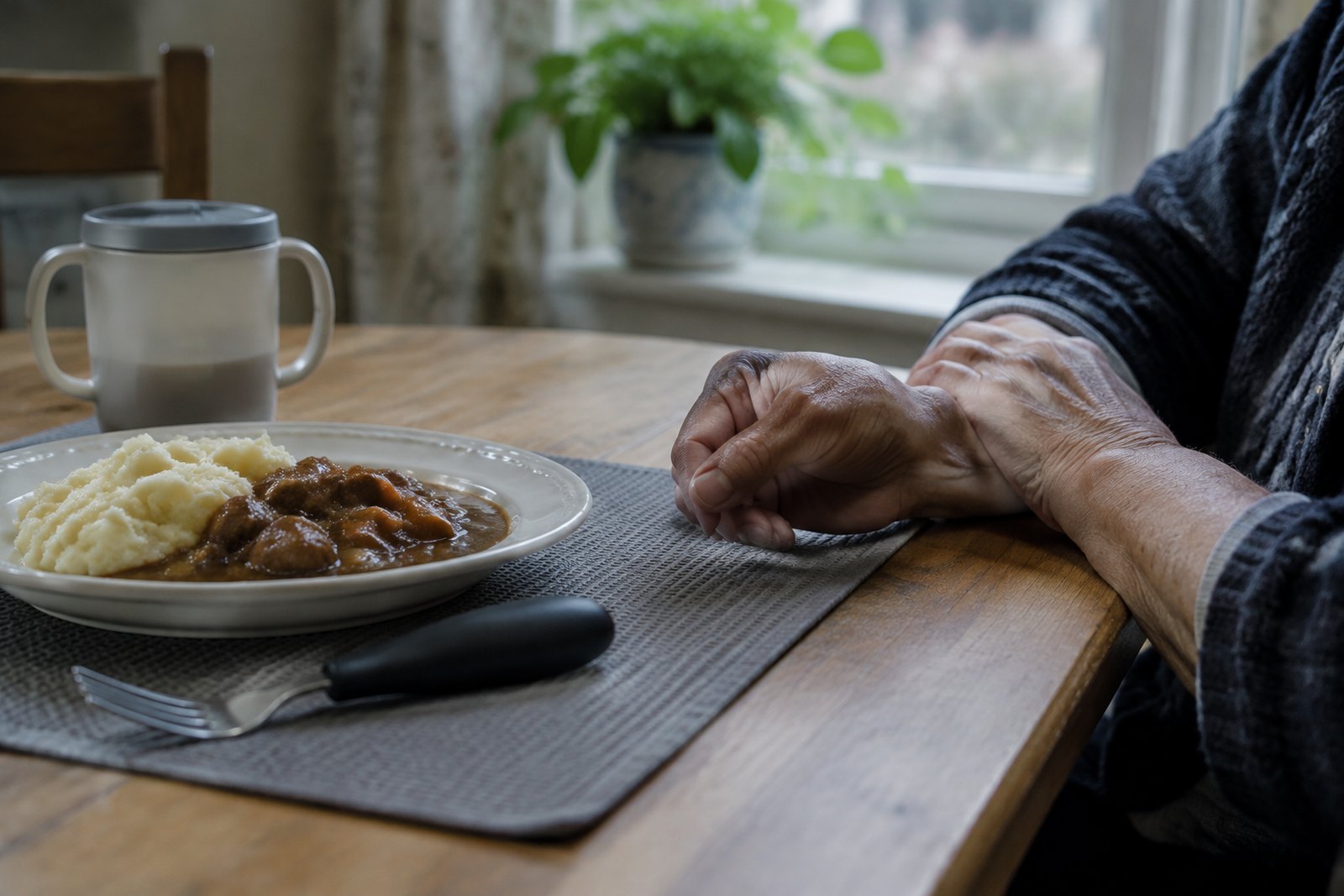
If your hands shake when you lift a cup, sign your name or do up a button, you are far from alone, and there is a lot you can do about the practical side of it. Essential tremor is one of the most common causes of a shake that shows up when you use your hands, rather than when they are resting in your lap. It often runs in families, usually comes on gradually and can also affect the head and voice. It is not the same as Parkinson's disease, although the two are often confused.
This guide is about getting on with daily life. The short version: brace your arms against something solid, add weight or bulk to what you hold, cut down on what makes the tremor worse, and change the task rather than fighting your hands. Below is the detail, task by task, plus when to see your GP and where an occupational therapist can help.
First, make sure it has been looked at
If your tremor is new, or it is changing, see your GP before you start working around it. Most tremors are not a sign of anything dangerous, but some have causes that can be treated, and a few need looking at properly. Book a GP appointment if:
- the shaking is new, or noticeably worse than it was
- it is getting in the way of eating, drinking, writing or work
- you also have stiffness, slowness, a shuffling walk, problems with balance or handwriting that is getting smaller
- you have other symptoms such as weight loss, feeling hot and sweaty, a racing heart or feeling anxious all the time
- it started after you began a new medicine (do not stop any medicine on your own, but do mention it)
- it mainly affects one side of the body
Call 999 if shaking comes on suddenly alongside a drooping face, weakness in an arm or leg, slurred speech or confusion, as these can be signs of a stroke. Call 999 for a seizure that lasts more than a few minutes or for a first fit. If you are not sure how urgent something is, call NHS 111.
Your GP can talk through what might be causing the tremor, whether treatment could help and whether you need to see a neurologist. Medication is an option for some people. That is a conversation for your GP, not for this page.
What makes a tremor worse
Most people with essential tremor notice it is worse on some days and at some times. Common culprits include:
- Stress and anxiety. Including the special kind that comes from being watched while you sign something or carry a tray. The more you worry about the shake, the bigger it gets.
- Caffeine. Coffee, tea, cola and energy drinks can all make a tremor more obvious.
- Tiredness and poor sleep. A bad night often means a shakier morning.
- Being cold or hungry. Cold hands and missed meals tend to make things worse.
- Effort. Holding something heavy, or holding a position for a long time, often brings the shake on.
- Some medicines. Ask your GP or pharmacist whether anything you take could be playing a part.
Some people notice that alcohol briefly calms their tremor and that the shake comes back worse afterwards. Using alcohol to manage a tremor is a trap that gets harder to climb out of. If you have noticed this pattern, it is worth telling your GP.
A simple diary for two weeks can be more useful than it sounds. Note when the tremor is worst, what you had to drink, how you slept and what you were doing. Many people find a clear pattern, such as better in the late morning and worse in the evening. Then plan fiddly jobs, like writing cards or cooking something tricky, for your better times. If you want to cut down on caffeine, switching to decaf gradually is usually easier than stopping overnight.
Bracing and stabilising: the techniques that help everywhere
These ideas work for almost every task, so they are worth learning first.
- Anchor your elbow. Rest it on the table, or tuck it firmly into your side. The closer the movement is to a fixed point, the smaller the shake at your fingertips.
- Use two hands. Hold a cup with both hands, or use one hand to steady the wrist of the other.
- Work close to your body. Bring the plate, the paper or the phone towards you rather than reaching out to it.
- Sit down for fine tasks. Standing adds another thing for your body to steady.
- Lean against something. At the kitchen worktop, resting your forearms or hips against it can make a noticeable difference.
- Loosen your grip. A white-knuckle grip often makes the shake worse. Bigger, softer handles let you hold things more lightly.
- Add weight. Heavier objects move less. Some people also find light wrist weights helpful for short tasks, while others find them tiring. Try before you buy.
- Slow down. Take a breath before you start, and do not rush because someone is waiting.
Eating and drinking
Drinking
Spilt drinks are often the thing people mind most, especially in front of others. Things that help:
- Fill cups only halfway. Simple, free and very effective. Top up more often instead.
- Use a heavier mug. A solid mug moves less than a thin cup. A mug with two handles lets you use both hands.
- Try a lidded cup. Adult travel-style mugs with a lid and a small drinking hole stop most spills. You do not have to use anything that looks like it belongs in a nursery.
- Use a long, flexible straw. The cup can stay on the table, so you never have to lift it. Reusable straws are easy to carry when you are out.
- Drink with your elbow on the table. Lean towards the cup rather than lifting it all the way to your mouth.
- Carry drinks safely. Use a lid, or put drinks on a tray with a non-slip mat, or use a kitchen trolley so you are not walking across the room with a full mug.
Eating
- Weighted cutlery. Heavier knives, forks and spoons can dampen a tremor for some people. Others notice little difference. If you can borrow a set or try one first, do.
- Thicker handles. Cutlery with wide, soft handles is easier to hold loosely. Foam tubing that slides over your own cutlery is a cheap way to test the idea.
- A fork over a spoon. Food speared on a fork tends to stay put better than food balanced on a spoon.
- Deeper dishes. A bowl, a plate with a raised lip or a clip-on plate guard gives you something to push food against.
- A non-slip mat. Stops the plate sliding away from you.
- Food that holds together. Mash, risotto, thick stews and sticky rice are easier than peas or runny soup. Soup is often easier drunk from a mug.
- Cut food first. Cutting is one of the hardest jobs. Choose food that does not need cutting, or ask for it to be cut in the kitchen.
There are also battery-powered stabilising spoons that sense the shake and move to counter it. Some people find them very helpful. Others do not get on with them, and they are not cheap, so try one before buying if you possibly can. Our guide to kitchen aids and mealtime independence covers more of the options.
Eating out is often where the confidence goes. It is fine to choose dishes you know are easier, ask for your drink half full, bring your own straw and sit where you can rest your elbows. You do not owe anyone an explanation.
Writing, typing and phones
Handwriting
- Use a thicker pen, or add a foam grip, so you can hold it more lightly.
- Try a weighted pen. Like cutlery, it suits some people and not others.
- Pens that glide, such as gel or felt-tip, need less pressure than a stiff ballpoint.
- Write larger, and print if joined-up writing has become hard.
- Rest your whole forearm on the table and sit squarely.
- Stop the paper moving with a non-slip mat or a clipboard.
If signing in front of people is stressful, tell your bank or the organisation involved. Many accept other ways of confirming who you are, and lots of forms can now be done online.
Typing and computers
Most computers have accessibility settings that help with a tremor, and they cost nothing. Look for settings that ignore brief or repeated key presses, slow down how quickly keys repeat and make the mouse pointer move more slowly. Other things that help:
- A keyguard: a rigid plate that sits over the keyboard with a hole for each key, so you can rest your hands without pressing the wrong one.
- A keyboard with larger keys.
- A trackball instead of a mouse, as it stays still while you move the ball.
- Wrist rests, so your forearms are supported.
- Word prediction, so you type fewer letters.
- Voice dictation, which is built into most computers and phones and is much better than it used to be.
Phones and tablets
Touch screens can be maddening with a tremor. In the accessibility settings, look for options to change how long you need to touch the screen before it responds and to ignore repeated touches. A stand or a grip on the back of the phone, a stylus and larger icons can all help. Voice assistants will make calls and send messages for you, speakerphone saves holding the phone to your ear, and a voice note is often quicker than a text.
Dressing and grooming
Sit down to get dressed, ideally on a firm chair or the edge of the bed, so you are not balancing at the same time. Then make the fastenings easier.
- Magnetic fastenings. You can buy shirts with magnets hidden behind the buttons, or have your own shirts converted.
- Button hooks. A loop of wire on a handle that pulls the button through the hole. Takes a little practice and then saves a lot of frustration.
- Zip pullers. A ring or loop on the zip tab is much easier to hold.
- Elastic laces or slip-on shoes with a firm back.
- Easier clothes. Pull-on trousers with elastic waists, bigger buttons, front-fastening bras and jumpers instead of cardigans.
- Jewellery with magnetic clasps.
For grooming, an electric razor and an electric toothbrush are both easier and safer than manual versions. For make-up, rest both elbows on a table in front of a mirror. Our guide to dressing aids and easier ways to get dressed goes into more detail.
Cooking safely with a tremor
The real risks in the kitchen are hot liquids and sharp knives, so these are worth thinking about carefully.
- Avoid carrying boiling water. A kettle tipper lets you pour by tilting rather than lifting. Fill the kettle with only what you need, using a jug.
- Slide, do not lift. Move pans along the worktop rather than carrying them. A continuous run of worktop between hob and sink makes this much easier.
- Drain without pouring. Cook pasta or vegetables in a pan with a basket insert, lift food out with a slotted spoon, or steam or microwave instead.
- Pour with support. Rest the spout on the rim of what you are pouring into, and keep both on the worktop.
- Cut down on cutting. Frozen or pre-chopped vegetables are fine. A chopping board with spikes holds food still, a rocking knife needs less sawing, and a small food processor does the job without a blade in your hand.
- Use a trolley to move plates and dishes to the table.
- Sit to prepare food. A perching stool at the worktop lets you rest your arms and steady yourself.
Work and confidence
Many people say the tremor itself is not the worst part. It is the feeling that people are watching, or assuming something about them. Telling colleagues or friends plainly ("I have a tremor, it is harmless, I may spill things") often takes the pressure off, and less pressure often means less shake.
At work, you can ask for changes such as a different keyboard, voice software or not being the person who carries the tea round. Our guide to reasonable adjustments at work explains how to ask.
Where an occupational therapist fits
An occupational therapist looks at the everyday tasks that matter to you, watches how you actually do them and works out what would make them easier. With a tremor, that might mean teaching bracing techniques, suggesting which equipment is worth trying, rethinking your kitchen layout, setting up your computer or reorganising your routine around your better times of day.
A private occupational therapist visiting at home sees your real kitchen, your real mugs and your real desk, which makes advice much more specific. They can help you try equipment before you spend money, as described on our equipment and aids page, and can write a report for your employer if you need workplace changes.
An occupational therapist does not diagnose the cause of a tremor or decide on medication. That is your GP, and sometimes a neurologist. Other professionals lead on other parts:
- A physiotherapist if you have problems with balance or walking, or have had falls.
- A speech and language therapist if a voice tremor affects your speech, or if you cough or choke when eating or drinking.
- A Parkinson's nurse if your tremor turns out to be Parkinson's. Our guide to Parkinson's and everyday tasks covers that situation.
You can ask your GP about an NHS referral to occupational therapy, or contact a private occupational therapist directly.
Frequently asked questions
Is essential tremor the same as Parkinson's?
No. Essential tremor usually shows up when you are using your hands, such as holding a cup. The tremor in Parkinson's is more often noticeable when the hand is resting, and Parkinson's usually brings other symptoms such as stiffness and slowness. Only a doctor can tell them apart, so see your GP if you are unsure.
Does weighted cutlery actually work?
For some people, yes, and for others it makes little difference or feels tiring. Thicker handles, bracing your elbow and choosing food that holds together often help as much. Try weighted cutlery before buying a full set if you can.
Will cutting out caffeine stop my tremor?
It will not cure it, but many people find their tremor is less obvious when they cut down. Switch gradually to decaf and see what difference it makes to you.
Can I get tremor aids on the NHS?
Some equipment can be provided by your council or local community equipment service after an assessment, but smaller items such as cutlery, cups and pens are often bought privately. You may not have to pay VAT on some equipment designed for disabled people if you have a long-term condition. Check the current rules on GOV.UK.
Will my tremor get worse?
Essential tremor often changes slowly over years, but it varies a lot from person to person. If yours changes quickly, or new symptoms appear, see your GP.
Can I still drive with a tremor?
Many people with a tremor drive safely, but it depends on how it affects you. Ask your GP whether your condition affects driving, and check GOV.UK for the conditions you must tell the DVLA about.
Next steps
If a tremor is making everyday tasks harder, an occupational therapist can look at what you do and suggest changes that fit your home. See our equipment and aids or home assessment pages, or current guide prices, and choose your area below.
Talk to an occupational therapist near you
This guide is general information. For advice about your own situation - or someone you look after - a local occupational therapist can visit you at home and see it for themselves.
Choose your area: