

Joint Hypermobility Syndrome in Adults: What Helps Day to Day
By Mobile Occupational Therapist • 6 October 2026 • 13 min read
Joint hypermobility means some or all of your joints move further than most people's. On its own that is common and often harmless. Plenty of people are bendy and never have a problem with it. It becomes a health issue when it comes with ongoing pain, fatigue, joints that partly slip out of place, or other symptoms that get in the way of ordinary life. Doctors used to call this joint hypermobility syndrome. Since 2017 the terms usually used are hypermobility spectrum disorder (HSD) or hypermobile Ehlers-Danlos syndrome (hEDS), and both are diagnoses made by a clinician after a proper assessment, not by an online quiz.
The more encouraging news is that a lot of what helps happens at home and at work, not in a clinic. Building strength and control with a physiotherapist, pacing your energy, setting up your chair and desk so your joints are not hanging at the end of their range, and swapping a few awkward tools for easier ones can make a real difference. This guide covers the practical side, and when you should see your GP.
Bendy joints or symptomatic hypermobility?
Being able to put your palms flat on the floor or bend your thumb back to your wrist is not a diagnosis. Doctors and physiotherapists often use a nine-point screen called the Beighton score to check how far certain joints move, but a high score only tells you that you are flexible. What matters is whether it is causing problems.
- Joint hypermobility - flexible joints, no particular trouble. Nothing needed beyond staying active and reasonably strong.
- Hypermobility spectrum disorder (HSD) - hypermobility plus symptoms such as pain, instability or fatigue, where the criteria for hEDS are not met. It is not a lesser label. Symptoms can be every bit as troublesome.
- Hypermobile Ehlers-Danlos syndrome (hEDS) - one of a group of inherited connective tissue conditions, diagnosed against a specific set of clinical criteria. There is currently no genetic test for hEDS, unlike several rarer types of EDS that are confirmed by genetic testing.
In practice, people with HSD and hEDS are usually managed in much the same way, with the focus on strength, pacing and day-to-day strategies. If a doctor suspects one of the rarer types of Ehlers-Danlos syndrome, they will refer you on to a specialist or genetics service. If you were the bendy child whose aches were put down to growing pains, our guide to hypermobility in children may ring some bells, and may help if your own children seem to take after you.
What it tends to look like day to day
Everyone is different, but these come up again and again:
- Pain - often in several joints, sometimes moving around, often worse after activity or the following day. Muscles can ache from working overtime to hold loose joints steady.
- Fatigue - not ordinary tiredness. Many people describe a heavy, drained feeling that a good night's sleep does not fix.
- Subluxations and dislocations - a joint partly slipping out and back in (subluxation) or coming fully out. Shoulders, kneecaps, fingers and thumbs are common culprits.
- Clumsiness - dropping things, clipping door frames, rolling ankles. Your sense of where your body is in space can be less precise when joints move a lot.
- Bruising and fragile skin - some people bruise easily, have soft or stretchy skin, or find cuts slow to heal.
- Dizziness - some people feel lightheaded or faint when they stand up, and a GP can check for conditions such as postural tachycardia syndrome (PoTS), which is seen more often alongside hypermobility.
Gut problems, bladder issues, anxiety and poor sleep are also reported by many people with HSD and hEDS. None of this means you will have all of it. It does mean that if you have been told each symptom on its own is nothing to worry about, it is reasonable to ask whether they are connected.
Protecting your joints without wrapping yourself in cotton wool
The aim is not to stop moving. Loose joints are best protected by strong, well-controlled muscles, and avoiding activity tends to make things worse over time. Joint protection is about doing the same things in a way that puts less strain on the most vulnerable joints.
The basic principles
- Stay out of the end of range. Many hypermobile people rest at the extreme without noticing: knees pushed back when standing, elbows locked straight, wrists bent fully back, sitting on a folded leg. It feels comfortable because you are hanging on your ligaments rather than using muscle. Aim for soft, slightly bent knees and elbows.
- Use bigger, stronger joints. Carry a bag over your forearm or shoulder rather than hooked on your fingers. Push heavy doors with your palm, forearm or hip. Lift a full kettle or pan with two hands.
- Spread the load. Two lighter bags instead of one heavy one. A rucksack on both shoulders. A shopping trolley or delivery for the big shop.
- Change position often. Holding any position for a long time, even a good one, tends to hurt. A reminder to shift every half hour or so helps.
- Avoid long, tight grips. Clutching a pen, phone, steering wheel or knife for long spells is hard on finger and thumb joints.
- Treat pain as information. Pain that builds through a task is a signal to stop, switch to something else, or change how you are doing it.
Posture and seating
Standing still is often harder than walking, because nothing is moving and your joints sink into their loosest position. If you stand to cook, queue or work, shift your weight regularly, put one foot up on a low step, or sit for jobs that do not need standing, such as chopping vegetables or ironing.
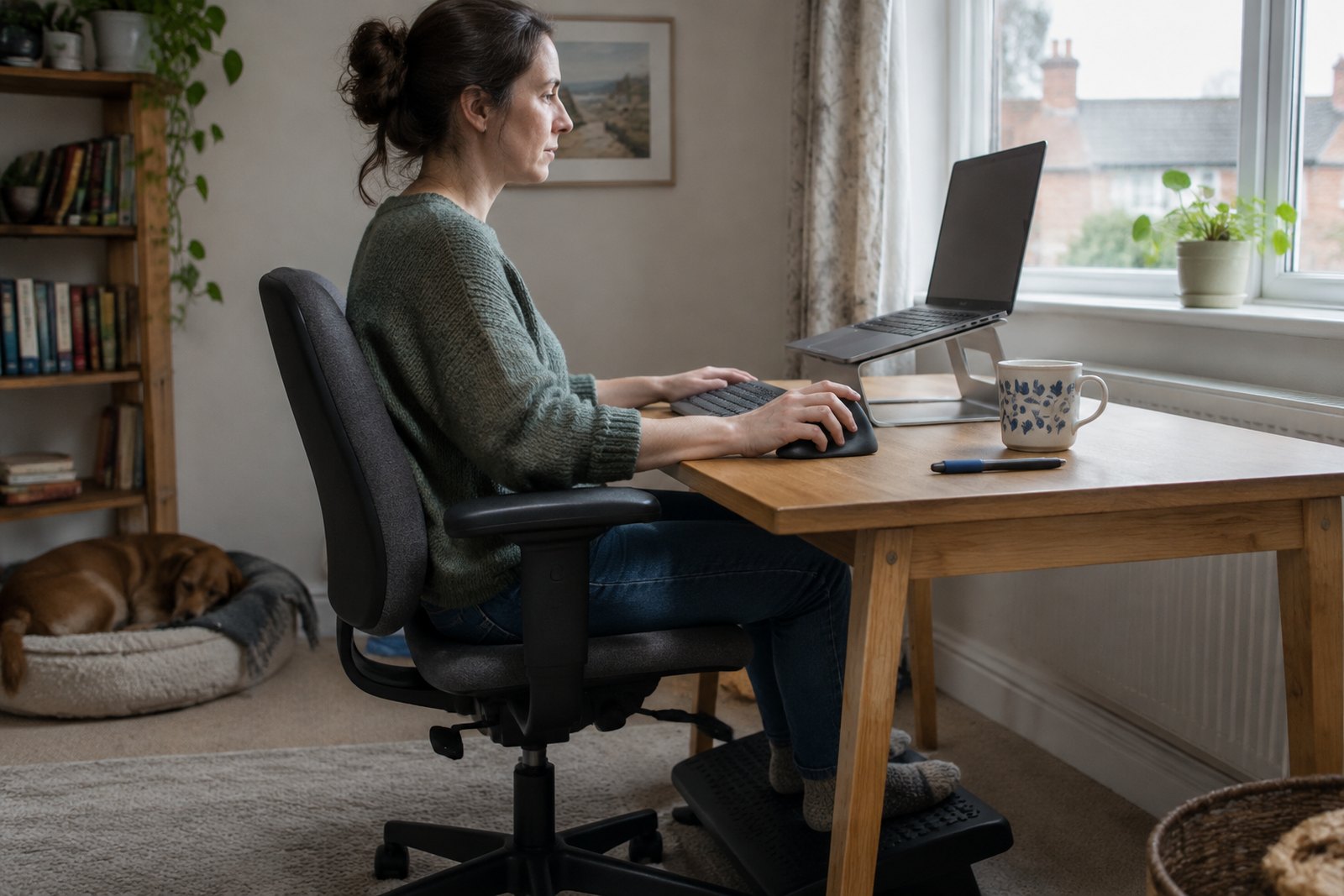
When sitting, you want your feet flat on the floor or a footrest, your hips level with or a little higher than your knees, and your lower back supported by the chair, a small cushion or a rolled towel. Armrests at the right height take the weight of your arms off your shoulders, which matters if your shoulders are the joints that slip. Deep, soft sofas are often the worst seat in the house: you sink, slump, and then have to haul yourself out using your wrists. A firmer seat cushion or a chair with a higher, firmer seat is usually kinder. Try to break the habit of sitting cross-legged or with your legs tucked under you, comfortable though it feels.
Hand-friendly tools
Fingers and thumbs take a battering in everyday tasks. Small swaps can cut down the strain:
- Thicker pens, or foam tubing slipped over pens, toothbrushes and cutlery handles, so you do not have to grip so tightly.
- Kitchen knives and peelers with chunky, soft handles, and a rocking knife for cutting.
- Jar openers that grip the lid, an electric tin opener, and a kettle tipper so you pour without lifting.
- Lightweight pans with a helper handle on the opposite side.
- Lever taps and lever door handles instead of round knobs.
- Key turners, spring-loaded scissors and a book or tablet stand so you are not holding things up for long.
Some people with fingers that bend backwards benefit from small finger splints, some of which look like rings. These need fitting by a hand therapist or occupational therapist, because the wrong size or type can do more harm than good.
Typing, phones and screens
Keyboards and phones are a quiet source of trouble. Keep your wrists straight rather than bent back, with forearms supported on the desk or armrests. A light-touch keyboard needs less force. A mouse that fills your hand, or an upright style that keeps your forearm in a handshake position, suits some people better than a small flat one. Voice dictation, built into most computers and phones, can take a lot of the load off your fingers. If you work on a laptop, raising it on a stand with a separate keyboard and mouse stops you hunching. Use a phone stand or holder rather than balancing your phone on your little finger for an hour. Our guide to a DSE assessment and workstation set-up goes through this step by step.
Pacing: the fatigue is real
Many hypermobile adults live in a cycle of boom and bust. On a good day you catch up on everything, then spend the next two or three days paying for it. Pacing is about flattening those peaks and troughs so you can do roughly the same amount most days.
- Keep a simple diary for a week or two. Note what you did, how long for, and how you felt that evening and the next day. Patterns usually appear quickly.
- Find your baseline. This is the amount you can do on a bad day without a flare. Start from there, not from your best day.
- Break tasks up. Clean one room, not the whole house. Do the ironing in two sittings.
- Mix heavy and light. Follow something physical with something seated, and something mentally demanding with something easy.
- Rest before you need it. Short, planned rests work better than collapsing once you are already done in.
- Build up slowly. Once your baseline feels steady, increase by small amounts.
Our practical guide to fatigue management and pacing was written with other conditions in mind, but the methods transfer well to hypermobility.
Sleep
Poor sleep and pain feed each other. A few things often help:
- A pillow between your knees when lying on your side keeps your hips and lower back in line.
- Hugging a pillow in front of you supports the top arm and can stop a loose shoulder rolling forward in the night.
- Avoid sleeping with your arms above your head, which strains the shoulders.
- A mattress that is supportive enough that you do not sink into twisted positions, plus a pillow that keeps your neck level with your spine.
- A regular wind-down routine and similar bed and wake times, even after a bad night.
If pain, dizziness, a racing heart or breathing problems are regularly waking you, mention it to your GP rather than putting up with it.
Work and everyday adjustments
If your hypermobility has a substantial, long-term effect on your day-to-day activities, you may be protected as disabled under the Equality Act 2010, and your employer must consider reasonable adjustments. Check the details on GOV.UK or the Acas website. Useful adjustments might include flexible hours or home working on bad days, a properly adjustable chair, voice software, regular short breaks, less lifting or carrying, and a parking space near the door. The government's Access to Work scheme can help pay for some equipment and support. Our guide to reasonable adjustments at work explains how to ask.
If you are pregnant or planning to be, tell your midwife or GP that you are hypermobile or have hEDS, so they can plan your care and refer you for physiotherapy if pelvic or joint pain becomes a problem.
When to see your GP, and when it is urgent
Book a GP appointment if you have:
- Joint pain that has lasted more than a few weeks and is affecting work, sleep or daily tasks.
- Joints that keep slipping out of place.
- Dizziness or fainting when you stand, or a racing heart.
- Very soft or stretchy skin, easy bruising or scars that heal poorly.
- A family history of Ehlers-Danlos syndrome, or of serious heart or blood vessel problems at a young age.
- Fatigue that is stopping you working or managing at home.
Ask about physiotherapy. In many areas you can refer yourself to NHS physiotherapy, and your GP surgery or local NHS website will tell you how.
Go to A&E if a joint dislocates and does not go back in, or if the limb below it is numb, cold, pale or extremely painful. Call 999 if fainting comes with chest pain, severe breathlessness or a sudden, severe headache. If you are not sure how urgent something is, call NHS 111.
Where physiotherapy and occupational therapy fit
Be clear about who does what, because it saves time. Your GP starts the process, rules out other causes, manages medicines and can refer you to rheumatology, a pain service or genetics if needed. A physiotherapist leads on the core of treatment: a graded programme to build strength, stability and control around loose joints. If you only do one thing, do that.
An occupational therapist works on the rest of your life: how you manage washing, dressing, cooking, work, childcare and getting about without your joints paying for it. An occupational therapist can look at how you do tasks, suggest equipment and simple changes, help set up your workstation, build a realistic pacing plan with you, and fit or advise on hand splints where relevant. They can also write reports that describe how your condition affects daily life, which can support benefit claims or conversations with an employer. A private occupational therapist visiting at home has the advantage of seeing your actual kitchen, desk, bed and stairs, rather than guessing. See our home assessment page for what a visit involves. An occupational therapist cannot diagnose HSD or hEDS, and is not a substitute for physiotherapy.
Frequently asked questions
Is joint hypermobility syndrome the same as hEDS?
Not quite. Joint hypermobility syndrome is an older term. Since the 2017 classification, people who would once have been told they had it are usually diagnosed with either hypermobility spectrum disorder or hypermobile Ehlers-Danlos syndrome, depending on whether they meet the stricter hEDS criteria. Day-to-day management is broadly similar for both.
Does hypermobility get better with age?
Joints often become stiffer as people get older, so some adults find they are less bendy than they were. That does not always mean fewer symptoms, because pain and fatigue can persist. Staying strong and active tends to matter more than age.
Should I avoid exercise?
No. The right exercise is one of the most helpful things you can do. Focus on strength and control rather than stretching further, since you are already flexible. Ask a physiotherapist to set a programme and tell any yoga or Pilates teacher that you are hypermobile so they can steer you away from pushing joints to their limit.
Do braces and supports help?
They can help for short spells, such as during a flare or a long day on your feet. Relying on them all the time may leave muscles doing less work. Get advice from a physiotherapist or occupational therapist about what to use and when.
Is hypermobility a disability?
It depends on its effect on you, not the diagnosis. Under the Equality Act 2010, it may count if the impact on daily activities is substantial and long term. Benefits such as Personal Independence Payment are also based on how your condition affects daily living and getting around, so describe your worst and typical days honestly.
Can a private occupational therapist diagnose me?
No. Diagnosis of HSD or hEDS is made by a doctor or suitably qualified clinician, often after GP assessment and sometimes a specialist referral. An occupational therapist can help with the practical effects whether or not you have a diagnosis yet.
Next steps
If daily tasks, your home or your work set-up are wearing your joints down, practical advice can help. See our equipment and daily living aids page, or current guide prices, and choose your area below.
Talk to an occupational therapist near you
This guide is general information. For advice about your own situation - or someone you look after - a local occupational therapist can visit you at home and see it for themselves.
Choose your area: