

How to Tie Shoelaces: Teaching a Child Step by Step
By Mobile Occupational Therapist • 29 September 2026 • 14 min read
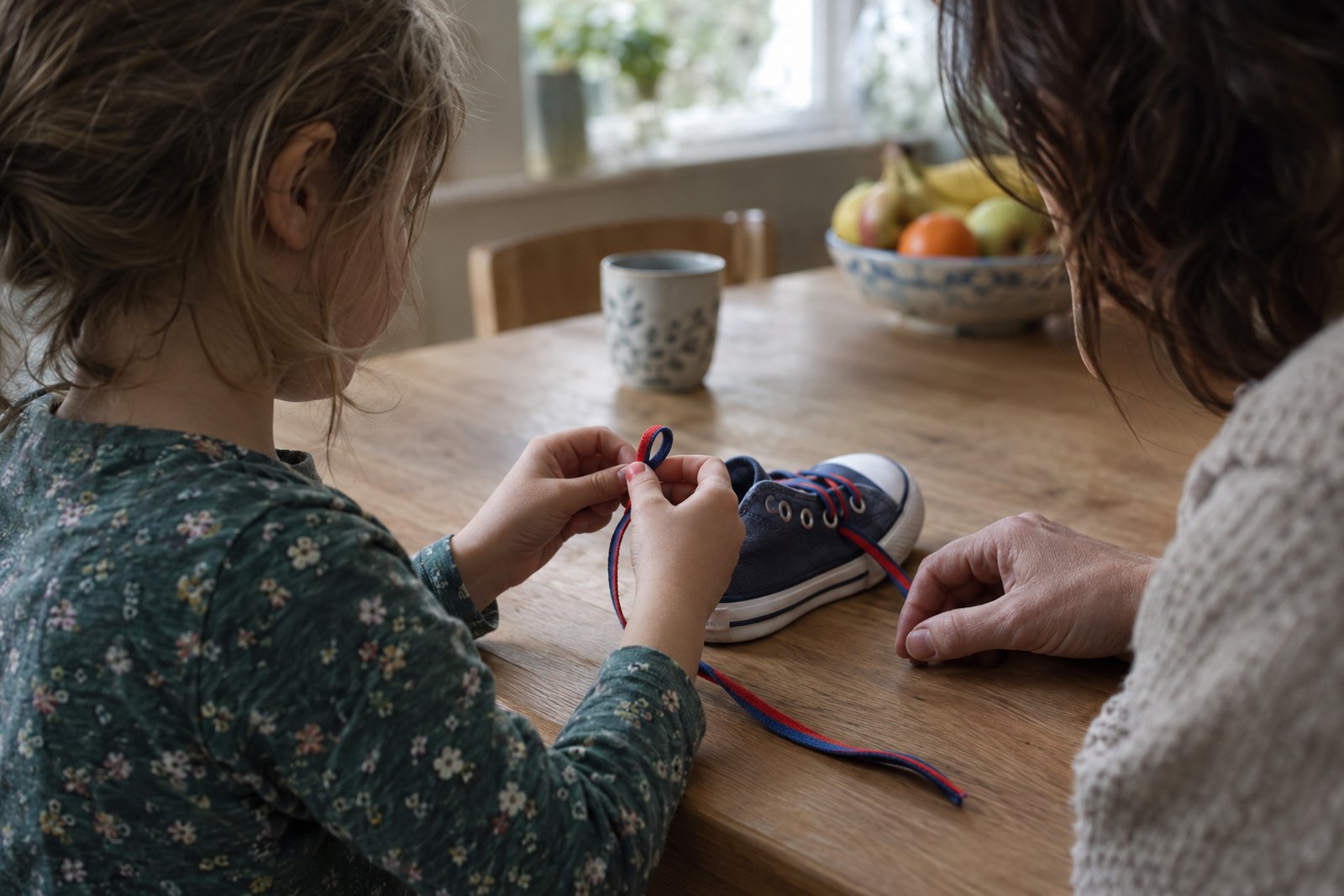
Most children learn to tie their shoelaces somewhere between about 5 and 7, although plenty manage it later and that is not, on its own, a cause for worry. The quickest route is usually to pick one method, teach it with the shoe off the foot on a table, use laces in two colours so your child can tell the sides apart, and let them finish the job themselves before they learn to start it.
There are two common methods: bunny ears, where you make two loops and tie them together, and loop, swoop and pull, which is the standard bow most adults use. Both are described below in plain words, hand by hand. If your child is trying hard and still cannot get there, or is struggling with lots of other hand tasks too, that is the point to look a bit closer, and we cover that at the end.
Is your child ready to learn?
Age is a rough guide, not a deadline. A better clue is what your child can already do with their hands. Children who are ready to start usually can:
- Do up large buttons and a zip, at least with some effort
- Thread big beads onto a string or a pipe cleaner
- Snip with child scissors, holding the paper with the other hand
- Copy a cross or a simple shape with a pencil
- Follow two or three steps in order, such as "wash, dry, hang up the towel"
- Concentrate on a fiddly job for a few minutes without melting down
Interest matters too. A child who suddenly wants to tie their own laces because a friend can will often learn in a week. A child who is pushed into it on a tired Monday may dig their heels in for months. If they are not ready, the activities in the next section are a perfectly good use of time.
The skills underneath shoelace tying
Tying a bow looks like one job but it is several skills stacked on top of each other. Knowing what they are helps you work out where your child is getting stuck.
Both hands working together
Shoelaces need bilateral coordination: one hand holds still and steady while the other does something different. Lots of young children can use both hands at once but find it hard when each hand has a separate job. Reaching across the body to grab the lace on the other side also relies on crossing the midline, which some children avoid. Our guide to crossing the midline and bilateral coordination has plenty of games that build this without a shoe in sight.
Finger strength and pinch
Holding a loop means pinching it firmly between the thumb and the side or tip of the index finger, then keeping hold while the other hand moves. Weak or tired fingers let the loop collapse, and that is when frustration starts.
Planning and remembering the order
There are roughly six steps, and they have to happen in the right order. Some children have the hand skills but lose track halfway through. Others can recite the steps but their fingers will not cooperate. Watching which part goes wrong tells you a lot.
Activities to build the groundwork
- Threading beads, pasta or cotton reels onto a shoelace
- Lacing cards, or holes punched around a paper plate
- Pegging washing or pictures onto a line
- Squeezing, rolling and pinching play dough or putty
- Tying a ribbon around a teddy, a parcel or a chair leg
- Tearing paper into small pieces for a collage
Setting up for success
A few small changes make a surprising difference before you even start.
- Shoe off the foot. Put the shoe on a table in front of your child, toe pointing away from them, so it is the same way round as when it is on their foot. Bending over feet on the floor makes everything harder.
- Sit beside them, not opposite. If you face your child, they see every movement back to front. Sitting alongside, on the same side as their writing hand, lets them copy you directly.
- Two-colour laces. Cut two laces in different plain colours in half, then tie one half of each together in the middle and thread the join under the shoe so each side is a different colour. Or simply colour one half of a white lace with a permanent marker. Now you can say "the blue one goes over" instead of "that one, no, the other one".
- The right lace. Flat, slightly stiff laces are easier than round, slippery ones. Make sure they are long enough to form loops without a struggle.
- A practice board. Punch two rows of holes in a shoebox lid or a piece of thick card and lace it up like a shoe. It stays still, which a wobbly trainer does not.
- Go big first. Some children find it easier to learn with a thick cord or skipping rope tied around a cushion or their own knee before moving down to a real lace.
Step one for both methods: the starting knot
Every method begins the same way.
- Hold one lace in each hand, pulling them up so they are straight.
- Cross them over to make an X. Say which colour goes on top, and keep it the same every time.
- Take the lace that is on top and post it down through the gap underneath the X, like posting a letter through a tunnel.
- Grab one lace end in each hand and pull them apart, out to the sides, until the knot sits snug against the shoe.
A short phrase helps: "Cross, post, pull tight." Many children need to practise just this step for a while, and that is fine.
Method one: bunny ears (two loops)
This method is often easier for younger children because both hands do the same thing at the same time, and nobody has to hold a loop while wrapping something round it.
- Do the starting knot.
- Fold each lace into a loop, so the end of the lace points back down towards the shoe. Pinch the bottom of each loop between thumb and index finger. These are the bunny ears.
- Cross the two ears over each other to make an X, just like the laces in step one.
- Take the ear that is on top, bend it down and push it through the gap under the X.
- Keep pinching both ears and pull them out to the sides, firmly, until the bow tightens.
The rhyme many families use: "Make the bunny ears, cross them over, dive through the hole, pull them tight." The bow this makes can loosen more easily, so a double knot at the end (tying the two loops into one more starting knot) is worth teaching once the bow is solid.
Method two: loop, swoop and pull
This makes the standard bow. It asks more of both hands working together, but it gives a neater, firmer result and is the method most adults will demonstrate without thinking.
- Do the starting knot.
- With one lace, make a single loop and pinch it at the bottom with thumb and index finger. Hold it upright, like a tree.
- With the other hand, take the second lace and wrap it around the front of the loop and round the back, so it goes all the way round the tree. This is the swoop.
- Look for the small hole that has appeared between the wrapped lace and the knot. Using the thumb or index finger, push a bit of the wrapping lace through that hole to form a second loop.
- Pinch one loop in each hand and pull them out to the sides until the bow is tight.
Step 4 is where most children get stuck, because one hand has to keep holding the first loop while the other pushes the second one through. Doing this step for them for a while is completely acceptable, and the next section explains why.
Which method should you choose?
Choose one and stick with it. Switching methods confuses children far more than either method on its own. Tell school and grandparents which one you are using, and use the same words every time, so your child hears one consistent story.
Backward chaining: let them finish first
Backward chaining is a well-established technique for teaching step by step skills, and shoelaces are a classic example. Instead of teaching from the first step, you do all the steps except the last one, and your child does the last one.
- Stage one: you do everything up to the two loops. Your child pulls them tight. They have tied their shoe.
- Stage two: you do everything up to the point the second loop is pushed through. Your child pushes it through and pulls tight.
- Stage three: you do the starting knot and the first loop. Your child does the rest.
- Keep working backwards until your child does the whole thing.
It works because your child always finishes with success, and the step they have practised most is always the one they are about to reach. Move to the next stage only when the current one is easy and reliable, not just when it has happened once.
Left-handed children
Left-handed children can use exactly the same methods, but they may naturally hold the loop in their right hand and swoop with their left, which is the mirror image of what a right-handed adult does. Let them. Their way is not wrong, just reversed. Sit on their left side, slow your demonstration right down, and if you are right-handed, try mirroring the movements yourself so your child sees what their hands should do. Our guide to left-handed children and everyday tasks has more on demonstrating skills the right way round.
Making it fun and keeping it short
- Five minutes is plenty. Stop while it is still going well. Little and often beats a long, tearful session.
- Pick calm moments. Not the school run, not when they are hungry, and not after a long day.
- Tie other things. A teddy's shoe, your shoe, a bow on a present, the ribbon on a dressing-up costume.
- Use stories and rhymes. Bunny ears, trees and swooping birds stick in young memories much better than "now take the left lace".
- Praise the trying. "You held that loop really steady" helps more than "well done" once the whole thing is finished.
- Keep practising after they can do it. A newly learned skill falls apart easily when a child is rushed or tired. Daily use is what makes it automatic.
Alternatives while they are learning
There is no rule that says a child must wear laces before they can tie them. In the meantime:
- Touch-fastening shoes are quick and widely available up to bigger sizes.
- Elastic no-tie laces turn lace-up shoes into slip-ons, so they look the same as everyone else's.
- Coiled or curly elastic laces work in a similar way.
- Lace locks or toggles let you pull laces tight and slide a clip down to hold them.
This is not giving up. It takes the morning pressure off and protects your child's confidence, especially at school, where changing for PE against the clock can be miserable for a child who cannot yet tie up. Keep practising at home, at the table, with the pressure off.
When it might be more than needing practice
Some children just need more time. Others find shoelaces hard because of an underlying difficulty with coordination. It is worth speaking to your GP, health visitor or your child's school if:
- Your child is around 8 or older and still cannot tie laces despite regular, patient practice
- They also struggle with buttons, cutlery, scissors or handwriting compared with children their age
- They seem clumsy, bump into things, find PE or riding a bike very hard, or tire quickly with physical tasks
- They get very distressed or avoid hand tasks altogether
These can be signs of developmental coordination disorder, also called dyspraxia. Our guide to dyspraxia in children explains the signs and how diagnosis works.
Please see your GP promptly if your child loses skills they already had, suddenly becomes weaker in one hand or arm, or has new problems with walking or balance. If weakness on one side comes on suddenly, call 999.
Where an occupational therapist fits
Children's occupational therapists help with exactly this kind of everyday task. An occupational therapist can watch your child try, work out which part is causing the difficulty (strength, both hands working together, motor planning, seeing which lace is which, attention or confidence), and then give you a plan to practise at home that fits your child. They can also suggest equipment and adaptations, advise school on things like PE changing, and write a report if your child needs extra support in school.
An occupational therapist does not diagnose dyspraxia on their own. Diagnosis is usually made by a paediatrician, often with input from occupational therapy or physiotherapy, and your GP is normally the first step. If the main concern is walking, running, balance or muscle tone, a children's physiotherapist may be the better lead.
NHS children's occupational therapy is usually reached through your GP, health visitor, school or school nurse, and waiting times vary by area. Some families choose a private occupational therapist visiting at home alongside this. If you go private, check that the therapist is registered with the HCPC. Our children's occupational therapy page explains what a home assessment can cover.
Frequently asked questions
What age should a child be able to tie their shoelaces?
Many children learn somewhere between about 5 and 7, but the range is wide. Plenty of children who wear touch-fastening shoes never practise and learn later without any underlying difficulty. Look at the bigger picture of their hand skills rather than age alone.
Is bunny ears easier than loop, swoop and pull?
For many younger children, yes, because both hands do the same thing at once. Loop, swoop and pull makes a firmer bow but needs one hand to hold steady while the other does something different. Either is fine. Choosing one and sticking with it matters more than which one you choose.
My child can tie a bow on the table but not on their own feet. Why?
Tying on the foot is harder. They have to bend forward, the shoe is further away, they cannot see as well and they often have to balance at the same time. Try having them sit on a low step with their foot up on a stool, so the shoe is close and still, before moving to the floor.
Should I just buy shoes without laces?
For everyday life, especially school days, that is often sensible. It takes away the stress and lets your child keep up with their friends. Keep practising at home with a practice board or a spare shoe so the skill still develops.
How do I teach a left-handed child if I am right-handed?
Sit beside them on their left, go slowly, and try mirroring the movements so they see the version their hands will do. Let them use whichever hand feels natural to hold the loop. Their bow will look just as good.
Does struggling with shoelaces mean my child has dyspraxia?
Not on its own. Shoelaces are one of the trickier everyday skills and lots of children find them hard for a while. It is worth asking about dyspraxia if your child is also struggling with several other coordination tasks, such as dressing, cutlery, handwriting and PE, and is not catching up with practice.
Next steps
If your child is still finding shoelaces and other hand tasks hard despite plenty of patient practice, an occupational therapy assessment at home can show where they are getting stuck and what to try next. See our children's occupational therapy page, or current guide prices, and choose your area below.

Talk to an occupational therapist near you
This guide is general information. For advice about your own situation - or someone you look after - a local occupational therapist can visit you at home and see it for themselves.
Choose your area: