

ADHD Homework Help: Getting It Done Without a Nightly Battle
By Mobile Occupational Therapist • 16 October 2026 • 12 min read
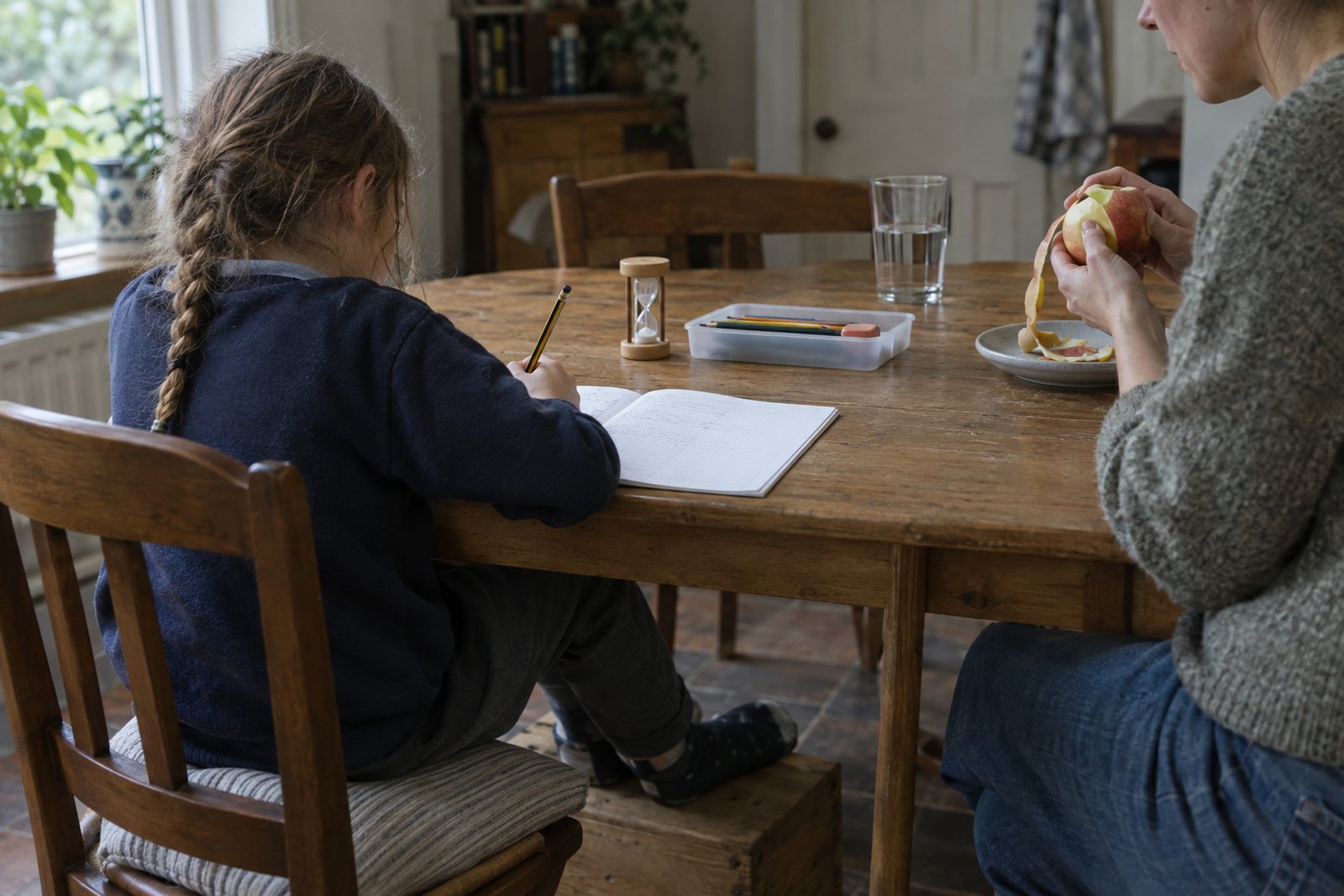
If homework in your house means an hour of stalling, tears and one sentence written, you are not doing it wrong and your child is not lazy. ADHD affects the exact skills homework depends on: getting started on something boring, keeping attention on it, holding instructions in mind, and judging how long things take. After a full school day of trying to hold it together, those skills are often running on empty by four o'clock.
What helps is mostly structure rather than willpower. A predictable time and place, tasks cut into small pieces, short bursts with breaks, an adult nearby, small quick rewards, and a school that adjusts the load. None of it is magic, and some nights will still go badly. But most families find homework gets shorter and calmer when the set-up does more of the work and your child has to do less of the remembering.
Why homework is so hard for a child with ADHD
ADHD is usually described as a problem with attention, but for homework it is more useful to think of it as a difficulty with the brain's self-management skills, often called executive function. Homework leans on nearly all of them at once.
Getting started
Starting a task that is dull, hard or unclear is one of the biggest hurdles. Many children with ADHD genuinely want to do the work and still cannot make themselves begin. From the outside it looks like defiance. From the inside it often feels like being stuck.
Keeping going
Once started, attention drifts. A noise, a thought, a pencil on the floor: anything more interesting than the worksheet wins. Your child may do three questions brilliantly, then lose ten minutes staring at the wall.
Working memory
Working memory is the mental sticky note that holds information while you use it. Children with ADHD often have a smaller one. They forget the instruction halfway through, lose a sentence while writing it, or never wrote down what the homework was.
Time
Many children with ADHD have a weak sense of time passing. Twenty minutes and two hours can feel much the same, which is why a project due next week does not feel real until the night before.
The end of the day
Plenty of children spend the school day working hard to sit still and follow the rules. By home time there is not much left. That is why some children who seem fine at school fall apart at the kitchen table.
Setting up the time and place
The aim is to take as many decisions out of homework as possible. Every decision, from when to start to where the pencil is, is a chance to get derailed.
A consistent time
Pick a time and keep to it most days, so homework becomes routine rather than a fresh negotiation. Straight after school is rarely the best moment. A snack, a drink and some proper movement first, such as a run round the garden or a walk to the shop, usually make the next half hour easier. Just before bed rarely works either. A clear start point like 'after your snack and ten minutes outside' tends to suit.
A consistent place
Same table, same seat, everything already there. A tray with pencils, a sharpener, a rubber, a ruler and paper saves the five-minute hunt that turns into forty. The kitchen table often beats a bedroom, because an adult is nearby and the bedroom is full of more interesting things.
Low distraction, not no distraction
Turn off the TV, put phones and tablets out of sight unless the work needs them, and face the chair towards a wall rather than a window. Some children work better with quiet background music, others need silence. Try both and watch what actually happens, not what your child says will happen.
Let them move
Sitting still uses up attention that could go on the work. It is fine for your child to stand at the counter, kneel on the chair, sit on a wobble cushion or swing their legs. Quiet fidget tools that can be used with one hand help some children, as long as they do not become the main event. Our guide to fidgeting, movement breaks and fidget tools explains what tends to help and what tends to distract.
Breaking homework into small pieces
'Do your homework' is far too big an instruction. So is 'write your story'. Your child needs to know exactly what the first small step is.
- Look at the whole task together. Read the instructions out loud and ask your child to tell you, in their own words, what they have to do.
- Write the steps down. For a piece of writing: choose a title, jot three ideas, say the first sentence out loud, write it down. Tick each step off.
- Make the first step tiny. 'Write your name and the date' is a perfectly good first step. Once started, many children keep going.
- Cover what is not needed. Twenty sums on one page can be overwhelming. Fold the sheet so only a few show at a time.
For projects due in a week or two, sit down on day one and break them into chunks on a calendar. Your child's sense of time will not do it for them, so the calendar has to.
Timers, breaks and body doubling
Short bursts you can see
Work in short, fixed bursts with breaks in between. For some children that is ten minutes, for others five. Start with what your child can actually manage, not what you wish they could, and stretch it slowly. Because time is hard to feel, make it visible: a sand timer, a kitchen timer or a visual timer with a shrinking coloured section. 'Ten more minutes' means little. Watching the colour disappear means much more.
Proper breaks
Breaks should involve movement and have a clear end. Fetching a drink, some star jumps or a lap of the garden are good. Screens are a risky choice, because getting back from one is a battle of its own. Set the timer for the break too.
Body doubling
Body doubling means having another person nearby while you work. You do not need to help or supervise closely. Sitting at the same table doing your own paperwork or peeling vegetables is often enough to keep a child with ADHD anchored to the task. It costs nothing, and many adults with ADHD use it too.
Rewards that actually work
Children with ADHD tend to respond best to rewards that are small, frequent and quick. A big treat at the end of term is far too distant to compete with whatever is happening right now.
- Praise the effort and the starting, specifically: 'You sat down and started straight away. That was hard and you did it.'
- Use small, immediate rewards: a sticker, a point on a chart, a few minutes of a favourite activity, choosing pudding.
- Reward the part that is hardest for your child. If starting is the problem, reward starting, not finishing perfectly.
- Do not take away rewards already earned. It tends to wreck the system fast.
Agree the system at a calm moment, keep it simple and change it when it goes stale, which it will.
Handwriting, typing and getting ideas down
For many children with ADHD, the physical act of writing is a big part of the problem. Handwriting can be slow and tiring, and holding a sentence in mind while forming letters strains working memory. By the first word, the rest of the idea has gone.
- Let your child say their ideas out loud first, and jot down key words as a prompt.
- Ask school whether you can scribe some work, noting that you did.
- Try voice-to-text for planning or drafts, if school is happy with it.
- Consider typing. For some children, especially from upper primary, it frees up their thinking. It needs teaching, though: two-finger hunting can be slower than writing. Our guide to touch typing for children with handwriting difficulties explains how to start.
If handwriting is slow, painful or very hard to read, it is worth asking whether something else is going on too. Coordination difficulties such as dyspraxia often overlap with ADHD.
Working with school
Schools set their own homework policies, and many will adjust homework for a child who is struggling, especially if you bring specifics rather than general frustration. Keep a short note for a couple of weeks: what was set, how long it took, and where it went wrong.
Adjustments worth asking about include:
- A reduced load - fewer questions, or a time limit after which your child stops and you sign to say they did their best.
- Instructions in writing or posted online, so your child does not have to remember a rushed end-of-lesson announcement.
- A planner check, where a teacher or teaching assistant makes sure homework is written down correctly before your child leaves.
- Other ways to record work, such as typing, bullet points or a scribe.
- Agreed extra time for longer projects, settled in advance rather than begged for after the deadline.
Start with the class teacher or form tutor. If adjustments are needed across subjects, or nothing improves, ask to speak to the special educational needs co-ordinator (SENCo). In England a child does not need a diagnosis to get SEN support. Our guide to SEN support in school explains how it works. In Wales, Scotland and Northern Ireland the systems differ, so ask the school how it works locally.
Protecting your relationship
This matters most and gets talked about least. If homework is a nightly fight, it does damage that no worksheet is worth.
- Set a stop point. When the agreed time is up, stop, even if the work is unfinished, and tell school. A child who knows homework will end is more willing to start it.
- Step away when your temper rises. Going to put the kettle on is not giving up.
- Keep homework in its box. Once it is done, do not bring it up over dinner.
- Notice what your child does well, out loud and often. Children with ADHD hear a lot of correction.
If homework regularly ends in meltdowns, that is information for school, not a failure on your part.
When to get more help
- The SENCo if homework is part of a wider struggle at school, or adjustments are not working.
- Your GP if you think your child may have ADHD and has not been assessed. The GP or school can usually refer to child and adolescent mental health services (CAMHS) or a community paediatric team, depending on how your area runs ADHD assessments. Waits can be long, so ask early.
- Your child's ADHD team or prescriber if your child already has a diagnosis and things have changed. If they take medication and homework seems much harder later in the day, mention it to the prescriber rather than changing anything yourself.
- Urgent help if your child seems very low, very anxious or talks about harming themselves. Contact your GP or CAMHS straight away or call NHS 111. If you think they are in immediate danger, call 999.
Where an occupational therapist fits
Occupational therapists help children manage the everyday activities that matter to them, and homework is one of those. An occupational therapist does not diagnose ADHD or prescribe medication; that is for a paediatrician or psychiatrist. Nor are they a tutor. What they can do is look at the practical reasons homework keeps breaking down.
A private occupational therapist visiting at home can:
- watch your child at their usual homework time and spot where things go wrong
- look at seating, table height, posture and the set-up of the space
- assess handwriting, fine motor skills and coordination, including difficulties such as dyspraxia
- look at sensory needs, such as a strong need to move or sensitivity to noise, and plan movement breaks
- help build routines and step-by-step strategies that fit your family
- write a report with recommendations for school, useful when asking for adjustments or SEN support
A speech and language therapist is the right person if the difficulty is understanding language or putting ideas into words. Educational psychologists, usually reached through school, look at learning more broadly. If anxiety or low mood is the main problem, mental health services lead. Our guide to occupational therapy and ADHD covers life beyond homework.
Frequently asked questions
How long should a child with ADHD spend on homework?
There is no set rule; it depends on age, school and child. Agree a reasonable time limit with school, work in short bursts within it, and stop when time is up. Focused short bursts usually achieve more than an hour of struggle.
Should I sit with my child while they do homework?
Being nearby usually helps, but you do not need to hover or do it for them. Sitting at the same table doing something of your own is often enough. As they get older, help them start and then gradually move further away.
Is it all right to tell school my child could not finish?
Yes. Teachers need to know if homework takes far longer than intended or ends in distress. A short note saying how long your child worked and where they got stuck is more useful than finished work you dragged out of them.
My child copes at school but falls apart at homework. Why?
Many children use a lot of energy holding it together at school and have little left by evening. Home is also where they feel safe enough to let go. Tell school what you see, because it completes the picture.
Can my child get homework adjustments without an ADHD diagnosis?
Often, yes. Schools can make adjustments and give SEN support based on a child's needs, not only a diagnosis. Start with the class teacher and ask to meet the SENCo if needed.
Next steps
If homework is still a nightly battle after trying the basics, see our children's occupational therapy page, or current guide prices, and choose your area below.

Talk to an occupational therapist near you
This guide is general information. For advice about your own situation - or someone you look after - a local occupational therapist can visit you at home and see it for themselves.
Choose your area: