

Equipment for Deaf People at Home: Doorbells, Phones and Alarms
By Mobile Occupational Therapist • 5 November 2026 • 13 min read
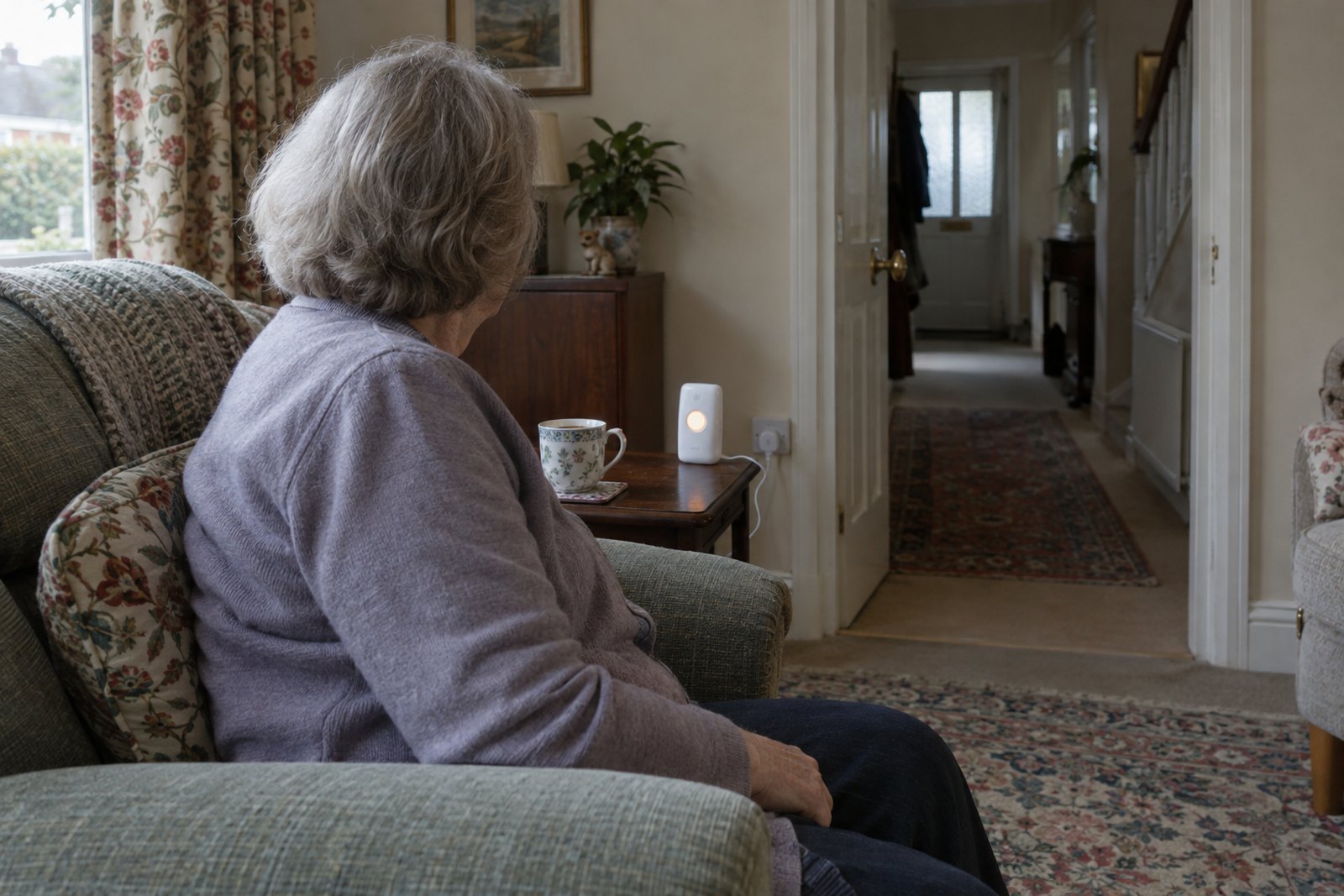
If you or someone you live with keeps missing the doorbell, the phone or, more worryingly, the smoke alarm, there is equipment that turns those sounds into something you can see or feel. Doorbells that flash a light or buzz a pager in your pocket. Phones that are louder, or that show what the caller is saying as text. Smoke alarms with a strobe light and a vibrating pad under the pillow. Much of it is simple, and some of it may be free.
The other half of the answer is the part people skip: get the hearing itself checked first, through your GP or NHS audiology, because hearing aids set up properly can make some equipment unnecessary and the rest work better. Then, if everyday life is still a struggle, ask your council's adult social care team for an assessment. Many councils have a sensory team who can assess and, if you are eligible, provide equipment. Your local fire and rescue service may be able to fit specialist smoke alarms through a free home fire safety visit.
Start with your hearing, not the gadgets
It is tempting to buy a louder doorbell and leave it there. But hearing loss usually creeps up slowly, and by the time the doorbell is a problem, conversations, the TV and the phone usually are too. A proper hearing check tells you what you are dealing with.
Start with your GP. They can look for simple causes such as earwax or an infection, and refer you to NHS audiology for a full hearing test. In some areas you can refer yourself to the NHS hearing service without seeing a GP first, so it is worth asking your surgery. NHS hearing aids are provided free. Some high street opticians and pharmacies also offer free hearing tests, but they usually sell hearing aids too, so be clear about what you are being offered before you agree to anything.
Get help quickly if hearing loss comes on suddenly in one or both ears, or comes with pain, discharge, dizziness or a recent head injury. Ask for an urgent GP appointment or call NHS 111. Call 999 if hearing loss comes with signs of a stroke, such as a drooping face, weakness in an arm or slurred speech.
Ask about the T setting
Many hearing aids have a telecoil, often called the T setting or loop setting. It picks up sound directly from hearing loop systems and some phones and TV equipment, cutting out background noise. It is not always switched on. Ask audiology at your fitting or next review whether your aids have it and whether it can be turned on. Several of the options below depend on it.
Doorbells: knowing someone is at the door
A missed doorbell is not just a missed parcel. It can be a carer left standing outside, a district nurse who cannot get in, or a worried family member ringing round. The options, roughly from simplest to most complete:
- Louder doorbells with extra receivers. Plug-in chimes you can put in each room you use, with adjustable volume and tone. Age-related hearing loss usually affects high-pitched sounds first, so a lower tone is often easier to hear.
- Flashing doorbells. A receiver with a bright light that flashes when the bell is pressed. Put one where you actually sit, not just in the hall.
- Vibrating pagers. A small unit you carry in a pocket or clip to a belt, which vibrates when someone rings. Useful if you move around the house or spend time in the garden.
- Multi-alert systems. Several transmitters linked to the doorbell, phone, smoke alarm and sometimes a baby monitor, all sending to one pager or set of flashing lights. Each sound gets its own pattern or symbol, so you know what is happening.
A few practical points. Check how far the receiver works from the door, especially in older houses with thick walls. Think about the kitchen and bedroom as well as the living room. If you use a doorbell that sends alerts to a mobile phone, set the phone to vibrate and flash too, or it only moves the problem. And if carers visit, a key safe may sit alongside the doorbell so nobody is stuck outside.
Phones: hearing the ring and following the caller
Noticing the phone ring
For a landline, a ringer amplifier makes the ring louder, and a flashing ring indicator plugs in to show a light when a call comes in. Mobiles usually have built-in settings to vibrate and flash the camera light on incoming calls. These sit in the accessibility settings and are worth ten minutes with a patient grandchild.
Hearing what the caller says
Amplified phones boost the caller's voice, often with tone control so you can make speech clearer rather than just louder. Many are designed to work with the hearing aid T setting. If arthritis or sight loss is also an issue, look for large, well-spaced buttons and a clear display.
When speech on the phone does not work
If you cannot follow a voice even when it is amplified, there are other ways:
- Captioned phones show what the caller is saying as text on a screen while you speak back normally.
- A free national text relay service lets you type and read during calls, with a relay assistant in the middle. RNID can point you to it.
- Video calls help many people who lip-read, and suit British Sign Language users talking to other signers.
- Text and messaging are often simply easier. Agree with family, the GP surgery and regular contacts that texting is fine.
For emergencies, deaf people can register to contact 999 by text message. You must register in advance, not during an emergency, so do it now. British Sign Language users can also contact 999 through a BSL video relay service. RNID has current details of both.
TV, conversation and everyday listening
The TV is where many families first notice the problem, usually through arguments about the volume. Some things that help:
- Subtitles. Free, already there, and underused. Most TVs and catch-up services have them.
- TV listeners. Wireless headphones or a neckloop with their own volume control, so one person hears clearly and the rest of the household is not deafened. Neckloops work with the T setting.
- Streamers. Some hearing aids connect wirelessly to the TV or phone through a small device. Ask audiology what works with your aids.
- Personal listeners. A small amplifier with a microphone and headphones, useful for one-to-one conversations, appointments or visitors.
The room matters as much as the kit. Sit where light falls on the speaker's face, not behind them. Turn off the radio when you talk. Soft furnishings, curtains and rugs cut echo in rooms with hard floors.
Hearing loops at home
A room loop is a wire run around the edge of a room, connected to the TV or another sound source. If your hearing aids have the T setting switched on, you hear the sound directly in your aids with much less background noise. Portable loops are also available for a chair or a small area. Check your aids have the T setting before buying anything, and follow the instructions carefully or ask someone competent to fit a fixed loop.
Waking up: vibrating alarm clocks
Most people take their hearing aids out at night, which means a normal alarm clock may not wake them. Vibrating alarm clocks use a pad that goes under the pillow or mattress, often with a flashing light as well. There are also wrist-worn vibrating alarms, which some people find useful as daytime reminders for appointments or meals.
Smoke alarms and carbon monoxide alarms for deaf people
This is the most important section. A standard smoke alarm may not wake someone with hearing loss, especially with their hearing aids out. Specialist systems add a strobe light and a vibrating pad that goes under the pillow or mattress, triggered by a radio link from the smoke alarms in the house. Some also link to carbon monoxide alarms.
Contact your local fire and rescue service. Many offer free home fire safety visits, sometimes called safe and well visits, and in many areas they can fit specialist alarms for people who are deaf or hard of hearing. What is offered varies, so ask directly. Your council sensory team may also be able to help.
Once fitted:
- Test the system regularly with the pad in place, so you know you will feel it.
- Make sure the pad goes under the pillow or mattress you actually sleep on, including if you sleep in a chair or a different room.
- Keep standard smoke alarms working on every floor. The specialist kit adds to them, it does not replace them.
- Plan how you would get out, and who would wake whom, especially if anyone else in the house has mobility problems.
Baby monitors for deaf parents
Deaf and hard of hearing parents can use baby monitors that flash or vibrate when the baby cries, either on a parent unit or through a vibrating pad at night. Some link to a multi-alert system. A monitor helps you notice your baby; it does not replace safe sleep guidance, which your health visitor can talk you through.
Getting equipment free or cheaper
You do not have to buy everything yourself. Routes worth trying:
- Your council. Ask adult social care for a needs assessment and say hearing loss is the reason. Sensory loss is covered like any other need. Many councils have a sensory team, with workers trained in hearing and sight loss, who can assess and, where you meet the criteria, provide equipment. Our guide to the Care Act needs assessment explains how to prepare. Arrangements differ in Wales, Scotland and Northern Ireland, so check with your local council or health and social care trust.
- Your fire and rescue service for smoke alarm systems, as above.
- VAT relief. Some equipment designed for disabled people can be bought without VAT if you are eligible. See our guide to VAT relief on disability equipment.
- RNID. The national charity for deaf people and people with hearing loss has free information on equipment, hearing aids and services, and can help you work out what to ask for.
Communication tips for families
Equipment deals with sounds. People deal with people. A few habits make a big difference:
- Get their attention before you start. Say their name, or a light touch on the arm.
- Face them, at the same level, with light on your face. Do not talk from another room.
- Speak clearly and at a normal pace. Shouting distorts lip patterns and sounds angry.
- If they do not catch something, rephrase it rather than repeating the same words louder.
- Cut background noise. Turn off the TV, close the window.
- One person talks at a time, especially at family meals.
- Write down important things: appointment times, names, medication changes.
- Expect tiredness. Listening hard all day is exhausting, and withdrawing from conversation is often fatigue, not rudeness.
Hearing loss can look like confusion or low mood, and it can also sit alongside them. If someone seems more muddled, withdrawn or down than hearing alone would explain, mention it to their GP.
Where an occupational therapist fits
Let us be honest about who leads what. An audiologist assesses hearing and fits hearing aids. Your GP deals with ear health and referrals. For hearing loss on its own, the council sensory team, usually through a rehabilitation worker or specialist worker for deaf and hard of hearing people, is often the right first stop for equipment. A speech and language therapist leads if speech or understanding of language is affected, for example after a stroke. For children, a qualified teacher of the deaf and the audiology service are central.
An occupational therapist fits when hearing loss is one part of a bigger picture. Perhaps your dad has hearing loss and failing sight, uses a walking frame and gets up several times at night. Perhaps your mum has dementia and cannot remember what the flashing light means. An occupational therapist looks at the whole person in their own home: whether they can reach and use the equipment with stiff hands, where alerts should go so they are noticed, whether they could get out safely if the smoke alarm went off, and how routines, lighting and layout could work better. Our guide to sensory impairment and how OTs help explains this in more detail, and there is more on combined loss in living with sight loss at home.
A private occupational therapist visiting at home can assess and write clear recommendations, which can be useful if you are waiting for the council or want to buy equipment yourself. A good one will work alongside the sensory team and audiology rather than around them. Alerts can also be linked into telecare, which we cover in personal alarms and telecare. See our sensory needs page for how this kind of visit works.
Frequently asked questions
Can I get a flashing doorbell for free?
Possibly. If a council assessment finds you have eligible needs, the sensory team may provide doorbell alerts and other equipment. Ask adult social care for an assessment and mention hearing loss specifically. If you are not eligible, they can usually still advise on what to buy.
Do I need to be registered deaf to get help?
You do not usually need to be on any register to ask your council for an assessment. Some councils keep a voluntary register of deaf and hard of hearing people, which can help them plan services. Ask your council how it works locally.
Will a vibrating smoke alarm work with my existing alarms?
Some specialist systems link to standard alarms by radio and some need their own linked alarms, so it depends on the system. Your fire and rescue service can advise and, in many areas, fit a suitable system. Whatever you have, test it regularly with the pad in place.
My mum will not wear her hearing aids. What can we do?
Find out why. Common reasons are discomfort, whistling, too much background noise or fiddly controls. Many of these can be fixed at an audiology review, so book one. Alerting equipment still works without hearing aids, so you can sort the doorbell and smoke alarm while you work on the rest.
How can a deaf person contact 999?
You can register to contact 999 by text, but you must register in advance. British Sign Language users can also use a BSL video relay service. RNID has current instructions for both.
Is an occupational therapist the right person for hearing equipment?
For hearing loss alone, start with audiology and the council sensory team. An occupational therapist is most useful when hearing loss comes with other difficulties, such as sight loss, mobility problems, falls or dementia, and you need the whole home and routine looked at together.
Next steps
If hearing loss is one of several things making home harder, see our sensory needs and equipment and aids pages, or current guide prices, and choose your area below.
Talk to an occupational therapist near you
This guide is general information. For advice about your own situation - or someone you look after - a local occupational therapist can visit you at home and see it for themselves.
Choose your area: