

Golfer's Elbow: Symptoms, Daily Changes and When to Get Help
By Mobile Occupational Therapist • 18 September 2026 • 13 min read
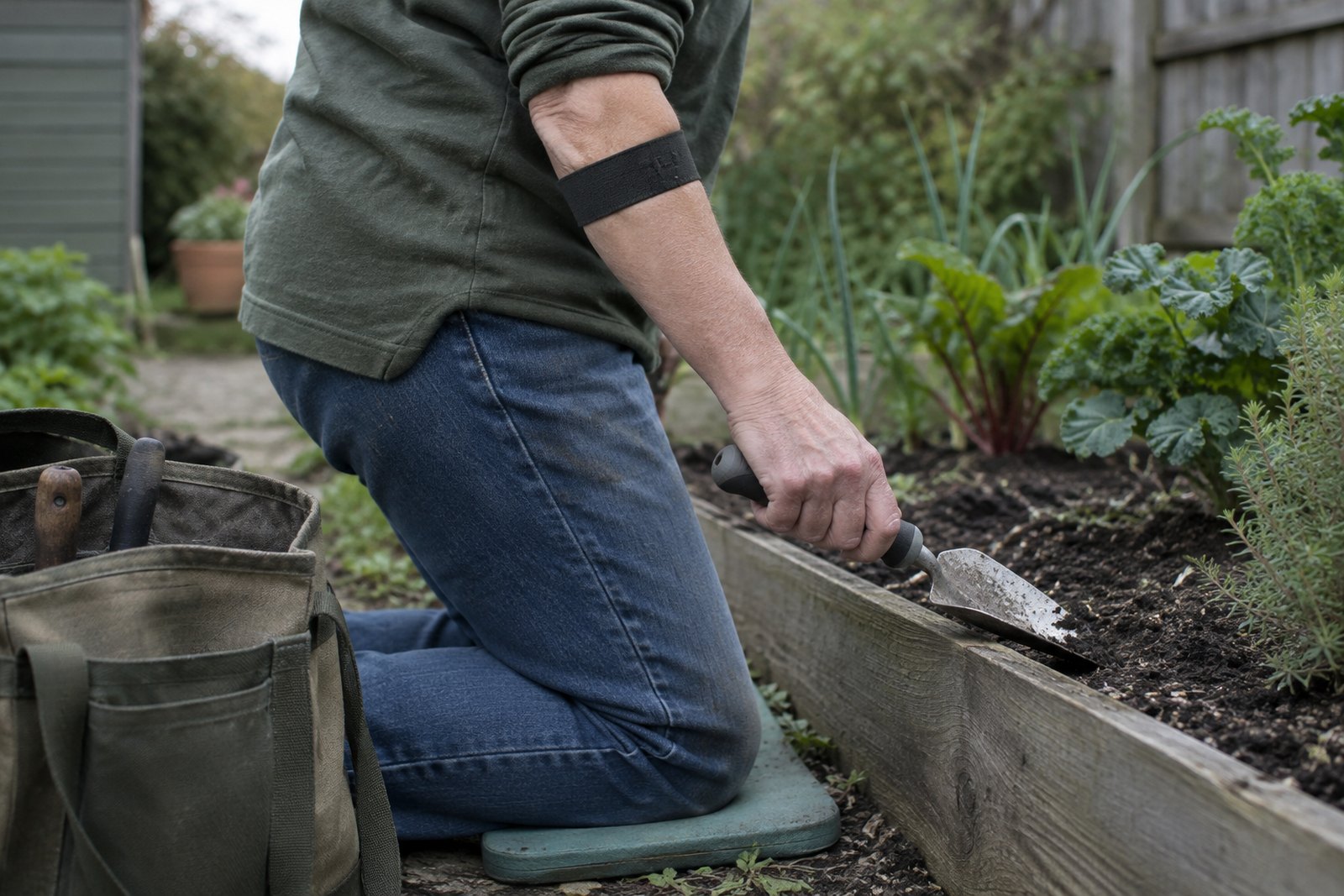
Golfer's elbow is pain on the inner side of the elbow, on the bony bump nearest your body when your palm faces forward. Its medical name is medial epicondylitis. It happens when the forearm muscles that bend your wrist, grip things and turn your palm down are overloaded, and the tendons where they attach to that bump become irritated and sore. Despite the name, most people who get it have never swung a golf club. Gripping tools, carrying heavy bags, gardening, lifting weights, using a mouse with a bent wrist or carrying a toddler on one arm all day can do it.
The honest headline is that it usually gets better, though it often takes months rather than weeks. What helps most is easing the load on those tendons without stopping using your arm altogether, then building strength back gradually. A physiotherapist leads on the exercise side. Small changes to how you grip, lift and work make a real difference, and that is where most of this article goes. If you have numbness or tingling in your ring and little fingers, real weakness, swelling, or pain that started with an injury, see your GP rather than managing it alone.
What golfer's elbow feels like
It tends to creep up over days or weeks rather than arriving all at once. Typical signs include:
- An ache or burning pain on the inner elbow, sometimes spreading down the inside of the forearm towards the wrist
- Pain when you grip, squeeze or carry something, such as a kettle, a shopping bag or a spanner
- Pain when you shake hands, turn a stiff door handle or wring out a cloth
- Stiffness first thing in the morning that eases as you get moving
- A weaker grip, or dropping things more than usual
- Tenderness when you press on the bony bump itself
Golfer's elbow, tennis elbow and RSI
Tennis elbow is the same kind of problem on the outer side of the elbow, affecting the muscles that lift the wrist back. Golfer's elbow is the inner side. You can have both. Both sit under the wider umbrella of overuse problems, and if your pain started at work it is worth reading our guide to repetitive strain injury at work, because the same principles apply.
Why it happens, and why it is rarely just golf
Tendons cope well with load they are used to. What they dislike is a sudden increase, or the same movement repeated for long periods without a break. Golfer's elbow often follows a change: a new job, extra shifts, a weekend of decorating, a new gym routine, a garden that suddenly needed clearing, or a new baby who needs carrying everywhere.
Common culprits include:
- Trades that involve a lot of gripping and twisting, such as joinery, plastering, plumbing and building work
- Kitchen work, cleaning, hairdressing, care work and warehouse picking
- Long days at a keyboard and mouse with the wrist bent or the hand clenched
- Gardening, especially pruning, digging and pulling weeds
- Climbing, weight training (pull-ups and curls in particular), racquet sports and, yes, golf
- Playing an instrument, knitting or other fine hand work for hours at a time
- Lifting and carrying children, car seats or heavy shopping
Working out what overloaded your arm is the most useful thing you can do, because that is what you need to change.
Daily changes that take the strain off
None of this is complicated. The aim is to make every grip, lift and twist ask a little less of those forearm muscles, so the tendons get a chance to settle.
Make grips bigger and softer
A thin handle makes you squeeze harder than a thick one. Building up handles spreads the effort and reduces the grip force you need. Foam tubing slipped over cutlery, pens, toothbrushes and garden tools works well. Look for tools with fat, padded or cushioned handles, and choose thicker pens. If you hold something tightly out of habit, practise holding it as loosely as you safely can.
Lift differently
- Use two hands wherever you can, and keep the load close to your body with your elbows bent.
- Avoid lifting with your arm stretched out in front of you. The further away the load, the harder your forearm works.
- Experiment with how you hold things. Some people find a palm-up grip with the elbow bent eases the pain; others find a thumb-up grip easier. Notice which hurts less for you and use that.
- Split loads. Two half-full bags, one in each hand, are kinder than one heavy one. Better still, use a trolley or a bag on wheels.
- Fill the kettle with only what you need, and slide heavy pans along the worktop rather than lifting them.
Let tools do the work
Anywhere you are twisting or squeezing hard, there is usually an easier way. A powered screwdriver instead of a manual one. A ratchet instead of a spanner. A sharp knife instead of a blunt one. A jar opener, lever taps, a long-handled dustpan, a lightweight vacuum. In the garden, long-handled tools used with both hands spread the load, and ratchet pruners need far less grip than standard secateurs.
Break up repetitive work
Short, frequent breaks help more than one long one. Every 20 to 30 minutes of gripping or typing, stop for a minute, let your hands relax and gently move your wrists. Alternate heavy tasks with lighter ones. Swap hands for simple jobs if you can. Spread big jobs across the week rather than doing everything on a Saturday.
At a desk
Keep your wrists roughly straight rather than bent up, down or sideways. Bring the mouse close so you are not reaching, and try not to clench it. Your keyboard should be around elbow height with your shoulders relaxed. Learning a few keyboard shortcuts cuts down mouse clicks. If you are employed, you can ask your employer for a workstation assessment.
Hobbies and sport
You do not necessarily have to give up what you enjoy, but you may need to do less of it for a while and do it differently. A coach can check your golf swing, racquet grip or lifting technique. In the gym, lighter weights, wider grips and fewer sets of pulling exercises give the tendon a rest. For gardening, little and often beats a long session.
Rest, but not too much
Resting the arm completely sounds sensible but is rarely what tendons need. Total rest tends to leave them weaker and more easily irritated when you return to normal life. What usually works is relative rest: cutting back the activities that clearly make it worse, while keeping the arm moving for everyday things.
A useful rule of thumb is that mild discomfort during an activity, which settles within a day, is generally acceptable. Sharp pain, or pain that is worse the next morning, means you did too much and need to scale back. Some people find a cold pack wrapped in a towel for a few minutes eases a flare. Never put ice straight onto skin. A pharmacist can advise you on pain relief that suits you.
Exercises: gradual loading, gently
The exercise approach for golfer's elbow is about slowly teaching the tendon to cope with load again. It is best taught by a physiotherapist or hand therapist, who can check your technique, set the right starting level and adjust it as you improve. To give you an idea of what this usually looks like:
- Holding exercises. Resting your forearm on a table, palm up, you press your hand upwards against your other hand or a fixed surface without actually moving the wrist, and hold for a short count. These often feel comfortable even when the elbow is sore.
- Slow lowering. Later, holding something light such as a small tin, you slowly lower the wrist down and use your other hand to help it back up. The slow lowering part is what does the work.
- Grip work. Gently squeezing a soft ball or therapy putty, building up gradually.
- Gentle stretches. With your arm straight in front of you and palm facing up, you ease the fingers and wrist back with your other hand until you feel a mild stretch along the inner forearm.
Expect it to feel a little uncomfortable at times, but not sharply painful. Progress is slow and steady, usually over weeks. If an exercise brings on numbness, tingling or pain that lingers, stop and get advice. In many parts of England you can refer yourself to NHS physiotherapy without seeing a GP first; your GP surgery or local NHS website will tell you how it works where you live.
Braces, straps and splints
Two kinds of support are common. A forearm strap, sometimes called a counterforce brace, is a band worn around the upper forearm just below the elbow. The idea is to take some of the pull off the sore spot. A wrist splint worn at night keeps the wrist straight so the muscles are not held bent for hours while you sleep.
Some people find these helpful and others notice little difference. If you try one, it should feel snug, not tight, and should never cause tingling, numbness or colour change in your hand. Think of a support as an aid while you make other changes, not a way of carrying on doing the thing that caused the problem.
How long it takes
Most people find golfer's elbow settles over several months, though for some it takes longer, and it can come back if you return to heavy or repetitive work too quickly. The people who recover fastest tend to be the ones who find and change the cause early, rather than pushing through for weeks first.
If you have made sensible changes for a few weeks and things are not improving, or the pain is stopping you working or sleeping, see your GP or a physiotherapist. Your GP may talk to you about other treatment options. Surgery is only considered occasionally, when other approaches have not worked over a long period.
When to see a GP, call NHS 111 or call 999
See your GP if:
- You have numbness, tingling or pins and needles in your ring and little fingers. This can mean the ulnar nerve, which runs past the inner elbow, is involved.
- Your hand or grip is getting noticeably weaker, or you are struggling with fine tasks like buttons
- The pain is not improving after a few weeks of changes, or it is getting worse
- The pain is there at rest and at night, not just when you use your arm
Get urgent advice from NHS 111 or your GP the same day if: the elbow is hot, red and swollen, especially if you feel unwell or feverish.
Go to A&E or an urgent treatment centre if: the pain started with a fall or injury, the elbow looks a different shape, it swelled quickly, or you cannot bend or straighten it.
Call 999 if: arm weakness or numbness comes on suddenly with a drooping face or slurred speech, or arm pain comes with chest pain, breathlessness or sweating.
Who helps: GP, physiotherapist, hand therapist and occupational therapist
Plenty of people get through golfer's elbow with no professional help at all. When you do need someone, it helps to know who does what.
Your GP confirms what is going on, checks for nerve problems or other causes, and can issue a fit note if you need time off or changes at work.
A physiotherapist leads on treatment for most people: assessment, the loading exercise programme and advice on getting back to sport. Our guide to the difference between an occupational therapist and a physiotherapist explains how the two roles overlap and differ.
A hand therapist is an occupational therapist or physiotherapist with specialist training in hands, wrists and elbows. They can provide splints, exercise programmes and advice, and are especially useful if the problem is stubborn or nerve symptoms are involved. Our article on hand therapy at home covers what this involves.
An occupational therapist is most useful when the problem is tangled up with how you work or live. A private occupational therapist visiting at home or at your workplace can look at exactly how you do your job, your hobbies or your housework, and find the specific grips and movements that keep setting it off. They can suggest adapted tools and equipment, rethink how a task is done, plan your days so the heavy jobs are spread out, set up your workstation, and write a report your employer can use to make reasonable adjustments or plan a gradual return. You can read more about how they help with hand and upper limb problems. An occupational therapist does not replace your GP or physiotherapist, and for straightforward golfer's elbow they are not usually the first person you need.
Frequently asked questions
Is golfer's elbow the same as tennis elbow?
They are the same kind of overuse problem in different places. Golfer's elbow is on the inner elbow and affects the muscles that bend the wrist and grip. Tennis elbow is on the outer elbow and affects the muscles that lift the wrist back. The self-help approach is similar for both.
Can I keep working with golfer's elbow?
Usually, yes, although you may need changes for a while, such as lighter tasks, more breaks, different tools or fewer hours on the hardest jobs. Talk to your manager early. If you need time off or adjustments, your GP can issue a fit note with suggestions, and your employer may refer you to occupational health.
Should I stop using my arm completely?
No. Complete rest tends to leave the tendon weaker. Cut back on whatever clearly makes it worse, keep using the arm for everyday things, and build up strength gradually, ideally with guidance from a physiotherapist.
Does a forearm strap work?
Some people find one helps, especially during tasks they cannot avoid. Others notice little difference. If you use one, wear it just below the elbow, snug but never tight enough to cause tingling or numbness, and do not rely on it alone.
Do I need a scan?
Most people do not. Golfer's elbow is usually diagnosed from your symptoms and an examination. Your GP may suggest tests if the picture is unclear, there are nerve symptoms, or it is not improving as expected.
Can I still play golf or go to the gym?
Often, with changes. Reduce how much and how hard you play or train for a while, check your grip and technique with a coach, and build back up slowly. If a session leaves you sorer the next day, scale back.
Next steps
If your elbow pain is tied up with your job, your tools or the way you manage tasks at home, an occupational therapist can look at it with you in person. See our work and ergonomics page, or current guide prices, and choose your area below.

Talk to an occupational therapist near you
This guide is general information. For advice about your own situation - or someone you look after - a local occupational therapist can visit you at home and see it for themselves.
Choose your area: