

Foot Drop: Daily Life, AFO Splints and Avoiding Trips at Home
By Mobile Occupational Therapist • 2 November 2026 • 14 min read
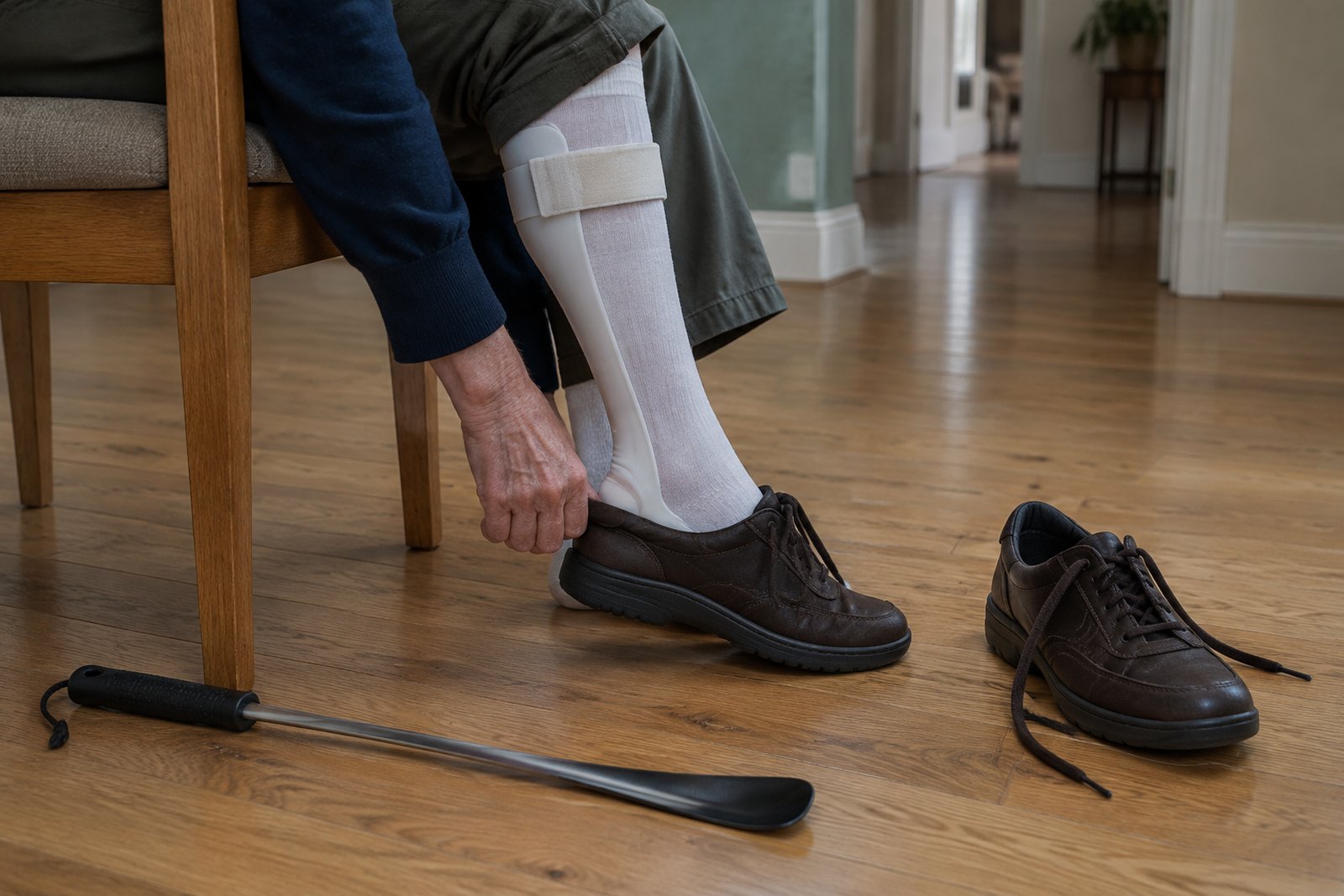
Foot drop, also called drop foot, means you cannot lift the front of your foot properly as you walk. The toes point down when they should come up, so they drag, scuff or catch on the floor, a carpet edge or a kerb. Many people notice it first as a trip they cannot explain, or a slapping sound as the foot lands.
Foot drop is a sign, not a diagnosis. Something is affecting the muscles that lift the foot, or the nerves and brain that control them, and a doctor needs to find out what. Once that is under way, most people manage day to day with a splint called an ankle-foot orthosis (AFO), sometimes with electrical stimulation, plus sensible changes to shoes, floors and stairs. This guide covers all of it. If your foot drop came on suddenly, read the urgent section below first.
What foot drop actually is
When you walk normally, the muscles at the front of your shin pull the foot up as your leg swings forward, so your toes clear the ground. With foot drop, that lift is weak or missing. The foot hangs down.
Your body tries to compensate, often without you realising. You might lift your knee higher than usual, as if climbing a step. You might swing the leg out to the side, or hitch your hip up. These tricks work up to a point, but they are tiring, they can cause aches in the hip and back, and they fail when you are tired, distracted, in the dark or on uneven ground. That is when most trips happen.
Foot drop can affect one foot or both, and it can be mild (you catch your toe now and then) or severe (the foot hangs and you cannot walk safely without support).
What causes it, and why a doctor needs to find out
There are a lot of possible causes, and they need very different treatment. The common ones include:
- A nerve injury at the knee. The nerve that controls lifting the foot runs close to the skin on the outside of the knee, just below it. It can be pressed or damaged by a knee injury, surgery, a tight plaster cast, long periods kneeling or squatting, or habitually crossing your legs, especially after weight loss.
- Back problems. A slipped (herniated) disc or narrowing in the lower spine can press on a nerve root that supplies the foot.
- Stroke. Foot drop is common on the weaker side after a stroke.
- Multiple sclerosis (MS). It may come and go, and often gets worse with fatigue or heat.
- Motor neurone disease (MND). Foot drop is sometimes an early sign.
- Other causes, including peripheral neuropathy (for example from diabetes), some inherited nerve conditions, brain injury, cerebral palsy and some muscle diseases.
Some causes improve on their own or with treatment, some stay the same, and some change over time. That is why guessing is a bad idea, and why a splint bought online before anyone has looked at you can mask something that needed attention. See your GP. They may examine you, arrange tests or refer you to a neurologist, orthopaedic specialist or physiotherapist.
When it is urgent
Call 999 if foot drop or leg weakness comes on suddenly alongside any sign of a stroke: a face drooping on one side, weakness in an arm, or slurred or muddled speech. Do not wait to see if it passes.
Call 999 or go to A&E if you have foot drop or leg weakness with back pain and any of these: numbness around your bottom or genitals, new problems passing urine or controlling your bladder or bowels, or weakness in both legs. These can be signs of cauda equina syndrome, which needs emergency treatment.
For any other new foot drop, even without pain, contact your GP the same day or call NHS 111. New weakness always deserves a prompt look.
Splints: ankle-foot orthoses (AFOs)
An AFO is a brace that holds your foot up at a better angle, so the toes clear the floor as you step. Most are made of thin moulded plastic or carbon fibre. They run up the back of the calf, cup the heel and sit under the foot inside your shoe, with a strap across the shin.
There are several types. Some are rigid and hold the ankle firmly. Some are hinged, allowing a bit of movement. Some are flexible and spring back to lift the foot. Some are off the shelf and some are custom-made from a cast or scan of your leg. Which one suits you depends on the cause, how strong your other muscles are, whether your foot rolls in or out, your skin and what you need to do in a day. That decision belongs to an orthotist, the professional who assesses for, prescribes and fits orthoses.
How to get one
On the NHS, AFOs usually come through a hospital orthotics service. You normally need a referral from a GP, physiotherapist or consultant, and the process can take a while, so ask early. Private orthotists also exist. Either way, the fitting matters: a badly fitting AFO can rub, cause sores or make your walking worse.
We have a separate, detailed guide on living with an AFO day to day. The short version:
- Wear a long, smooth sock that comes higher than the top of the splint, with no thick seams or wrinkles under it.
- Build up wearing time gradually if your orthotist advises it.
- Check your skin every time you take it off. Red marks that do not fade soon after, blisters or broken skin mean the fit needs looking at. Stop wearing it and contact the orthotics service.
- Check your skin even more carefully if you have reduced feeling in your feet, because you may not feel a sore developing.
- Go back if anything changes: swelling, weight change, new pain, or the splint cracking.
Functional electrical stimulation (FES)
FES is a different approach. A small battery device sends gentle electrical pulses through pads on the skin (or, more rarely, an implant) to the nerve that lifts the foot. It is timed to your walking, usually by a sensor in the shoe or on the leg, so the muscles lift your foot at the right moment as you step.
It is mainly used when the problem comes from the brain or spinal cord, as in stroke, MS, brain injury or some spinal cord conditions, and when the nerve and muscles in the leg can still respond. It is not suitable for every cause. NICE has guidance on FES for drop foot of this kind. Availability on the NHS varies by area, and it is usually assessed and set up by a specialist physiotherapy or rehabilitation team. Ask your physiotherapist or consultant whether you might be suitable. Some people use FES and an AFO for different situations.
Shoes that work with an AFO
This is where many people get stuck. You get your splint, go home and discover none of your shoes fit over it. Things to look for:
- An opening that goes low down towards the toes, so you can get your foot and splint in without forcing it. Lace-ups and touch-fastening straps are easiest.
- Depth and width. Many people need to go up a half or full size, or buy a wider fitting. Some buy different sizes for each foot.
- A removable insole. Taking it out often creates the space the splint needs.
- A low, broad heel and a firm back that holds your heel in place. A shoe with a high heel changes the angle and can undo what the splint is doing.
- A sole with grip but not too much. Very sticky soles can catch on carpets, which is the last thing you need.
Always try shoes on with the splint and the sock you will wear. Walk around the shop. And yes, slippers are a common problem: backless slippers and loose mules are a trip hazard even without foot drop. A supportive, closed shoe for the house is safer.
Trip-proofing your home
Foot drop turns small hazards into real ones. A rug edge you have stepped over for twenty years is suddenly exactly the height your toe catches. Walk your usual routes, especially bedroom to bathroom and the route to the front door, and look at the floor.
- Rugs and mats. Remove loose rugs where you can. Door mats should be flat, heavy and ideally sunk into a recess or replaced with a thin mat that does not curl.
- Carpet edges and thresholds. Raised door strips between rooms are classic toe-catchers. Low, gently sloped threshold strips are available, and a handyperson can often lower or replace them.
- Cables. Move them to run along walls or behind furniture. Do not run them across walkways.
- Clutter. Shoes, bags, laundry baskets and pet bowls on walkways. Give them a home that is not the floor.
- Lighting. Many trips happen at night. Plug-in night lights or motion-sensor lights on the route to the toilet help. Have a light switch you can reach from bed.
- Wet floors. Bathrooms and kitchens. Wipe spills at once and consider non-slip flooring if a room is being redone.
- Pets. Small dogs and cats under your feet are a hazard. Know where they are before you move.
The night-time toilet trip deserves special thought. Most people do not put their AFO on to go to the loo at 3am, so they walk with an unsupported foot, half asleep, in dim light. Options include keeping the route completely clear and lit, sitting on the edge of the bed for a moment before standing, using a walking aid you keep within reach, or in some cases a commode or urinal at night for a while. Talk this through with your physiotherapist or occupational therapist rather than just hoping.
For more on reducing falls generally, see our guide to falls at home beyond exercise.
Stairs
Going up, the risk is the toe catching on the front edge of the step. Coming down, it is the foot landing badly or the heel slipping off the edge. Some practical points:
- Rails on both sides make a real difference. A second banister is often one of the most useful changes you can make.
- Up with the good, down with the bad. Going up, step first with your stronger leg. Coming down, lead with the weaker leg. Your physiotherapist can confirm the right pattern for you.
- Good lighting at top and bottom, with switches at both ends.
- A contrasting strip on each step edge makes it easier to see where the step ends, especially if your eyesight is also affected.
- Do not carry things on the stairs if it means you cannot hold the rail. Keep a basket at the top and bottom, or a bag you can wear.
- Avoid stairs in socks or bare feet, and do not leave items on steps to take up later.
If stairs are becoming genuinely unsafe, an assessment can look at rails, half steps, moving your bed downstairs or, in time, a stairlift.
Getting dressed with an AFO
Putting on a splint, sock and shoe takes longer than you would think, especially if your hands are also affected. A routine helps:
- Sit down in a stable chair with arms, feet flat on the floor. Never dress standing on one leg.
- Put your trousers on the weaker leg first, before the splint, unless they are too narrow at the ankle to go over it later.
- Pull the long sock on smoothly. A sock aid can help if you cannot reach.
- Many people find it easiest to put the AFO into the shoe first, loosen the laces fully and open the tongue, then slide the foot in together. Others put the splint on the leg and then the shoe. Try both.
- Use a long-handled shoe horn to ease your heel down into the back of the splint and shoe.
- Make sure your heel is right at the back before you fasten anything. A heel sitting too high is the most common reason a splint rubs.
- Fasten the strap, then the shoe. Elastic laces or touch-fastening shoes save effort.
If fatigue is part of the picture, as it often is after a stroke or with MS, it can be worth getting dressed sitting down in a quieter part of the day rather than rushing first thing.
Driving
Foot drop can affect pedal control, particularly if it is your right foot. You must tell the DVLA if you have a medical condition or disability that may affect your driving, and you should tell your insurer about any medical condition or car adaptation that affects your driving. The rules depend on the condition, so check on GOV.UK and ask your doctor.
Many people do return to driving, sometimes with an automatic car or adaptations such as a left-foot accelerator. Accredited driving mobility centres around the UK offer assessments and can advise on what is needed. Do not simply assume you can drive wearing an AFO: some restrict the ankle movement you need for the pedals, so ask your orthotist and get properly assessed if in doubt.
Where an occupational therapist fits
Let us be clear about who does what. A doctor finds the cause. An orthotist fits the splint. A physiotherapist leads on walking, strength, balance and stretching, and often on FES. If foot drop is part of a wider condition, a neurologist or specialist nurse may coordinate your care.
An occupational therapist looks at how you manage your actual life with it. A home visit can include:
- Walking your routes at home and spotting the specific trip hazards, including the night-time ones.
- Assessing stairs, the bathroom, getting in and out of the bath or shower, and the kitchen, and recommending rails, equipment or adaptations.
- Working out a dressing routine with the splint, sock and shoes, and suggesting equipment if reach or grip is a problem.
- Helping with fatigue and pacing, which often decide whether you trip in the afternoon.
- Looking at work, hobbies and getting out, and helping you plan a return.
- Writing reports to support applications for adaptations, grants or benefits.
If your foot drop follows a stroke, our guide to one-sided weakness after a stroke covers the wider picture. If it is part of MS, see living with multiple sclerosis at home.
Frequently asked questions
Will foot drop go away?
It depends entirely on the cause. Foot drop from a pressed nerve at the knee or a disc problem can improve as the nerve recovers, though this can take months. After a stroke, some people regain strength with rehabilitation. With progressive conditions it may stay or change over time. Your doctor or physiotherapist is the right person to ask about your own outlook.
Can I get an AFO on the NHS?
Yes, AFOs are provided through NHS orthotics services. You usually need a referral from your GP, physiotherapist or consultant. Ask about a referral early, because waits vary from area to area.
Should I buy an off-the-shelf foot drop splint online?
Not before you have had the cause checked and spoken to a physiotherapist or orthotist. A splint that does not suit your foot can rub, make walking harder or cover up a problem that needs treatment. Some people are prescribed an off-the-shelf splint, but that choice is best made by someone who has examined you.
Do I need to wear my AFO all the time?
Usually it is worn when you are on your feet, but follow the instructions you were given. Splints for walking are different from splints worn at night to stretch the calf. If you are unsure, ask your orthotist.
Is FES better than an AFO?
Neither is simply better. FES suits some people whose foot drop comes from the brain or spinal cord, and some prefer how walking feels with it. An AFO is simpler and works for a wider range of causes. Some people use both. A specialist assessment will tell you what is realistic.
What are the best shoes for foot drop?
Look for closed shoes with an opening that goes low towards the toes, lace or touch fastening, enough depth and width for the splint, a removable insole and a low heel. Try them on with your splint and sock before buying.
Next steps
If trips, stairs or dressing are getting harder, a home visit can help you make practical changes that fit your life. See our home assessment and neurological occupational therapy pages, or current guide prices, and choose your area below.

Talk to an occupational therapist near you
This guide is general information. For advice about your own situation - or someone you look after - a local occupational therapist can visit you at home and see it for themselves.
Choose your area: