

Fire Safety for Older and Disabled People: A Practical Home Guide
By Mobile Occupational Therapist • 6 October 2026 • 13 min read
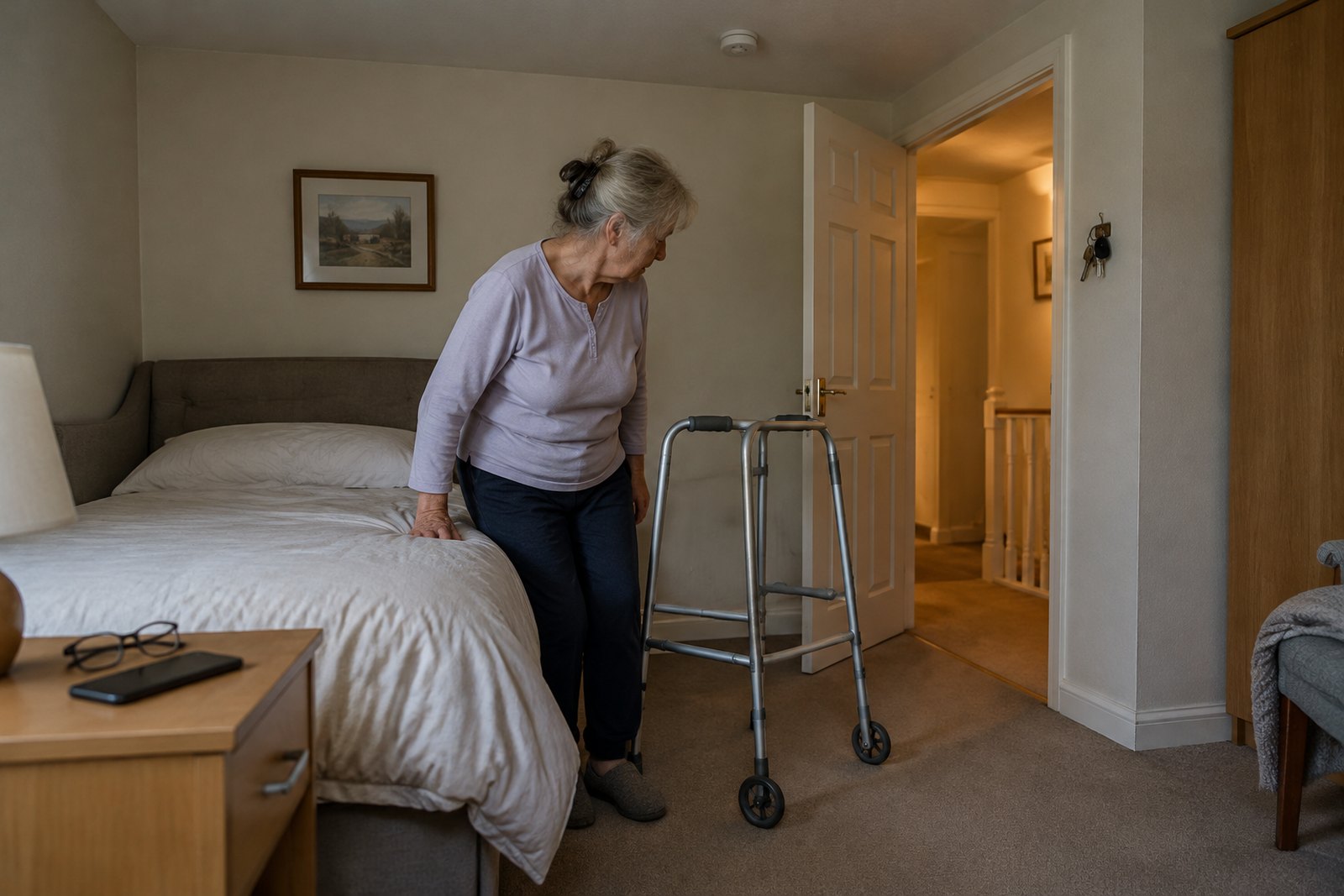
If you or someone you care for is older, disabled or slower to move than they used to be, fire safety at home comes down to three things. Know about a fire as early as possible. Be able to get out, or stay safe until help arrives. Cut down the things most likely to start one. The single most useful step for most people costs nothing: book a home fire safety visit from your local fire and rescue service.
Most fire and rescue services in the UK offer these visits free, and they prioritise people at higher risk. That usually includes older people, people who live alone, people with limited mobility, people who are deaf or have sight loss, people who smoke and people using home oxygen. Many services call them Safe and Well visits. You can usually book on the fire service's website or by phone, and you can book for a parent or neighbour with their agreement. What is offered varies by area, so check your own service. The rest of this guide covers what you can sort out today, and what to ask about when they come.
Book a home fire safety visit
Search for your local fire and rescue service by name and look for home fire safety, Safe and Well, or home safety check. Someone will walk round the home, check the alarms, talk through how you would get out, and point out the risks they spot. In many areas they can fit smoke alarms free, and some can provide specialist equipment for people at highest risk, such as alarms for deaf people or fire-retardant bedding and throws.
They are not there to judge the state of the house. They have seen everything. What helps them most is honesty. If mum smokes in her chair at night, uses oxygen, puts on a lot of emollient cream or has started leaving pans on the hob, say so. That is exactly the information that changes what they recommend.
Smoke alarms: enough of them, in the right places, actually working
A smoke alarm only helps if it works and the person can hear or notice it. The basics:
- At least one on every level of the home, usually in the hallway and on the landing. It is also worth having one in the room where the person sleeps and in the main living room, especially if they nap or smoke there.
- A heat alarm in the kitchen rather than a smoke alarm. Smoke alarms in kitchens go off at every slice of toast and end up being taken down, which is worse than useless.
- Test them at least once a month. If reaching the ceiling is hard, press the test button with the end of a broom handle, or ask someone else. Nobody should be climbing on a chair to do it.
- Check the date. Alarms do not last forever. Many newer ones have a sealed long-life battery and are replaced as a whole unit at the end of their life. The date and instructions are on the alarm itself.
- A carbon monoxide alarm in any room with a gas, oil, coal or wood-burning appliance such as a boiler, gas fire or stove. Carbon monoxide has no smell and a smoke alarm will not detect it.
Linked alarms
Interlinked alarms talk to each other, so when one goes off they all go off. This matters if the person sleeps downstairs and a carer sleeps upstairs, if the house is large, or if a fire could start in a room nobody is in. They come as mains-wired systems, which need an electrician, or radio-linked battery systems that are simpler to fit.
The rules differ across the UK
In Scotland, all homes are now required to have interlinked smoke and heat alarms, plus a carbon monoxide alarm where there is a carbon-fuelled appliance. In England, private and social landlords must fit a smoke alarm on every storey used as living space and a carbon monoxide alarm in rooms with a fixed combustion appliance. Wales and Northern Ireland have their own rules. If you rent, alarms are largely your landlord's responsibility. Check the current position on GOV.UK, mygov.scot, GOV.WALES or nidirect.
Alarms for people who are deaf or hard of hearing
A standard alarm is no use to someone who takes their hearing aids out at night, and plenty of people with mild hearing loss sleep straight through one. There are alarm systems designed for this: a vibrating pad that goes under the pillow or mattress, often with a bright flashing strobe light, triggered when the smoke alarm sounds. Some link to the household's ordinary alarms so the whole system works together.
Ask your fire service first, as many supply these to people who need them. Your council's sensory services team may also be able to assess and provide equipment. Our guide to hearing loss equipment for doorbells, phones and alarms explains the options in more detail.
An escape plan that fits how you actually move
The standard advice is get out, stay out and call 999. It assumes you can get out quickly. If you use a frame, take ten minutes to get out of bed, or rely on someone else to help you move, the plan has to be built around that. Think through these:
- Where the person sleeps. If stairs are slow or impossible, sleeping downstairs near an exit can make a real difference. A ground floor room close to the front door is ideal.
- Keys by the door. Keep keys for every exit door in one agreed place near that door, so nobody is hunting for them in smoke. Some people swap a key-operated lock for one with a thumb-turn on the inside. Ask the fire service about this and check your home insurance.
- Phone by the bed. Charged, within reach, and with emergency numbers easy to find.
- Mobility aids within reach at night. Frame or stick by the bed, glasses and hearing aids where a hand can find them in the dark.
- Clear routes. Hallways and stairs are escape routes, not storage. Do not park or charge a mobility scooter where it would block the way out.
- Close internal doors at night. A closed door slows smoke and fire and buys time.
- A plan B. If you cannot get out, go to a room with a window and, ideally, a phone. Close the door, block the gap at the bottom with bedding or towels, call 999 and open the window to call for help. Tell the call handler exactly where you are in the house and that you have limited mobility.
Walk the route once in daylight. It is surprising what you notice, like the rug that catches the frame or the door that sticks.
If someone else has to help you out
Be honest about who that person is and where they are at 3am. A daughter who lives twenty minutes away is not an escape plan. For people who cannot get out alone, the plan often rests on very early warning, such as linked alarms or telecare that calls for help automatically, and on staying in a protected room until the fire service arrives. This is exactly the conversation to have during a home fire safety visit.
Home oxygen and smoking
Oxygen does not burn by itself, but it makes everything around it burn far more fiercely and quickly. Hair, clothes, bedding and skin creams can catch fire easily in an oxygen-rich atmosphere. If someone uses home oxygen:
- Never smoke, or let anyone else smoke, in the home where oxygen is used, even when it is switched off, as oxygen can stay in clothing, hair and bedding for some time. That includes e-cigarettes.
- Keep it away from naked flames, gas hobs, candles, open fires and heaters.
- Avoid oil-based creams and petroleum jelly on the face and lips. Ask the oxygen team or a pharmacist about water-based alternatives.
- Follow the safety advice from the oxygen supplier and ask whether they can refer you to the fire service for a visit.
If smoking continues in the home without oxygen, cut the risk as far as you can. Do not smoke in bed or when drowsy, use deep, heavy ashtrays that cannot tip, and make sure cigarettes are properly out. Our guide to managing COPD and breathlessness at home covers daily life with oxygen more broadly.
Emollient creams: a risk most people have never heard of
This one surprises people. The UK medicines regulator, the MHRA, warns that emollient creams, lotions and ointments, both paraffin-based and paraffin-free, can soak into clothing, bedding, bandages and chair covers. The dried residue makes fabric catch fire more easily and burn faster. Washing at a high temperature may reduce the build-up but may not remove it completely.
The risk is highest for people who smoke, sit near heaters or open fires, use gas hobs, or cannot move away quickly if something catches. The answer is not to stop the cream, which often matters for skin health. Instead:
- Do not smoke, and keep away from naked flames and heaters.
- Change clothing and bedding regularly, and wash them often.
- Tell the fire service during a visit, as they may suggest fire-retardant bedding or throws.
- Ask the pharmacist or GP if you are unsure about the product being used.
Heaters, electric blankets and electrics
- Portable heaters. Keep them well away from curtains, bedding and furniture, never dry clothes on them, and switch them off when leaving the room or going to bed. Place them where a walking frame or a pet cannot knock them over.
- Open fires. Use a fireguard and have the chimney swept regularly.
- Electric blankets. Check for worn fabric, scorch marks, frayed wires or exposed elements. Do not use one with a hot water bottle. Switch it off before getting into bed unless it is designed for all-night use. Do not use one if bladder leaks are a problem. Some fire services offer blanket testing.
- Sockets and leads. Avoid overloading extension leads and running them under rugs.
- Chargers and batteries. Use the proper charger for scooters, powerchairs and phones, charge them in a safe place rather than an escape route, and do not leave things charging on beds or sofas. GOV.UK lists product safety alerts and recalls if you want to check an older item.
Cooking safely, especially with memory problems
Cooking is one of the most common ways house fires start. Some simple habits help:
- Do not leave pans unattended. Use a timer if attention wanders.
- Roll up loose sleeves and keep dressing gowns, tea towels and oven gloves away from the hob.
- Swap a traditional chip pan for a thermostatically controlled fryer, or oven chips.
- If a pan catches fire, never throw water on it. Turn off the heat only if it is safe to do so, get out, close the door and call 999.
When memory problems mean pans get forgotten, the answer is rarely to ban cooking outright. Options include automatic cooker shut-off devices, gas isolation valves, a heat alarm linked to a monitoring service, switching to a microwave for most meals, or cooking together at set times. Watch for warning signs like scorched pans, burnt food in the bin or a smell of smoke. If memory seems to be changing, see the GP first.
Hoarding and clutter
Large amounts of paper, clothes or other belongings add fuel, block escape routes and can make it much harder for firefighters to get in and find someone. Hoarding is not about being untidy, and forcing a big clear-out rarely works and often damages trust. Start with what matters most: a clear route from bed to front door, and clear space around the cooker, heaters and sockets. Fire services deal with hoarding regularly and many work with council teams. Our guide on how to help someone who hoards covers the gentler approach.
Personal alarms and telecare
A pendant alarm is useful if you fall, but an ordinary smoke alarm only makes noise inside the house. Telecare smoke and heat detectors are linked to a monitoring centre, which can call the fire service even if you cannot. Carbon monoxide detectors can be linked in the same way. These are available through council telecare services and private providers. A key safe can also let emergency services in quickly. Our guide to personal alarms and telecare explains what is worth having.
Where an occupational therapist fits
Let us be clear: the fire service leads on fire safety. They know alarms and fire risks, and in many areas they visit free. An occupational therapist is not a fire safety officer and does not fit alarms.
Where an occupational therapist helps is with how the person actually moves and manages in their own home. Can they get out of bed quickly? Manage the stairs in a hurry? Reach the door and work the lock? Notice an alarm? From there, an occupational therapist can recommend changes such as moving the bedroom downstairs, adjusting bed height or adding a rail so getting up is quicker, equipment and telecare, safer kitchen routines for someone with dementia, or evidence for rehousing if the current home cannot be made safe enough. Council occupational therapy through adult social care is free, though there may be a wait. A private occupational therapist visiting at home can usually come sooner.
Other people lead on other parts. The GP should look at new memory problems, the oxygen team handles oxygen safety, and council sensory services help with hearing and sight loss. The best results usually come from combining a fire service visit with an assessment of how the person moves day to day.
Frequently asked questions
Is a home fire safety visit really free?
In most areas, yes. Fire and rescue services usually prioritise people at higher risk, and the criteria and what they can provide vary from one service to another. Check your local fire service's website.
Can I book a home fire safety visit for my elderly parent?
Usually yes, as long as they agree. It helps if you can be there too, so you can mention risks they might play down and hear the advice first hand.
Should someone with limited mobility sleep downstairs?
It is often worth considering if stairs are slow, painful or risky, especially if they live alone. It is a big change for some people, so talk it through. A fire service visit or an occupational therapy assessment can help weigh it up.
Do I need to stop using emollient cream?
No. The advice is to keep using it if you need it, but to stay away from flames, heaters and smoking, and to change and wash clothing and bedding often. Ask your pharmacist or GP if you have questions about your product.
Who provides smoke alarms for deaf people?
Many fire services supply vibrating pad and strobe light alarms to people who need them. Council sensory services may also assess. If neither can help, you can buy them yourself.
What if someone with dementia keeps leaving the cooker on?
Speak to the GP if memory seems to be changing, and book a fire service visit. Automatic cooker shut-off devices, gas isolation valves and linked heat alarms can all reduce the risk without taking away cooking altogether.
Next steps
Book a home fire safety visit with your local fire service first. If you also want help working out how someone can get out of bed, move around and stay safe at home, see our home assessment page, or current guide prices, and choose your area below.
Talk to an occupational therapist near you
This guide is general information. For advice about your own situation - or someone you look after - a local occupational therapist can visit you at home and see it for themselves.
Choose your area: