

Living With COPD: Managing Breathlessness During Everyday Tasks
By Mobile Occupational Therapist • 4 October 2026 • 15 min read
If you are living with COPD, the hardest part of the day is often not a walk or a flight of stairs. It is getting washed and dressed. Lifting your arms, bending to your feet, standing in a steamy bathroom and holding your breath while you concentrate can leave you more breathless than almost anything else, and you have barely started the day.
The good news is that a lot can be done. Changing how you position yourself, how you breathe while you move, the order you do things in and what you do sitting down can make ordinary tasks noticeably easier. Pulmonary rehabilitation, which you can usually get through your GP, teaches much of this properly. This guide covers the practical side, room by room, plus home oxygen safety and the signs that mean you need help quickly.
Why everyday tasks leave you so breathless
With COPD, air gets trapped in the lungs and it is harder to breathe out fully. Anything that makes your body work harder, or that squashes your chest and tummy, makes this worse. A few things are especially hard work:
- Arms above your shoulders. Washing your hair, reaching into a high cupboard or hanging washing uses muscles that also help you breathe. When they are busy holding your arms up, they cannot help your breathing.
- Bending forward and down. Putting on socks or shoes or picking things up from the floor squashes your tummy against your lungs.
- Holding your breath. Most people do this without noticing while lifting, pulling or concentrating.
- Heat, steam and strong smells. Hot showers, cooking fumes, aerosol sprays and perfume can all set off coughing and breathlessness.
- Rushing. Doing a task quickly and then collapsing in a chair is far more tiring than doing it slowly with pauses.
Getting breathless when you are active is expected with COPD and is not usually harmful in itself, and avoiding activity altogether tends to make muscles weaker, which makes breathlessness worse over time. Breathlessness that is much worse than usual, or comes with chest pain or confusion, needs urgent help as described below. The aim is not to stop doing things. It is to do them in a way your lungs can keep up with.
Positions that ease breathlessness
When you get breathless, the right position can help you recover faster. These are the ones most people with COPD find useful. Try them when you are fairly well so they feel natural when you need them.
- Sitting and leaning forward. Sit with your feet flat, lean forward and rest your forearms on your thighs, or fold your arms on a table with a pillow on top. Let your shoulders drop.
- Standing and leaning forward. Lean your forearms on a kitchen worktop, the back of a sturdy chair or a windowsill. This is handy in the middle of a task.
- Standing and leaning back. Rest your back and hips against a wall with your feet slightly away from it, arms loose by your sides.
- Lying on your side. In bed, lie on your side propped up on several pillows, with your top shoulder relaxed and your knees slightly bent.
A small handheld fan blowing cool air across your face can also help the feeling of breathlessness settle. Many people keep one by the bed, in the living room and in a bag.
Breathing control while you move
Breathing techniques are best learned from a respiratory physiotherapist or on a pulmonary rehabilitation course, because they can watch you and correct small things. In general terms, the ones people use most are:
- Relaxed, gentle breathing. Breathing in gently through your nose, letting your tummy rise, with your shoulders and upper chest relaxed. This is what you return to when recovering.
- Pursed-lip breathing. Breathing in through your nose and out slowly through lips held as if you were about to whistle or blow out a candle. It helps empty your lungs and slows your breathing down.
- Blow as you go. Breathing out during the hardest part of a movement: as you stand up, lift, step up or push. Breathe in before the effort and out during it, rather than holding your breath.
- Paced breathing. Matching your breathing to your steps, for example breathing in for one step and out for two, which is useful on stairs and walking.
If you have not been taught these properly, ask your GP or practice nurse about pulmonary rehabilitation. It is one of the most useful things available for COPD and is covered further down.
Pacing and planning your day
Energy conservation sounds like something for a power station, but it simply means spending your energy where it matters most to you. Some practical ways to do it:
- Spread the heavy jobs out. Do not shower, change the bed and do the hoovering on the same morning. Put one bigger job on each day if you can.
- Work out your best time of day. Many people with COPD are slow and chesty first thing. If that is you, there is no rule saying you must wash first. Have breakfast, take your time, and wash later.
- Rest before you need to. Stopping for a minute halfway through a task is better than pushing on until you are gasping and need half an hour to recover.
- Break tasks into pieces. Make the bed in stages. Prepare vegetables in the morning and cook in the evening.
- Sit down whenever you can. Standing uses more energy than sitting. Ironing, chopping, washing up and grooming can all be done seated.
- Ask whether it needs doing at all. Towels do not need ironing. A robe can save drying yourself. A dishwasher, a delivery or a family member might take a job off the list entirely.
For a fuller explanation of pacing, which works in the same way for many long-term conditions, see our guide to fatigue management and pacing.
Washing, dressing and the bathroom
Getting washed
- Sit on a shower stool or shower chair rather than standing. Many people find a strip wash sitting at the basin easier than a shower on bad days.
- Keep the water warm rather than hot, and keep steam down: leave the door ajar, open a window or run the extractor fan, and do not let the room fill with mist.
- A handheld shower head lets you wash without lifting your arms high. A long-handled sponge helps you reach your back and feet without bending.
- Wash your hair separately, sitting at the sink or with the shower head, so you are not doing everything at once with your arms up. Rest your elbows on the edge of the basin.
- Instead of drying yourself with a towel, put on a towelling dressing gown and sit down for a few minutes. It does the work for you.
- Use unscented products where you can, and avoid aerosol deodorants and sprays.
Getting dressed
- Lay out your clothes the night before, within reach of where you will sit.
- Sit on a firm chair or the edge of the bed with your feet flat on the floor.
- Dress your bottom half first while sitting. Cross one leg over the other to reach your foot rather than bending straight down, or use a sock aid, long-handled shoehorn and elastic laces.
- Choose loose, front-opening tops and avoid tight waistbands, which press on your tummy and make breathing harder.
- Breathe out as you pull clothes over your head or lift your legs, and take a pause between each item.
On the toilet
Straining makes breathlessness worse. A raised toilet seat or a frame around the toilet makes standing up less effort, and keeping a small footstool in front of the toilet can make opening your bowels easier. If constipation is a regular problem, mention it to your GP or pharmacist.
The kitchen
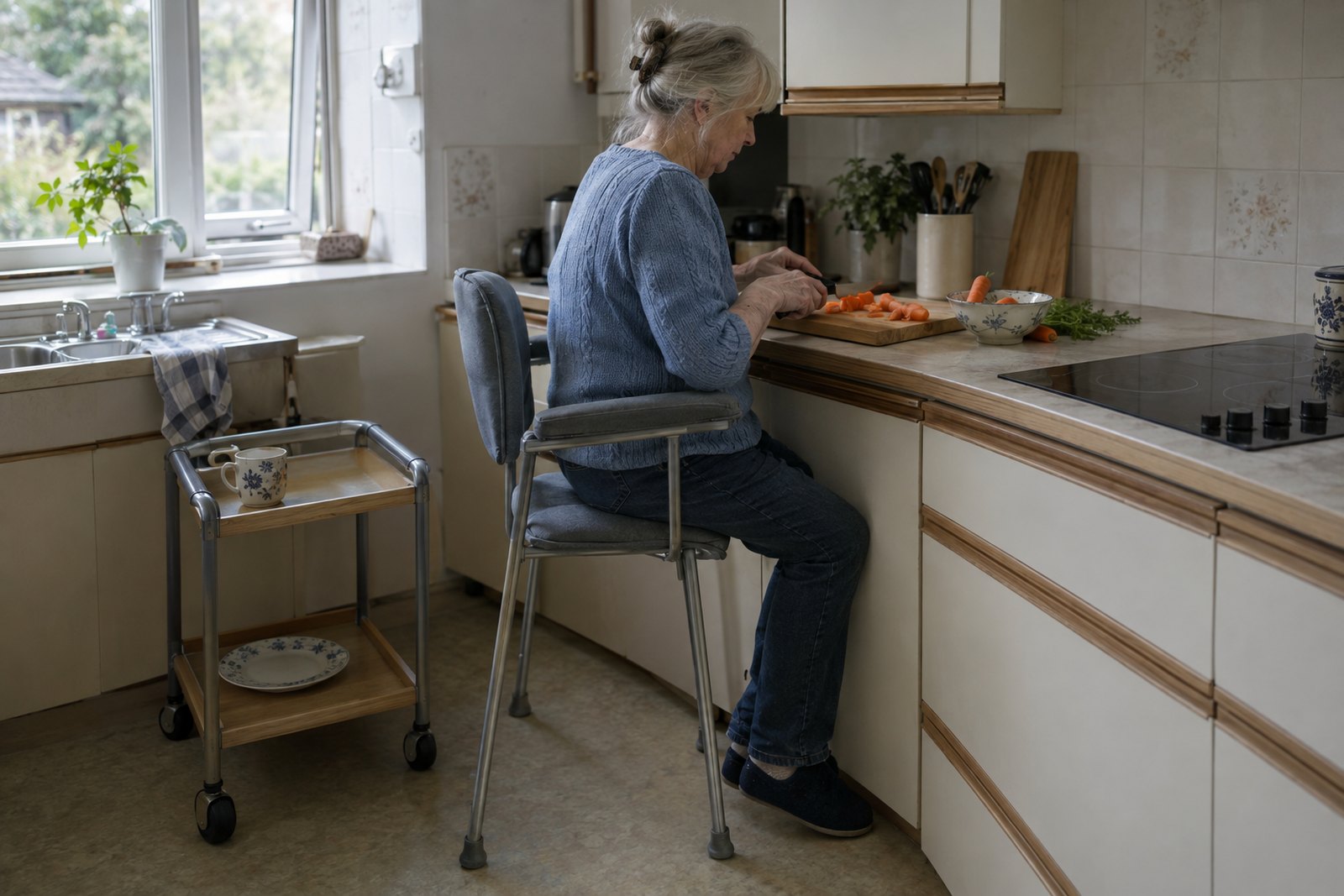
- Sit to prepare food. A perching stool, which is a tall seat that slopes slightly forward, lets you work at the worktop without standing. Our guide to perching stools explains who they suit and how to get one.
- Reorganise. Put the things you use every day between waist and shoulder height. Move heavy pans down from high shelves and up from low cupboards.
- Slide, do not carry. Push pans along the worktop. A sturdy kitchen trolley lets you move plates, drinks and food to the table without carrying them.
- Fill the kettle with less water or use a jug to fill it, so you are not lifting a heavy weight. A kettle tipper lets you pour without lifting at all.
- Cut down on fumes and heat. Use the extractor fan, keep lids on pans and open a window. Slow cookers and microwaves produce less steam and smell than frying.
- Cook once, eat twice. Make double portions on good days and freeze the rest for days when you are not up to it.
Eating can be breathless work too. Smaller meals more often are often easier than three large ones, because a full stomach presses upwards on your lungs.
Shopping and getting out
- Online grocery delivery takes the heaviest, most tiring errand out of your week completely.
- If you do go to the shops, go at quieter times so you can move at your own pace, and use a trolley rather than a basket. Leaning on the trolley handle puts you in a forward-lean position that helps breathing.
- Many larger shops have seating near the entrance or tills. Know where it is before you need it.
- A wheeled walker with a built-in seat gives you something to lean on and somewhere to rest wherever you are.
- If you are breathless walking any distance, a Blue Badge may be worth looking into. Your local council can tell you how to apply.
- Plan for cold weather. Cold air can trigger breathlessness, and loosely covering your mouth and nose with a scarf helps warm the air you breathe.
Stairs
Stairs are hard for almost everyone with COPD, but technique makes a real difference.
- Stand at the bottom and get your breathing settled before you start.
- Breathe in while standing still, then breathe out as you step up. One or two steps per breath out is fine. Slow and steady beats fast and gasping.
- Use the handrail. A second rail on the other side makes climbing safer and easier.
- Stop and rest as often as you need. Some people put a chair on the landing.
- Cut down on trips by keeping a few essentials both upstairs and downstairs, and using a bag or basket left at the bottom of the stairs to take items up in one go.
Our guide to managing stairs without a stairlift has more ideas, including when other options are worth considering.
Equipment that saves energy
None of this is essential, but the right piece of equipment in the right place can save a lot of effort. Commonly useful items include:
- A shower stool, shower chair or bath board
- A long-handled sponge and long-handled hairbrush
- A sock aid, long-handled shoehorn and elastic laces
- A perching stool for the kitchen or bathroom
- A kitchen trolley
- A long-handled grabber for picking things up
- A raised toilet seat or toilet frame
- A wheeled walker with a seat
- A riser recliner chair for people who find standing up very tiring
- A handheld fan
You may not need to buy all of this. Some items can be provided on loan after a council or NHS assessment; see our guide to community equipment services. Equipment works best when it has been chosen for your home and your body, which is where an assessment helps.
Home oxygen safety
If you have been prescribed home oxygen, it can make daily tasks much more manageable. It also brings a serious fire risk, because oxygen makes things burn far more fiercely.
- Never smoke, and do not let anyone smoke near you, while oxygen is in use. This includes e-cigarettes.
- Keep away from naked flames and heat: gas hobs, gas fires, candles, matches, lighters and open fires. Your oxygen supplier will tell you how far away to keep the equipment. Follow their guidance exactly.
- Avoid oil-based creams and petroleum jelly on your face and lips. Ask your pharmacist or oxygen team about water-based alternatives.
- Keep tubing tidy so it does not become a trip hazard, especially on stairs.
- Make sure your home has working smoke alarms. Your local fire and rescue service may offer a free home fire safety visit.
If you cook with gas and use oxygen, do not use the gas hob while your oxygen is on, and talk to your oxygen team before you next cook about how to cook safely. Do not adjust your oxygen flow yourself unless you have been told how to by the team that prescribed it.
When to get help urgently
Know the difference between your usual breathlessness and something more serious. If you have a self-management plan from your GP or respiratory team, follow it.
- Call 999 if you have severe breathlessness that is not easing with rest or your usual plan, chest pain, blue or grey lips or skin, confusion or unusual drowsiness, or you are struggling to speak in full sentences.
- Contact your GP or call NHS 111 the same day if you are more breathless than usual, coughing more, bringing up more phlegm or phlegm that has changed colour, or you feel you are having a flare-up.
Do not wait to see if a flare-up settles on its own. Getting help early can make a real difference.
Pulmonary rehabilitation
Pulmonary rehabilitation is a programme of exercise and education for people with lung conditions, usually run by physiotherapists, nurses and sometimes occupational therapists. It typically runs for several weeks in a group, though some areas offer home-based versions. It covers breathing techniques, exercise, managing flare-ups and many of the energy-saving ideas in this guide.
Ask your GP, practice nurse or respiratory team for a referral. In some areas you can refer yourself. If you were offered it before and turned it down, or did not finish, it is fine to ask again.
Where an occupational therapist fits
Your GP, practice nurse and respiratory team lead on your medical care, including inhalers, medication, flare-ups and oxygen. Respiratory physiotherapists teach breathing techniques and ways to clear phlegm, and usually run pulmonary rehabilitation. A pharmacist can check your inhaler technique. An occupational therapist does not replace any of them.
What an occupational therapist does is look at the practical side: how you manage the tasks that matter to you, in your own home. A visit usually involves watching how you get washed, dressed, cook, use the toilet and get around, and then suggesting ways to make those tasks easier. That might mean changing the order of your routine, reorganising the kitchen, recommending equipment and showing you how to use it, or advising on adaptations such as an extra stair rail or a level-access shower.
The NHS and councils provide occupational therapy, but waits vary and it may focus on safety rather than energy. A private occupational therapist visiting at home can spend time on the detail of your routine and on what you want to keep doing. Our independence for older people page explains more about the kind of help available.
Frequently asked questions
Is it harmful to get breathless when I do things?
Getting breathless during activity is expected with COPD and is not usually harmful in itself. Gradually avoiding activity tends to weaken your muscles and make breathlessness worse. If your breathlessness is suddenly worse than usual or comes with chest pain or confusion, get help straight away as described above.
What is the best position for COPD breathlessness?
Most people find sitting and leaning forward with their forearms on their thighs or a table works best. Standing and leaning forward on a worktop or leaning back against a wall are useful when you are on your feet. Try a few when you are well to see which suits you.
How do I get pulmonary rehabilitation?
Ask your GP, practice nurse or respiratory team for a referral. Some areas accept self-referrals, and your local NHS service will be able to tell you. Asthma + Lung UK also has information about what the programme involves.
Can I get equipment for COPD for free?
Sometimes. Council adult social care or NHS community services can assess you and may lend equipment such as shower stools or toilet frames. Smaller items are often bought privately, and it is worth checking whether you qualify for VAT relief on disability equipment.
Can an occupational therapist help with COPD?
Yes, with the everyday side of it. An occupational therapist can help you find easier ways to wash, dress, cook and get around, recommend equipment and suggest changes to your home. They do not manage medication, oxygen or flare-ups, which stay with your GP and respiratory team.
Can I cook on a gas hob if I use oxygen?
Naked flames, including gas hobs, are a serious fire risk when oxygen is in use, so do not cook on a gas hob while your oxygen is on. Speak to your oxygen supplier or respiratory team about safe ways to cook, and follow their safety guidance closely.
Next steps
If everyday tasks are wearing you out, a home visit can help you find easier ways to manage. See our home assessment and equipment and aids pages, or current guide prices, and choose your area below.
Talk to an occupational therapist near you
This guide is general information. For advice about your own situation - or someone you look after - a local occupational therapist can visit you at home and see it for themselves.
Choose your area: