

End of Life Care at Home: Equipment, Adaptations and Support
By Mobile Occupational Therapist • 12 October 2026 • 14 min read
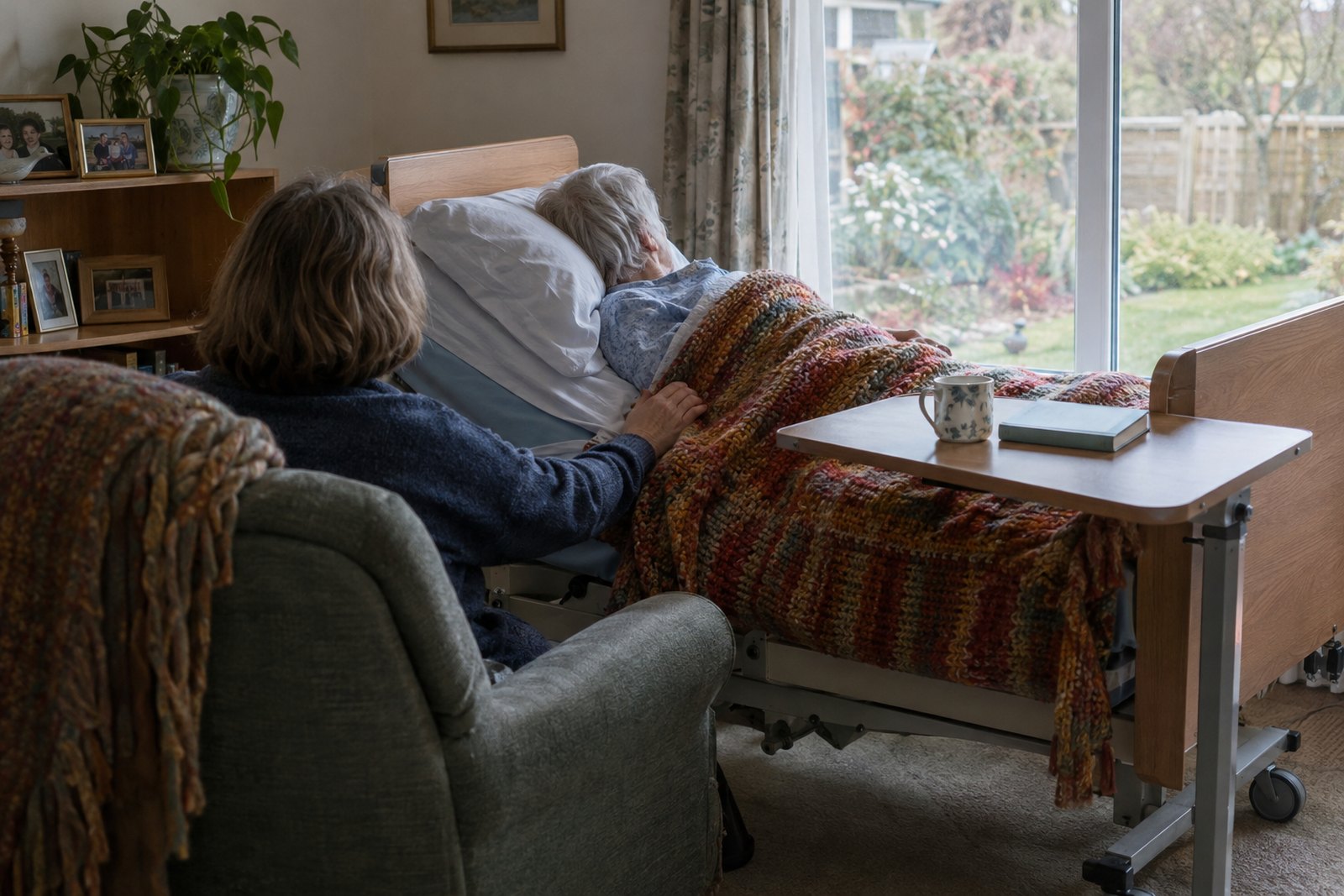
Yes, many people can be cared for at home towards the end of their life, and many choose to be. Palliative care at home means support to stay comfortable and live as well as possible with an illness that cannot be cured. End of life care is the part of that care that comes nearer the end, however long that turns out to be. In most areas it is coordinated by the GP and the district nursing team, often alongside a local hospice or specialist palliative care team. The equipment that makes it possible, such as a hospital-style bed and a pressure-relieving mattress, is usually lent free through the NHS and council.
What follows is the practical side: who does what, how to get equipment quickly, how to arrange the home so it works for everyone, and how to keep going if you are the one caring. It does not try to tell you what will happen or when. Nobody can tell you that from a web page, and the nurses and doctors who know the person are the right people to ask.
Who organises palliative care at home
It can feel as though there are a great many people involved and nobody quite in charge. In most places the picture looks something like this.
- The GP is the medical lead. They prescribe, refer to other services and fill in forms for funding and benefits.
- District nurses visit at home, look after skin and pressure areas, manage symptoms with the GP, order equipment and are often the main day-to-day contact. They may arrange for "just in case" medicines to be kept at home so that symptoms can be treated quickly if they appear. Ask them how this works locally rather than trying to sort it yourself.
- The hospice or specialist palliative care team includes specialist nurses and doctors, and often occupational therapists, physiotherapists, social workers and chaplains. They advise on difficult symptoms and offer emotional support to the person and the family. You do not have to be staying in a hospice to get their help.
- Hospice at home and Marie Curie nurses provide hands-on nursing care at home in many areas, sometimes overnight.
- Council adult social care or a care agency may provide visits to help with washing, dressing and using the toilet.
- Others come in as needed: a speech and language therapist if swallowing becomes difficult, a physiotherapist for breathing or moving, a dietitian.
Three things are worth asking for early. First, one named key contact, so you know who to ring. Second, the daytime and out-of-hours numbers, written down and kept by the phone. Third, a conversation about wishes: where the person would like to be cared for, what matters to them, and whether they want a ReSPECT form or a DNACPR decision in place. Many GP practices keep a palliative care register so that out-of-hours doctors know the situation. Keep important paperwork somewhere everyone, including visiting nurses and ambulance crews, can find it.
Paying for care: fast-track funding and benefits
Money is the last thing anyone wants to think about now, which is why it helps to know that much of this support is free, and that there are faster routes designed for exactly this situation.
Fast-track NHS Continuing Healthcare
In England, when someone's condition is deteriorating quickly and they may be nearing the end of their life, a clinician such as the GP, a district nurse or a hospital consultant can complete what is called the Fast Track Pathway Tool. If it is agreed, the NHS funds the care package without the person having to go through the full assessment first. It is not means tested and it can pay for care at home. Wales, Scotland and Northern Ireland have their own arrangements, so check locally if you live there. Our guide to NHS Continuing Healthcare and CHC funding explains the wider system. You do not have to wait to be offered fast track. It is reasonable to ask the district nurse or GP whether it would be appropriate.
Benefits under the special rules
Disability benefits such as Attendance Allowance, Personal Independence Payment and Disability Living Allowance, and Universal Credit, can be claimed under special rules for people nearing the end of life. A doctor or specialist nurse usually completes a form called SR1, and claims are dealt with more quickly. A carer may also be able to claim Carer's Allowance. In Scotland, Adult Disability Payment has replaced Personal Independence Payment and Carer Support Payment has replaced Carer's Allowance, and terminal illness claims use a form called BASRiS through Social Security Scotland. The rules change from time to time, so check the current details on GOV.UK or mygov.scot, or ask a hospice social worker or welfare adviser to help.
Equipment
Equipment from the community equipment service is lent free when a professional assesses that it is needed. You do not normally have to buy a hospital bed or a pressure mattress.
Equipment that often helps
Not everyone needs everything on this list. Equipment should follow what the person actually needs, and needs can change quickly, so it is fine to ask early rather than waiting for a crisis.
A profiling bed
A profiling bed is an electric bed that raises the head and knee sections and goes up and down in height. It lets the person sit up to eat, breathe more easily or chat, and it saves the backs of whoever is helping, because care can be given at waist height. Our guide to profiling beds and getting comfortable covers how they work. Bed rails sometimes come with them, but they should only be used after a proper risk check, because they suit some people and are dangerous for others.
A pressure-relieving mattress and cushion
When someone spends most of the day in bed or in one chair, skin can break down quickly. The district nurse will usually assess this and may arrange a foam or air mattress. Air mattresses run on a pump that needs a socket nearby and must not be switched off. They hum quietly, which some people find soothing and others do not. A pressure cushion for the chair matters just as much. See our guide to pressure relief cushions and mattresses for more.
Commodes, urinals and continence supplies
A commode beside the bed can mean the difference between getting to the toilet with dignity and not. Urinals and slipper bedpans help when getting out of bed becomes too much. The district nurse can assess for continence products such as pads, which are often provided free.
Hoists, slide sheets and moving equipment
If the person can no longer stand to move between bed and chair, a mobile hoist with a sling sized for them may be needed. Slide sheets help carers turn and reposition someone in bed without dragging skin. Nobody should use either without being shown how. Our guide to hoists at home explains the types and what training to expect.
Chairs
Getting out of bed and into the living room, even for an hour, matters to many people. A riser recliner can help someone stand or rest. When sitting upright becomes tiring, a tilt-in-space chair supports the whole body and lets the person stay part of family life. These are usually assessed by an occupational therapist or the hospice team.
Smaller things that make a real difference
- An over-bed table for drinks, books and meals.
- A bell, a baby monitor or a phone within reach so the person can call for help.
- A reading light they can switch on themselves.
- A long-handled grabber for dropped things.
- A shower chair or perching stool while washing in the bathroom is still possible.
- Cups and beakers that are easier to hold. If drinking causes coughing or choking, ask for a speech and language therapist rather than changing cups and hoping.
Getting equipment quickly
Most equipment is ordered by a district nurse, the hospice team or an occupational therapist through the local community equipment service. Many services can deliver urgently for people receiving end of life care, so tell whoever is ordering that it is needed quickly and ask when it will arrive.
- Ask early. It is much easier to have a bed in place a little before it is needed than to wait until someone cannot climb the stairs.
- Clear the space before delivery. Move furniture, roll up rugs and make sure there is a socket nearby.
- Measure doorways and hallways if space is tight, and mention it when equipment is ordered.
- Have someone at home for the delivery, and ask the technician to show you how everything works.
- If the person is coming home from hospital, the main equipment should be in place before discharge. Ask the ward to confirm this.
Buying privately is possible, but check with the nurse first. A bed or mattress bought separately may not work safely with loaned equipment, especially where bed rails or an air mattress are involved. Our equipment and aids page explains how an occupational therapist can advise on what to get. When equipment is no longer needed, the service will collect it. There is no rush, and you can ring them when you are ready.
Rearranging the home
Often the bed moves downstairs, which is a big change and can be an emotional one. When choosing the room, think about:
- Where the person wants to be. Some want to be in the middle of family life. Others want quiet. Ask them.
- A window and a view, and warmth.
- Space around the bed. Carers need room on both sides, and a hoist needs space to roll under the bed and turn.
- The toilet or commode being close by.
- Sockets for the bed, mattress pump and a lamp, without wires trailing across the floor.
- A chair for visitors and somewhere for a carer to sleep nearby if needed.
Then make it work day to day. Keep the person's water, glasses, phone, remote and photos within reach. Use a night light so nobody stumbles in the dark. Keep supplies such as pads, gloves and wipes in one set of drawers so visiting carers can find them. Keep any medicines and the nurses' notes in an agreed place.
And keep it looking like home. Their own bedding on the hospital bed, their music, their pets if they want them, the flowers from the garden. A room can hold a profiling bed and still feel like theirs. Large building works rarely make sense on a short timescale, so the aim is usually sensible temporary changes rather than renovation.
Keeping the person doing what matters to them
Comfort is not only about lying still. For many people, what matters most is small: sitting in the garden, eating at the table, watching the football with a grandchild, writing cards, doing their own hair. With energy often limited, it helps to plan the day around what the person most wants to do, to do those things when they have most energy, and to let go of the rest without guilt. Ask the person what matters. The answer is sometimes surprising, and it is the best guide to how to spend the time.
Looking after yourself if you are caring
Everyone will tell you to look after yourself. Most carers in this situation think the same thing: when, and how, when there is always something that needs doing.
Start with the practical. You are entitled to ask the council for a carer's assessment, which looks at what support you need, and our guide to carers' assessments explains how. Ask the district nurse about overnight nursing, including Marie Curie nurses where they work locally, so you can sleep. Many hospices offer day services, sitting services, family support and bereavement support that starts before a death, not only after. Marie Curie also runs a free support line and has clear information for families.
When people offer help, have a list ready: shopping, a meal, walking the dog, sitting with the person for two hours so you can get out. Tell your own GP that you are caring. And know that if care at home stops being possible, moving to a hospice, hospital or care home is not a failure. Sometimes it is the kindest option for everyone.
Where an occupational therapist fits
Occupational therapists work in hospice teams and in NHS and council community services, and their help is free. Ask the district nurse or hospice team for a referral. An occupational therapist can:
- Look at how the person moves, washes, uses the toilet and sits, and work out what would make it safer and less tiring.
- Recommend and often order equipment, from a commode to a tilt-in-space chair.
- Help with positioning in bed and in the chair, for comfort, breathing and skin.
- Show family carers how to help safely, including with slide sheets and transfers.
- Help plan the day around limited energy.
- Find ways for the person to keep doing the things that matter to them.
A private occupational therapist visiting at home can be useful where NHS services have a wait, or earlier on, when someone is living with a progressive illness and there is time to plan ahead. They can advise on rearranging the home, what equipment to buy, and how to set up a downstairs room. They may not be able to order loaned equipment directly in your area, so they will often work alongside the district nurses.
Be clear about what an occupational therapist does not do. Pain and other symptoms, and medicines, are for the GP, nurses and palliative care team. Swallowing is for a speech and language therapist. The care package is arranged through social care or Continuing Healthcare. In the final days, the nursing team should be your first call.
Frequently asked questions
What is the difference between palliative care and end of life care?
Palliative care is care that aims to keep someone comfortable and living as well as possible with an illness that cannot be cured. It can last a long time, and people can have it alongside other treatment. End of life care is palliative care nearer the end of life. The words are often used loosely, so ask the team what they mean if it is unclear.
Is end of life care at home free?
Care from the GP, district nurses and hospice teams is free, and equipment is usually lent free. Personal care, such as help with washing and dressing, may be funded through fast-track Continuing Healthcare, or by the council subject to a financial assessment. Ask the district nurse about fast track and check benefits on GOV.UK.
How quickly can we get a hospital bed at home?
It depends on your local community equipment service, but many can deliver urgently for end of life care. Tell the nurse or therapist ordering it that it is urgent, clear the space and ask for a delivery date. It is better to ask a little too early than too late.
Can we get help at night?
Often, yes. Ask the district nurse about overnight nursing from Marie Curie or a hospice at home service, or about night care as part of a fast-track funded package. Availability varies between areas, so ask early.
Who do we call if something changes suddenly?
Use the out-of-hours number the nursing or hospice team gave you. If you do not have one, call NHS 111. In an emergency, call 999, and have any ReSPECT form or DNACPR paperwork ready to show the crew so they know the person's wishes.
What if we can no longer manage at home?
Talk to the district nurse or hospice team. Options may include more care at home, a hospice bed, or a care home. Plans can change, and needing a different arrangement is not a sign you have let anyone down.
Next steps
See our home assessment and equipment and aids pages, or current guide prices, and choose your area below.
Talk to an occupational therapist near you
This guide is general information. For advice about your own situation - or someone you look after - a local occupational therapist can visit you at home and see it for themselves.
Choose your area: