

Dyspraxia at Secondary School: Getting Ready for the Move
By Mobile Occupational Therapist • 25 September 2026 • 12 min read
For many children with dyspraxia, also called developmental co-ordination disorder or DCD, the move to secondary school is the hardest transition they make. Everything dyspraxia makes difficult arrives at once: a big site, a timetable that changes every day, a bag to pack for six subjects, more and faster writing, changing for PE in a crowded room, and a dozen teachers instead of one who knew your child well.
The reassuring part is that most of the problems are predictable, so most can be planned for. What helps most is simple. Get to know the building before September. Make organisation visual with colours, photos and checklists. Agree a plan for handwriting or typing. Tell the school clearly what your child needs, and make sure any support is written down rather than left to goodwill. This page goes through each of those, plus what to practise over the summer and where an occupational therapist fits.
Why the jump is bigger with dyspraxia
Dyspraxia affects how the brain plans and co-ordinates movement. Day to day, that shows up as clumsiness, slow or untidy handwriting, trouble with fastenings and sport, and often difficulty with organisation, time and sequencing. Many children also tire quickly, because tasks that are automatic for others take conscious effort. For a fuller picture of the condition, see our guide to dyspraxia in children.
Primary school hides some of this. One classroom, one teacher, a peg with your name on it, and someone who notices your coat is still on at ten past nine. Secondary school removes that scaffolding at exactly the moment demands go up. Children who coped in Year 6 can come home in October exhausted, losing things daily and convinced they are stupid. They are not. The system has simply stopped doing the organising for them.
Getting to know a big site
Getting lost is the fear most Year 6 children mention, and with dyspraxia it is a reasonable one. Sense of direction is often weaker, and a corridor of hurrying older pupils is not the place to work out left from right.
- Ask for extra transition visits. On top of the standard induction day, ask the SENCo (special educational needs co-ordinator) whether your child can have a quieter visit when corridors are empty.
- Take photos of key places, with permission: reception, the nearest toilets, the canteen, the changing rooms and the tutor room. Put them in order in a small booklet.
- Learn routes, not maps. A printed map is hard for many children with dyspraxia. A sequence of landmarks often works better: out of the tutor room, left, past the trophy cabinet, up the stairs by the science lab.
- Agree a safe place and a safe person for when things go wrong.
- Ask about leaving lessons a minute early to avoid the crush, especially if your child is unsteady on busy stairs.
Timetables, bags and organisation
Organisation is where many children come unstuck in Year 7, and where home can make the biggest difference.
Colour-code everything
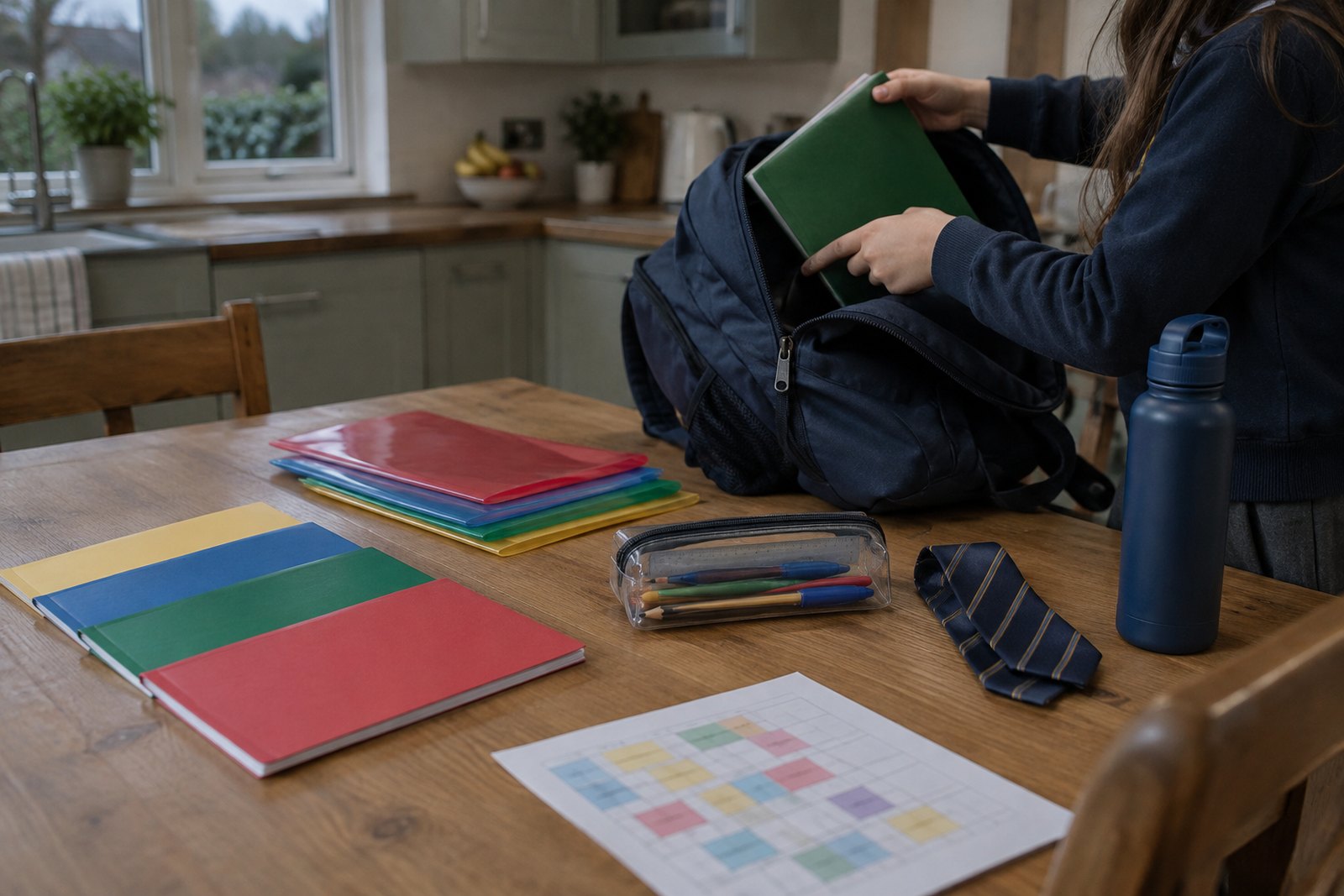
Give each subject a colour and use it everywhere: timetable, book covers or stickers, folders, planner. A child who cannot read a timetable quickly can still see that Tuesday period three is green, and green means science. Keep the colours the same all year so the system becomes automatic.
A timetable they can actually use
Make several copies: one by the front door, one in a plastic wallet in the bag, one photographed on their phone if the school allows it. A coloured weekly version with one column per day is easier to scan than a dense grid. If the school runs a two-week timetable, give Week A and Week B different background colours.
Photos of the packed bag
One of the most useful tricks there is. Pack the bag together for each day, lay everything out on the bed and take a photo. Stick the five photos up where the bag gets packed. Instead of remembering a list, your child matches the bag to the picture. Add a short fixed checklist for daily items: planner, pencil case, water bottle, lunch card, keys, bus pass.
Pack the night before
Mornings are when sequencing and time pressure collide. Pack the bag, check PE kit and lay out uniform in the order it goes on the evening before. A bag with a few clear compartments beats one big hole, and a see-through pencil case shows what is missing.
Handwriting, typing and getting work down
The volume of writing rises sharply in secondary school, and teachers expect it faster. For many children with dyspraxia, handwriting is slow, tiring and sometimes painful, and forming letters leaves little capacity for thinking about content.
- Ask what can be reduced. Printed notes, less copying from the board or permission to photograph the board can make a big difference.
- Start typing early. Typing is not a magic fix, but for many teenagers with dyspraxia it becomes faster and less tiring than handwriting once properly learned. A few minutes of touch typing practice a day over the summer means it is useful by autumn rather than another struggle. Ask how laptops are used in class and whether one can be provided or brought in.
- Ask about simple tools such as a writing slope, pen grips or wider-lined paper.
- Keep handwriting going too. Most children still need to handwrite some things, so typing is usually an addition, not a replacement.
If writing difficulties seem out of step with the rest of their ability, our guide to dysgraphia explains how specific writing difficulties are assessed and supported.
PE and changing
PE can be the most dreaded part of the week. Co-ordination difficulties are on public display, and the changing room adds time pressure that a child who struggles with buttons, ties and laces feels every lesson.
- Simplify the uniform. Many schools accept clip-on ties, shoes with Velcro or elastic laces, and easier fastenings. Ask before you buy.
- Practise changing against the clock at home, in the order it will happen.
- Ask for a little extra changing time, or to start a few minutes early.
- Talk to the PE department about avoiding public team picking and including activities where co-ordination is less exposed.
- Keep your child active in something they enjoy. Swimming, cycling, climbing and martial arts suit many children with dyspraxia.
Practical subjects: science, technology and food
These lessons involve heat, sharp tools, glassware and precise measuring, which is where clumsiness carries real risk. Children are usually perfectly capable of these subjects; the set-up just needs thought.
- Ask teachers to think about where your child works, so they are not reaching across a Bunsen burner or squeezed into a busy corner.
- Non-slip mats under bowls and chopping boards, and trays for carrying things, help.
- A steady partner with clearly divided roles reduces accidents and embarrassment.
- Step-by-step written or picture instructions help children who lose track halfway through a recipe or experiment.
- Cooking simple meals together at home is excellent practice.
Homework and planners
Homework often goes wrong before it starts: not written down, written illegibly, or written down and lost. Many schools now set homework online, which helps. Find out how your child's school does it and get your own log-in.
Agree a routine: a break after school, then same time, same place. Break bigger tasks into steps with a tick box for each, and keep a colour-coded weekly wall planner showing what is due when. If a task meant to take thirty minutes is taking two hours, tell the school early.
Friendships and the social side
Some children with dyspraxia find group games, fast conversation and unstructured break times hard, and visible clumsiness can make them a target. Secondary school is also a fresh start, which can be a real opportunity. Clubs are often the easiest way in, because they gather children around a shared interest. Ask whether there is a lunchtime club, quiet room or buddy scheme for Year 7.
Tiredness, irritability and Sunday evening dread are common in the first term. But if your child becomes very withdrawn, starts refusing school or talks about hurting themselves, speak to the school and your GP. If they are in immediate danger, call 999.
Telling teachers
Do not assume information passes smoothly from primary to secondary. Often it reaches the SENCo and stops. A one-page profile helps teachers who have thirty children in front of them. Keep it practical:
- what dyspraxia means for your child, in a couple of lines
- what they find hard, such as copying from the board or finding rooms
- what helps, such as printed notes, typing or a seat near the front
- what they are good at and interested in
- signs they are struggling, and who to contact
Write it with your child if you can. Teenagers are more likely to accept support they helped design, and it starts building the skill of explaining their own needs.
SEN support, EHCPs and exam arrangements
In England, most children with dyspraxia have their needs met through SEN support, where the school plans, provides and reviews extra help. Ask for a meeting with the SENCo before or early in Year 7, and ask what will be written down and when it will be reviewed. Our guide to SEN support in school explains how it should work.
If needs go beyond what the school can provide from its own resources, an education, health and care plan may be appropriate, and parents can ask the local authority for an assessment themselves. See our guide to EHCPs and what an occupational therapy report adds, and check current rules on GOV.UK or with IPSEA. Wales, Scotland and Northern Ireland have their own systems.
Exam access arrangements, such as extra time, rest breaks, a word processor, a reader or a scribe, are applied for by the school under rules set by the Joint Council for Qualifications. Schools usually need evidence that the arrangement reflects your child's normal way of working. That is why it pays to establish typing or extra time in Year 7 rather than Year 10. Ask the SENCo or exams officer how they handle it.
What to practise over the summer
- The journey to school, at the right time of day, until they can do it without you.
- Packing the bag from the photos.
- Getting into uniform and PE kit, timed, including tie and shoes.
- Reading the timetable: what do you have after break on Wednesday?
- Touch typing, ten minutes a day.
- Carrying a tray with a drink and plate, ready for the canteen.
- Making a simple snack or meal.
Do not try to do it all. Pick the three things that worry your child most. Little and often, with plenty of praise, beats a stressful boot camp in the last week of August.
Where an occupational therapist fits
An occupational therapist looks at how dyspraxia affects the everyday things your child needs to do, and what would make them easier. For the secondary move, that can mean assessing handwriting and typing, recommending equipment such as writing slopes or pen grips, working on dressing and organisation strategies, advising on PE and practical subjects, and writing a report with recommendations for the school or an EHCP application.
A private occupational therapist visiting at home can see how your child manages their actual bag, uniform and homework space, which often reveals things a clinic would miss. Some children are seen by NHS children's occupational therapy instead; your GP or school can tell you how referral works locally.
An occupational therapist is not the right person for everything. Diagnosis of DCD usually involves a paediatrician. A physiotherapist may lead on balance, strength and gross motor skills. A speech and language therapist helps with speech, language and social communication. An educational psychologist looks at learning and thinking, and the SENCo co-ordinates support in school. Occupational therapy works best alongside them, not instead of them.
Frequently asked questions
When should I start preparing for the move?
As soon as you know which secondary school your child will attend. Contact the SENCo then, so plans and extra visits can be arranged before the summer holidays, and use the summer for practice.
My child coped well in primary. Do I still need to tell the secondary school?
Yes. Coping in primary often depends on support nobody wrote down. Tell the school about the diagnosis and what helped, even if things were going well.
Can my child get help without a formal diagnosis?
Yes. SEN support should be based on need, not on a diagnosis. Describe the difficulties you see and ask the school to assess and respond to them.
Will my child be allowed to use a laptop in lessons?
It depends on the school and on your child's needs. Raise it with the SENCo early. If typing becomes their normal way of working, it also supports a later application to use a word processor in exams.
Does my child need an EHCP to get extra time in exams?
No. Exam access arrangements are separate from EHCPs. The school applies based on evidence of need and how your child normally works in class.
Should my child tell classmates about their dyspraxia?
That is their choice. Some find a simple explanation helps friends understand; others prefer to keep it private. Help them practise a short sentence they are comfortable saying, in case they want it.
Next steps
If you would like help preparing for the move, see our children's occupational therapy page, or current guide prices, and choose your area below.
Talk to an occupational therapist near you
This guide is general information. For advice about your own situation - or someone you look after - a local occupational therapist can visit you at home and see it for themselves.
Choose your area: