

Discharge To Assess: What It Means And What To Ask
By Mobile Occupational Therapist • 23 September 2026 • 14 min read
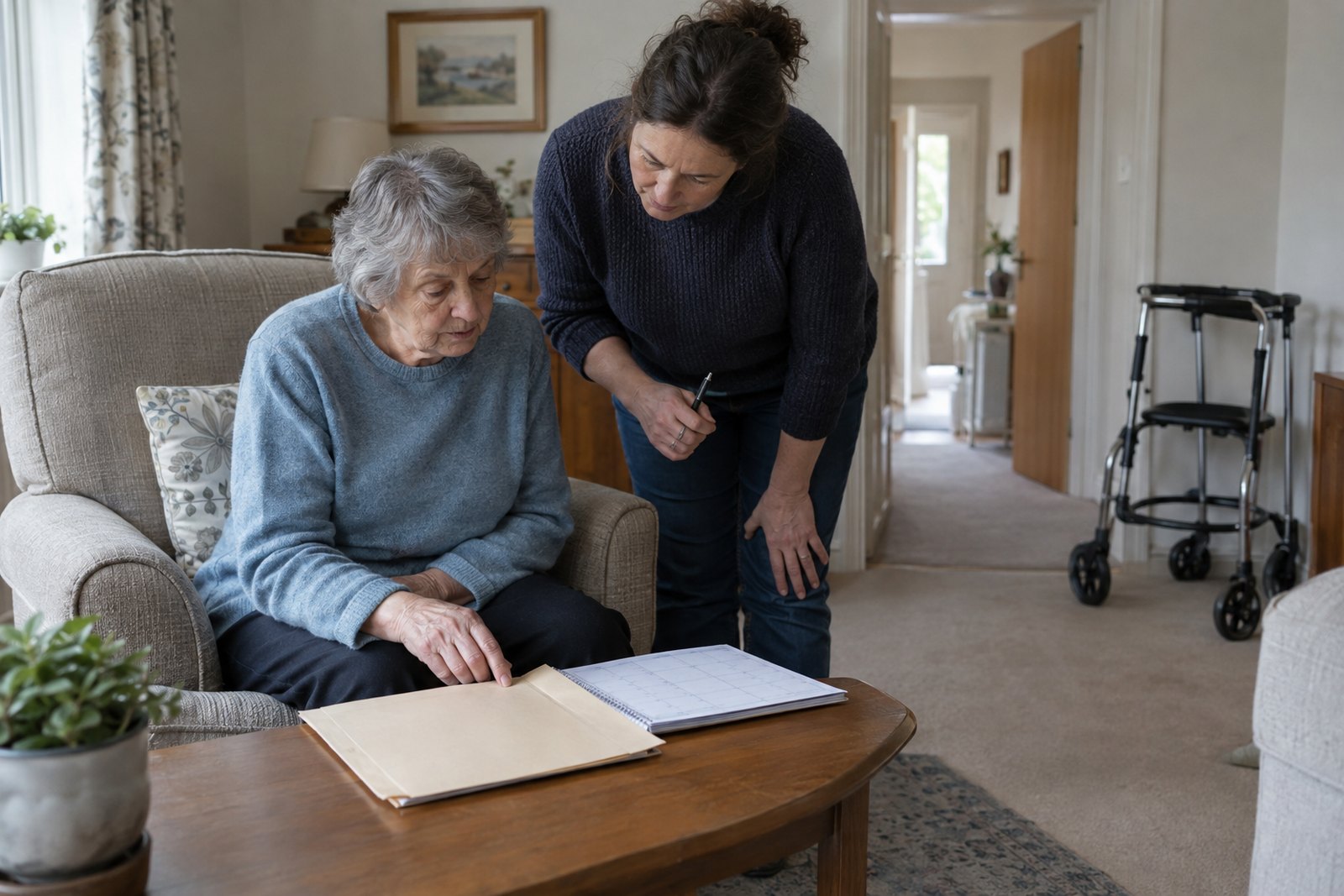
Discharge to assess (often shortened to D2A) means the hospital plans for you or your relative to leave before a full long-term care assessment is finished. Instead, the assessment happens in the right place to judge day-to-day life: at home, or sometimes in a short-term bed in a community setting.
For families, the key point is this: going home (or to a short-term bed) does not automatically mean the person is back to normal, or that everything is sorted. It means the hospital believes they are well enough not to need an acute hospital bed, and that support and assessment will continue after discharge. Your job is to make sure the plan is clear, safe, and written down.
What discharge to assess means in plain English
Hospitals are busy, noisy, and not a great place to judge what someone can do in real life. People often do worse in hospital because they are tired, in pain, and off their usual routine. D2A is meant to stop people staying in hospital longer than necessary while teams try to work out long-term care needs.
In a D2A approach, the hospital focuses on what is needed to leave safely today, not what the person might need forever. After discharge, there should be a period of assessment and support, then a decision about what happens next.
It can still feel abrupt. Especially if you are the one expected to make everything work at home, with two hours' notice and a carrier bag of medication.
The D2A pathways: what they usually look like
Different areas use slightly different labels, but most D2A pathways boil down to four broad options. People can move between them depending on what happens over the next days and weeks.
1) Home with no new support
Sometimes the plan is simply: go home, follow up with your GP, and carry on. This may be right if the person was managing before and has bounced back quickly.
Before you agree, think about the first 48 hours. Can they get to the toilet, wash, eat, drink, and move around safely? If the answer is "not really, but we will muddle through", that is a sign you need a clearer plan.
2) Home with short-term support (often reablement)
This is the most common "D2A feeling" discharge. The person goes home, and a community team supports them for a short time while they build skills and stamina, and while the longer-term picture becomes clearer.
Support might include carers visiting for personal care, therapy input, and equipment being provided. The aim is not to do everything for the person. The aim is to help them do as much as possible for themselves, safely.
3) A short-term bed while things are assessed
Some people are not safe to go straight home, but do not need to remain in an acute hospital bed. They may go to a short-term bed in a community setting while therapy, nursing, and assessment continue.
This can be a stepping stone to home, or a way of testing what level of support is needed, or a short period to recover strength after an illness.
4) Planning for longer-term care
Sometimes, after a period of assessment and short-term support, it becomes clear that the person is unlikely to manage safely at home even with adaptations and care. At that point, the conversation may move towards longer-term care at home with a care package, or a move to a care setting.
If that happens, it should not be decided in a rush on day one of discharge planning. It should be based on how the person is actually managing, what matters to them, and what support is realistically available.
What to ask before discharge: a family checklist
If you are exhausted, you will forget half of this. That is normal. Use it as a prompt and write answers down. If you can, ask the ward to email or print the discharge plan.
People and timing
- Who is picking them up, and when? If hospital transport is being arranged, ask for a realistic window and what happens if it is delayed.
- Who is coming in on day one at home? Names if possible, but at least which service (reablement, carers, district nurse, therapy).
- What time are the first visits? If medication, meals, toileting, or turning in bed depend on visits, timings matter.
- What happens overnight? If they cannot safely get to the toilet, ask what the plan is. Do not assume someone else will solve it.
- Is anyone expected to stay with them? If yes, say what you can and cannot do. Hospitals should not assume family will provide care you have not agreed to.
Care tasks: what is the actual plan?
- Washing and dressing: What help will they get, and what can be left for now?
- Toileting: Can they get on and off the toilet safely? Do they need prompting? What is the plan at night?
- Meals and drinks: Who will shop, cook, and make sure they drink enough?
- Stairs: Can they manage stairs safely? If not, where will they sleep and wash?
- Supervision: If they are confused, impulsive, or at risk of falls, who will be there?
Equipment and the home set-up
- What equipment is being provided, and when will it arrive? Ask what will be delivered before they get home, and what will be delivered after.
- Is the equipment being fitted? Some items need proper installation. Make sure this is not being left to you.
- What space do you need to clear? For example: room for a bed downstairs, room to use a walking aid, space next to the bed for safe transfers.
- Is there a plan for keys and access? If the person lives alone, how will staff get in? (If a key safe is suggested, ask who is fitting it and when.)
Medication, symptoms, and follow-up
- Do you have an up-to-date medication list? Ask for the discharge summary and any changes clearly explained.
- Do you have enough medication to get started? Ask what you need to collect and when the first post-discharge prescription will be available.
- What symptoms are expected, and what are not? Ask what should prompt a call to the GP, NHS 111, or 999.
- What follow-up is booked? For example: clinic appointments, blood tests, therapy, district nurse, wound care.
One phone number to call when it wobbles
- Who do you contact if the plan is not happening? Ask for a single number for the discharge team, reablement, or community service, plus what to do out of hours.
- If the person deteriorates, what is the escalation plan? In plain terms, who do you call first?
If you want a broader overview of discharge planning (including what to prepare at home), see coming home from hospital: a family's guide to discharge planning.
Reablement and intermediate care: what to expect
Reablement is a type of intermediate care and is short-term support designed to help someone regain independence after illness or a hospital stay.
It is meant to be active and goal-focused: practise the stairs, wash at the sink safely, rebuild confidence in the kitchen, get back to making a simple meal.In England, intermediate care, including reablement, should be time limited and should be provided free of charge for up to 6 weeks, but local eligibility criteria and what is included vary.
If you are unsure what is being offered, ask: "Is this reablement? How long is it for? Is there a charge?"Reablement can be brilliant. It can also be frustrating if expectations are mismatched. Staff may arrive for short visits and may not be able to do everything you hoped. You will get the best out of it by being clear about the priorities.
How to make reablement work better in real life
- Pick three goals for the first week. For example: safe toilet transfers, washing at the sink, making a hot drink without falls risk.
- Agree what "safe enough" looks like. Not perfect. Safe enough.
- Keep a simple note of what is going wrong. "Nearly fell when turning in bathroom" is more useful than "struggling".
- Be honest about fatigue. People can look fine for 10 minutes and crash afterwards.
- Ask what is expected between visits. If practise is needed, who will supervise it?
There is a fuller explanation of what reablement is and how it links to discharge in reablement and intermediate care: the six weeks after hospital.
Where an occupational therapist fits after discharge
Occupational therapists (OTs) focus on everyday function. Not just whether someone can stand up once in a hospital corridor, but whether they can wash, dress, use the toilet, get a meal, manage steps, and stay safe at home without burning out the family.
After a discharge to assess plan starts, a community OT may be involved through the NHS or council services. Their role might include:
- Assessing transfers and mobility in the actual home layout. Beds, chairs, toilets, showers, doorways, stairs.
- Recommending and arranging equipment to reduce falls risk and make care safer and more dignified.
- Advising on routines and techniques that reduce effort and improve safety (for the person and for you).
- Helping with longer-term planning where the home set-up is part of the problem, for example if stairs are no longer manageable.
- Reducing carer strain by changing the task, not just expecting you to "cope better".
What OTs do not do: diagnose medical problems, prescribe medication, or replace physiotherapy for strength and gait rehabilitation. If the main issue is breathlessness, new neurological symptoms, chest pain, worsening confusion, or signs of infection, the right first call is usually your GP, NHS 111, or 999 depending on urgency.
Some families choose to pay for an OT to visit at home when they are worried about safety, when they are stuck waiting for community input, or when they need a clear written plan (for example for work, housing, or ongoing care planning). If you are exploring that route, start with hospital discharge support to see what a home visit can cover.
Carers: what you are entitled to, and what you can say no to
D2A can quietly shift responsibility onto families. Suddenly, you are doing medication prompts, meals, toileting support, and supervising walking, because "it is only for a bit". That "bit" can stretch.
If you are providing unpaid care, you have rights too. In England, you can ask the council for a carer's assessment, even if the person you care for has not had their own needs assessment yet. A carer's assessment looks at what you are doing, what it is doing to you, and what support could help you keep going (or what needs to change if you cannot).
Practical point: you can say "I cannot provide that level of care." It is better to say it early than to agree, struggle, and then end up in crisis. If you want to understand what you can ask for, read carer's assessment: what family carers are entitled to. It also helps to understand the person's own assessment process, which is covered in Care Act needs assessment: what to expect and how to prepare.
If you feel the discharge is unsafe
Sometimes the plan on paper and the reality at home are miles apart. Other times, the plan is vague and you are expected to improvise. If you believe the discharge is unsafe, you are allowed to be difficult about it. You are trying to prevent a fall, a pressure sore, a carer injury, or a rapid readmission.
Before discharge: how to raise concerns clearly
- Ask to speak to the nurse in charge and the discharge coordinator. Explain the specific risk: "She cannot get to the toilet without two people" is clearer than "I am worried".
- Ask what the minimum safety plan is for the first night. Not the ideal plan, the minimum safe plan.
- Ask whether a same-day therapy review is needed. If the person cannot transfer safely, ask if an OT or physio can reassess before discharge.
- Ask for the plan in writing. Verbal promises are easily lost between shifts.
- If the person lacks capacity to decide, ask how best interests decisions are being made. You should be involved in the conversation as family, where appropriate.
After discharge: what to do if it is going wrong
- If there is an immediate emergency (for example severe breathlessness, chest pain, signs of stroke, a serious fall, or you cannot keep them safe), call 999.
- If it is urgent but not life-threatening, call NHS 111 for advice.
- If the issue is that services are not turning up, use the number you were given for the community team or discharge team and state clearly what is not in place.
- If you think there is a safeguarding risk (for example the person is being left without essential care, or you as a carer are being put under unsafe pressure), tell the services involved and ask for it to be treated as a safeguarding concern. You can also contact your local council adult social care.
It can feel like you are making a fuss. You are not. A vague plan is not a plan, it is a gap. Gaps are where people fall.
Scotland, Wales and Northern Ireland in one sentence
The idea of getting people out of acute hospital promptly and assessing needs in the community exists across the UK, but the names, pathways, and who arranges and pays for what differ in Scotland, Wales and Northern Ireland, so check your local NHS board, health board, or health and social care trust guidance.
Frequently asked questions
Is discharge to assess the same as being medically fit?
Not exactly. You might hear "medically optimised" or "medically fit for discharge", meaning the hospital team believes the person does not need acute hospital care right now. D2A is about what happens next: assessment and support continuing outside the hospital.
How long does discharge to assess last?
There is no single national timescale that applies to everyone. Some people need only a few days of support, others need a few weeks to recover and be assessed properly. If reablement is involved, it is usually time limited and reviewed.
Does reablement cost money?
In England, intermediate care and reablement should be provided free of charge for up to 6 weeks if they meet the definition, but local eligibility criteria and what is included vary. Always ask what is being offered, how long it is for, and whether there will be any charges after it ends, and who will do the financial assessment if ongoing care is needed.
Can we refuse a discharge to assess plan?
You can raise concerns and ask for the plan to be reconsidered, especially if key risks are not addressed. The hospital can discharge someone if they judge it is safe to do so, but they should still involve the person (and family where appropriate), explain the plan, and arrange suitable follow-up. If you cannot provide care that is being assumed, say so clearly and early.
What if my mum or dad refuses support once they are home?
This is common, especially if they feel embarrassed, frightened, or determined to prove they are fine. Try to frame support as short-term rehabilitation rather than "care", and focus on what matters to them (getting back upstairs, going out again, staying at home).
If refusal creates serious risk and the person may not understand that risk, it may be a mental capacity issue and professionals may need to reassess. Start with the community team, the GP, or NHS 111 depending on urgency.
Will the council make us pay for care after reablement ends?
If ongoing social care is needed, the council will usually carry out a needs assessment and, if eligible, a financial assessment to work out what contribution the person may need to make. The rules are detailed and depend on savings, income, and the type of care. Ask the council to explain this in writing so you are not trying to guess.
Next steps
If you want practical, at-home help to make discharge safer and clarify what needs to happen next, see our hospital discharge page, or home assessment, check current guide prices, and choose your area below.

Talk to an occupational therapist near you
This guide is general information. For advice about your own situation - or someone you look after - a local occupational therapist can visit you at home and see it for themselves.
Choose your area: