

Dementia Hallucinations: What They Are and How to Respond
By Mobile Occupational Therapist • 1 November 2026 • 13 min read
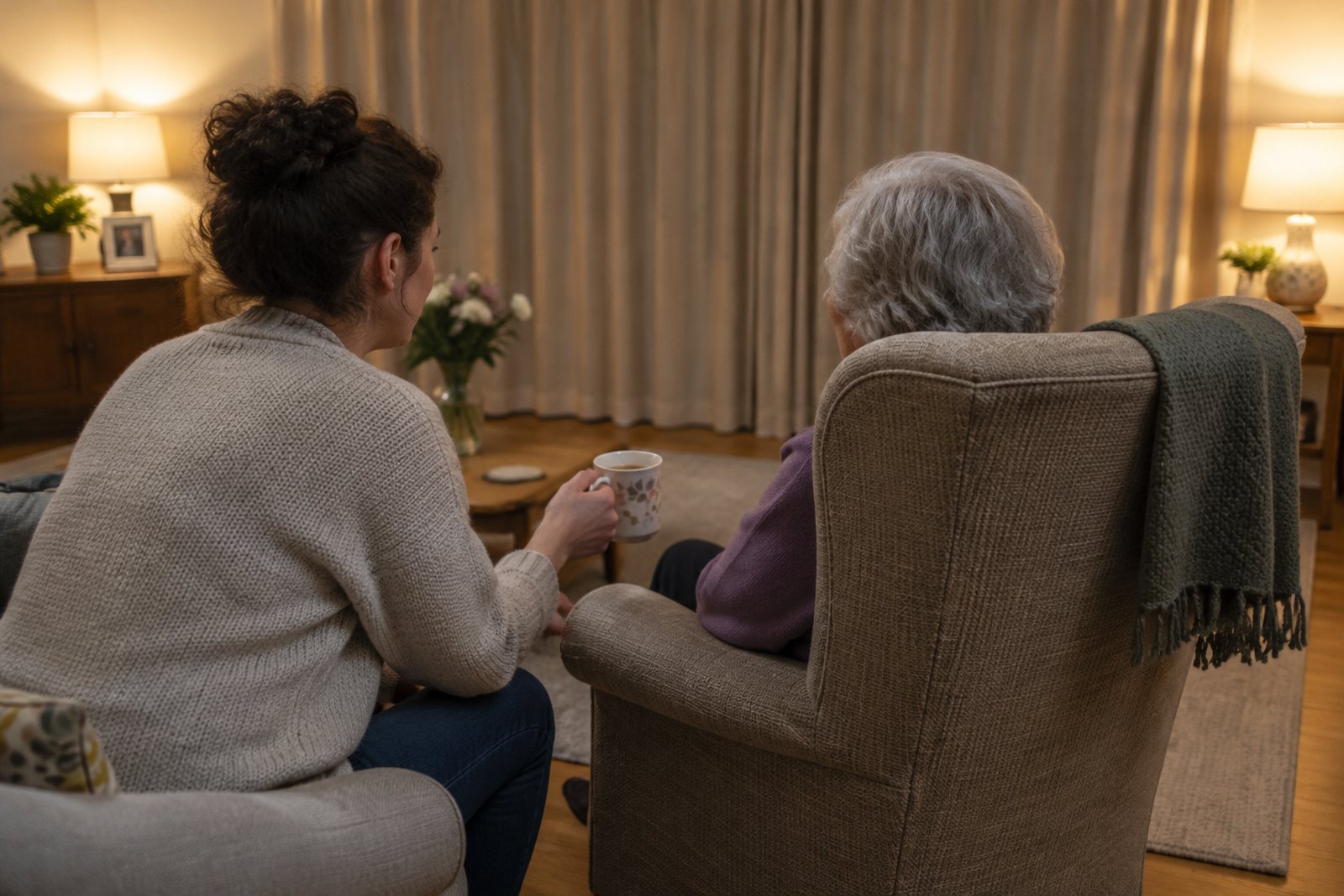
Hallucinations in dementia are when someone sees, hears, smells or feels something that is not there. Your mum insists there is a little girl sitting on the end of the bed. Your dad keeps asking who the men in the garden are. They are not making it up and they are not being difficult. To them, it is really there. Hallucinations can happen in any type of dementia, but they are much more common in some, especially Lewy body dementia and dementia linked to Parkinson's.
What to do, in short: first make sure nothing else is causing it, because infections, delirium, medicines, poor sight, dehydration and pain can all bring on hallucinations, and those can be treated. Then respond to the feeling rather than arguing about the facts. If the hallucination is not upsetting anyone, it is often fine to leave it be. If it has come on suddenly, or the person is much more confused or drowsy than usual, get medical help the same day.
Hallucinations, misperceptions and delusions: what is the difference?
Families tend to call all of this "hallucinating", and it helps to separate it out, because each one has a different fix.
Hallucinations
The person experiences something with nothing there to cause it. Seeing people, children or animals is the most common type. Some people hear voices or music, smell burning, or feel insects on their skin. They can be vivid, detailed and very convincing. Some people know they are not real; many do not.
Misperceptions
Here there is something real, but the brain gets it wrong. A dressing gown on the back of a door becomes a man standing there. A dark rug looks like a hole in the floor. Flecks in the carpet look like insects. Their own reflection in a mirror or a dark window becomes a stranger in the house. People on the television seem to be in the room. Dementia affects how the brain makes sense of what the eyes send it, so this is very common, and it gets worse in dim light, shadows and clutter.
Delusions
A delusion is a firm belief that is not true, rather than something seen or heard. Someone is stealing my purse. My husband is an impostor. I have to collect the children from school. Delusions often grow out of memory loss: if you cannot remember where you put your purse, "someone took it" is a reasonable-feeling explanation.
Why it matters: misperceptions can often be reduced by changing the room. Hallucinations may need a doctor to look for a cause. Delusions mostly need patience and a calm, practical response.
First, rule out other causes
Do not assume new hallucinations are simply the dementia. Book a GP appointment and mention what you have noticed, when it started and anything else that has changed. The GP will want to look for:
- Infection and delirium. A urine infection, chest infection or other illness can cause delirium, a sudden change in confusion, alertness and behaviour. Hallucinations are a common part of delirium. In someone with dementia it can look like the dementia has suddenly got much worse. It is a medical problem and needs treating.
- Medicines. New medicines, changed doses and some medicines for pain, bladder problems, sleep and Parkinson's can cause or worsen hallucinations. Do not stop or change anything yourself. Ask the GP or pharmacist for a medicines review and bring a list of everything taken, including anything bought over the counter.
- Poor sight or hearing. Glasses that are dirty, the wrong pair or an old prescription make misperceptions far more likely. So do hearing aids that are not in or not working. Arrange an eye test; if the person cannot get to an optician, ask whether a home visit is possible.
- Dehydration and constipation. Both can tip someone with dementia into more confusion. Many older people drink very little, especially if they are worried about getting to the toilet.
- Pain. Someone who cannot explain pain may become restless, frightened or agitated instead.
- Tiredness, poor sleep and low mood. Hallucinations are often worse when someone is exhausted, and at the edges of sleep.
If the person already has a memory service or specialist team, let them know too. They may want to review the diagnosis or medication.
When it cannot wait for a routine appointment
Sudden new confusion, or a sudden change over hours or a day or two, needs same-day help. Ring the GP surgery and ask for an urgent appointment, or call NHS 111 if the surgery is closed. Signs to treat as urgent include being much more confused, sleepy or hard to wake, agitated in a way that is new, feverish, not eating or drinking, or suddenly unable to do things they managed yesterday.
Which types of dementia are hallucinations most common in?
Visual hallucinations are one of the hallmarks of Lewy body dementia, and they are also common in dementia linked to Parkinson's. They often start earlier in these conditions and tend to be detailed: people, children or animals, sometimes quite calm and silent. Some people with Lewy body dementia can react badly to certain medicines sometimes used for agitation or hallucinations, so make sure every doctor, hospital and care service knows the diagnosis.
In Alzheimer's disease and vascular dementia, hallucinations are less common overall and are more likely in the later stages, although they can happen at any stage and should still be checked, especially if they are new or worsening. You can read more about the different types on our dementia page.
How to respond in the moment
This is the hard part, and the advice can sound simple when you are tired and it is the fourth time tonight. These steps help most people.
- Stay calm. Your tone matters more than your words. Speak slowly, sit down if you can and keep your voice low and warm.
- Do not argue. Telling someone "there is nobody there" rarely works. What they see feels completely real, so being contradicted can feel like being called a liar, and it often makes the fear worse.
- Acknowledge the feeling. You do not have to agree that the man is there. You can say "That sounds frightening" or "I can see you are worried." Responding to the emotion is honest and it usually lowers the temperature.
- Reassure. "I am here. You are safe. I will stay with you." A hand on the arm, if they like touch, can say more than words.
- Check it out together, if it feels safe. Turn the light on first. Only walk over to look or move the coat if the person is steady on their feet and it will not add to their upset. This often settles a misperception straight away.
- Gently distract. Move to another room, put the kettle on, look at photographs, put on familiar music or ask for help with a small job. Changing the scene changes what the brain is working with.
- Make a note afterwards. What time was it, where were they, how was the light, how had they slept, had they eaten and drunk? Patterns often appear within a week or two and they are useful for the GP.
Should you play along? Most families find a middle path works best. You do not need to pretend to see things, but you also do not need to correct every detail. "I will make sure they leave" or "Let's go into the kitchen" can be kinder than a debate about reality. If the person asks you directly whether you can see it, it is usually better to say gently that you cannot, but you believe it is real to them.
When you can leave it alone
Not every hallucination is a problem. Some people see quiet figures, children playing or animals and are not bothered at all. Some even enjoy them, or treat them as company. If the person is calm, safe and not distressed, you do not have to do anything. Trying to talk them out of a harmless experience can create the distress you were trying to avoid.
The questions to ask are simple. Is anyone frightened? Is anyone at risk? Is it stopping them eating, sleeping or living their day? If the answer to all three is no, keep an eye on it, mention it at the next GP or memory service appointment, and let it be.
Making the home less confusing
Many frightening experiences are misperceptions, and the room is often half the cause. A walk round the house at the time of day the problems happen, ideally sitting where the person sits, is one of the most useful things you can do.
- Light. Make light bright and even. Dim rooms, single ceiling lights and pools of light with dark corners are the worst combination. Put lamps on before dusk, not after. Use night lights on the route to the toilet. Our guide to lighting and colour contrast for dementia and sight loss goes into the detail.
- Shadows. Look for shadows cast by lamps, plants or furniture, and for shapes moving on curtains from outside lights or passing cars.
- Mirrors and windows. If a reflection is being seen as a stranger, cover the mirror or take it down. Close curtains when it gets dark so the windows do not become mirrors.
- Patterns. Busy patterned rugs, carpets, wallpaper and bedding can look like moving shapes, holes or insects. Plain, matt surfaces are calmer. A shiny floor can look wet.
- Things on doors and chairs. Coats on hooks, dressing gowns on the back of the bedroom door and clothes piled on a chair are classic "people". Put them away, especially in the bedroom.
- The television. Some people cannot tell that what is on screen is not happening in the room. Choose calm programmes, avoid news and violent drama, and switch it off rather than leaving it on in the background.
- Noise. Background radio, echoes and noises from outside can be heard as voices or people in the house. Fewer competing sounds help.
Room-by-room ideas are in a dementia-friendly home, room by room. If hallucinations and agitation build up in the late afternoon and evening, it may be part of a wider pattern; see sundowning and what helps.
Charles Bonnet syndrome: when sight loss is the cause
People who have lost a lot of their sight, from conditions such as macular degeneration, glaucoma or diabetic eye disease, can see things that are not there. This is called Charles Bonnet syndrome. The images can be patterns, shapes, faces, people or whole scenes. It is caused by the brain filling in for missing information from the eyes. It is not a mental health problem and it is not dementia.
People with Charles Bonnet syndrome often know the images are not real, although this is not always the case, and the images can still be unsettling. It can happen alongside dementia, which makes things harder to untangle. If the person you care for has poor sight, tell the GP and optician about the hallucinations, and say whether the person seems to know they are not real. Simply knowing the name and that it is common relieves a lot of people, who often worry they are "going mad" and have kept quiet. Our guide to low vision aids and living with sight loss covers practical changes that help.
When to get urgent help
- Call 999 if anyone is in immediate danger: the person is trying to escape something they see in a way that puts them at risk, is violent, has injured themselves or someone else, or is seriously unwell, for example very hard to wake or struggling to breathe.
- Get an urgent GP appointment or call NHS 111 if hallucinations are new and sudden, if confusion has changed quickly, or if distress is so severe that the person or the people around them could be put at risk.
- Book a routine GP appointment for hallucinations that are ongoing, not dangerous, but worrying or getting more frequent.
If you are the main carer and you are not coping, say so. That counts as a reason to ask for help too.
Where an occupational therapist fits
An occupational therapist does not diagnose the cause of hallucinations or prescribe for them. That is the GP's job, along with the memory service or specialist dementia team. Eyes are for the optician or eye clinic, hearing for audiology, and if delusions or agitation are severe, the community mental health team for older people may get involved.
Where an occupational therapist helps is the day-to-day life around it. A private occupational therapist visiting at home can look at the rooms where problems happen, at the right time of day, and suggest changes to lighting, layout, contrast, mirrors and clutter. They can look at routine and daytime activity, because a person who is bored, under-stimulated or dozing all day often has a harder evening and night. They can check night-time safety, such as the route to the toilet, and whether equipment is needed. And they can help you plan responses that suit this particular person, written down so other family members and paid carers respond the same way.
Frequently asked questions
Should I tell them the hallucination is not real?
Usually not in the moment. Arguing tends to increase fear and frustration. Acknowledge how they feel, reassure them they are safe, and offer to check or move somewhere else. If they ask whether you can see it, you can gently say you cannot, while accepting it is real to them.
Do hallucinations mean the dementia is getting worse?
Not necessarily. In Lewy body dementia and Parkinson's disease dementia they can appear early. A sudden change is more often a sign of something else, such as an infection, delirium or a medicine, which is why a GP check matters. Ongoing hallucinations should be mentioned to the GP or memory service so they can review things.
Can medication help?
Sometimes, but it is a decision for the GP or specialist, and it is not usually the first step. They will look for causes first and may review existing medicines. Some medicines need particular care in Lewy body dementia, so make sure every prescriber knows the diagnosis.
Why are they worse in the evening?
Fading light, more shadows, reflections in dark windows and tiredness all make misperceptions and hallucinations more likely. Putting lamps on early, closing curtains at dusk and keeping evenings calm and predictable often helps.
Mum keeps seeing my dad, who died years ago. What do I say?
Reminding her that he has died can make her grieve as if for the first time, again and again. It is usually kinder to talk about him: "You are thinking about Dad. Tell me about him." Follow her feelings rather than the facts.
How do I know if it is Charles Bonnet syndrome or dementia?
You may not be able to tell, and both can happen together. Significant sight loss, and the person knowing the images are not real, point towards Charles Bonnet syndrome. Tell the GP and optician what is happening and let them work it out.
Next steps
If hallucinations or misperceptions are making home feel unsafe, a visit to look at lighting, layout and routine can help. See our home assessment page, or current guide prices, and choose your area below.

Talk to an occupational therapist near you
This guide is general information. For advice about your own situation - or someone you look after - a local occupational therapist can visit you at home and see it for themselves.
Choose your area: