

Changing Places Toilets: What They Are and How to Find One
By Mobile Occupational Therapist • 7 October 2026 • 13 min read
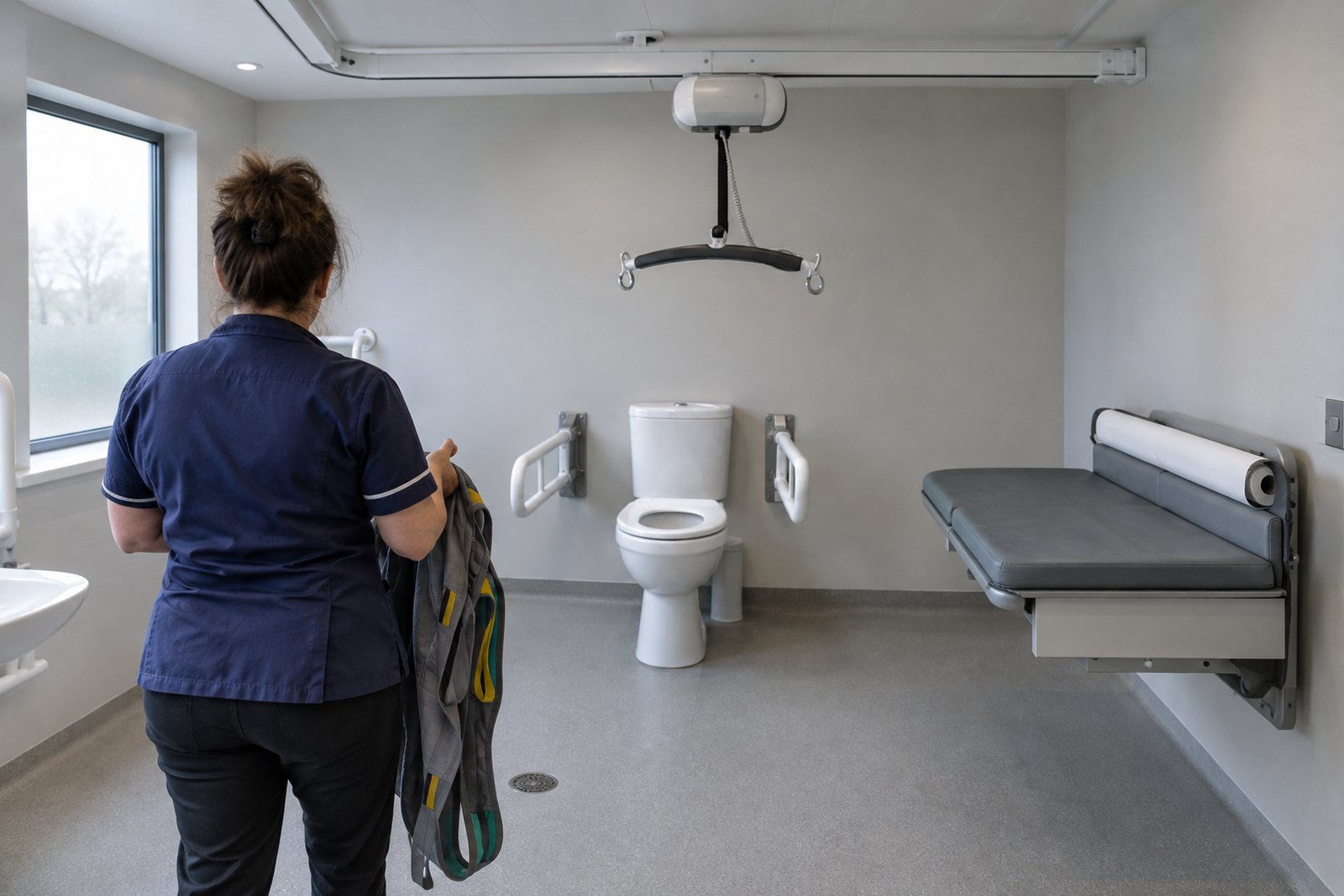
A Changing Places toilet is a large accessible toilet built for people who cannot use a standard disabled toilet, even with help. As well as the usual toilet and basin, it has a ceiling hoist, a height-adjustable adult-sized changing bench, a toilet set away from the wall so carers can help from both sides, and enough room for the disabled person plus up to two carers. Without one, many families are left changing an adult on a toilet floor, or cutting a day out short.
To find one, use the official Changing Places map on the Changing Places website. It lists registered toilets across the UK, usually with opening hours and access details. Before you set off, phone the venue to check it is open and working, ask whether you need a key, and take your own hoist sling if you use one. The rest of this guide explains each of those steps, who these toilets are for, where the law in England now requires them, and what to do when the one you were counting on is locked.
How a Changing Places toilet differs from a standard accessible toilet
The accessible toilet you see in most cafes and shops (sometimes called a Doc M toilet, after the building regulations guidance that describes it) is designed mainly for a wheelchair user who can transfer on and off the toilet independently or with a little help. It has grab rails, a lowish basin within reach of the toilet, an emergency pull cord and a door that opens outward. It is a good design for the people it was meant for. It is far too small for someone who needs to be hoisted, changed lying down, or helped by two people.
A Changing Places toilet adds the things that gap requires. The recommended minimum floor space is around 12 square metres, which is several times the size of a typical accessible toilet. Inside you should find:
- A ceiling track hoist. A rail fixed to the ceiling with a motor unit that lifts a person in a sling. The track usually covers the bench and the toilet, so you can move someone between them without a mobile hoist.
- An adult-sized changing bench. Height-adjustable, either wall-mounted or free-standing, so a carer can change pads or clothes at a safe working height instead of bending over a floor.
- A peninsular toilet. The toilet sits out from the wall with space on both sides, so one or two carers can stand either side to help. There are usually fold-down rails on each side.
- Space for two carers. Many people who need these toilets need two people to move them safely.
- A privacy screen or curtain. So a carer who is not needed for every step can step back, and the person keeps some dignity.
- Other details. Typically a height-adjustable basin, a large waste bin for pads, a non-slip floor, an emergency alarm, and sometimes a shower.
Signs vary. Some venues put a disabled symbol on any large toilet. The words "Changing Places" on the door, or the venue being listed on the official map, are better guides than a picture of a wheelchair.
Who needs a Changing Places toilet
Anyone who cannot use a standard accessible toilet. That includes many people with profound and multiple learning disabilities, cerebral palsy, motor neurone disease, multiple sclerosis, spinal cord injury, muscular dystrophy, acquired brain injury or advanced dementia, as well as older people who have become very frail. It also includes people recovering from serious illness who need hoisting for a period of time.
Some people use them for toileting with a hoist. Others are fully continent but need to lie down to manage a catheter, stoma or clothing. Others need to have pads changed. Children who have outgrown baby changing tables use them too. A baby change shelf in the corner of a disabled toilet is no use for a twelve-year-old, let alone a forty-year-old.
If you or the person you care for has been managing with a standard accessible toilet but it is getting harder, more dangerous or more exhausting, that is often the point to start planning outings around Changing Places toilets. It is also often a sign that things at home need a fresh look, which we cover below.
Where Changing Places toilets are required
In England, the building regulations guidance on access (Approved Document M) was updated so that, for most building work applications made from 2021 onwards, certain larger new buildings used by the public must include a Changing Places toilet. Broadly, that covers places such as large shopping centres and retail premises, big sports, leisure and entertainment venues, and some other public buildings. It also applies to some major extensions and changes of use.
Two things to know. First, the rule is not retrospective: existing buildings are not required to add one, although many have chosen to, sometimes with help from government funding. Second, the exact thresholds and building types are set out in the guidance itself, so if you want to check whether a particular new development should have one, look up Approved Document M on GOV.UK or ask the local council's building control team. Scotland, Wales and Northern Ireland have their own building rules, so check with the relevant government if you live there.
How to find a Changing Places toilet
Use the official map
The Changing Places Consortium, a group of charities that runs the campaign, keeps the official map on the Changing Places website. You can search by town, postcode or venue. Entries usually include the address, opening hours, whether you need a key or staff to open it, and notes on the equipment. Only registered toilets that meet the standard appear, which is more reliable than a general toilet-finding app.
Check before you travel
A listing tells you a toilet exists. It does not tell you it is working today. Hoists break, batteries run flat, rooms get used as storage, and opening hours change. Phone the venue on the morning of your trip if you can, and ask:
- Is the Changing Places toilet open and working, including the hoist and bench?
- Do we need a RADAR key, or do we ask staff for the key? Where do we go?
- Is it inside a paid area, such as behind the ticket barrier at a stadium or attraction?
- What are the hours? Does it close before the venue does?
Plan your route around them
Many families plan a day out backwards from the toilets: where is the nearest Changing Places to the destination, and is there one on the way? Motorway services, large supermarkets, hospitals, shopping centres and some libraries and leisure centres are worth checking. Save the ones you rely on and keep a note of a back-up.
Getting in: keys and access
Changing Places toilets are often locked to stop misuse. The most common arrangements are:
- A RADAR key. Many are fitted with the National Key Scheme lock, the same one used on lots of accessible toilets. If you do not have a key, our guide to RADAR keys and where they work explains how to get one.
- Staff hold the key. You ask at a customer service desk, reception or ticket office. Allow time for this.
- Open access during opening hours. Less common, but some are simply unlocked.
Using a Changing Places toilet is normally free, though you may need to have paid entry to the venue it sits in. You do not need to show proof of disability. If a member of staff questions whether you need it, you are entitled to explain that you need the hoist or the bench and leave it there.
What to bring
Your own sling
This is the one that catches people out. Hoist slings are personal equipment. They come in different types and sizes, and the right one depends on the person's body, posture and what they are being moved for. Many Changing Places toilets do not provide slings at all, and if one is provided, it may not be the right type or size, and there are hygiene concerns about sharing. If you use a sling at home, take it with you.
Check that your sling will attach to the ceiling hoist's spreader bar. Most attach with loops or clips, and not every sling fits every hoist. If you are unsure, ask whoever supplied your sling, or ask the venue what type of hoist they have. Our guide to hoists at home explains sling types and attachments in plain English.
A day-out kit
- Pads, wipes and gloves, plus more than you think you need.
- Disposal bags, in case the bin is full.
- Spare clothes, including trousers and socks.
- A towel or blanket to keep the person warm and covered on the bench. Never leave the person alone on the bench, keep a hand on them when turning, use any side rails it has, and lower it before stepping away.
- Disposable bench covers or a washable mat, in case the paper roll has run out.
- Any catheter, stoma or skin care supplies.
- Hand sanitiser.
If pads are a large part of your monthly costs, our guide to NHS continence services and free pads explains how to get assessed.
Safety checks before you hoist
Only use a hoist you and the other carer know how to operate, with a sling you have been shown how to use. Before lifting, check the hoist responds properly, the battery is charged, the sling is not worn or frayed, and the clips or loops are secure. The hoist and the sling each have a safe working load, usually shown on a label; make sure the person's weight is within both. If anything looks wrong, do not use it, and tell staff. If moving someone safely is new to you, our guide to safe moving and handling for family carers is a good place to start.
Space to Change toilets
You may also see Space to Change toilets. These are smaller than a full Changing Places toilet, often created by adapting an existing accessible toilet, and they include an adult-sized changing bench and a hoist. They are designed for places where a full Changing Places room would not fit, such as smaller venues, offices or community buildings. They are not a full substitute, as there may be less room for two carers or no peninsular toilet, but for many people they make the difference between staying and going home. If you are asking a venue to improve, a Space to Change toilet can be a realistic suggestion when they say there is no room.
When the toilet is out of order: reporting and campaigning
It is exhausting to arrive and find the room locked, broken or full of boxes. When it happens, tell staff on the spot and follow up in writing to the venue's customer services. Be specific: date, time, what was wrong, and what it meant for you. Venues often do not know a hoist has failed until someone tells them.
If somewhere you regularly visit has no Changing Places toilet, ask. Shopping centres, leisure centres, theatres and councils do respond to repeated, polite requests, especially from local people. Your local councillor and MP are worth contacting about council-run buildings. The Changing Places Consortium has campaign resources, and many families share experiences through local parent and carer forums, which carries weight with venues and councils.
Where an occupational therapist fits
An occupational therapist does not build or inspect Changing Places toilets, and you do not need one to use them. Where an OT can help is with the person and the equipment.
- Sling and hoist assessment. An occupational therapist can assess which type and size of sling is right, whether a second sling would suit outings, and how to hoist safely. On the NHS, this usually comes through community occupational therapy and your local community equipment service.
- Moving and handling plans. An OT can write a clear plan for how many carers are needed and how transfers should be done, which helps family, paid carers and respite services.
- Home. If someone now needs a Changing Places toilet when out, home often needs the same thinking: a hoist, a changing bench or bed, or bathroom adaptations. An OT assessment can support an application for a Disabled Facilities Grant.
- Getting out. Planning trips, managing fatigue, and equipment for changing away from home.
Other people lead elsewhere. Continence problems should go to your GP or the NHS continence service. Wheelchairs come through NHS wheelchair services. Skin breakdown, new pain, or a sudden change in someone's ability to move should be checked by a GP; call NHS 111 if you are worried and 999 in an emergency, such as after a fall with a suspected injury.
Frequently asked questions
Do I need a RADAR key to use a Changing Places toilet?
Sometimes. Many use the National Key Scheme lock, but others are opened by staff or are unlocked during opening hours. The listing on the official map usually says which, and a quick phone call confirms it.
Do Changing Places toilets provide a sling?
Often not, and even when they do, it may not suit the person. Bring your own assessed sling and check it attaches to the hoist.
Can I use one with a disabled child?
Yes. Changing Places toilets are for children and adults who need them. They are particularly useful once a child is too big for a baby changing table.
Is there a charge?
The toilet itself is normally free. You may need to have paid to enter the venue, such as a stadium, attraction or ticketed event.
Does every new building have to have one?
No. In England, the requirement applies to certain larger new public buildings and some major building work, generally for applications from 2021. Check Approved Document M on GOV.UK for the details, or ask the council's building control team.
What should I do if the toilet is broken?
Do not use faulty equipment. Tell staff straight away, then report it in writing to the venue. If it keeps happening, contact the venue's management or, for council buildings, your local councillor.
Next steps
If you need advice on the right sling, a hoist at home or equipment for days out, see our equipment and aids page or home adaptations page, or check current guide prices, and choose your area below.

Talk to an occupational therapist near you
This guide is general information. For advice about your own situation - or someone you look after - a local occupational therapist can visit you at home and see it for themselves.
Choose your area: