Cerebral Palsy Occupational Therapy in the Staffordshire Moorlands
By Mobile Occupational Therapist • 26 October 2026 • 11 min read
Local Occupational Therapist -
Georgie Leeson, Staffordshire Moorlands
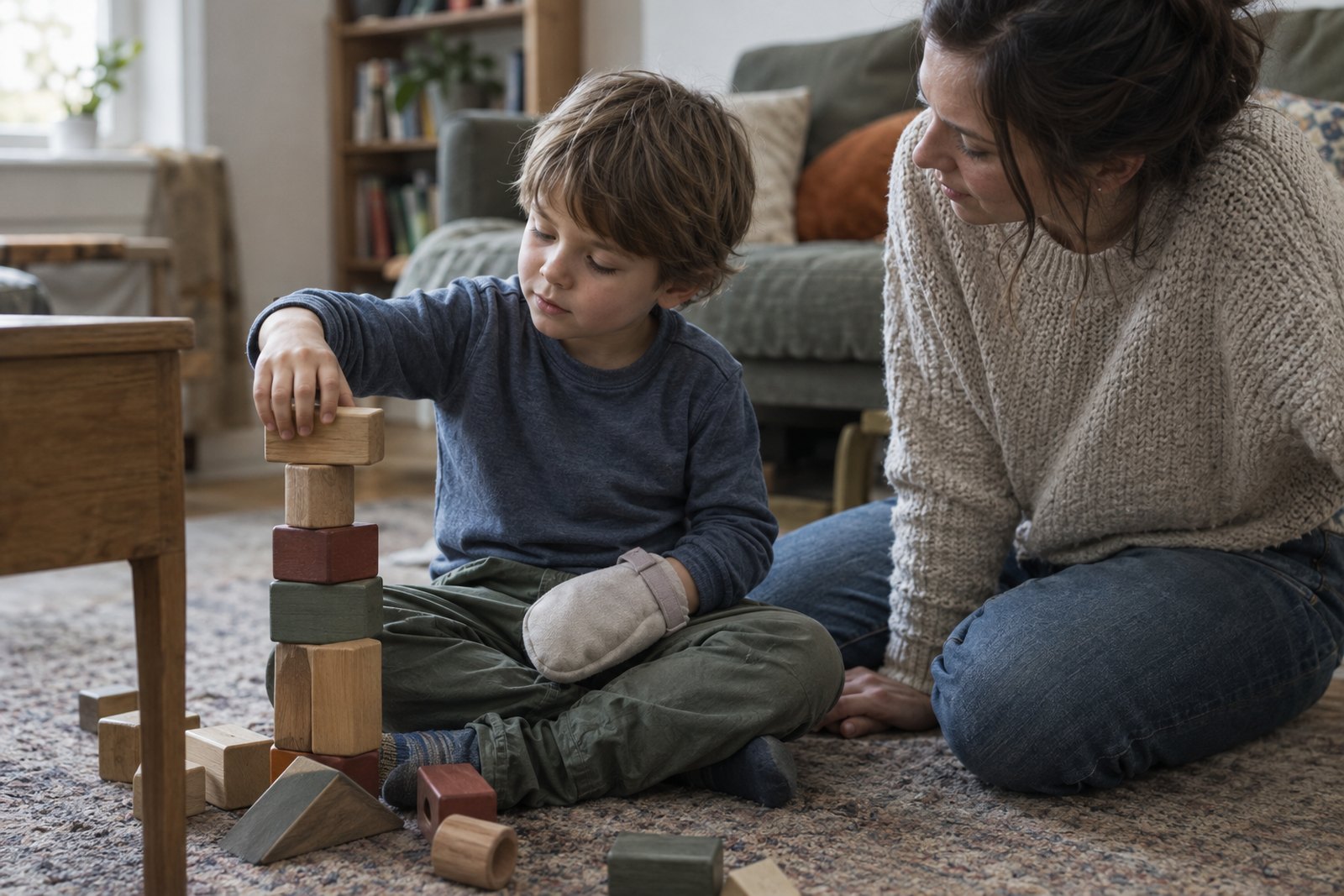
If your child has cerebral palsy and you live in the Staffordshire Moorlands, an occupational therapist can come to your home and look at the everyday things that are hard right now: getting dressed, eating, playing, sitting comfortably, using both hands, and coping at school. That is what occupational therapy is for. It does not cure cerebral palsy. It is about making the day work better for your child, and for you.
You can get this help through the NHS, through school, or privately, and these are not either/or. Some families also ask about constraint-induced movement therapy, usually shortened to CIMT, which is one way of helping a child use a weaker arm and hand more. This guide explains what a home assessment covers, what CIMT actually asks of a family, who leads on what, and how the council can help with adapting your home in the Moorlands.
Who does what in your child's care
Cerebral palsy rarely means one professional. It usually means a team, and it helps to know who holds which part.
- The paediatrician leads on medical care: diagnosis, medication, monitoring, and referrals to other specialists.
- The physiotherapist leads on movement, posture, stretching, walking and gross motor skills, often working with an orthotist on splints and supports.
- The speech and language therapist leads on communication, and on eating, drinking and swallowing.
- The occupational therapist looks at the jobs of daily life: self-care, play, hand use, seating, equipment, the home and school.
A private occupational therapist works alongside that team, not instead of it. If you see one, tell your child's existing professionals and share any reports. It saves duplication and stops your child being pulled in different directions.
One more thing before the practical part. If your child has new pain, loses skills they had, or their movement changes suddenly, talk to your GP or paediatrician promptly. If you are worried and unsure where to turn, call NHS 111. In an emergency, such as a seizure that does not stop or a child who cannot be woken, call 999.
What a home occupational therapy assessment looks at
Seeing a child at home matters. A clinic shows what a child can do on a good morning in a quiet room. Home shows what actually happens at the breakfast table on a school day. A good assessment usually starts with you: what is hardest, what your child wants to do, and what you are running out of energy for.
Self-care
Dressing, washing, toileting, brushing teeth and eating. The therapist watches how your child does these things, where they get stuck, and how much you are doing for them. Often the answer is a mix of a different method, a small piece of equipment, and breaking the task into steps your child can own. Our guide to everyday skills for children with cerebral palsy goes into this in more detail.
Play and hand use
Play is a child's work, and it is where a lot of hand skill is built. The therapist looks at how your child reaches, grasps, lets go, and uses two hands together. For a child with one side more affected, this is where questions about CIMT or other arm and hand training usually come up.
Seating and positioning
How a child sits affects nearly everything else: eating, breathing comfortably, using their hands, concentrating, and joining in at the table with everyone else. The therapist looks at the chairs your child uses at home, how they sit on the floor, and how they are positioned for meals and play. Positioning advice should fit with what your physiotherapist recommends, so expect the two to talk. Our guide to seating for disabled children at home and school explains the options.
Equipment
Bath seats, toilet supports, adapted cutlery, specialist seating, ramps and rails. Some equipment is provided through NHS or council routes, so it is worth asking your child's team before you buy anything. A therapist can help you work out what is genuinely needed, and what will be outgrown in six months.
School
Handwriting, using scissors, getting changed for PE, carrying a tray at lunch, moving around the building. If your child has an Education, Health and Care plan, or you are applying for one, an occupational therapy report can describe their needs in the detail the plan requires. The local authority decides what goes into the plan, but clear evidence helps. Our guide to the EHCP process and what an OT report adds walks through it.
Constraint-induced movement therapy, in plain English
What it is
CIMT is based on a simple observation. A child with one stronger hand will, very sensibly, use that hand for almost everything. The weaker hand gets less practice, so it stays weaker. CIMT gently restricts the stronger hand for set periods, usually with a soft mitt, a splint or sometimes a cast, so that the child has to use the weaker hand. During those periods the child does lots of play and everyday tasks designed to be just hard enough.
The point is not the restriction. The point is the practice. The mitt simply makes sure the practice happens.
Who it is usually for
CIMT is generally considered for children whose cerebral palsy affects one side of the body more than the other, sometimes called hemiplegia or unilateral cerebral palsy. The child usually needs some active movement in the weaker hand to build on. A therapist will assess that before suggesting it.
What it asks of a family
Be honest with yourself here, because CIMT is not a light commitment. Programmes vary in how they are run, but they usually involve regular, frequent sessions over a number of weeks, and much of that practice happens at home with you. That means:
- Finding time most days, around school, siblings and work.
- Turning practice into play your child actually wants to do, which takes ideas and patience.
- Coping with frustration, which is common at the start. A child who cannot do something the quick way may get cross, and so may you.
- Checking skin under any splint or cast, and stopping and asking for advice if something looks wrong.
Done well, families often find their own ways to fit it into the day: a mitt on for a game of shops, a bath-time challenge, snack time with the weaker hand doing the work.
When it is not the right choice
CIMT is not right for every child. It may not suit a child with very little movement in the weaker hand, a child where both sides are significantly affected, or a family going through a period when they simply cannot take on something intensive. There are other ways to work on arm and hand use, including approaches that practise using both hands together, and a therapist should talk through the options rather than push one method. If you are told CIMT is the only answer, it is reasonable to ask why.
NHS, school and private routes
Many children with cerebral palsy are seen by NHS children's therapy services, and that is often where equipment and longer-term support come from. If your child does not have an occupational therapist and you think they need one, ask your GP, your child's paediatrician, or the school's special educational needs coordinator how to be referred.
Families choose a private occupational therapist for different reasons. Some want a detailed home assessment sooner. Some want help with a particular goal, such as dressing before starting school, or a structured programme like CIMT. Some need a report for an EHCP, a grant or a legal case. Going private does not mean leaving the NHS. Your child keeps their place with their existing team.
Help with adapting your home in the Moorlands
If your home makes daily life harder for your child, a Disabled Facilities Grant may help with adaptations such as a level-access shower, ramps, wider doors or a stairlift. Under the standard rules the grant is up to £30,000, and there is no means test when the grant is for a disabled child. These rules are set nationally and can change, so check the current position on GOV.UK.
In the Staffordshire Moorlands, the route works like this:
- For a disabled child, the first contact is Staffordshire County Council's Children and Families Services, who arrange the assessment.
- If the county supports the application, it sends a referral to Alliance Norse: N-Able, the partnership that runs the grant for Staffordshire Moorlands District Council.
- N-Able handles the forms, plans, quotes and builders from start to finish.
The district council approves grants across the area, including Leek, Biddulph, Cheadle, Endon, Cheddleton, Werrington, Blythe Bridge and the villages around them. The council's published policy says applications will normally come with an occupational therapy report, and names a private occupational therapist as one possible source of that report alongside the county council and other agencies. The policy online is marked as a draft, and the council's policies can change, so check with N-Able or the county how a private report would be used before you book one. Our Staffordshire Moorlands grant page has the contact details and more on how it works.
Georgie Leeson, occupational therapist in the Staffordshire Moorlands
The occupational therapist listed for this area on our directory is Georgie Leeson, a Clinical Specialist Occupational Therapist who works with children and young people with complex needs. Georgie visits families at home across the Staffordshire Moorlands, so assessments happen where your child actually lives and plays.
Georgie's profile lists cerebral palsy, autism and ADHD among the conditions Georgie specialises in, and names Constraint-Induced Movement Therapy as one of the techniques used, along with Cognitive Orientation to daily Occupational Performance, an approach where children learn to work out their own strategies for tasks they find difficult. The profile describes a focus on participation and independence, thorough assessments leading to individual plans, and working closely with families, schools and other health professionals so that therapy fits together rather than happening in separate boxes.
Georgie is HCPC registered, and children's therapy and sensory needs are among the services Georgie offers. You can read more about what a children's occupational therapy service involves on our site.
Frequently asked questions
Can occupational therapy help my child with cerebral palsy?
It can help with the practical side of daily life: self-care, play, hand use, seating, equipment and school. It works alongside physiotherapy and medical care rather than replacing them, and the goals should be ones that matter to your child and your family.
Is constraint-induced movement therapy safe?
When it is planned and supervised by a qualified therapist, CIMT is a recognised approach for suitable children. It should not be improvised at home without guidance. Any splint or cast needs regular skin checks, and you should stop and ask for advice if your child is in pain or the skin looks sore.
Does CIMT work for every child with cerebral palsy?
No. It is usually considered for children with one side more affected and some movement in the weaker hand. It also needs a family that can commit time to regular practice. A therapist should explain other options if CIMT is not a good fit.
Will a private OT report be accepted for a grant in the Moorlands?
The council's published policy names a private occupational therapist as one source of the report that normally comes with an application. That policy is marked as a draft, so check with N-Able or the county council before you book a private assessment for this purpose.
Do we lose our NHS therapy if we go private?
No. Seeing a private therapist does not affect your child's place with NHS services. Let your child's team know, and share any reports so everyone is working from the same picture.
Next steps
If you would like a home assessment for your child, you can read Georgie's profile, check the prices page, and send Georgie an enquiry describing what is hardest for your child right now and what you would most like to change.