

Special Needs Chair for a Child: Postural Seating at Home and School
By Mobile Occupational Therapist • 23 October 2026 • 14 min read
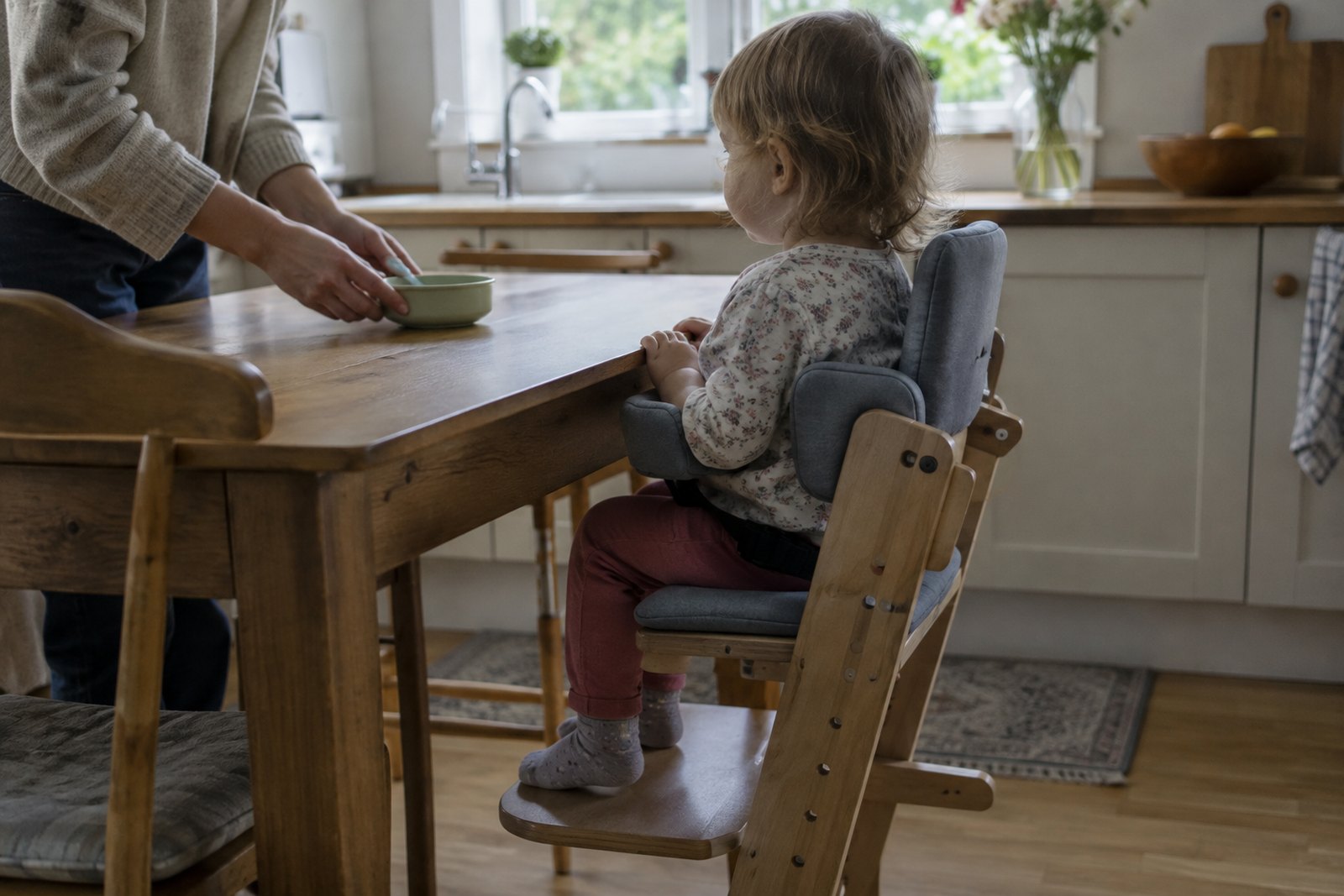
If your child slumps, slides, leans or tires quickly when sitting, an ordinary chair may not be giving them enough support. A special needs chair for a child, more properly called postural or supportive seating, holds the body in a steady position so the child does not spend all their energy just staying upright. That frees them up to eat, play, talk, use their hands and learn.
Postural seating is usually assessed by a children's occupational therapist or physiotherapist, and often both. At school it is normally arranged through SEN support or an education, health and care plan. At home it may come through NHS children's therapy, the council or the local community equipment service, depending on where you live. Before any of that, there is a fair amount you can check and change yourself, today, with things already in the house.
Why good seating matters so much
Most of us never think about sitting. We shift, cross our legs, lean on the table, and our muscles quietly do the rest. For a child with low muscle tone, high tone, weakness, poor balance or a condition such as cerebral palsy, sitting is work. Sometimes it is the main piece of work they are doing, and everything else gets whatever is left over.
Good seating helps in several ways:
- Hands and learning. A stable trunk and pelvis give the arms and hands a steady base. Children who are not fighting to stay upright often draw, write, use a tablet or play with toys more easily.
- Eating and drinking. An upright, even position with the head slightly forward generally makes chewing and swallowing easier. Slumped or tipped-back sitting can make mealtimes harder and messier.
- Breathing and talking. A child folded forward or collapsed to one side has less room for their chest to move.
- Comfort and attention. Discomfort looks a lot like poor behaviour. Wriggling, getting up and refusing to sit are often a body asking for support.
- Joining in. The right chair can put a child at the same height as the family at the table, or alongside classmates, rather than off to one side.
- Protecting the body over time. For some children, especially those who cannot easily change position themselves, sitting in the same lopsided posture day after day can contribute to tight muscles, changes at the hips and curves of the spine. Good positioning is one part of protecting against that. A physiotherapist usually leads on this, sometimes as part of a wider postural management plan covering sitting, lying and standing across the whole day and night.
Signs your child may need more support
You do not need to be a therapist to spot these. Watch your child for ten minutes at a meal or doing something at the table, and notice whether they are:
- Slumping into a C shape, with the head dropping forward.
- Sliding forward so their bottom ends up at the front edge of the seat and they are almost lying down.
- Leaning or falling to one side, or always propping on one elbow.
- Resting their head on a hand or on the table.
- Wrapping their legs round the chair legs, or hooking their feet behind them, to hold on.
- Sitting with feet dangling, or kneeling up on the chair.
- Fidgeting constantly, getting up and down, or refusing to sit at all.
- Fine for the first few minutes, then falling apart as they tire.
- Managing hand tasks better lying on their tummy or supported on the floor than sitting at a table.
- Getting red marks on the skin after sitting, or complaining of a sore bottom, back or legs.
Children with low muscle tone often show several of these. Our guide to hypotonia and low muscle tone in children explains why sitting is so tiring for them and what helps beyond seating.
When to see a GP or get help quickly
Seating is not the answer to everything. Speak to your GP or your child's paediatrician if you notice a new curve in the spine, one hip or leg looking different from the other, pain when moving or sitting, or your child losing skills they used to have. If your child often coughs, splutters or seems to struggle while eating or drinking, or has repeated chest infections, ask about a referral to a speech and language therapist, who assesses swallowing. If your child is choking and cannot breathe, call 999.
Basics you can check at home today
Before thinking about specialist chairs, get the basics right. They apply to almost every child, and small changes can make a surprising difference.
Feet supported
Feet should rest flat on something solid: the floor, a footplate, or a firm box or step. Dangling feet let the pelvis roll and make sliding and slumping much more likely. A sturdy footstool or a wooden box works well at home. Check it cannot slide or tip, and that it is big enough for both feet.
Hips, knees and ankles
As a rough guide, aim for hips, knees and ankles each bent at about a right angle, with the thighs level and supported along most of their length. Some children need different angles, and a therapist may advise otherwise, but this is a sensible starting point.
Seat depth and width
The seat should end just behind the knees, leaving a gap of roughly two or three of your fingers. If the seat is too deep, the child slides forward so their knees can bend over the edge. A firm cushion behind the back can shorten a deep seat. If the seat is far too wide, a child may lean to one side. Rolled towels down the sides can help for now, but they are not a long-term fix.
Table height
With your child sitting well and shoulders relaxed, the table should be roughly at elbow height or a little above. Too high and the shoulders hunch up; too low and they bend over it. A booster seat with a footrest at the family table, or a lower table for play, often solves this.
Stop the slide
A thin non-slip mat on the seat can stop a child edging forward. A firm seat is usually better than a soft, squashy one, which lets the pelvis sink and tilt.
What not to do: do not improvise straps or belts, and do not wedge a child in so tightly they cannot move or get out. If you feel straps are needed, that is a sign it is time for a proper assessment.
Types of supportive seating, in plain terms
There is a wide range of children's seating. Names vary between suppliers, but most chairs fall into a few broad groups.
Classroom chairs with supports
These look much like an ordinary school chair but adjust in seat height, depth and back angle, usually with a footrest. Extras might include a pelvic positioning belt, small side supports or a shaped back. They suit children who mainly need a stable base and their feet supported, and they blend in with classmates.
Activity chairs
Modular, very adjustable chairs that can be built up with accessories: a shaped back, side supports for the trunk, a headrest, knee blocks, a pommel between the knees to keep the legs apart, a tray, and sometimes tilt. They suit children who need support in several places. They can be bulky, and setting one up well matters far more than the number of extras bolted on.
High-low chairs
These raise and lower over a large range, from close to the floor up to table height, and many tilt back. They are useful for younger children and for families who move between floor play, the table and care tasks, and they can cut down on lifting for parents.
Floor sitters and corner seats
Low seats that support the back and sides so a child can sit on the floor and play at the same level as siblings or classmates. They are often used for younger children or floor-based activities.
The rest of the picture
Some children also use a feeding chair, a supportive bath seat, a standing frame or a lying support. Wheelchairs come through NHS wheelchair services, and car seats are a separate matter again. A specialist chair is rarely the whole answer, and no child should spend all day in one position, however good it is.
Who assesses for postural seating
Children's occupational therapists and physiotherapists both work with seating, and in many areas they assess together.
- Physiotherapists usually lead on posture, muscle tone, hip and spine health and the overall postural management plan.
- Occupational therapists usually focus on what the child needs to do while sitting: eating, playing, writing, using a computer, joining in at school and at home. They look at the chair, the table, other equipment and the room together.
An assessment usually involves watching your child in their usual chairs, checking body shape and how far joints move, measuring, and often trying a chair or two. The therapist then recommends a type and set-up, shows you and the school how to use it, and should agree when it will be reviewed.
To get an NHS children's therapy assessment, ask your GP, health visitor, paediatrician or the school SENCO about a referral. Some services accept referrals directly from parents. Waiting times vary a great deal between areas, so ask what to expect.
Getting seating at school
In England, schools are expected to meet many special educational needs from their own resources through SEN support. Seating recommended by a therapist for use in class is often provided by the school, sometimes with help from the local authority or the NHS service, though who pays varies by area. If your child has, or is being assessed for, an education, health and care plan, seating and the therapy to set it up can be written into the plan. Our guide to EHCPs and what an occupational therapy report adds explains how. Arrangements in Scotland, Wales and Northern Ireland are different, so check with the school or your council.
A few practical things to agree with school:
- Who checks the chair is set up correctly each day, especially footrests and belts.
- How long your child should sit, and what other positions they use during the day.
- That the chair goes with your child for different lessons, or that there is suitable seating in each room.
- Who to contact when your child grows or the chair stops working for them.
Getting seating at home
Home seating comes through a patchwork of routes. Depending on your area, it may be provided by NHS children's therapy services, loaned through the community equipment service, or arranged by the council's children's social care team, which may have its own occupational therapist. If caring for your child at home is getting harder, ask the council for an assessment. A parent carer needs assessment looks at what you need as well.
Loaned equipment usually belongs to the service and goes back when it is outgrown. Some families buy privately or apply to charities for grants. If you are buying, get advice first. Specialist chairs are expensive, and one that is wrong for your child's body can make things worse. Equipment designed for disabled people can sometimes be bought without VAT; check the current rules on GOV.UK.
Reviews as your child grows
Children's seating is never finished. Many chairs are designed to adjust with growth, but someone has to actually adjust them. Ask for a review if:
- The seat now stops well short of the knees, or feet no longer rest flat on the footplate.
- Side supports sit too low, or the headrest is behind the neck rather than the head.
- Your child has had a growth spurt, surgery, new splints or orthoses, or treatment for muscle tone.
- Slumping, sliding or leaning have come back.
- Red marks, pain or new reluctance to sit appear.
- Your child is moving class or school.
A quick check once a month helps: sit your child in the chair, look from the front and the side, and compare with photos taken when it was first set up. Those photos are worth having on your phone.
Where an occupational therapist fits
An occupational therapist looks at seating through the lens of daily life. The question is not just whether your child sits straight, but whether they can eat a meal, build with bricks, write a sentence or sit with the family without exhausting themselves. An occupational therapist can assess seating at home and school, recommend types of chair and set-up, advise on tables, footrests and other equipment, and help staff and family use it well.
NHS and council services are the usual first route, and much of what your child needs may come that way. A private occupational therapist visiting at home can help if you are waiting, want advice before buying, need seating looked at across home and school together, or want an independent report for an EHCP. See our children's occupational therapy page for more.
Be clear about the limits. If your child has concerns about their hips or spine, a physiotherapist and paediatrician lead, and any private recommendation should fit with their plan. Wheelchairs come through NHS wheelchair services. Swallowing problems are for a speech and language therapist. New pain or loss of skills is for your GP.
Frequently asked questions
Can I just buy a special needs chair for my child myself?
You can, but get an assessment or at least advice first. These chairs are costly, the range is wide, and the right choice depends on your child's body, what they need to do and the space you have. A chair that looks supportive in a photo may push your child into the wrong position.
Will the school chair come home, or the home chair go to school?
Usually not. Equipment bought by a school normally belongs to the school, and equipment loaned for home belongs to the service that loaned it. Many children end up with one chair in each place. If that is not happening and your child needs it, raise it with the SENCO or in EHCP discussions.
How long should my child sit in a supportive chair?
There is no single answer. Even well-supported children need regular changes of position, movement breaks and time out of the chair. Ask the therapist who set it up how long is right for your child and write it down for school and anyone else who looks after them.
Is a wobble cushion or footstool enough?
For some children with mild difficulties, a firm footrest, the right table height and a non-slip seat solve most of the problem. A wobble cushion can help some children who need to move, but it adds instability, which is the opposite of what a child who slumps or leans usually needs. If simple changes have not helped, ask for an assessment.
Does the chair need straps or a harness?
Some children need a pelvic belt or more support to sit safely, and some do not. Belts and harnesses should only be used as prescribed and set up by a therapist, to support posture, never to stop a child moving about. Never leave a child unsupervised in a harness.
My child hates the chair. What now?
Take it seriously. It may be uncomfortable, set up wrongly, too restrictive, or simply different from what siblings or classmates use. Tell the therapist, describe what happens, and ask for a review. Small changes to fit, padding or how it looks can make a big difference to whether a child will use it.
Next steps
See our equipment and aids page, or current guide prices, and choose your area below.

Talk to an occupational therapist near you
This guide is general information. For advice about your own situation - or someone you look after - a local occupational therapist can visit you at home and see it for themselves.
Choose your area: