

Back Surgery Recovery at Home: The First Weeks, Practically
By Mobile Occupational Therapist • 13 October 2026 • 14 min read
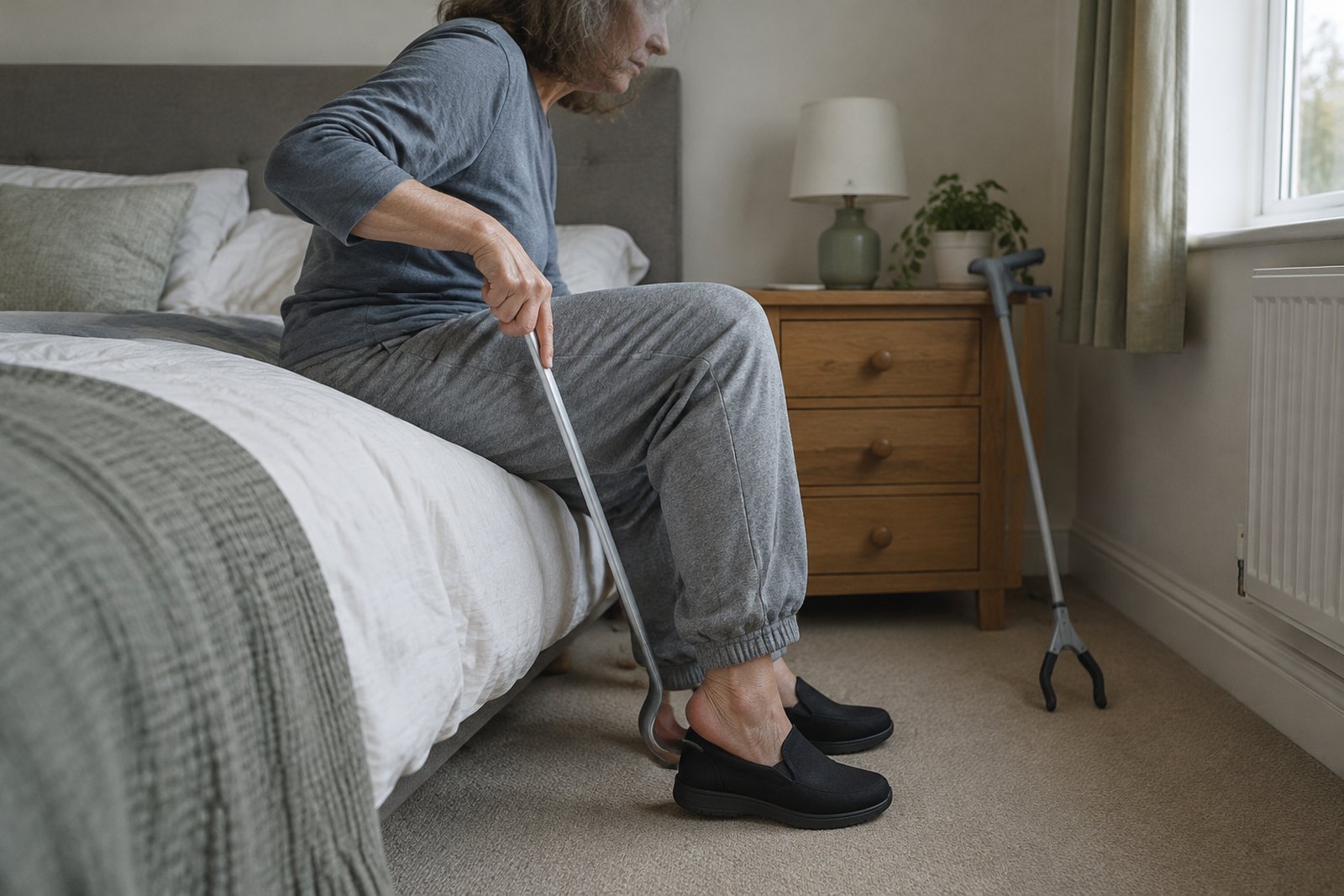
Recovering from back surgery at home mostly comes down to three things in the first weeks. You follow your surgical team's instructions exactly. You keep moving gently and often, usually by walking. And you change how you do ordinary things, like getting out of bed, sitting, dressing and using the toilet, so you are not bending, twisting or straining while the area heals.
That applies whether you have had a lumbar decompression, a discectomy or a spinal fusion, though fusion usually comes with stricter limits for longer. This guide covers the practical side: getting the house ready, the log roll, chairs, socks, showers, the car, sleep and work. It also covers the warning signs that mean you need help today, not next week. Read that section even if you skip the rest.
Your surgical team's instructions come first
Every spinal team gives slightly different advice, and it depends on what was done, how your surgery went and your own health. If anything here differs from what your surgeon, ward physiotherapist or discharge letter says, follow them, not us. If the advice you were given is vague (it often is, and you were often groggy when you heard it), ring the ward or the number on your discharge paperwork and ask. Write the answers down. Things worth asking:
- How long should I avoid bending, lifting and twisting? Some teams shorten this to BLT.
- Is there a limit on how long I should sit at a time?
- When can the wound get wet, and when should stitches or clips come out?
- When can I drive, and when can I be a passenger on a long journey?
- What exercises should I be doing, and how far should I be walking?
- Who do I ring with a worry, in and out of hours?
Getting the home ready before surgery
If you have a date, the week before is the time to organise. It is far easier to move the kettle now than to work out at nine at night, with a sore back, that the mugs are in the bottom cupboard.
- Bring things to waist height. Move everyday items in the kitchen, bathroom and bedroom to between hip and shoulder height. Nothing you need daily should be on the floor or in a low cupboard.
- Sort out a chair. You want a firm chair with arms, high enough that your hips are level with or slightly higher than your knees. Low, squashy sofas are hard to get out of without bending and pushing through your back.
- Check the bed height. When you sit on the edge, your feet should be flat on the floor with your knees at roughly a right angle. Very low beds are hard work.
- Clear the floor. Rugs, trailing cables, shoes, the dog's toys. A trip now is the last thing you need.
- Stock up. Freezer meals, easy snacks, a supply of drinks. Ask someone to do the heavy shopping for the first few weeks.
- Get slip-on shoes with a back to them, and loose clothes with elastic waists.
- Think about the toilet and shower (more on both below) and whether you need equipment in place before you come home.
- Line up help. Someone around for at least the first few days is a real help, especially with laundry, bins, pets and anything on the floor.
Some hospitals run a pre-operative clinic or an occupational therapy assessment before fusion surgery and may provide basic equipment. Ask whether yours does. If not, our guide to coming home from hospital covers what to ask before you leave the ward.
Getting in and out of bed: the log roll
You will probably be shown this on the ward. It keeps your shoulders and hips moving together so your spine does not twist.
Getting out of bed
- Lying on your back, bend both knees up so your feet are flat on the mattress.
- Roll onto your side as one unit, shoulders and knees turning together, towards the edge of the bed you want to get out of.
- Slide your lower legs over the edge of the bed.
- At the same time, push up with your underneath elbow and your top hand on the mattress. Your legs going down helps your body come up.
- Sit on the edge for a moment before you stand, especially in the night or if you feel lightheaded.
Getting into bed
Do the same in reverse. Sit on the edge, lower yourself down onto your side using your arms while lifting your legs onto the bed, then roll onto your back with your knees bent. If lifting your legs onto the bed is a struggle, a leg lifter or a bed lever can help; see our guide to leg lifters and bed levers.
Sitting
Sitting is often what people find hardest early on, particularly after fusion. Many teams advise short spells of sitting at first, building up gradually. Some practical points:
- Use a firm, upright chair with arms. Sit right back, feet flat on the floor.
- A small cushion or rolled towel in the small of your back can feel more comfortable.
- To stand, shuffle forward to the edge of the seat, put your feet slightly back, and push up through the chair arms with your back straight. Lean forward from the hips, not by curling your spine.
- Change position often. Stand up, walk around the room, then sit again.
- Avoid low sofas, reclining deep into soft chairs, and sitting cross-legged.
If your chairs are all too low, furniture raisers or a firm cushion can add height. Get the height right rather than guessing, as too high is unstable too.
Dressing the lower half
Socks, shoes, pants and trousers all involve bending to your feet, which is exactly what you are often told to avoid. A few cheap aids make a big difference:
- A sock aid: a flexible gutter you put the sock over, drop to the floor using its long cords, slip your foot into and pull up.
- A long-handled reacher (grabber) for pulling trousers and pants up from the floor and picking things up.
- A long-handled shoehorn and slip-on shoes or elastic laces.
- A dressing stick for pushing garments off your feet.
Sit on the edge of the bed or a firm chair to dress. Put your trousers and pants on together: use the reacher to get them over your feet, pull them up to your knees, then stand and pull them up the rest of the way. Do the reverse to undress. Practise with the aids before your operation if you can, because they feel clumsy the first few times. Our guide to dressing aids explains each one in more detail.
Washing and showering
Your team will tell you when the wound can get wet and what dressing to use. Until then, a strip wash at the basin is fine, sitting on a stool or chair if standing for long is tiring.
- A long-handled sponge or brush helps you reach your legs and feet without bending.
- If you have a walk-in shower, a shower stool or chair lets you sit to wash your lower legs. A non-slip mat matters.
- Getting into a bath, or stepping over the side into a shower over a bath, usually needs bending and lifting a leg high. Many people are advised to avoid it early on. Check with your team, and if you have no other option, ask about a bath board or other equipment before you try.
- Pat the wound dry rather than rubbing, and keep an eye on it (see the warning signs below).
The toilet
A standard toilet is low, and sitting down and getting up from it involves a lot of bending. A raised toilet seat, a toilet frame, or both, can make it much easier and safer. Our guide to raised toilet seats, frames and rails explains the options. Use long-handled toilet tongs if reaching behind to wipe is difficult.
Constipation is common after surgery, partly from strong painkillers and partly from moving less. Straining is uncomfortable and puts pressure through your back. Drink plenty, eat fibre where you can, keep walking, and talk to your pharmacist or GP if it is a problem. Constipation is not the same as the bladder and bowel warning signs below, which are an emergency.
Lifting, bending and household jobs
The rules vary, so check yours. In general, people are advised in the early weeks to avoid lifting anything heavier than a light object, avoid bending down to the floor, and avoid twisting while carrying. In real life that means:
- No hoovering, mopping, carrying laundry baskets, emptying the washing machine from the floor or putting out the bins.
- No lifting children, shopping bags, pets or garden pots.
- Carry things close to your body, and use a kitchen trolley or bag on a walking frame if you have one to move plates and drinks.
- If you must get lower, bend your knees and keep your back straight, holding onto something sturdy. Better still, use the reacher.
Walking
Walking is usually the main thing you are encouraged to do. Little and often beats one long walk. Start with short walks around the house, then outside on flat ground, gradually going further as your team and physiotherapist advise. Wear supportive shoes. On stairs, go one step at a time holding the rail. Expect some days to be better than others; a bad day is not necessarily a setback, but a steady worsening is worth reporting.
Sleep
Many people sleep badly for the first weeks. Positions that tend to be comfortable are on your back with a pillow under your knees, or on your side with a pillow between your knees to keep your hips and spine lined up. Use the log roll to change sides. A reasonably supportive mattress helps; a very soft or sagging one can make things harder. Short daytime rests are fine but keep moving between them.
Car travel
You will probably go home as a passenger. Push the seat right back and recline it slightly. Get in bottom first: stand with your back to the seat, lower yourself down, then swing your legs in together while turning your whole body as one. A plastic bag on the seat can make it easier to swivel; take it out before you set off. Keep early journeys short and stop for breaks on longer ones.
As for driving yourself, the NHS advice is not to drive until you can safely do an emergency stop and comfortably look over your shoulder, and to check with your surgeon. Do not drive if your painkillers or other medicines make you drowsy or slow your reactions, as driving while impaired by medicines is an offence; ask your pharmacist or GP if you are unsure. Tell your insurer you have had surgery. If you are unsure whether your condition needs reporting to the DVLA, check the guidance on GOV.UK.
Going back to work
When you return depends on the surgery and the job. Desk-based work usually comes sooner than heavy manual work, which may need a much longer gap or adjusted duties. Your surgeon or GP can give you a fit note, which can suggest changes such as reduced hours or lighter tasks. A gradual return often works better than going straight back full time; see our guide to a phased return to work. Think about your commute, your chair and how long you will be sitting.
Warning signs: when to get help urgently
Go to A&E or call 999 straight away if you have:
- New numbness or tingling around your genitals, bottom or inner thighs (the area you would sit on in a saddle).
- New problems with your bladder or bowels, such as not being able to pee, not knowing when you need to go, or leaking.
- New or worsening weakness in one or both legs, or new numbness in both legs.
- Sudden breathlessness, chest pain, or coughing up blood.
The first three can be signs of pressure on the nerves at the base of the spine, called cauda equina syndrome, which needs emergency treatment. The last can be a sign of a blood clot in the lung.
Contact your surgical team, GP or NHS 111 the same day if you have:
- Pain, swelling, warmth or redness in one calf or leg, which can be a sign of a blood clot.
- A wound that is red, hot, increasingly painful, swollen, leaking fluid or pus, or opening up.
- A high temperature or feeling hot and shivery.
- Clear fluid leaking from the wound, or a severe headache that gets worse when you sit or stand up.
- Pain that is steadily getting worse instead of better.
Where an occupational therapist fits
Your surgeon leads on the operation, your wound and your restrictions. A physiotherapist usually leads on exercises, walking and building strength back up. Your GP handles pain relief, fit notes and anything worrying in between. An occupational therapist focuses on the everyday tasks in your actual home: getting in and out of bed, the toilet, washing, dressing, the kitchen, and work.
In the NHS, hospital occupational therapists often see people before or after spinal surgery, particularly fusion, and may arrange equipment. If that did not happen, or you want help sooner or in more depth, a private occupational therapist visiting at home can:
- Look at your home before surgery and tell you what to move, what equipment you need and what height it should be.
- Measure chairs, beds and toilets properly, and show you and your family how to use equipment.
- Help you plan the first weeks if you live alone or care for someone else.
- Help plan a return to work, including your workstation and duties.
If you are leaving hospital and the plan feels thin, our hospital discharge page explains how an occupational therapist can help. An occupational therapist will not change your surgical instructions and cannot assess new symptoms; those go back to your team or GP.
Frequently asked questions
How long does recovery from lumbar decompression take?
It varies a lot. Many people are walking around the day after surgery and managing basic tasks within a few weeks, but full recovery takes longer, and fusion usually takes longer again. Your surgeon is the right person to give you a realistic timeframe for your operation and job.
Is it normal to still have leg pain after back surgery?
Some leg pain, numbness or tingling can take time to settle as the nerve recovers, and some people have pain from the wound itself. Pain that is getting worse, or new weakness or numbness, needs reporting. Numbness around the bottom or genitals, or bladder or bowel changes, is an emergency.
Can I sleep on my side after back surgery?
Usually yes, unless your team says otherwise. A pillow between your knees keeps your spine straighter. Use the log roll to turn over rather than twisting.
Do I need to buy equipment?
Not always. A reacher, sock aid and long-handled shoehorn are inexpensive and very commonly used. Bigger items such as toilet frames or chair raisers may be provided by the hospital or your local council's community equipment service if an assessment shows you need them. Ask before you buy.
When can I go back to the gym or gardening?
Ask your surgeon and physiotherapist. Heavy lifting, digging and high-impact exercise are usually some way down the line, especially after fusion. Your physiotherapist can build you up to them safely.
What if I live alone?
Plan ahead. Prepare the house, stock up on food, arrange someone to check in daily at first, and keep your phone with you. Tell the ward you live alone before discharge, as it may change what support they arrange.
Next steps
If you want help preparing your home before back surgery or managing after it, see our home assessment page, or current guide prices, and choose your area below.

Talk to an occupational therapist near you
This guide is general information. For advice about your own situation - or someone you look after - a local occupational therapist can visit you at home and see it for themselves.
Choose your area: