

Arm Recovery After Stroke: Everyday Practice at Home
By Mobile Occupational Therapist • 26 October 2026 • 14 min read
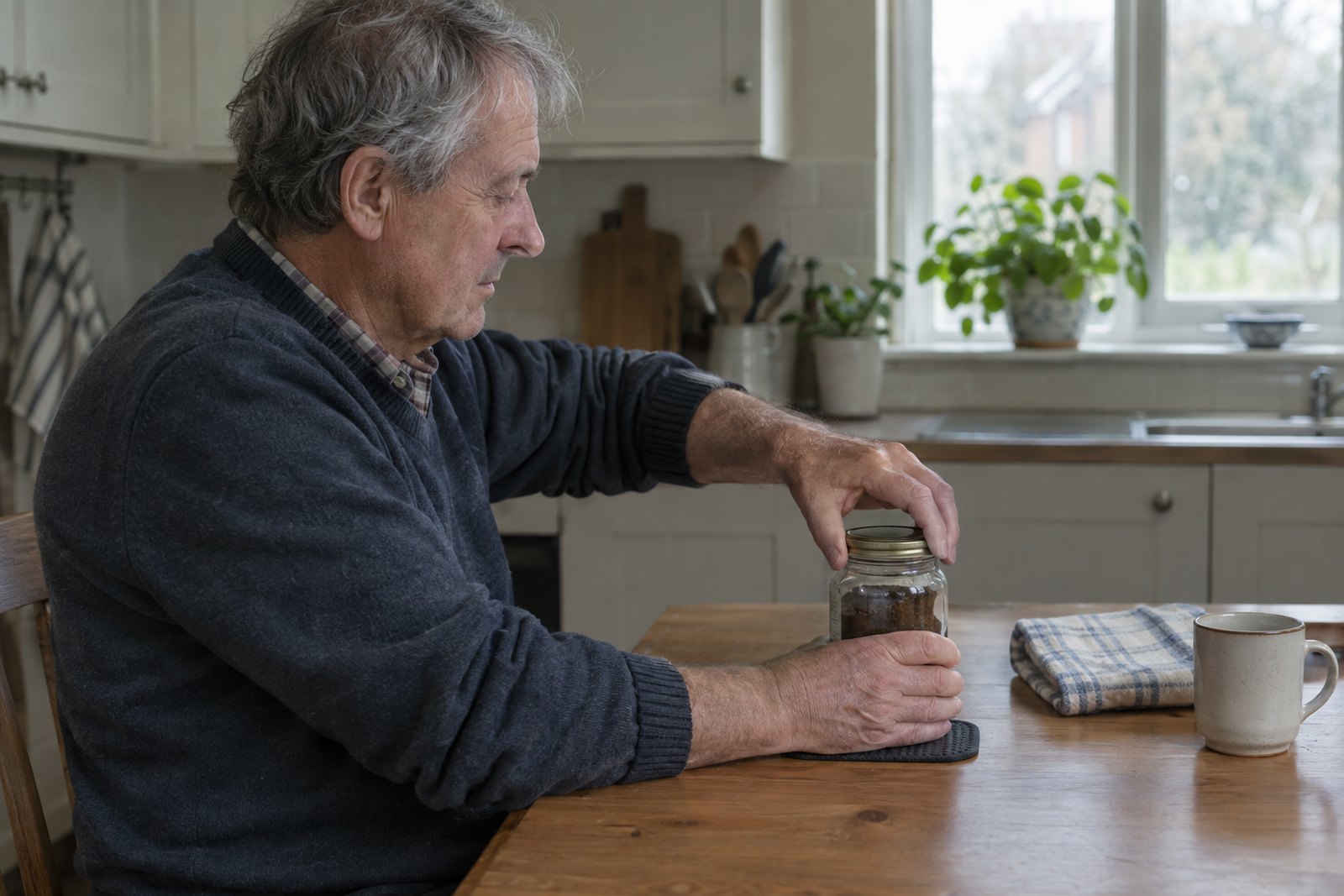
Arm and hand recovery after a stroke depends heavily on practice: lots of it, little and often, using the weaker arm in real tasks as well as in set exercises. The brain relearns movement by doing. The arm that sits in your lap all day tends to lag behind the arm that is asked to help with the washing up. Many people make their quickest gains in the early weeks and months, but improvement can carry on well beyond that, especially if the practice carries on too.
The first rule is simple. Your stroke team's programme comes first. The physiotherapists and occupational therapists who assessed you have looked at your arm, your shoulder, your feeling and your balance, and set exercises that suit where you are now. This article is about the rest of the day: how to turn ordinary jobs at home into practice, how to look after the shoulder, and what to do when progress stalls or tiredness wins.
Why repetition matters so much
After a stroke, the parts of the brain that controlled the arm may be damaged, but other areas can learn to take on some of that work. That learning needs repetition. Not ten goes at an exercise once a day, but movement repeated over and over, spread across the day, in ways that matter to you.
This is why therapists keep saying "use it". When an arm is weak, people quite sensibly start doing everything one-handed. It is quicker, less frustrating and the job gets done. The trouble is that the brain becomes very good at one-handed living and the weaker arm gets left behind. Therapists sometimes call this learned non-use. You do not need to make every task two-handed, which would be exhausting, but you do want the weaker arm involved in something most hours of the day.
Real tasks have another advantage over exercises: they have a point. Wiping a table until it is clean is more interesting than lifting your arm ten times, and tasks with a purpose are easier to keep doing week after week. Exercises still matter, because they target specific movements your therapist wants to build. Everyday practice fills the long gaps between them.
Start with what your stroke team has set
Before adding anything, check what you have already been given. If you came home with an exercise sheet, keep it somewhere you will actually see it, not in a drawer. If you are not sure whether a movement is safe for you, ask your community stroke team, early supported discharge team or GP before trying it. Questions worth asking:
- Which movements should I practise, and roughly how often?
- Is it fine to lean or put weight through my weaker arm, for example on a table?
- Is there anything I should avoid, such as reaching overhead?
- How should my arm rest when I am sitting and lying down?
- What signs mean I am overdoing it?
Using the weaker arm in real tasks
What you can do depends on how much movement has come back. Broadly, people fall into three groups, though everyone is different and you may move between them over weeks or months.
Little or no movement yet
Even with no active movement, the arm can still be part of the day. Keep it where you can see it, resting on the table in front of you rather than hanging at your side or tucked out of sight. People who have reduced awareness of one side often need gentle, repeated reminders that it is there.
- Rest the weaker hand flat on a sheet of paper to hold it still while you write with the other.
- Use the weaker forearm to steady a newspaper or a plate, if your therapist is happy with that position.
- With your stronger hand, gently take the weaker one through movements your therapist has shown you, such as straightening the fingers or turning the palm up.
- Some stroke teams suggest watching yourself do a task with the stronger arm and imagining the weaker one doing it. Ask whether this would suit you.
Some movement returning
This is where everyday tasks really earn their keep. The weaker arm does not have to do the hard part. Its first job is often to hold or steady while the stronger hand does the fiddly bit.
- Stabilising a jar while the other hand turns the lid. A damp cloth or non-slip mat underneath stops it spinning.
- Holding a bowl still while you stir.
- Wiping a table or worktop with a cloth under the weaker hand: pushing forward, drawing back, making circles. Your stronger hand can sit on top to guide it at first.
- Folding laundry: smoothing a towel flat, pairing socks, pulling a pillowcase straight.
- Carrying light, unbreakable items: a tea towel, an empty plastic cup, a cushion from one chair to another, a soft toy for a grandchild. Not hot drinks, and nothing you would mind dropping.
- Small household moves: pushing a door open, switching on a light, opening a drawer.
- In the bathroom: holding the toothbrush while the other hand adds toothpaste, or rinsing the weaker hand under the tap once you have checked the water with the stronger one.
Good movement, but slow or clumsy
Now the focus moves to speed, control and fine skills.
- Picking up coins, buttons or dried pasta and dropping them into a pot.
- Doing up large buttons, then smaller ones.
- Pegging out washing, or clipping pegs onto the edge of a box.
- Turning pages, dealing cards, playing dominoes.
- Writing a shopping list, however messy.
- Peeling a satsuma or buttering toast.
- Drinking from a half-full cup of a cool or cold drink with the weaker hand while sitting at the table.
Fitting practice into the day
Most people practise more when it is tied to things that already happen. A few ideas:
- Pick one job per room for the weaker hand: it opens the fridge in the kitchen, holds the toothbrush in the bathroom, switches on the lamp in the lounge.
- Use the kettle boiling or the adverts as a cue for a few minutes of your exercises.
- Let the weaker arm try first, then help with the stronger one if needed, rather than defaulting to the good hand.
- Short sessions spread through the day are usually easier to sustain than one long one.
- Accept that things will be slower and leave time for it. Practice is the first thing dropped when you are rushing.
Positioning and protecting the shoulder
The shoulder is the part most easily hurt after a stroke. When the muscles around it are weak, the weight of the arm can drag on the joint, and the shoulder can become painful. Pain makes practice much harder, so protecting the shoulder is part of recovery, not a separate job.
- Sitting: support the weaker arm on a pillow, a table or the arm of the chair rather than letting it hang.
- Standing and walking: ask your therapist how best to support the arm. Do not buy a sling without advice, because they are not right for everyone.
- Lying down: follow the positions your team has shown you. A pillow under the arm often helps.
- Moving and helping: nobody should pull on the weaker arm or lift under that armpit to help you stand or move up the bed. Ask the team to show family safe ways to help.
- Exercise: avoid overhead pulleys or swinging the arm about unless a therapist has told you to.
- Dressing: weaker arm into the sleeve first, out of it last.
If the shoulder becomes painful, the hand swells, or the arm becomes stiff and tight, tell your stroke team or GP rather than pushing through. Tightness has its own management, explained in our guide to spasticity after a stroke or MS. For practical day-to-day life with weakness down one side, including washing and dressing, see living with one-sided weakness after a stroke.
When feeling has changed
Many people find the weaker hand does not feel properly. It may be numb or tingly, or unable to tell what it is holding without looking. This matters for recovery, because the hand relies on feeling to judge how hard to grip. It also matters for safety, because a hand that cannot feel heat can be burned without you noticing.
Sensory retraining is a group of approaches therapists use to help the brain make sense of touch again. In general terms it involves practising noticing and telling apart textures, shapes, temperatures and positions, often first without looking and then checking with your eyes. Your therapist can tell you whether it suits you. At home you can support it by handling different textures during the day (a rough towel, smooth crockery, a woolly jumper) and paying attention to what you feel, and by watching your hand while you use it so your eyes make up for missing feeling.
Safety habits to build in:
- Test bath and washing-up water with your stronger hand.
- Keep the weaker hand clear of hobs, oven doors, radiators and hot water bottles.
- Check the hand and arm each day for cuts, marks or redness you may not have felt.
Mirror therapy and constraint-induced approaches
You may come across these two online. Both are genuine approaches with research behind them, and both work best when set up by a therapist who has assessed you.
Mirror therapy
A mirror is stood upright between your arms so that you see the reflection of your stronger arm where the weaker one should be. As the stronger hand moves, the brain sees what looks like the weaker hand moving. It is used for movement and sometimes for pain. It looks simple, but it is easy to do in a way that achieves little, and some people find it confusing or upsetting. Ask your therapist whether it is worth trying and exactly how to do it.
Constraint-induced movement therapy
This involves restricting the stronger arm, often with a mitt, for part of the day so the weaker arm has to do the work, alongside intensive practice. It only suits people who already have some active movement in the wrist and fingers, and it is demanding. Restricting the good arm can also affect your balance and your ability to save yourself if you stumble. Do not try it on your own. If you are interested, ask your stroke team whether a version of it would suit you. The same goes for electrical stimulation and other technology you may read about.
Keeping going when progress is slow
Many people find the arm improves more slowly than walking does. That is disheartening, and motivation is a real part of recovery, not a matter of willpower. Things that help:
- Small goals that mean something to you: holding a mug, zipping a coat, stroking the dog, shuffling cards. Not "get my arm back".
- A record of change: a weekly note of what you managed, or a short video every few weeks, shows progress that is too slow to notice day to day.
- Company: card games, cooking together or a child's board game turn practice into time with people.
- Expect plateaus: progress often comes in bursts with flat patches in between.
- Family who wait: the most useful thing relatives can do is often to hold back from doing it for you, and to notice when something has improved.
Low mood and depression are common after a stroke and make practice much harder. If you have felt low or hopeless for more than a couple of weeks, talk to your GP. That is part of stroke care, not a separate problem.
Fatigue: practising without wiping yourself out
Tiredness after a stroke is common and is not the same as ordinary tiredness. Concentrated arm practice is hard work for the brain, and it is easy to do a big session on a good day and lose the next two. Short bursts, resting before you are exhausted, and putting practice at the time of day you have most energy all help. Our guide to fatigue after a stroke covers pacing in more detail.
When to ask for more therapy
Community stroke rehabilitation often ends after a set period, which can feel abrupt if your arm is still changing. It is reasonable to ask your GP or stroke team for a review if:
- your arm or hand is still improving and you want guidance to keep it going
- you have new or worsening shoulder pain
- the arm is getting stiffer, or the hand is curling into a fist
- the hand or arm is swollen
- progress has stopped and you want to know whether anything else could help
- you want to get back to something specific, such as work, driving or a hobby
National guidance from NICE recommends that people have a review of their needs after a stroke, at around six months and then regularly after that. If you have not been offered one, ask your GP. The Stroke Association also has information about arm and hand problems and a helpline.
Any sudden new weakness, numbness, facial drooping or difficulty speaking is an emergency. Call 999 straight away, even if it seems to settle.
Where an occupational therapist fits
In NHS stroke teams, physiotherapists and occupational therapists both work on the arm, and the line between them is often blurred. Physiotherapists tend to lead on movement, strength, posture and the shoulder. Occupational therapists focus on using the arm in daily life: washing, dressing, eating, cooking, writing, work and hobbies, and on equipment and different ways of doing things while recovery continues. Speech and language therapists help with communication and swallowing. Your GP or stroke consultant leads on medication, including for pain and spasticity.
A private occupational therapist visiting at home can help if NHS therapy has ended or you want more support. They can watch how you actually manage in your own kitchen and bathroom, build a practice programme around your routines and goals, suggest equipment that lets the weaker hand join in rather than be bypassed, and show family how to help without taking over. Some occupational therapists have extra training in neurological rehabilitation or hand therapy, so it is worth asking. Private therapy should sit alongside your NHS team, not replace it. For the wider picture of the first months home, see stroke recovery at home.
Frequently asked questions
How long does arm recovery take after a stroke?
It varies a great deal. Many people see the most change in the first few months, but improvement can continue for much longer with steady practice. Your stroke team can give you a better idea based on how your own arm is responding.
Can I do too much arm practice?
Yes, in the sense of pain and exhaustion. Shoulder pain, a swollen hand or being wiped out the next day are signs to ease off and tell your team. Little and often is usually better than long, hard sessions.
Should I squeeze a soft ball to strengthen my hand?
Check with your therapist first. If your hand tends to curl into a fist, squeezing may not be what it needs, and practising opening the hand and letting go of objects may matter more.
Is it too late if the stroke was years ago?
Not necessarily. Some people still make gains with focused practice long after a stroke. Ask your GP about a referral back to therapy, and be specific about what you want to be able to do.
My dad will not use his weaker arm. What can I do?
Nagging rarely works. Try placing things so the weaker hand is naturally involved, set one small task a day, and notice when he manages it. If he seems unaware of that side altogether, mention it to his stroke team, as reduced awareness of one side needs its own approach.
Will equipment stop my hand recovering?
Not if it is chosen well. A non-slip mat that lets your weaker hand steady a bowl helps practice. Equipment that does everything one-handed can sometimes reduce practice, so it is worth balancing independence now with recovery later. An occupational therapist can help you get that balance right.
Next steps
If you would like help building arm and hand practice into daily life at home, see our neurological occupational therapy page, or current guide prices, and choose your area below.

Talk to an occupational therapist near you
This guide is general information. For advice about your own situation - or someone you look after - a local occupational therapist can visit you at home and see it for themselves.
Choose your area: