

Adaptive Clothing: What It Is and Who It Helps
By Mobile Occupational Therapist • 19 October 2026 • 13 min read
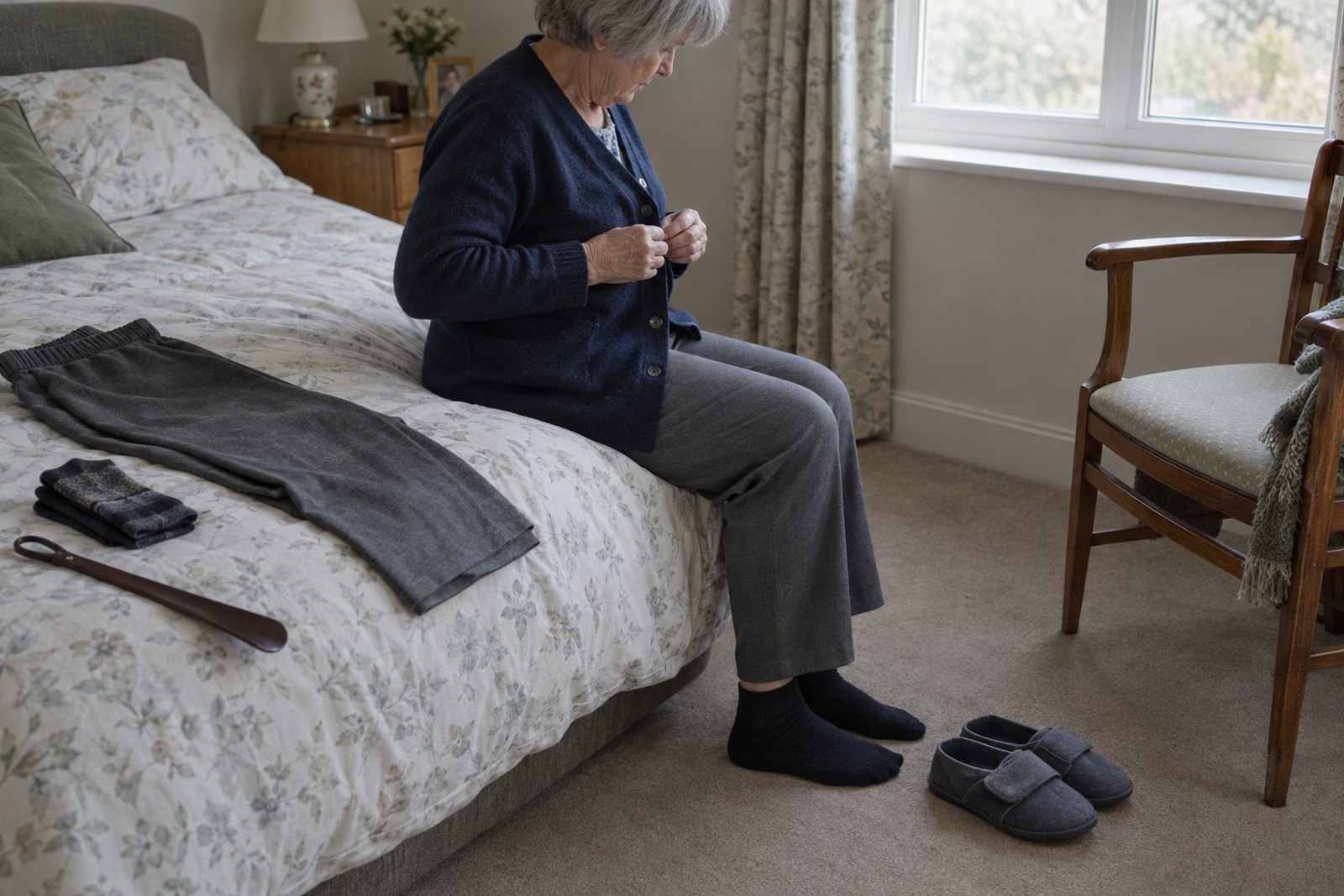
Adaptive clothing is clothing designed to be easier to put on, take off and wear when your body no longer cooperates the way it used to. Instead of small buttons and fiddly zips it might use magnetic or hook-and-loop fastenings. Instead of going over your head it might open down the side or the back. Trousers can be cut for sitting in a wheelchair all day, tops can open to give access to a feeding tube or stoma, and shoes can open wide enough to get a swollen foot or a leg splint inside. Most of it looks like ordinary clothing from the outside, which is rather the point.
It helps people with arthritis, people recovering from a stroke, people living with dementia and the family members who dress them, wheelchair users, people who spend much of the day in bed, and children who cannot bear seams and labels. It is not always the answer, though. A lot of dressing problems can be solved with a cheap change to clothes you already own, a better technique or a simple aid. This guide covers all three, and says honestly when it is worth getting someone to look at the problem properly.
What adaptive clothing actually is
The word covers a wide range, from a shirt with magnets hidden behind the buttons to a fully open-backed nightdress for someone being cared for in bed. These are the main features you will come across.
Easier fastenings
Magnetic closures snap together when the two sides get close, so you do not need to line up a button with a buttonhole. They are often hidden behind sewn-on buttons, so the shirt or cardigan looks completely normal. Hook-and-loop strips do a similar job and are cheap and tough, though they can catch on knitwear and lose their grip after many washes. Other options include large buttons, toggles, zips with big ring pulls, elasticated waists, and bras that fasten at the front or have no fastening at all.
Side and back openings
Some trousers open along the side seam, occasionally the full length of the leg, so they can be put on while lying down or over a cast, leg brace or swollen leg. Tops can open at the shoulder or along the sleeve for someone who cannot lift an arm, which is common after shoulder surgery or a stroke. Wrap styles and front-opening garments avoid pulling anything over the head.
Seated-cut trousers for wheelchair users
Ordinary trousers are cut for standing. If you sit all day, the waistband digs in at the front and gapes at the back, the hems ride up, and back pockets, rivets and thick seams end up sitting directly under the bones you are sitting on. Seated-cut trousers are higher at the back and lower at the front, have no back pockets, use flat seams and are longer in the leg. For someone at risk of pressure sores this is about skin, not just comfort.
Easy access for tubes, stomas and catheters
Some tops and dresses have discreet openings over the tummy so a feeding tube can be used without undressing. Trousers and underwear can have higher, softer or wider waistbands that sit comfortably above or below a stoma. Others have a zip along the lower leg so a catheter leg bag can be emptied or checked without taking the trousers down. For anything around a stoma, the stoma nurse is the best person to ask what will and will not work for you.
Open-back clothing for dressing someone in bed
These are tops, dresses and nightwear that open completely down the back, usually with overlapping panels so nothing is exposed once the person is lying or sitting. A carer can put them on without lifting the person's arms over their head or rolling them back and forth repeatedly. From the front they look like ordinary clothes. They are genuinely useful for people who are very frail, have stiff or painful shoulders, have severe contractures, or are near the end of life, and they reduce strain on the carer too. They are not the first choice for someone who can still take part in dressing with a bit of help, because they can quietly take that ability away.
Adaptive footwear
Adaptive shoes and slippers open wide or fully flat, use adjustable straps, and come in extra depth and width for swelling, bunions, dressings or an ankle-foot orthosis. Look for a firm sole and an enclosed heel. Backless, floppy slippers are a common trip hazard, however comfortable they feel. If feet or ankles swell suddenly, or one leg becomes swollen, red, hot or painful, ask for an urgent GP appointment the same day or call NHS 111. If you also have chest pain or sudden breathlessness, call 999. If you have diabetes or numb feet, a podiatrist should check your footwear.
Who it helps
Arthritis and painful hands
Small buttons, stiff zips, bra hooks, tights and shoelaces are hard work when your fingers are stiff and sore. Magnetic or hook-and-loop fastenings, big zip pulls and stretchy fabrics reduce the amount of pinching and twisting your joints have to do. This matters more on bad days and in the morning, when stiffness is usually worst.
Stroke and one-sided weakness
After a stroke, many people dress with one hand. Fastenings that can be done one-handed, loose sleeves and stretchy necklines all help. In practice, though, technique often makes the bigger difference, and stroke rehabilitation teams spend a lot of time on it. If someone suddenly cannot use an arm, their face droops or their speech changes, that is not a dressing problem. Call 999.
Dementia
Dementia can make dressing confusing rather than physically hard. Simple clothes with fewer layers and obvious fastenings, laid out in the order they go on, often help more than anything specialist. Some families are offered one-piece garments with back zips for someone who undresses at the wrong times. These can restrict a person and raise real questions about dignity and liberty, so they should only be considered with the person's care team and in their best interests. Look for the reason first: being too hot, needing the toilet, itchy fabric or pain are all common.
Wheelchair users and people who sit most of the day
Seated-cut trousers, shorter jackets and capes that do not bunch behind the back, and coats that open fully all make life easier. Anything that creates lumps under the bottom or the back of the thighs is worth avoiding.
Parkinson's, MS, frailty and recovery from surgery
Tremor, fatigue, stiffness and restrictions after operations such as hip or shoulder replacement all make dressing slower. Easier fastenings and front openings save energy you might rather spend on something else. After surgery the need is often temporary, so cheap adaptations usually make more sense than buying a new wardrobe.
Children with sensory needs or disabilities
Some children find seams, labels, waistbands and certain fabrics genuinely distressing. Seamless socks, tag-free labels and soft, stretchy fabrics can turn the morning battle into something manageable. Our guide to sensory-friendly clothing for children goes into this in detail. Children with physical disabilities or feeding tubes may also need adaptive clothing, and as they grow they deserve clothes that look like what their friends wear.
Adapting ordinary clothes cheaply
Before buying anything specialist, it is worth trying these. Many cost very little, and a local alterations service can do the sewing if you cannot.
- Swap buttons for hook-and-loop or magnets. Sew the button back on top of the buttonhole so the garment still looks the same, and put the fastening underneath.
- Sew cuff buttons on with elastic thread. The cuff stays looking buttoned but stretches enough to slide your hand through.
- Add zip pulls. A key ring, loop of ribbon or large ring threaded through a small zip tab makes it much easier to grip.
- Go up a size or choose stretch fabrics. Slightly looser clothing is easier to get on, especially over a stiff shoulder or swollen legs.
- Choose front-opening tops rather than anything that goes over the head.
- Use elastic or no-tie laces so shoes can be slipped on and off without bending to tie them.
- Cut out labels and choose flat seams if skin is sensitive or sore.
- Try front-fastening or pull-on bras, or fasten a standard bra at the front and turn it round.
- Replace tight waistbands with elastic, or choose trousers with an elasticated waist from the start.
- Pre-tie ties or swap to elastic-backed versions for formal occasions.
Dressing techniques that matter as much as the clothes
The right clothes help, but how you go about dressing often matters more.
- Sit down. Dress sitting on a firm chair with arms or on the edge of the bed with feet flat on the floor. Standing on one leg to put on trousers is a common way to fall.
- Lay clothes out in order the night before, in the order they go on.
- Weaker side first when dressing, stronger side first when undressing. Put the weak or painful arm or leg into the garment first, and take it out last.
- Do the hard parts when you have most energy, and rest between top and bottom halves if you need to.
- Keep the room warm so there is no rush, and allow more time than you think.
- Use simple aids. Sock aids, long-handled shoehorns and dressing sticks reduce bending and reaching. Our guide to dressing aids and easier ways to get dressed explains each one, and there is a separate guide to button hooks, zip pullers and easier fastenings.
If you are helping someone else, let them do every part they can, even slowly. Doing it for them is quicker today and makes tomorrow harder.
Dignity and choice
Clothes are part of who we are. Someone who has always worn a pressed shirt may not want to live in a tracksuit, however practical it is. The best adaptive clothing is the kind the person actually likes wearing, so involve them in the choice wherever possible, including people with dementia, who can often still choose between two options.
Be wary of clothing chosen mainly for the carer's convenience. Sometimes that is the right call, particularly when someone is very unwell and every movement hurts. But it should be a deliberate decision, not a default. And remember that adaptive clothing does not have to look clinical. A lot of it is indistinguishable from ordinary clothes.
Paying for it, including VAT relief
In general, adaptive clothing is something people buy themselves, and the council or NHS does not usually supply it. Some items designed solely for disabled people can be bought without VAT if you have a long-term illness or disability and they are for your own use, but ordinary clothing does not qualify just because it is easier to put on. Our guide to VAT relief on disability equipment explains how it works, and GOV.UK has the official rules. Check with the seller before you buy.
Buy one item first and see how it washes and wears before ordering several. Magnetic and hook-and-loop fastenings vary a lot in quality.
Where an occupational therapist fits
Occupational therapists look at everyday tasks, and dressing is one of the most common. An occupational therapist can watch how you or your relative actually get dressed, work out what is getting in the way - grip, balance, reach, pain, fatigue, memory or something else - and suggest the simplest fix. That might be a change of technique, a piece of equipment, a different chair, adapted clothing, or a combination. They can also look at the wider picture, such as whether getting to the bathroom or in and out of bed is causing problems too.
On the NHS, occupational therapy is usually reached through your GP, a hospital or community team, or your council's adult social care department. Waits vary. A private occupational therapist visiting at home can usually see you sooner and look at dressing alongside anything else that is a struggle.
Other professionals lead in some areas. A physiotherapist works on strength, movement and balance. A podiatrist deals with foot problems and footwear for diabetes. An orthotist fits splints and leg braces. A stoma nurse advises on clothing and stomas, and the continence service on pads and continence. If dressing has suddenly become much harder, see your GP, because a sudden change can be a sign of illness that needs checking.
Frequently asked questions
Can I get adaptive clothing on the NHS?
Generally not. Adaptive clothing is usually bought privately. Some specialist garments linked to medical treatment may be provided by NHS teams, so ask the professional involved in your care. Dressing aids are sometimes available through the council's community equipment service after an assessment.
Is magnetic clothing safe for everyone?
Not quite. Some implanted devices, such as pacemakers and defibrillators, come with advice about keeping magnets away from them. If you have an implanted device, check with your device clinic or cardiology team before choosing magnetic fastenings. Hook-and-loop is a good alternative.
What is the best clothing for someone with dementia?
Usually simple, familiar clothes in the person's own style, with easy fastenings and few layers. Laying them out in order and offering a choice of two often helps more than anything specialist. If dressing has become a daily battle, an occupational therapist can look at why.
What should a wheelchair user look for in trousers?
A higher back rise, lower front, no back pockets or rivets, flat seams and a longer leg so the hems do not ride up when seated. If you are at risk of pressure sores, anything that creates a lump under your bottom or thighs is worth avoiding.
Is it worth buying adaptive clothing for a child who will grow out of it?
Sometimes. Adapting ordinary clothes, choosing seam-free basics and buying a size up often work well and cost less. Specialist items make most sense where a child's needs are long term, such as feeding tube access or seated-cut trousers.
Should I buy open-back clothing for my mum?
Only if she can no longer take part in dressing, or moving her arms and body is very painful. If she can still help, front-opening clothes and a good technique will keep her doing more for herself. An occupational therapist can help you decide.
Next steps
If dressing has become a struggle, see our equipment and aids page, or current guide prices, and choose your area below.
Talk to an occupational therapist near you
This guide is general information. For advice about your own situation - or someone you look after - a local occupational therapist can visit you at home and see it for themselves.
Choose your area: