

Dementia Wandering: Keeping Someone Safe When They Walk About
By Mobile Occupational Therapist • 22 October 2026 • 14 min read
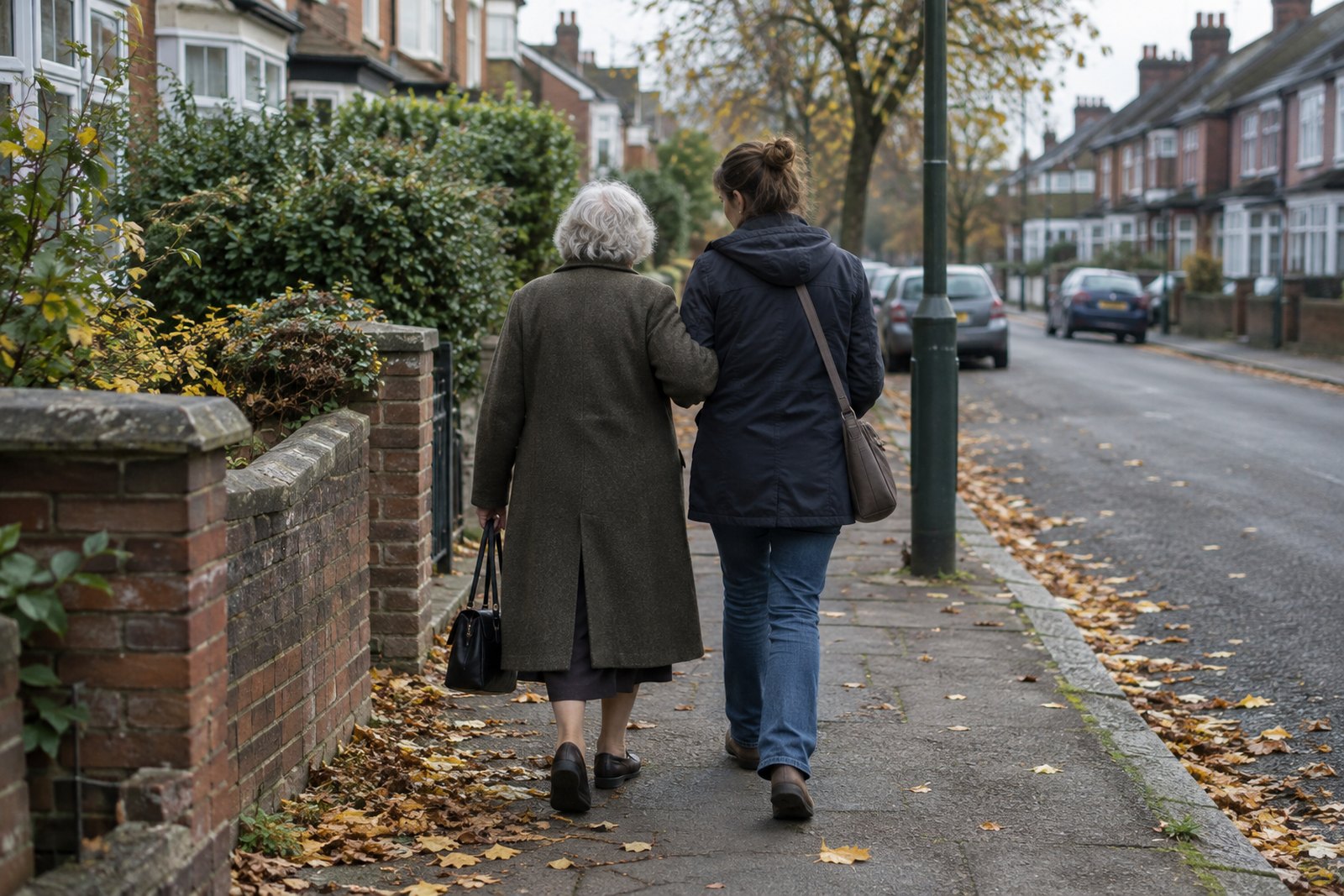
If someone you love has dementia and has started walking about, especially at night or out of the front door, the short answer is this. You usually cannot stop it completely, and trying to stop it by force tends to make things worse. What you can do is work out why they are walking, meet that need where possible, make the walking safer, and have a plan ready in case they get lost. If they ever go missing, call 999 straight away. You do not need to wait.
Most of this guide is about the first three, because they make the fourth less likely. It covers the reasons people walk, the daytime and night-time changes that tend to help, the technology worth considering, the legal line you must not cross, the police scheme many families never hear about until they need it, and where an occupational therapist can help.
Why "walking about" rather than "wandering"
You will see the word wandering everywhere, including in leaflets and search results. Many dementia organisations, including Alzheimer's Society, now prefer "walking about". The reason is not politeness for its own sake. "Wandering" suggests aimless drifting. In fact the person almost always has a reason, even if they cannot explain it and even if it makes no sense to anyone else. Your mum may be setting off to collect children who are now in their fifties. Your dad may be heading for a job he retired from twenty years ago. To them, the walk has a purpose.
Once you see it that way, the question changes from "how do I stop this?" to "what is she looking for?" The second question is far more useful.
Why people with dementia walk about
There is rarely one cause. Common ones include:
- Looking for someone or somewhere. A parent, a partner who has died, or "home", which may mean a childhood house rather than the one they are in. Feeling lost in your own home is frightening, and walking is a natural response.
- Old routines. Walking the dog, going to work, fetching the paper, the school run. The habit outlasts the memory of why it stopped.
- Boredom. A long day with nothing in it leaves energy and restlessness with nowhere to go.
- Pain or discomfort. Arthritis, toothache, constipation, being too hot or too cold. Someone who cannot say "my knee hurts" may simply keep moving.
- Needing the toilet. Very common at night. They get up, cannot find the bathroom, and end up in the hall or at the front door.
- Restlessness and anxiety. Noise, too many people, a new carer, a change of routine.
- Confusion about time. Waking at 3am, seeing it is dark, and thinking it is early evening and time to go somewhere.
- Illness or medicines. An infection, poor sleep or a new medicine can all make someone more restless.
Keep a simple diary for a week or two
Note the time, what happened just before, where they tried to go and anything they said. Patterns appear surprisingly quickly: always after lunch, always when the house goes quiet, always around the time they used to leave for work. That pattern is your best clue to what will help.
When to see the GP
If the walking about has started suddenly, or the person has become much more confused, agitated or drowsy over a few hours or days, it could be delirium. This is often caused by an infection, dehydration, constipation or a change in medicines, and it needs medical attention the same day. Contact the GP urgently or call NHS 111. If they are very unwell, call 999. Even when the change is gradual, ask the GP to check for pain, infection and medicine side effects before assuming it is just the dementia. Do not stop or change any medicine without speaking to the GP or pharmacist.
Reducing the risk without restraint
The instinct when someone keeps leaving is to lock the doors. It is understandable, and it can be dangerous.
Never lock someone in alone
If a person with dementia is locked in the house on their own and there is a fire, they may not be able to get out, and help may struggle to get in. Being locked in can also leave someone frightened and distressed, which often makes them more determined to leave. If you are in the house with them, keep keys where you can reach them instantly, not hidden away, and make sure everyone in the household knows where they are.
Many fire and rescue services offer free home fire safety visits, and some prioritise people living with dementia. It is worth asking your local service.
The legal side
Under the Mental Capacity Act 2005, which covers England and Wales, any decision made for someone who lacks the capacity to make it themselves must be in their best interests and should be the least restrictive option that works. Keeping someone under continuous supervision and control and not letting them leave can amount to a deprivation of liberty, which needs legal authorisation, even in their own home. This is not a reason to worry about ordinary, loving care. It is a reason to talk to council adult social care, or take legal advice, if you find yourself relying on locked doors, constant watching or anything that physically stops the person moving about. Scotland and Northern Ireland have their own laws. GOV.UK has guidance on the Mental Capacity Act.
Gentler ways to make walking safer
- Make the door less of a magnet. Some families find a curtain across the front door, or a door painted the same colour as the wall, means it gets noticed less. A coat, hat and keys hung by the door can be an invitation, so move them out of sight.
- Redirect rather than argue. If your dad says he has to get to work, telling him he retired years ago rarely helps. "Let's have a cup of tea first" or "Shall I walk with you?" usually goes better. Walking alongside and gently turning for home after a few minutes is a perfectly good outcome.
- Make home feel safe. Familiar photos, a favourite chair, less clutter and noise, and good light in the late afternoon.
- Make the garden somewhere to walk. A secure gate and a clear path that loops back round can let someone walk outdoors safely.
- Carry identification. A card in a wallet or coat pocket with your phone number, or an identity bracelet, helps a stranger get them home. Sew a name and number label into a coat they always wear.
- Tell neighbours and local shops. People who know your mum by sight are far more likely to notice if she is out at an odd hour and ring you.
Activity and exercise during the day
A person who has walked, done something useful and had some fresh air during the day is more likely to sleep at night. This is the most underrated part of the whole picture.
- Plan a walk together, ideally in daylight and at the time they usually get restless. If the walking is purposeful, give it a purpose: post a letter, buy a paper, feed the birds.
- Offer real jobs. Folding laundry, drying up, sorting cutlery, sweeping leaves, polishing shoes. Feeling useful settles many people more than any entertainment.
- Keep daytime naps short where you can, and try to avoid a long doze late in the afternoon.
- Get daylight. Time outside, or by a bright window in the morning, helps the body clock.
- Use day centres and groups if there are any locally. Ask council adult social care or a local dementia charity.
Our guide to activities for people with dementia at home that actually work has many more ideas for different stages. If the problem is too much sleep in the day and too little at night, see why people with dementia sleep so much.
Night-time: how to reduce walking about after dark
Night-time walking is often what pushes families to the edge. You cannot lie awake every night listening for the door. These are the changes that most often help.
The late afternoon and evening
Many people become more restless and confused as the light fades. This is often called sundowning, and it can set up a difficult night. Our guide to sundowning and what helps goes into detail. In short: close the curtains and put the lights on before it gets dark, keep the evening calm and predictable, and avoid busy visits or appointments late in the day.
A routine for bed
- Go to bed and get up at roughly the same times each day.
- Cut down caffeine in the afternoon and evening, including tea, coffee and cola. A warm milky drink can be part of winding down.
- Offer the toilet just before bed.
- Check the bedroom is a comfortable temperature and the bed is comfortable too.
Help them find the toilet, not the front door
Because needing the toilet is one of the commonest reasons for getting up, make the route obvious. Leave the bathroom door open with a light on, use plug-in night lights or motion-sensor lights along the way, and consider a picture sign on the toilet door. Some families keep a commode by the bed. Clear the route of rugs, cables and clutter to cut the risk of a fall.
If they wake and want to go out
Speak calmly, keep the lights low and avoid arguing about what time it is. Offer the toilet, a drink, or simply sit with them for a while. A clock that clearly shows whether it is day or night helps some people. If they are adamant, a short walk round the house together can be quicker and kinder than a battle.
Door sensors, GPS trackers and telecare
Technology can give you warning and help you find someone faster. It does not replace supervision, and it raises questions worth thinking through first.
What exists
- Door sensors that sound a chime or send an alert to your phone or a monitoring centre when an outside door opens, often set to work only at night.
- Bed or chair sensors that alert you if the person gets up and does not return within a set time.
- Pressure mats placed by the bed or inside the front door.
- GPS location devices, worn as a watch or pendant or carried in a pocket, that let you see where someone is.
- Telecare packages, often arranged through the council, which link sensors to a round-the-clock response service.
Our guide to personal alarms and telecare explains the options and how to get them.
Consent and capacity
Tracking someone is a significant step. Where you can, talk about it early, while the person can still take part in the decision. Many people are happy to agree to something that lets them keep walking on their own. If they no longer have capacity to decide, the choice must be made in their best interests, involving them as much as possible. If someone holds a registered Lasting Power of Attorney for health and welfare that covers this kind of decision, that attorney makes the decision, acting in the person's best interests. Ask whether it is the least restrictive way to keep them safe. A tracker that lets someone keep going out alone can be far more freeing than a locked door.
One practical point: a GPS device only works if it is charged and with the person. Choose something they will actually wear or carry, and build charging into the daily routine.
The Herbert Protocol
The Herbert Protocol is a scheme used by many UK police forces. You fill in a form in advance with key information about the person: a recent photo, a physical description, medical needs, contact numbers, and places they might head for, such as previous homes, old workplaces or favourite spots. You keep it somewhere easy to find, and care homes often keep one for each resident. If the person goes missing, you hand it to the police, which saves precious time at the moment you are least able to think clearly.
Schemes and forms vary by area, so check your local police force's website or ask on the non-emergency number, 101. Update the photo every few months.
What to do if someone goes missing
- Search the house and garden quickly, including sheds, garages, cupboards and the car.
- Call 999 straight away if you cannot find them. Someone with dementia who is missing is vulnerable, especially at night or in cold weather. There is no rule that you have to wait 24 hours.
- Tell the police they have dementia and give them the Herbert Protocol form if you have one, or a recent photo and a description of what they were wearing.
- Think about where they might go: an old address, a former workplace, a place of worship, a shop, a bus stop, a route they used to walk.
- Keep someone at home and by the phone in case they come back or someone rings.
When they are found, try to be calm and reassuring, however frightened you were. They may not remember being told off, but they may hold on to the upset. Check for injuries, cold or dehydration, and contact the GP if you are worried.
Where an occupational therapist fits
An occupational therapist looks at the person, their routines and their home together, which is exactly what walking about needs. A private occupational therapist visiting at home can:
- help you work out the pattern and the likely reasons behind the walking, using what you have noticed;
- build a daily routine with meaningful activity and exercise matched to what the person can still do;
- look at the home room by room: lighting, the route to the toilet at night, signs and cues, the front door and the garden;
- suggest sensors, telecare and other equipment, and think through how they fit with the person's wishes and capacity;
- check the risk of falls, since night-time walking and falls often go together;
- write a report that supports a request for council help or care.
An occupational therapist will not diagnose the cause of sudden confusion, review medicines or decide legal questions about deprivation of liberty. For any sudden change, the GP leads. For memory services, ask the GP for a referral. For legal questions, speak to council adult social care or a solicitor. Your council can also carry out a free needs assessment, and a carer's assessment for you, and NHS or council occupational therapists may be available, though waits vary by area.
Frequently asked questions
Should I lock the doors at night to stop Mum walking out?
Never lock someone in on their own. If you are in the house with them, some families do lock outside doors at night, but the key must always be instantly reachable in case of fire. If you find you are relying on locks to keep someone in, talk to council adult social care about safer options such as door sensors and about the legal side.
Is it legal to use a GPS tracker for someone with dementia?
It can be, but it should be agreed with the person if they have capacity to decide. If they do not, it should be a best interests decision, involving them and anyone with Lasting Power of Attorney for health and welfare, and it should be the least restrictive option. GOV.UK has guidance on the Mental Capacity Act.
Can medication stop dementia wandering?
There is no medicine that simply stops walking about. Medicines are sometimes considered for severe distress, but they carry real risks and the decision belongs with a doctor. National guidance favours trying non-drug approaches first. If you are concerned, speak to the GP.
How long should I wait before reporting someone with dementia missing?
You should not wait. After a quick search of the house and garden, call 999 and tell them the person has dementia. Acting early matters, especially at night or in cold weather.
Is the Herbert Protocol available everywhere?
It is used by many police forces across the UK, but the forms and arrangements differ. Check your local police force's website or call 101 to find out what applies where you live.
What if I cannot cope with broken nights any more?
That is a sign you need more support, not that you have failed. Ask your council for a carer's assessment and a review of the person's care needs, which may lead to overnight help, respite or day services. Tell the GP how things are too.
Next steps
See our home assessment page, or current guide prices, and choose your area below.

Talk to an occupational therapist near you
This guide is general information. For advice about your own situation - or someone you look after - a local occupational therapist can visit you at home and see it for themselves.
Choose your area: