

Activities for People With Dementia at Home That Actually Work
By Mobile Occupational Therapist • 17 September 2026 • 9 min read
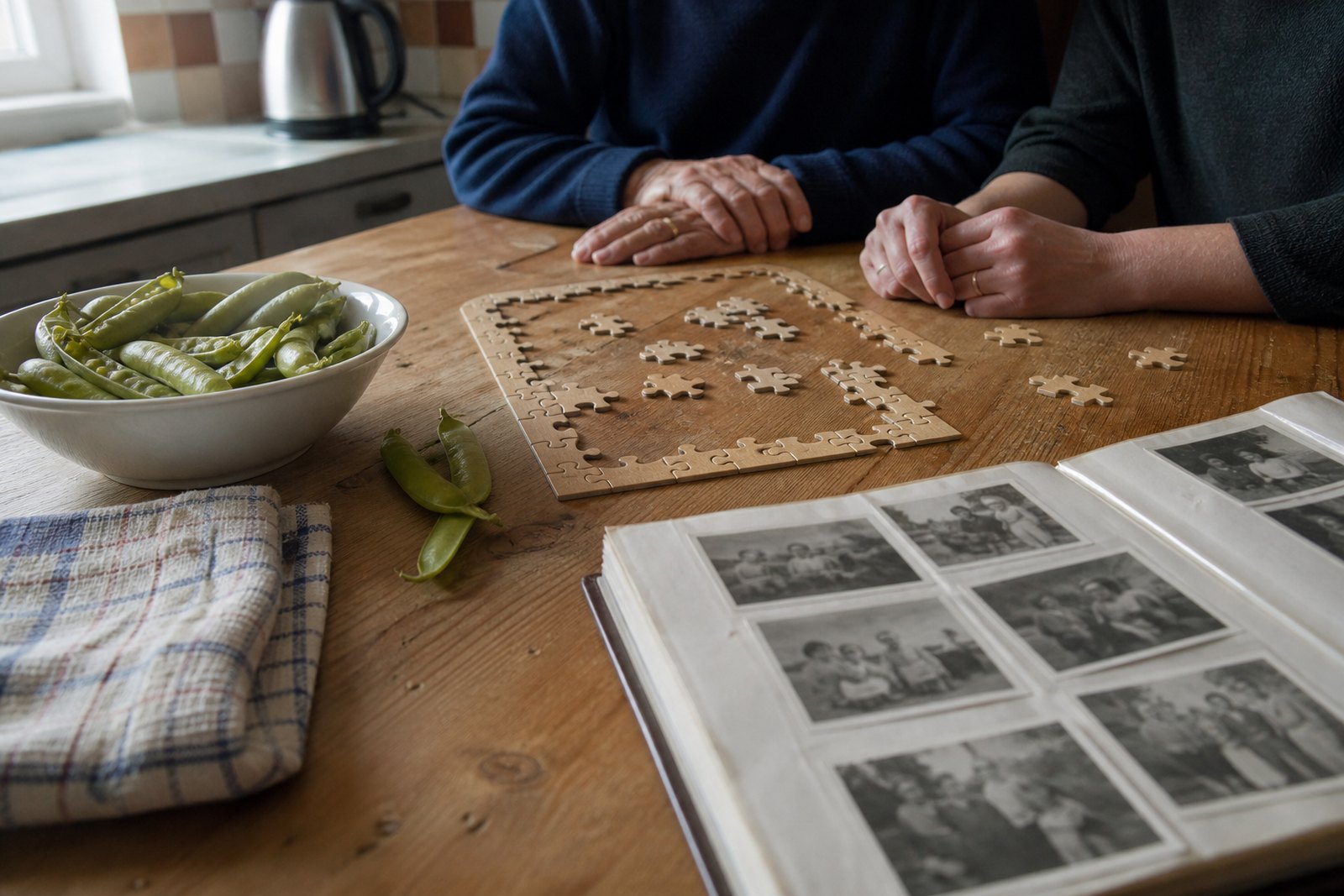
Most lists of activities for people with dementia are interchangeable, and that is exactly what is wrong with them. Jigsaws, colouring, memory games, bingo. They arrive with no idea who the person is, what they did for a living, or whether they have ever in their life enjoyed a jigsaw. Handed to a retired mechanic, a children's puzzle is not an activity. It is a test he did not ask to sit.
Meaningful activity is the heart of occupational therapy, so this is the subject we care most about getting right. The useful question is never "what dementia activities should I buy?" but "what did this person do, what can they still do, and what would feel like theirs?" This guide covers why activity matters, how to match it to the person, what failure-free means, the ideas that hold up best at home, what to do when they say no, and where to get free dementia activity packs.
What activity is actually for
Occupying somebody is not the point. Doing things they recognise as their own has real effects: better mood, less apathy, less agitation in the late afternoon, better sleep at night, and a day with a shape to it. It also gives a person a role. Somebody who dries up after tea is helping. Somebody who is handed a colouring book is being managed, and most people can feel the difference even when they cannot say so.
There is a benefit for the carer too. Doing something alongside each other takes the pressure off conversation, which gets harder as dementia progresses. Half an hour podding peas together is easier than half an hour of questions. Our page on occupational therapy for dementia covers the wider picture.
Start with the person, not with a list
Before choosing anything, write down what you know: their job, their hobbies, how they spent Saturdays, what they were proud of, what they never liked. A former teacher may want to sort, mark and organise. A gardener wants soil on their hands, not a photograph of a garden. A woman who ran a household for fifty years may want to fold, wipe and put away, and may find sitting down to be entertained faintly insulting.
Then be honest about what still works. Sight, hearing, hand strength, standing tolerance, attention span and what time of day they are at their best all shape what is realistic, and they change over time. Something that worked in the spring may need simplifying by the autumn. That is not failure; it is the same activity, offered differently.
Failure-free activity: no right answer, no test
This is the most useful idea here. An activity is failure-free when there is no way to get it wrong: nothing to remember, no score, no correct order, nothing that exposes what has been lost. Sorting buttons by colour is failure-free. A quiz about the 1960s is not, however gentle it sounds, because it can be failed in front of somebody they love.
Practical ways to make almost anything failure-free: break it into one step at a time, start it yourself and hand it over, use fewer pieces, avoid anything with instructions, and never correct. If the tea towels end up folded in a way you would not choose, the tea towels are folded. The point was never the tea towels.
Everyday tasks, and the jobs the house already contains
The best activities are usually already happening in the house and cost nothing. They are familiar, they are real, and they carry a purpose that a purpose-made product never quite manages. Good light and a clear surface help more than any gadget, as our guide to a dementia-friendly home explains.
- Kitchen jobs. Podding peas, topping beans, stirring, drying up, putting cutlery away, buttering bread. Working alongside somebody at the sink is one of the easiest half hours you will spend.
- Laundry and tidying. Folding towels, pairing socks, dusting, polishing shoes or a bit of brass. Repetitive, rhythmic, and satisfying to finish.
- Sorting. Buttons, coins, cards, screws, cotton reels, seed packets. Choose a set of objects that belongs to their life rather than a bag bought for the purpose.
- Laying the table. A job with a beginning, a middle and an obvious end, done at the hour of the day when a job is most needed.
- Gardening and plants. Watering, deadheading, potting on, sweeping a path. A pot on a windowsill counts when the garden is too much.
- Baking. Weighing, mixing, rolling. The smell does as much as the task, and there is something at the end of it.
Music, the senses, reminiscence and getting out
When tasks stop being manageable, activity does not have to stop. It moves towards the senses, where far less has to be worked out.
- Music from their own youth. Roughly the music of their teens and twenties. Music reaches people long after words become difficult, and singing along often survives when speaking does not. Local singing groups and dementia choirs are worth finding.
- Touch and texture. Hand massage with a little cream, a soft blanket, a warm flannel, kneading dough, stroking a cat. Calming, and something you can offer when nothing else lands.
- Smell and taste. Baking, fresh coffee, lavender, a favourite biscuit. Strong, direct, and needing no explanation.
- Reminiscence. Photographs, an old tin of odds and ends, a football programme, tools, an old film. Ask about the feeling rather than the fact: not "who is that?" but "she looks like she was fun."
- Movement. A walk, seated exercises, a dance in the kitchen, throwing a soft ball back and forth. Movement helps sleep, appetite, mood and bowels, and it does not need to look like exercise.
- Outdoors. A bench, a garden centre, feeding ducks, a bus ride to a familiar street. Daylight steadies the body clock, and going out is an activity in itself.
- Faith and community. A church service, prayers, hymns, a familiar building. Long-held routines can hold when a great deal else has gone.
Other people matter too. Dementia cafes, memory groups, singing groups and day services exist in most areas, run by the Alzheimer's Society, Age UK, local carers organisations and councils. One-to-one suits somebody who finds groups noisy; a group suits somebody who has always liked company, and gives a carer a genuine break.
When they say no, and when a no is something else
Refusal is normal and is not a verdict on you. A no often means it is the wrong time of day, too noisy, too complicated, or that being helped feels like being talked down to. Offer, do not insist. Start the task yourself and leave a space. Two minutes of interest is a success, not a failure, and the offer itself is part of what tells somebody they are still included.
A change is different from a refusal. If somebody who was engaging suddenly stops, becomes markedly more confused, sleepy, agitated or withdrawn over hours or a day or two, do not treat that as the dementia progressing. It is very often delirium, and delirium usually has a treatable cause: a urine or chest infection, pain, constipation, dehydration, or a new or changed medicine. It needs a GP the same day, or NHS 111 when the surgery is closed. Steady low mood over weeks is worth a GP appointment too, because depression is common, easily missed and treatable.
Where to find free dementia activity packs and printables
You do not need to buy anything, and much of what is sold as a dementia product is an ordinary object at three times the price. The Alzheimer's Society and Dementia UK both publish free practical guidance on activities, and their helplines will talk through what suits a particular person. Local libraries often hold reminiscence boxes, large-print and picture books and audio, and staff are pleased to be asked. Your council's memory service, a local dementia support worker or an Admiral Nurse will know what free activity packs, groups and printables are circulating locally. Old photographs, the family's own music and the contents of the airing cupboard remain the cheapest and best resources in the house.
Frequently asked questions
What are the best activities for dementia patients at home?
The ones that belong to that particular person. Everyday household jobs done together, music from their youth, sorting and folding, gardening, baking and looking at photographs hold up best across the widest range of people, because they are familiar and cannot be got wrong. If you take one rule away, take this: no tests, no quizzes, no correcting.
What makes an activity dementia friendly?
Dementia friendly activities share four things: they are failure-free, they use an ability the person still has, they are short enough to finish, and they mean something to that person. Practically, that usually means one step at a time, few pieces, no written instructions, good light, low background noise, and an adult subject rather than anything that looks like a children's toy.
Are there free printable activities and dementia activity packs?
Yes. The national dementia charities publish free guidance and resources, libraries lend reminiscence materials, and local memory services and dementia support workers often have activity packs to hand out. Ask before you buy anything, and be wary of expensive products that repackage ordinary objects.
What if they lose interest after two minutes?
Then two minutes is what the activity was, and that is fine. Attention shortens as dementia progresses, so plan for several short offers spread through the day rather than one long session. Leave the materials out to be picked up again, and try the same thing at a different hour: an activity can work at eleven and fail at four.
Next steps
An occupational therapist assesses activity properly: what the person can still do, what the task actually demands, and how to close the gap by changing the task, the environment or the support rather than giving up on it. Our guide to what happens on a home visit shows how, and our independence for older people page covers the wider aim. Find your local occupational therapist via our areas we cover page, or see our prices page for current guide pricing.
Talk to an occupational therapist near you
This guide is general information. For advice about your own situation - or someone you look after - a local occupational therapist can visit you at home and see it for themselves.
Choose your area: