

Twiddle Muffs and Fidget Blankets for Dementia: An Honest Guide
By Mobile Occupational Therapist • 9 October 2026 • 13 min read
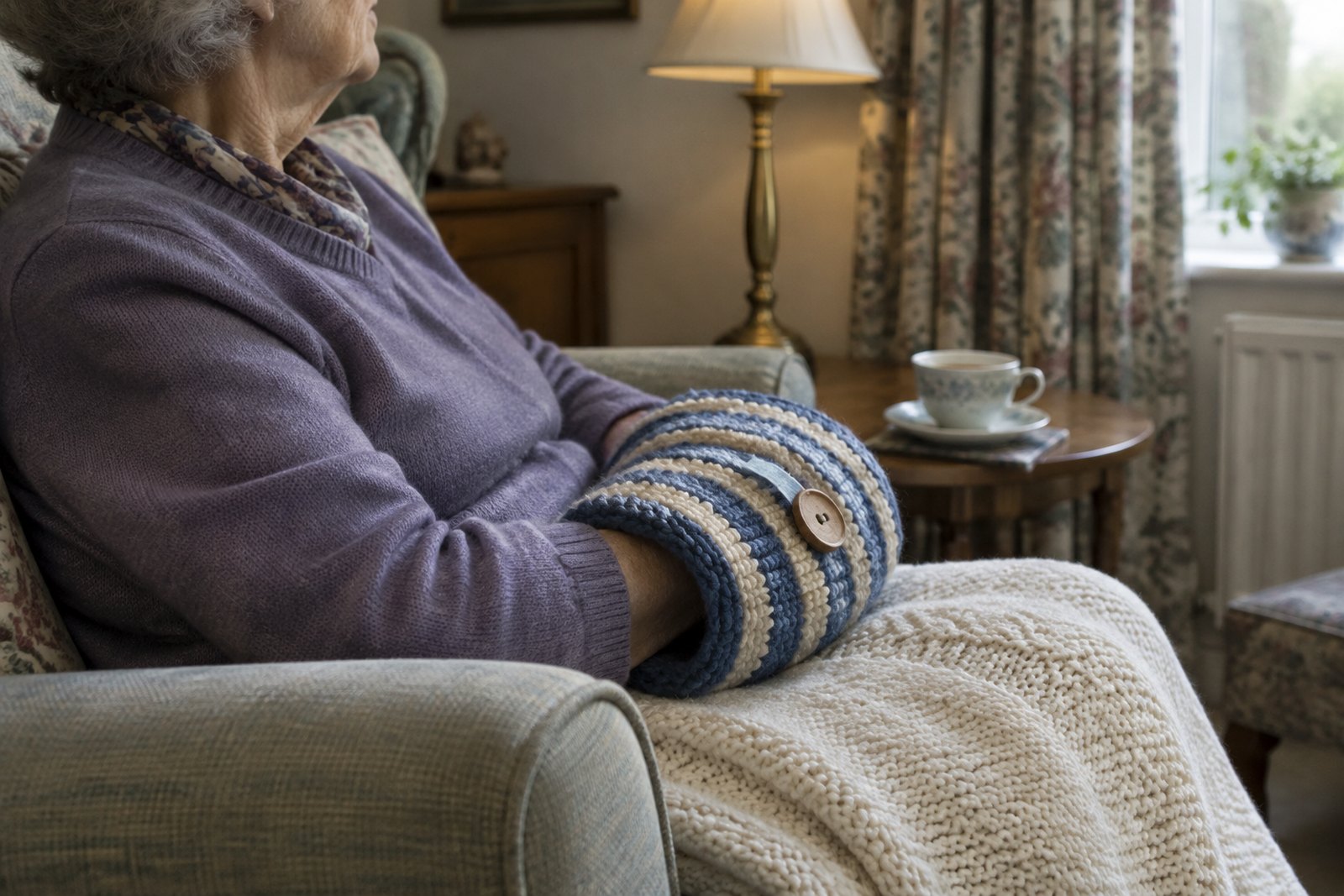
A twiddle muff is a knitted tube, a bit like an old-fashioned hand warmer, that a person slips both hands into. Inside and out it has things sewn on to fiddle with: large buttons, short ribbon loops, a pom-pom, a strip of different texture. A fidget blanket is the same idea laid flat. It is a lap-sized blanket or mat made of fabric panels with fastenings, pockets and textures to touch, turn and fasten. Both are made for people with dementia whose hands are restless, and many are knitted or sewn by volunteers and given away free through hospitals and local groups.
Do they work? For some people, yes, and rather well. A muff can give busy hands something to do, offer warmth and comfort, and take the edge off anxious moments such as being washed or sitting through a long afternoon. For other people they do nothing at all, or feel babyish and insulting. The honest answer is that they are worth trying, cost little or nothing, and need to be safe and offered with respect. This guide covers all three.
What twiddle muffs and fidget blankets actually are
Twiddle muffs
A typical twiddle muff is knitted double thickness, so it is soft, warm and holds its shape. It is long enough to cover the hands and wrists comfortably, with room for both hands to meet in the middle. The outside usually has a handful of things firmly stitched on: a big button or two, a short loop of ribbon, a crocheted flower, a patch of a different yarn. The inside often has a few more, so the hands find something to explore without anyone seeing. Mixed yarns are common because the point is variety: smooth, nubbly, fluffy, ribbed.
Fidget blankets
A fidget blanket (sometimes called a sensory blanket or activity blanket) is usually sewn rather than knitted. It sits across the lap and is made of patches of different fabrics such as corduroy, fleece, cotton, faux fur or satin. Sewn onto it you might find a zip with a large puller, a pocket with a soft item inside, big buttons with buttonholes, hook-and-loop tabs, large press studs, a short buckle strap or a shirt cuff to button and unbutton. Because there is more space, a blanket can be made very personal.
Related ideas
You may also come across fidget aprons, fidget cushions and activity boards. Boards are usually wooden panels with latches, bolts, switches and handles fixed on. They can suit someone who spent their life working with their hands and finds soft fabric a bit pointless. The principle is the same: something safe, interesting and within reach for hands that want to be busy.
Why they can help some people with dementia
Restless hands are common in dementia. You might see someone picking at their clothes, rubbing the arm of the chair, folding and unfolding a tissue, pulling at bedding or fiddling with a dressing. A twiddle muff or fidget blanket can help in a few ways.
- Somewhere for restless hands to go. Fiddling is not a problem in itself. Giving it a safe outlet can protect skin, clothes and dressings and can be calming.
- Comfort and warmth. Many people with dementia feel the cold, and their hands often feel it first. A soft, warm muff is simply pleasant.
- Distraction during care. Washing, dressing, having a dressing changed or sitting through a hospital procedure can feel frightening. Something familiar to hold can help a person cope.
- Something to do when words get harder. When conversation and hobbies fall away, touch and simple repeated movements can still feel satisfying.
- In hospital. Hospital wards are boring and confusing. Muffs are often used to give hands something to do other than tugging at a cannula or tube. This is a distraction, never a restraint.
Check what is behind the restlessness first
Before you treat fidgeting as something to keep busy, it is worth asking what is driving it. Restless hands can be a sign of pain, needing the toilet, constipation, being too hot or too cold, hunger, thirst, tiredness, boredom or worry. Fixing the cause often helps more than any muff.
A sudden change matters more. If someone becomes much more agitated, confused, drowsy or distressed over hours or a few days, it may be delirium, which is often caused by an infection, dehydration or a medication issue. Contact their GP the same day or call NHS 111. If they are very unwell, struggling to breathe, or you cannot wake them properly, call 999. If restlessness builds in the late afternoon and evening, our guide to sundowning has practical ideas.
Safety: what to check before and after every use
A twiddle muff is soft and friendly looking, which makes it easy to forget that it can carry risks. Most problems come from things coming loose.
If the person puts things in their mouth
Some people with more advanced dementia put objects in their mouth. If that applies to the person you care for, keep things very simple.
- No small loose parts at all: no beads, sequins, small buttons, bells, googly eyes or anything that could be bitten off.
- Use only large, flat buttons stitched down hard, or leave buttons off and rely on texture.
- Avoid pom-poms and loose tassels, which can shed fibres or pull apart.
- Choose items that would not fit in the mouth even if they did come loose.
If you notice someone regularly chewing, mouthing or coughing on things, mention it to their GP, who can refer them to a speech and language therapist if there are concerns about swallowing.
Cords, ribbons and loops
Long cords, laces and ribbons can wrap around fingers, wrists or the neck. Keep any ribbons short and stitch them down at both ends to make closed loops rather than dangling strands. Avoid elastic loops a hand could get trapped in, and avoid anything that ties or tightens.
Checking the sewing
Fiddling is the whole point, so items get pulled hard and often. Check every attachment before you hand it over and again when you take it back. Tug each button, ribbon and patch. If anything feels loose, take the muff away and repair it or remove the item. Check seams for holes where stuffing or fibres could come out.
Washing
At home, a muff or blanket needs to be machine washable, so choose yarns and fabrics you can wash and dry easily, and check the labels. Wash it regularly, especially if it is used at mealtimes or during personal care.
Hospitals usually have stricter rules for infection control. Commonly, a muff given on a ward is for one person only and goes home with them, and donated muffs often need to be made from yarn that can survive a hot wash. Rules vary between trusts, so if you are making muffs to donate, ask the ward or the hospital's voluntary services team what they need before you start.
Skin, warmth and freedom to move
Older skin can be thin and fragile. Avoid scratchy yarns, rough seams and hard edges. The cuffs of a muff should be loose enough that the person can pull their hands out easily and nothing digs into the wrist. Check hands for redness or soreness, and watch for overheating in a warm room. The person must always be free to take their hands out.
Making one yourself
Knitting a twiddle muff
You do not need to be an expert. Many hospitals and dementia charities publish free twiddle muff patterns, and most follow the same basic idea:
- Knit a long rectangle in a soft, washable yarn, often chunky or two strands held together. Changing yarn partway through gives a different texture inside and out.
- Before sewing up, stitch your chosen items to the half that will be the inside and the half that will be the outside.
- Fold the rectangle so one half sits inside the other, giving a double-thickness tube, then sew the long edge closed.
- Tug every attachment and check every seam before giving it away.
Keep the decorations to a sensible handful. A muff smothered in bits is harder to keep safe and can feel overwhelming.
Sewing a fidget blanket
- Start with a sturdy backing fabric about the size of a lap or a tray.
- Cut patches in contrasting fabrics and colours, which helps if eyesight is poor.
- Add one fastening per patch: a zip with a large puller, a big button and buttonhole, a large press stud, a hook-and-loop tab, a short buckle strap.
- Sew on a pocket or two, perhaps holding a soft fabric item that cannot come out.
- Stitch everything twice and finish edges so nothing frays.
Making it personal
The best fidget blankets reflect the person. A keen gardener might like a patch of tweed and a pocket to rummage in. A former seamstress might enjoy buttons and a tape-measure-style ribbon stitched down at both ends. Someone who wore a uniform might like a cuff with a button. A favourite colour, an old shirt fabric or a familiar football club colour scheme can all make it feel like theirs rather than something handed out.
Getting one from local groups and hospitals
If you cannot knit or sew, there are plenty of people who would love to. Places to ask include:
- The hospital ward, dementia team or voluntary services team, if the person is or has been in hospital.
- Local knitting and craft groups, which often make muffs specifically to give away.
- Dementia cafés, memory clubs and carers' centres.
- Libraries, community centres and places of worship, which often know who the local knitters are.
- A friend or relative who knits and would be glad to help.
Handmade versions are also sold at craft fairs and online. However you get one, check it against the safety points above before use. Something made with love can still have a loose bead.
Introducing it with respect
This is where many twiddle muffs fail. The person is an adult who has lived a full life, and being handed a brightly coloured fabric object can feel patronising. How you offer it matters as much as what it is.
- Offer, do not impose. Put it within reach or on the table and let them notice it. Never push hands into it.
- Watch your words. Do not call it a toy. Something like "I brought this, it's lovely and warm" or "Can you help me with this button?" works better.
- Show rather than explain. Fiddle with it yourself for a moment. People often copy.
- Choose a good moment. Times of boredom, restlessness or before personal care tend to work better than when someone is already very distressed.
- Choose adult colours and designs where possible, unless bright colours genuinely appeal to them.
- Accept a no. If it is pushed away, put it out of sight and try another day, or try something else. A refusal is useful information.
Keep an eye on whether it actually helps. If the person seems calmer, more settled or simply enjoys it, keep going. If it makes no difference, that is fine too.
Other ways to keep hands and minds busy
A muff or blanket is one option among many. Familiar, purposeful tasks often work better because they feel like real life rather than an activity laid on:
- Folding towels, tea towels or socks.
- Winding wool into balls.
- Polishing shoes, brass or cutlery.
- Sorting a box of large items such as clothes pegs or cotton reels (supervise if small items could be mouthed).
- A handbag or rummage box with safe, familiar things to look through.
- A smooth stone, a soft fabric square or a well-loved scarf to hold.
- Stroking a pet, if there is one.
Our guide to activities for people with dementia at home has many more ideas by stage. If washing is a daily struggle, helping someone with dementia wash and shower explains how something to hold fits into a calmer routine.
Where an occupational therapist fits
You do not need a professional to try a twiddle muff. But if restlessness, distress or boredom is a big part of daily life, an occupational therapist can help look at the wider picture. Occupational therapists focus on what people do all day and how to make it possible, safe and meaningful.
A private occupational therapist visiting at home can:
- Look at the person's routine, environment and life history to find activities that suit them now.
- Notice sensory preferences, such as whether they seek out touch, warmth or movement, or find some textures unpleasant.
- Suggest ways to make personal care, mealtimes and evenings less stressful.
- Check the home for safety and advise on equipment, lighting and layout.
- Help carers adjust activities as the dementia changes.
Other people lead in other areas. The GP is the first stop for any sudden change in behaviour, pain, infection or medication questions. A memory service or community mental health team for older people can help with distress and diagnosis. A speech and language therapist assesses swallowing and communication. You can read more about the support available on our dementia page.
Frequently asked questions
Where can I get a twiddle muff for free?
Ask the hospital ward or voluntary services team if the person has been in hospital, as many receive donations from volunteer knitters. Local knitting groups, dementia cafés and carers' centres are also worth asking. Supply depends on local volunteers, so it varies from area to area.
Do twiddle muffs actually work?
For some people they are very soothing; for others they are ignored. They are best seen as one thing to try rather than a solution. If restlessness is severe or new, look for a cause such as pain, infection or discomfort first.
Can twiddle muffs be washed?
They should be. Make them from machine-washable yarn and check the label. Hospitals often have their own rules, such as one muff per patient and yarn that tolerates a hot wash, so ask before donating.
Is a fidget blanket the same as a weighted blanket?
No. A fidget blanket is about things to touch and fasten. A weighted blanket is heavy on purpose. Weighted blankets carry their own risks for frail people, including difficulty moving out from underneath, so get advice from a health professional before using one.
Are twiddle muffs only for dementia?
They were developed with dementia in mind, but some people with learning disabilities, brain injury or anxiety also find them comforting. The same safety and dignity points apply.
Can a twiddle muff stop someone pulling out a drip or catheter?
It can offer a distraction, but it must never be used to restrain anyone. The person should always be able to take their hands out freely. If someone keeps pulling at a line or tube, tell the nursing staff so they can look at the cause.
Next steps
If restless hands, distress or long empty days are wearing everyone down, an occupational therapist can help find activities and routines that fit. See our older people's independence page, or current guide prices, and choose your area below.

Talk to an occupational therapist near you
This guide is general information. For advice about your own situation - or someone you look after - a local occupational therapist can visit you at home and see it for themselves.
Choose your area: