

Trigger Finger Exercises, Splinting and When to See a Doctor
By Mobile Occupational Therapist • 22 September 2026 • 14 min read
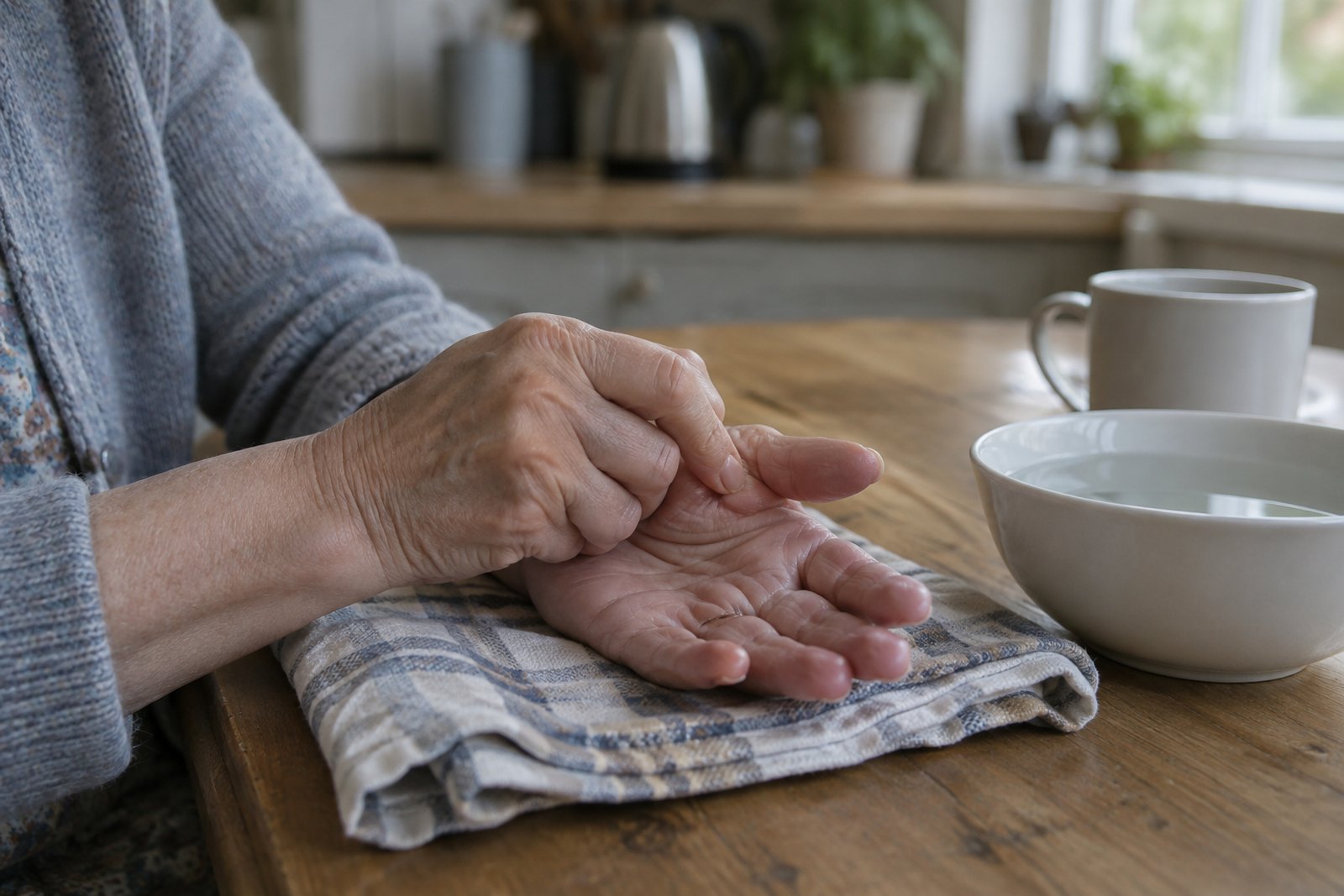
Trigger finger is when a finger or thumb catches as you bend it, then clicks or snaps straight, sometimes painfully. On a bad day it can lock bent, and you have to straighten it with your other hand. It happens because the tendon that bends the finger no longer slides smoothly through its tunnel at the base of the finger. When it affects the thumb, it is called trigger thumb.
The short answer to what you can do about it: gentle movement exercises, a splint that rests the finger (often at night) and changing the way you grip things all help many people, especially early on. Mild trigger finger sometimes settles by itself. If it does not, or your finger is locking, see your GP, because a steroid injection or a small operation are both common and usually effective. If the finger is hot, red and swollen, or you feel unwell, do not wait. That needs same-day medical advice.
What is actually happening in your finger
The tendons that bend your fingers run along the palm side of the hand, from muscles in your forearm to the bones of each finger. They pass through a series of tough bands called pulleys, which keep them close to the bone like the rings along a fishing rod. In trigger finger, the first pulley, roughly where the finger meets the palm, becomes thickened and tight, and the tendon itself can develop a small swelling. The swollen part gets stuck at the narrow spot, then pops through. That is the click.
Common signs include:
- a tender lump at the base of the finger or thumb, on the palm side
- clicking, catching or a popping feeling when you bend or straighten
- stiffness that is often worst first thing in the morning and eases as the day goes on
- a finger that locks bent and needs help to straighten
- in the thumb, pain at its base and trouble with pinching, buttons or opening things
The ring finger and the thumb are affected most often, but any finger can be, and sometimes several at once.
Who gets trigger finger
Anyone can, but it is more common in:
- people over 40
- women
- people with diabetes
- people with rheumatoid arthritis
- people whose work or hobbies involve a lot of repeated or forceful gripping, such as hand tools, gardening or some musical instruments
If you have diabetes, trigger finger is more likely, it can affect more than one finger, and it can be more stubborn to treat. Make sure whoever treats you knows about your diabetes. Plenty of people have no obvious cause at all, so there is no need to blame the gardening.
Babies and toddlers can also get trigger thumb, where the thumb stays bent at the top joint. It is usually not painful. The exercises in this article are for adults. If your child's thumb or finger seems stuck, see your GP or health visitor.
When to see a doctor, and when it is urgent
Trigger finger is not dangerous in itself, but a few things that look similar are.
Get same-day help (call NHS 111)
If your finger is red, hot and swollen along its length, very painful to move or straighten, especially after a cut, bite, splinter or thorn, or you have a temperature, get help the same day. Infection inside the tendon sheath can damage the tendon quickly and needs urgent treatment. If you feel seriously unwell, go to A&E or call 999.
See your GP
- your finger locks and will not straighten, or you cannot fully bend it
- the triggering is getting worse, or has not improved after a few weeks of self-help
- it is affecting your work, sleep or everyday tasks
- you have numbness, tingling or pins and needles, which can point to a different problem such as carpal tunnel syndrome
- it started after an injury
- a child's thumb or finger is stuck bent
Never force a locked finger straight. Gently easing it with your other hand is how most people manage, but if it hurts a lot or will not go, stop and get it seen. Your GP can usually diagnose trigger finger by looking at and feeling your hand. Scans are not normally needed.
Gentle trigger finger exercises you can do at home
The aim is to keep the finger moving smoothly and stop it stiffening, without repeatedly dragging the tendon through the tight spot. That last part matters. Clicking it over and over to "work it loose" tends to irritate it further.
A few ground rules first:
- Move slowly and stay within comfort. A mild stretch is fine. Sharp pain or more catching is your cue to back off.
- Little and often beats one long session. A handful of gentle repetitions, a few times a day, is plenty.
- Warmth can help in the morning. Some people find moving their fingers in a bowl of warm (not hot) water eases stiffness.
- If an exercise makes the finger trigger, do a smaller version that stops just before the catch.
- If things are worse after a week or two rather than better, stop and get advice.
1. Gentle straightening
Rest your hand palm up on a table. With your other hand, slowly ease the affected finger straight and hold it for around 10 to 15 seconds, then relax. For the thumb, gently ease the top joint straight in the same way. You should feel a light stretch, not pain.
2. Finger lifts
Place your hand flat on the table, palm down. Lift each finger off the table one at a time, hold for a moment, and lower it. This moves the finger without bending it into the catch.
3. Small tendon glides
Start with your fingers straight. Bend only the knuckles at the base of the fingers so your hand makes a flat "tabletop" shape, then straighten again. Next, try a gentle hook: keep the base knuckles straight and curl just the top two joints, as if making a claw, then straighten. Skip the full tight fist if that is what sets off the click, or stop short of it.
4. Spreading and thumb circles
Spread your fingers wide apart, then bring them back together. For trigger thumb, make slow, small circles with your thumb, and lightly touch your thumb to each fingertip in turn without pressing hard.
5. Flat hand stretch
Put your palm flat on the table with your fingers straight and gently lean a little weight through it, so the fingers and palm stretch out. Ease off if the lump in your palm is tender.
What to skip for now
Squeezing hard rubber balls, putty or spring grip strengtheners loads the tendon right at the tight spot and often makes things worse. A hand therapist may add strengthening later, particularly after treatment, once the triggering has settled.
Splinting: what it does and how to use one
A splint rests the irritated tendon by stopping the movement that makes it catch. For a finger, a common approach holds the knuckle at the base of the finger fairly straight, so the tendon is not sliding back and forth through the tight pulley, while leaving the other joints free so you can still use your hand. Another approach keeps the whole finger straight overnight. Many people curl their fingers in their sleep, which is one reason mornings are often the worst time.
For trigger thumb, a splint usually supports the thumb so the top joint is not bending and catching.
Some practical points:
- Splints are often worn at night, and sometimes during the day for the activities that set it off. Give it a fair trial of several weeks, not a few days, and ask whoever advised it how long to persist.
- It should be snug, not tight. Tingling, numbness, a change in colour, swelling beyond the splint or red marks that do not fade soon after taking it off all mean it is too tight or the wrong shape.
- Take it off to wash, check your skin and do your gentle exercises, unless you have been told otherwise.
- Ready-made finger splints are widely sold and suit some people. Fingers vary a lot, though, and a poor fit can rub or hold the finger in the wrong position. A hand therapist can make a custom splint from a mouldable plastic that is shaped to your hand.
Splinting tends to work best when the triggering is mild and has not been going on long. If your finger is locking regularly, a splint alone may not be enough, and that is a conversation for your GP.
Avoiding the grips that make it worse
The things that aggravate trigger finger most are sustained, hard gripping and pressure on the palm right over the sore spot. You do not have to stop doing things. You do have to do some of them differently.
- Build up thin handles. Foam tubing on cutlery, pens, toothbrushes and garden tools means you do not have to close your hand so tightly.
- Pad the palm. Padded gloves help for gardening, cycling, pushing a mower or using a walking stick or frame.
- Choose spring-assisted tools. Scissors and secateurs that spring open save your fingers pulling them apart.
- Carry differently. Hooking heavy shopping bags over your fingers is a classic trigger. Carry them on your forearm or shoulder, or use a shopping trolley.
- Make the kitchen easier. Lever taps, a jar opener and an electric can opener cut out a lot of twisting and squeezing.
- Rethink the phone. Long scrolling with the same thumb aggravates trigger thumb. Swap hands, rest the phone on a stand or use voice commands.
- Break up long tasks. Knitting, DIY, long drives and hours at a keyboard are easier with short breaks to open your hand and stretch.
- Loosen your grip. On a steering wheel, mop or walking aid, try holding with a relaxed hand and changing position now and then.
- Push up with a flat hand. When getting up from a chair, push through your open palm or forearms rather than curled fingers.
Many of these are the same principles used for arthritis, and our guide to joint protection for arthritic hands has more ideas that work just as well here.
Treatments a doctor may offer
Steroid injection
A steroid injection into the tendon sheath at the base of the finger is a common treatment and often helps. It may take a little while to work, and the triggering can come back, in which case it is sometimes repeated. If you have diabetes, a steroid injection can raise your blood sugar for a few days, so ask the doctor how to keep an eye on it. Some GPs give these injections themselves; others refer you on.
Surgery
If other treatments have not worked, or the finger is stuck, you may be offered a trigger finger release. The surgeon divides the tight pulley so the tendon can glide freely again. It is usually done under local anaesthetic as a day case, so you go home the same day. It is normally done through a small cut in the palm, and some units use a needle technique instead. Waiting times vary across the country, so ask your GP what to expect locally.
Other referrals
Your GP may refer you to NHS physiotherapy or hand therapy for a splint and exercises, to a hand or orthopaedic clinic, or to rheumatology if they suspect an inflammatory arthritis is behind it.
Recovering after trigger finger surgery
Always follow the instructions from your own surgical team, because they vary. In general terms:
- You will have a dressing for the first few days. Keep the wound clean and dry until it has healed, and keep your hand raised for the first day or two to help with swelling.
- Most people are encouraged to move their fingers gently soon after the operation. Early movement helps prevent stiffness and keeps the tendon gliding.
- You will be told whether your stitches dissolve or need removing, and when.
- Light everyday tasks are usually fine early on. Heavy gripping and lifting usually have to wait a few weeks.
- The palm is often tender and the scar can feel firm or lumpy for some time. Once the wound has fully healed, gentle scar massage with a plain moisturiser is often recommended.
- Only drive when you can grip the wheel firmly and control the car safely, including in an emergency. Check with your surgical team and your insurer.
- When you return to work depends on your job. Desk work is usually sooner than manual work.
Contact your surgical team, GP or NHS 111 if the wound becomes red, hot, swollen or starts leaking, if you develop a temperature, or if the pain gets worse instead of better. If your finger is still stiff and hard to bend or straighten a couple of weeks after surgery, ask about a referral to hand therapy rather than waiting it out.
Where an occupational therapist fits
Hand therapy in the UK is carried out by occupational therapists and physiotherapists with extra training in hands. Either can be the right person. Your GP diagnoses trigger finger, and a doctor or surgeon gives injections and operates. An occupational therapist does neither.
What an occupational therapist with hand therapy experience can do:
- assess how the triggering is affecting the everyday things you need to do
- make or fit a splint, check it is right and adjust it as things change
- give you an exercise programme suited to your finger, and move it on as you improve
- look at the specific tasks that set it off, at work, in the kitchen, in the garden or with hobbies, and suggest different grips, tools and equipment
- look at keyboard, mouse and tool set-ups at work and suggest changes
- help after surgery with stiffness, swelling and scar care, and with getting back to full use
- see the bigger picture if you have several fingers affected, or arthritis or diabetes as well
On the NHS, hand therapy usually comes through a referral from your GP or surgeon. A private occupational therapist visiting at home has one advantage: they can see the actual jar you cannot open, the tools in your shed and the way you hold your phone, and make changes that fit your life. Whoever you see, check they are registered with the HCPC and ask about their hand experience. Our guide to hand therapy at home explains what a visit looks like, and our page on hand and upper limb problems covers related conditions.
Frequently asked questions
Can trigger finger go away on its own?
Yes, sometimes, particularly if it is mild and you ease off the activities that aggravate it. If it is getting worse, locking, or has not improved after a few weeks, see your GP rather than waiting indefinitely.
Are trigger finger exercises safe if my finger keeps locking?
Gentle movement within comfort is usually fine, but do not force the finger through the catch or straighten a locked finger roughly. A finger that locks regularly is a reason to see your GP, as exercises alone are unlikely to fix it.
How long should I wear a splint?
It depends on the type of splint and how long you have had the problem. Many people wear one at night for several weeks. Ask whoever gave you the splint, and stop and get advice if it causes numbness, tingling, swelling or sore skin.
Is trigger finger a sign of arthritis?
Not by itself, although it is more common in people with rheumatoid arthritis. It is also different from Dupuytren's contracture, where thick cords form in the palm and slowly pull a finger down without the clicking. If you are not sure which you have, your GP can tell the difference.
Should I massage the lump in my palm?
Some people find light, gentle massage over the area comfortable, especially with warmth in the morning. Avoid pressing hard or digging into the lump, which can make it sorer.
Can I keep working with trigger finger?
Most people can, often with some changes such as padded or thicker-handled tools, more breaks or swapping tasks for a while. Talk to your employer about what is aggravating it. An occupational therapist can look at your work tasks and suggest practical adjustments.
Next steps
If grip and everyday tasks are the problem, see our equipment and daily living aids page, or if your job is setting it off, our work and ergonomics page. You can also check current guide prices, and choose your area below.

Talk to an occupational therapist near you
This guide is general information. For advice about your own situation - or someone you look after - a local occupational therapist can visit you at home and see it for themselves.
Choose your area: