

Therapy Putty: Hand Exercises to Build Strength and Movement
By Mobile Occupational Therapist • 29 October 2026 • 13 min read
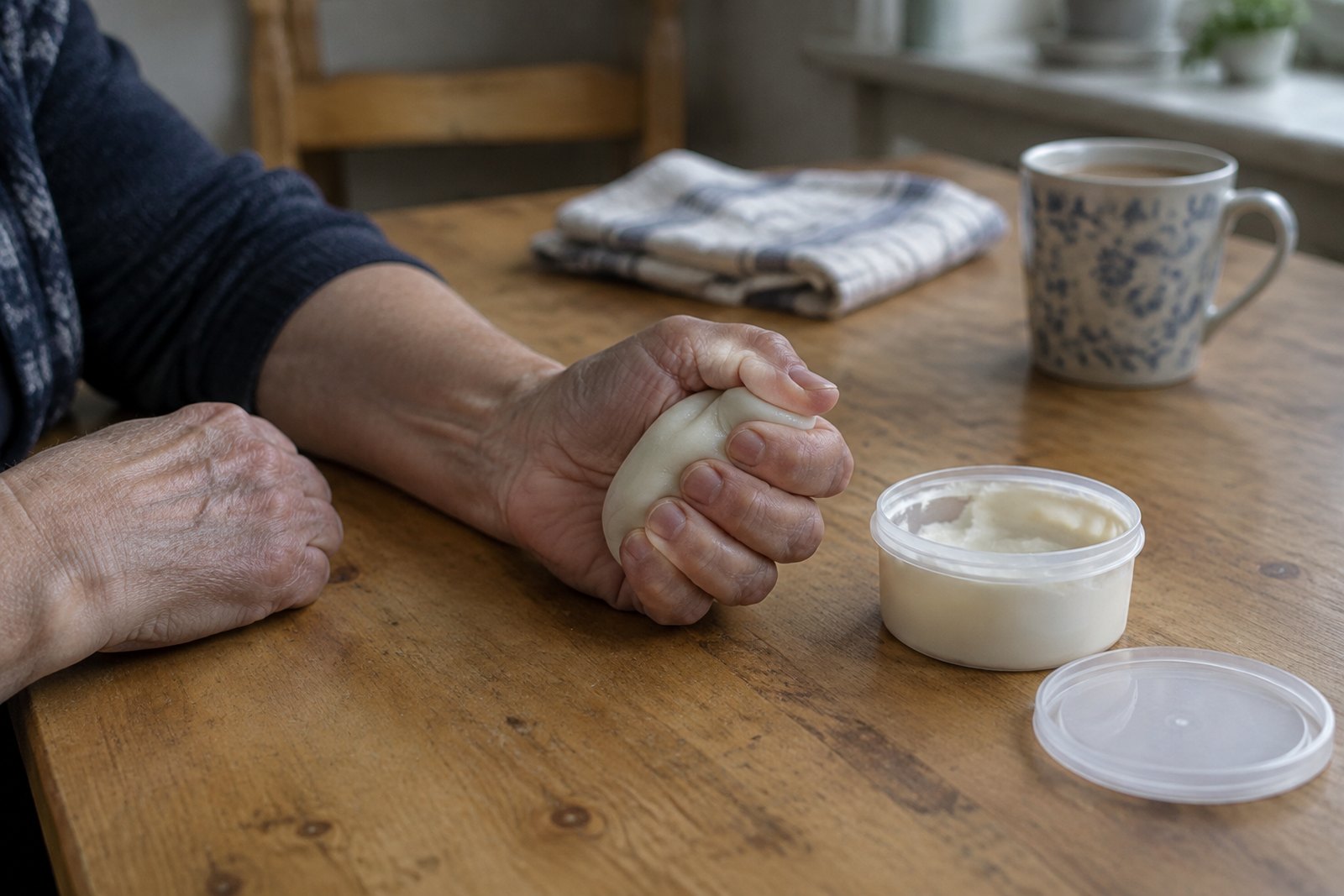
Therapy putty is a soft, stretchy material that you squeeze, pinch, roll and pull to exercise the muscles and joints of your hand and fingers. It comes in different resistances, from very soft to very firm, so you can start easy and work up. People use it to rebuild grip after an injury or operation (once they are allowed to), to keep hands moving with arthritis, and to help children build the finger strength they need for pencils, buttons and cutlery.
It is cheap, simple and genuinely useful. It is also easy to use badly: too firm a grade, too much too soon, or starting before a surgeon or hand therapist says your hand is ready. This guide covers how to choose a grade, a set of therapy putty exercises described step by step, how much to do, and the pain rules that keep you on the right side of helpful.
What therapy putty actually is
Therapy putty looks a bit like modelling dough but behaves differently. It does not dry out, crumble or set. Squeeze it and it resists, then slowly gives. Leave it on a table and it gradually flattens out. That slow, even resistance is the point. Your fingers have to work through the whole movement rather than just snapping shut, and you can reshape it and go again as many times as you like.
Most putty is sold in small round tubs with a lid. Many types are latex-free, but not all, so if you or anyone in your house has a latex allergy, check the packaging before you buy.
Resistance grades: which one to start with
Putty comes in grades, usually something like extra soft, soft, medium, firm and extra firm. Makers often colour code them, but the colours are not standard. One maker's yellow might be the softest; another's might be medium. Go by the grade name on the tub, not the colour, and if you are replacing putty, buy the same make or compare the descriptions carefully.
- Extra soft or soft suits most people starting out: after an injury or operation, with painful or arthritic hands, older people with a weak grip, and most children.
- Medium suits people with a reasonable grip who want to build strength, or who have found soft too easy for a while.
- Firm and extra firm are for hands that are already fairly strong, such as the later stages of rehabilitation or getting back to physical work or sport.
If in doubt, start softer. A grade that is too firm tempts you to clench with the wrong muscles, strains the joints and puts you off. You have it about right if you can do the movements smoothly, you feel your hand working by the last few repetitions, and nothing hurts. Some people keep two grades: a softer one for single-finger exercises and a firmer one for whole-hand squeezing, because individual fingers are much weaker than your whole grip.
Who therapy putty helps, and when to hold off
After a hand or wrist injury or operation
Putty is a staple of hand therapy after things like a broken wrist, tendon repairs, carpal tunnel release or trigger finger release. But timing matters a great deal. Healing bone, tendons and wounds need protecting early on, and gripping against resistance too soon can undo a repair. Do not start putty until your surgeon or hand therapist says so, and follow their programme over anything you read elsewhere, including this page. Our guide to hand therapy at home explains how that process usually works.
Arthritis
With osteoarthritis or rheumatoid arthritis, gentle movement helps keep joints flexible and muscles working. Putty can be part of that, with care. Use a soft grade, favour gentle movements such as rolling and finger spreading over hard squeezing, and leave the putty alone on days when joints are hot, swollen or flaring. Rest and gentle movement without resistance are usually better then. Some people with arthritis at the base of the thumb find pinching makes it worse, so skip or soften any exercise that does. Our post on hand exercises for arthritis covers movements you can do without putty too.
Children
Children who find pencils, scissors, buttons or cutlery hard work often enjoy putty, and playful hand strengthening can help. It is not a fix for everything. Handwriting difficulties can be as much about coordination, posture, eyesight or attention as finger strength. But as one tool among several, it earns its place. Our guide to fine motor skills activities by age has more ideas and explains when to get a child assessed.
Other people who use it
Older people whose grip has weakened, people recovering from a stroke or living with a neurological condition (when a therapist has suggested it), and people building hand strength back up for work all use putty. The principle is the same: start soft, keep it short, and link it to the things you actually want to do.
When to get checked before you start
- Numbness, tingling or pins and needles that is getting worse, or weakness with no obvious reason: see your GP.
- A finger or wrist that looks out of shape, is very swollen or bruised after a fall: get it checked at a minor injuries unit, urgent treatment centre or A&E, as it may be broken.
- A finger that keeps locking or catching: see your GP rather than trying to exercise through it.
- Sudden weakness in a hand or arm, especially with a drooping face or slurred speech: call 999. These can be signs of a stroke.
If you have carpal tunnel symptoms, be aware that repeated hard gripping can aggravate them. Ask your GP or therapist before adding putty.
Therapy putty exercises: a basic set
Before you start, take off rings, sit at a table and rest your forearm on it. Warm hands move more easily, so washing them in warm water first helps. Knead the putty for a minute to soften it. Do each exercise slowly, and reshape the putty between repetitions.
1. Full grip squeeze
Roll the putty into a ball or a short, fat sausage and hold it in your palm. Squeeze with all your fingers, as if making a fist, so the putty pushes out between them. Hold for a moment, then relax and reshape. This works your overall grip: holding a cup, a walking stick handle or a shopping bag.
2. Fingertip pinch
Take a small ball of putty and pinch it between the pad of your thumb and the pad of your index finger, tip to tip. Then repeat with your middle, ring and little fingers in turn. This works the fine pinch you use for buttons, coins, zips and picking up small things. If the base of your thumb aches, use a softer grade or skip this one.
3. Key pinch
Hold the putty between the pad of your thumb and the side of your index finger, as if holding a key, and press. This is the grip for turning a key, holding a card or pulling a plug.
4. Finger spread
Flatten the putty into a thick ring, like a doughnut. Put your fingers and thumb together into the hole, then spread them apart against the putty, stretching it outwards. Relax and repeat. This works the muscles that open the hand, which squeezing does not, so it balances out the gripping exercises. It is often a good one for arthritic hands.
5. Finger straightening
Bend your fingers slightly and drape a strip of putty over the fingertips, holding the ends down with your other hand or against the table. Straighten your fingers against it. You can do the same with your thumb on its own. This helps with opening your hand fully to reach for a glass or let go of something.
6. Thumb press
Flatten the putty into a thick pancake on the table, or hold a ball of it in your palm. Press your thumb into it as deep as is comfortable, then pull it out and smooth it over. This builds thumb strength for pressing buttons, opening packets and pushing things through.
7. Rolling
Put the putty on the table and roll it into a long sausage using a flat hand with your fingers straight. Then try rolling it with just your fingertips. This is gentle, works wrist and finger movement, and makes a good warm-up or cool-down. On a sore day, rolling may be the only exercise you do.
For children: finding hidden treasure
Hide beads or small objects in a ball of putty and let your child dig them out with their fingers. Children love it, and it works pinching, poking and pulling all at once. But small objects are a choking risk, so:
- Only do this with children who are past the stage of putting things in their mouths.
- Use objects that are as large as practical, and count them in and count them out.
- Stay with your child the whole time and put everything away afterwards.
For younger children, skip hidden objects. Instead, roll snakes, pinch the putty into spikes, poke holes in it one finger at a time, or snip it with child-safe scissors. Putty itself should not go in mouths either.
How much and how often
If a therapist has given you a programme, follow it. If not, start small. Pick a few exercises, do around five to ten slow repetitions of each, once a day, and see how your hand feels the next day. That might take five or ten minutes. If all is well, add a few repetitions or a second short session. Little and often tends to work better than one long session, and a day off when your hand is tired is fine.
Move up a grade only when the whole set has felt easy for a while, not just one exercise on a good day. And keep an eye on everyday life, because that is the real test. Opening a jar, doing up a coat or holding a pen for longer matters more than how hard you can squash a tub of putty.
For children, a few minutes as a game is plenty. Build it into a routine, such as before homework, and stop while it is still fun.
Pain rules
- Usually fine: your hand feels tired, or a mild ache that settles within an hour or so.
- Too much: sharp pain during an exercise, pain that lasts into the next day, more swelling, or stiffness that is worse the next morning. Drop the repetitions, switch to a softer grade, or rest for a day or two.
- Stop and get advice: numbness, tingling, pins and needles, or a joint that clicks painfully or gives way.
- After surgery: if a wound becomes red, hot, swollen or starts to leak, or you feel feverish or unwell, contact your surgical team, your GP or NHS 111.
Pushing through pain does not make your hand stronger faster. With a healing injury or arthritis, it usually does the opposite.
Storage and hygiene
Putty keeps well if you look after it. Put it back in its tub with the lid on as soon as you finish, because left out it slowly flows and picks up dust and fluff. It sticks to fabric, carpet, hair and soft furnishings, so use it at a table rather than on your lap or the sofa. Keep it away from radiators, direct sunlight and anywhere hot.
Wash your hands before and after. Do not use putty if you have open cuts, broken skin or a healing wound on your hands, unless your therapist has said it is fine. Keep one tub per person, which matters in families, classrooms and care homes. Replace it when it is grubby, full of fluff, or feels noticeably different. Keep it out of reach of young children and pets, and it is not a good idea for anyone who might put it in their mouth, including some people living with dementia.
Where an occupational therapist fits
Putty is a tool, not a plan. An occupational therapist looks at what your hands need to do in your actual life, then works backwards. They can assess your grip, pinch and movement, choose the right grade and exercises, check your technique, and turn exercises into practice with real tasks such as opening containers, fastening clothes or using cutlery.
Just as usefully, they will tell you when strength is not the whole answer. If grip is unlikely to return fully, an occupational therapist can suggest simpler ways of doing things, joint protection habits and equipment such as jar openers, chunky-handled cutlery or tap turners. For children, a paediatric occupational therapist can work out whether a struggle with handwriting or dressing is really about strength or about coordination, sensory processing or something else. You can read more on our hand and upper limb injuries page.
Be clear about who leads, though. After hand or wrist surgery or a fracture, your NHS hand therapy team (occupational therapists or physiotherapists with specialist training) or your surgeon should guide your rehabilitation, and their instructions come first. After some injuries a physiotherapist leads. Unexplained numbness, weakness or swelling is a job for your GP. A private occupational therapist visiting at home can help when NHS input has finished, when you want help making exercises fit daily life, or when a child needs an assessment.
Frequently asked questions
What colour therapy putty is the softest?
It depends on the maker. Colour coding is common but not standard, so one brand's softest colour may be another brand's medium. Always check the grade name on the tub.
Can I use play dough, slime or a stress ball instead?
For children's play, play dough is fine, but it is softer, crumbles and dries out. Slime does not give an even resistance. A stress ball only really works the full squeeze. Therapy putty is graded, so you can choose and increase the resistance, which matters for rehabilitation.
Is therapy putty good for arthritis?
It can be, used gently. Choose a soft grade, focus on rolling, spreading and light squeezing, and stop on flare days or if a joint gets hotter or more swollen. If an exercise makes your thumb base ache, leave it out.
When can I start putty after hand or wrist surgery?
Only when your surgeon or hand therapist says so. The timing depends on the operation and how you are healing, and starting too early can damage a repair. Ask at your next appointment if you are not sure.
How long does therapy putty last?
Kept in its tub and used on a clean table, it lasts a good while. Replace it when it gets dirty, picks up fluff or hair, or feels different from when you bought it. If you have moved up a grade, keep the softer one for warm-ups.
Can I get therapy putty on the NHS?
Some NHS hand therapy and children's therapy services give putty out as part of treatment, but it varies by area and service. If you are under a therapy team, ask them. Otherwise it is widely available to buy and is not expensive.
Next steps
If you would like help choosing the right exercises or equipment for your hands, or your child's, see our equipment and aids page, or current guide prices, and choose your area below.

Talk to an occupational therapist near you
This guide is general information. For advice about your own situation - or someone you look after - a local occupational therapist can visit you at home and see it for themselves.
Choose your area: