

Sensory Circuits: What They Are and How to Run One
By Mobile Occupational Therapist • 7 October 2026 • 14 min read
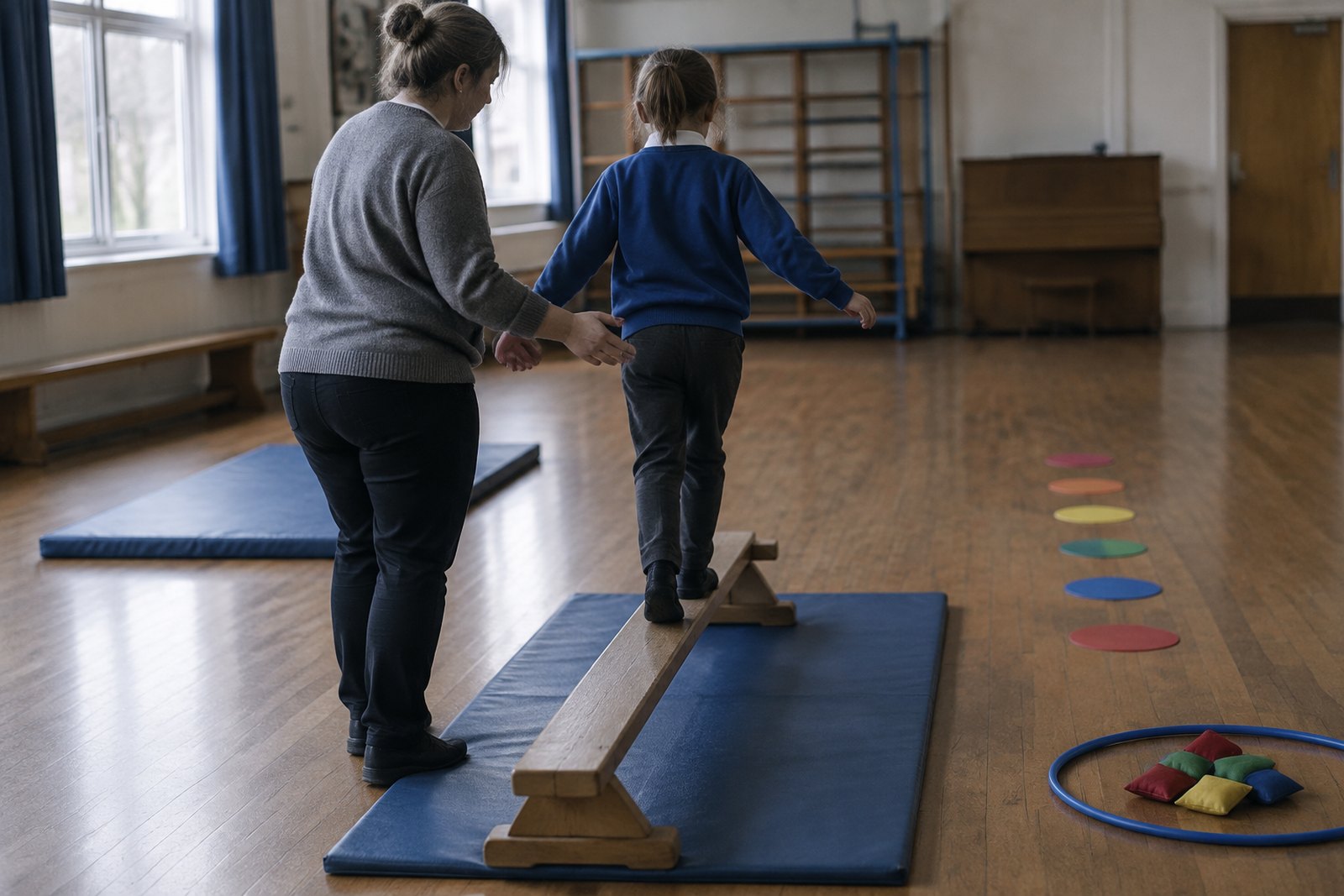
A sensory circuit is a short sequence of physical activities that some children do at the start of the school day or after lunch to help them settle and get ready to learn. It usually lasts about 10 to 15 minutes. It runs in three parts, in a set order: alerting activities that wake the body up, organising activities that need focus and coordination, and calming activities that bring the child back down to a steady state before they go into class.
Many UK primary and special schools use them, often for children who arrive either flat and sluggish or wired and bouncing off the walls. You can run a simple version at home with cushions, a hallway and a bit of patience. The honest bit: the research behind sensory circuits is limited, and they work best when the activities are chosen for a particular child rather than copied from a list. This guide explains how they work, gives activity ideas for each section, and covers safety and when to ask an occupational therapist.
What a sensory circuit is for
The idea comes from sensory integration theory, which suggests that some children find it harder to process information from their senses, and that the right kind of movement can help them reach a state that is calm but alert. Teachers often call this being 'ready to learn'. A child who has spent the morning rushing, or who finds the noise of the playground too much, may arrive at the classroom door anything but.
Sensory circuits lean heavily on two senses most of us never think about. The vestibular sense, in the inner ear, tells you about movement, balance and which way up you are. Proprioception tells you where your body parts are and how hard your muscles are working, and it gets most of its input from pushing, pulling, lifting and carrying. If these are new to you, our guides to the vestibular system and to proprioception explain them in plain English, and the 8 sensory systems explained puts them in context.
A circuit is not PE, and it is not a reward or a punishment. It is a routine, done the same way most days, so the child knows exactly what is coming. That predictability is part of what makes it work.
The three sections, with activity ideas
The order matters. You go up, you get organised, you come down. Finishing on an alerting activity and sending a child straight into a maths lesson is how you end up with a child doing laps of the classroom.
1. Alerting: waking the body up
Alerting activities give quick, strong movement input. They suit the child who is slumped, yawning or hard to get going. A few minutes is plenty. Ideas:
- Bouncing on a small exercise trampoline with a handle, one child at a time, for a counted number of bounces such as 20.
- Star jumps.
- Sitting and bouncing on a large therapy ball, feet flat on the floor, with an adult steadying the ball.
- Skipping, with or without a rope.
- Jogging on the spot, or a short shuttle run between two cones.
- Hopping or jumping along a line of floor spots.
Spinning is sometimes included in circuits, but it is the strongest and least predictable kind of input, and many occupational therapists leave it out of group circuits altogether. More on that in the safety section.
2. Organising: focus and coordination
Organising activities ask the brain and body to work together: planning a movement, balancing, timing, crossing the middle of the body, following a sequence. They take more concentration, and this is often where you see a child start to come together. Ideas:
- Walking heel to toe along a low balance beam, or along a line of tape on the floor.
- Throwing beanbags into a hoop or bucket while standing on one foot or on a wobble cushion.
- Crawling through a play tunnel.
- Commando crawling under a row of chairs or a stretched-out sheet.
- Stepping in and out of a line of hoops, alternating feet.
- Throwing and catching a ball with a partner or against a wall, counting each catch.
- Wheelbarrow walking, with the adult holding the child at the thighs or knees rather than the ankles.
- Copying a short sequence of movements, such as clap, touch knees, touch the opposite shoulder.
3. Calming: coming back down
Calming activities use slow, heavy, deep-pressure input. They help a child leave the circuit settled rather than buzzing. Ideas:
- Wall push-ups: hands flat on the wall, ten slow pushes.
- Chair push-ups: sitting with hands on the seat either side, pushing down to lift the bottom slightly.
- Lying on the tummy on a mat while an adult slowly rolls a large therapy ball over the back and legs with firm, steady pressure. Never over the head or neck, and only if the child likes it.
- Carrying something fairly heavy, such as a box of books, a short distance.
- Lying under a heavy cushion or beanbag with the head and face completely clear.
- Slow animal walks, such as a bear walk or crab walk.
- Slow breathing: blowing a cotton wool ball across a table through a straw, or 'smell the flower, blow out the candle'.
- Squeezing a stress ball or a lump of putty.
How long, how often and in what order
Most school circuits take 10 to 15 minutes, split roughly evenly across the three sections. A common pattern is two or three activities per section, done once or twice through. Some schools run a circuit first thing as children arrive; others add a shorter one after lunch, when energy and noise levels jump.
A few practical points make a big difference:
- Keep the order fixed. Alerting, organising, calming, every time.
- Count rather than time. 'Ten bounces' is easier to follow than 'one minute', and it has a clear end.
- Use a picture sequence. Simple pictures of each station, in order, help children who struggle with spoken instructions.
- Keep groups small. A handful of children with at least one adult, so each child can be watched and helped.
- Watch, then adjust. If a child is more wound up afterwards, cut the alerting section down. If they are still flat, it may need a little more.
- Go straight into class. The point is to arrive ready. A long wait in a noisy corridor afterwards undoes a lot of the good.
Who sensory circuits suit
Schools tend to use sensory circuits for children who:
- find it hard to settle at the start of the day or after break
- seek lots of movement, crash into things, fidget constantly or cannot sit still
- seem tired, floppy or switched off, and slump at their desk
- are autistic, or have ADHD, dyspraxia (developmental coordination disorder) or sensory processing differences
- have poor balance and coordination and benefit from extra practice somewhere low pressure
A diagnosis is not usually needed. Many schools let any child who would benefit join in, and some children simply enjoy it.
It is not right for everyone. A child who becomes overwhelmed in busy groups may find a circuit in a shared hall harder than staying in class. A child who hates being watched may dread it. Some children need something quieter, or a version that is almost all calming. That is fine. The circuit should fit the child, not the other way round.
Doing a sensory circuit at home
You do not need a hall or special kit. A short circuit at home can help a child who struggles to get out of the door in the morning, or one who comes home from school either exhausted or bouncing. Keep it to 5 to 10 minutes and make it part of the routine rather than another battle.
A simple home version might look like this:
- Alerting (2 to 3 minutes): 20 star jumps, jumping from cushion to cushion laid flat on the carpet, or marching on the spot to a favourite song.
- Organising (3 to 4 minutes): walk heel to toe along a line of masking tape on the floor, crawl through a tunnel made of chairs and a blanket, throw rolled-up socks into a laundry basket from a set distance.
- Calming (2 to 3 minutes): ten wall push-ups, carry a bag of books to the front door, lie on the sofa under a couple of heavy cushions with the face clear, then five slow breaths.
Everyday jobs count too. Carrying the washing basket, pushing a full laundry bag down the hall, helping move a chair or stripping the bed all give useful heavy input. Plenty of families find these work better than anything that looks like therapy, because they are just part of the day and nobody has to be persuaded.
If a short circuit seems to help, it often makes sense to spread similar activities across the whole day. That is the idea behind a sensory diet, which we explain in our guide to building a sensory diet at home.
Safety: what to get right
Sensory circuits are low risk when run sensibly, but they involve jumping, balancing and moving at speed, and the children doing them often have shaky balance or a limited sense of danger. Get the basics right.
- Supervise closely. An adult watching and within reach for anything involving height, bouncing or balance.
- Clear the space. Move furniture with sharp corners and anything breakable, keep away from radiators, and leave room around each station.
- Mats under anything off the floor. Use gym mats or another firm, soft, non-slip surface under balance beams and around a trampoline. A rug that slides is a hazard, not a mat.
- One child at a time on a trampoline. Small exercise trampolines with a handle are the safest option. No flips or somersaults.
- Keep it low. A beam just off the floor is enough. Extra height adds risk without adding benefit.
- Be careful with spinning. It can cause dizziness, nausea or distress, sometimes a while after the activity has finished. Never spin a child who does not want it. Most families and schools are better leaving it out unless an occupational therapist has advised it.
- Nothing over the face. Cushions, beanbags and therapy ball rolls must never cover the head, face or neck.
- Stop if the child is distressed. Pale, sweaty, unusually quiet, crying or panicking means stop and let them rest.
Children with medical conditions
Check with the child's GP, consultant, physiotherapist or school nurse before starting a circuit if the child has epilepsy, a heart condition, a shunt, fragile bones, significant joint hypermobility, a recent operation or injury, or any condition where exertion, bouncing or neck movement needs care. Heavy cushions and deep pressure also need care for children with breathing difficulties or who could not easily push the weight off themselves. In school, any limits should be written into the child's individual healthcare plan.
What the evidence says, honestly
Sensory circuits are widely used, and many teachers and parents say they help. That matters. But there is little good-quality research looking at sensory circuits specifically, and the wider evidence on sensory-based approaches for children is mixed. Some of what is written about them online goes well beyond what has been shown.
What can fairly be said is this. Regular physical activity, a predictable routine and a calm transition into class are all sensible for children who find the school day hard, and a circuit packages those up. Run safely, it is unlikely to do harm. It may help some children a lot and others not at all. The best approach is to try it, watch carefully, and keep it only if it seems to help that particular child.
A circuit is also not a substitute for proper support. If a child is struggling a great deal in school, speak to the school's SENCo about their wider needs. A circuit can sit alongside that, but it should not be the whole plan.
Where an occupational therapist fits
Occupational therapists are the profession most closely linked with sensory circuits. They are the right person when a generic circuit is not working, when a child's needs are complex, or when you want to understand why a child reacts the way they do. An occupational therapist can:
- assess how a child responds to movement, touch, sound and other sensations, and how that affects school, play, eating, dressing and sleep
- work out whether a child needs more alerting, more calming or a different mix altogether
- design a circuit or set of activities for one child or a small group, with clear safety limits
- show school staff and parents how to run it and what to watch for
- write a report that can support a school's SEN planning or a request for an EHC needs assessment
A private occupational therapist visiting at home can see the child where daily routines actually happen, which is often where the hardest moments are. Our children's occupational therapy page explains more.
Other professionals lead in some areas. A physiotherapist is often the right person for muscle weakness, poor balance, or problems with walking and running. A speech and language therapist leads on communication, and on eating, drinking and swallowing difficulties. Your GP, health visitor or your child's school can usually help you get a referral for NHS assessment for autism, ADHD or coordination difficulties (the route varies by area), and the school's SENCo is the person to talk to about support in school. If a child seems very low or anxious, or talks about hurting themselves, see your GP promptly. If you are worried about their safety right now, call NHS 111, or 999 in an emergency.
Frequently asked questions
What is a sensory circuit in school?
It is a short, structured set of physical activities, usually done in a small group with an adult, at the start of the day or after lunch. It moves from alerting to organising to calming, with the aim of helping children feel settled and ready for lessons.
How long should a sensory circuit last?
Around 10 to 15 minutes in school is typical, and 5 to 10 minutes is usually plenty at home. Longer is not better. A short circuit done consistently tends to be more useful than a long one done now and then.
What equipment do you need for a sensory circuit?
Very little. Schools often use mats, a small trampoline with a handle, a low beam, hoops, beanbags, a therapy ball and a play tunnel. At home, cushions, masking tape, a blanket over chairs, rolled-up socks, a basket and a wall will cover most activities.
Can a sensory circuit make a child more hyperactive?
Yes, if it ends on alerting activities, has too much bouncing or spinning, or is followed by a noisy wait. If a child comes out more wound up, shorten the alerting section, lengthen the calming section, and make sure they go straight into a calm setting afterwards. If it still does not suit them, it may simply not be the right approach for that child.
Is a sensory circuit the same as a sensory diet?
Not quite. A sensory circuit is one short session at a set time. A sensory diet is a plan of activities spread through the whole day, at home and at school, tailored to a child's needs. A circuit can be one part of a sensory diet.
Can I ask my child's school to start a sensory circuit?
You can. Speak to the class teacher or SENCo, explain what you see at home and what seems to help, and ask whether they run one or would consider it. If your child has an occupational therapist, ask them to share specific suggestions with the school.
Next steps
If you would like a circuit or activity plan designed around your child, see our sensory needs page, or current guide prices, and choose your area below.

Talk to an occupational therapist near you
This guide is general information. For advice about your own situation - or someone you look after - a local occupational therapist can visit you at home and see it for themselves.
Choose your area: