

Reminiscence Therapy for Dementia: How to Do It at Home
By Mobile Occupational Therapist • 11 October 2026 • 13 min read
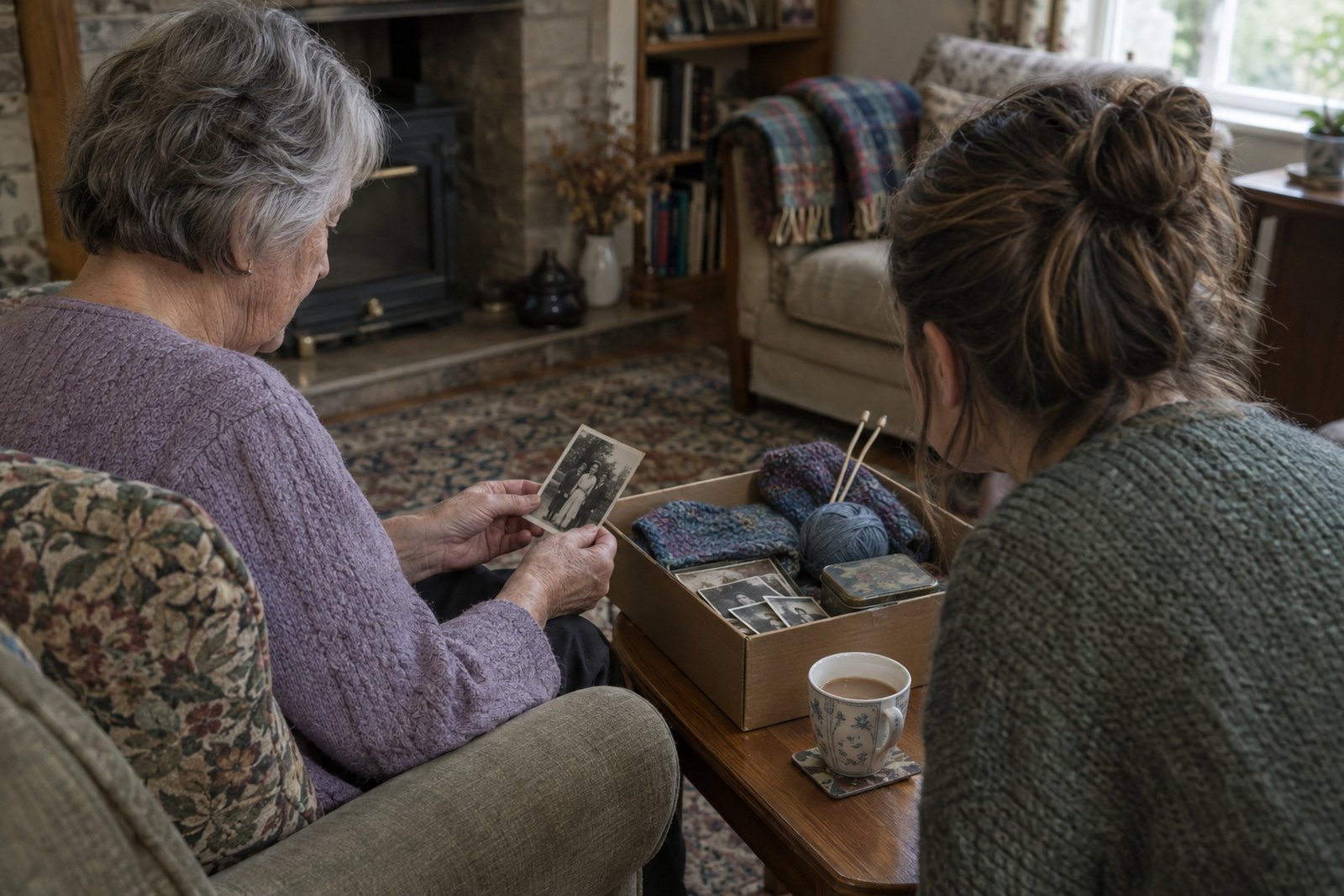
Reminiscence therapy means sharing memories from someone's past, usually with prompts such as old photographs, music, familiar objects or smells. Life story work is its practical cousin: gathering a person's history, people, likes and routines into a book or profile so that everyone who cares for them knows who they are. You do not need training or special kit to do either at home. You need some time, a few prompts and a willingness to follow where the conversation goes.
Does it work? For some people, yes, in the sense that matters most day to day: it can lift mood, ease conversation and give a person living with dementia a sense of being known and capable. It does not slow or reverse dementia, and the effects vary a great deal from person to person and from one day to the next. Treat it as a good way of spending time together rather than a treatment, and you will not be disappointed.
What reminiscence and life story work actually are
Reminiscence
Reminiscence is simply talking about the past, on purpose, with something to spark it. It can be one-to-one at the kitchen table or in a group at a memory café. The aim is not to get facts right. The aim is enjoyment, connection and a chance for the person to be the expert on their own life for a while, which is a rare feeling once dementia starts taking things away.
Life story work
Life story work collects that history and puts it somewhere useful. It might be a scrapbook, a folder, a box, a one-page profile or a set of photos on a tablet. A good life story covers the big things (where they grew up, work, family, places they loved) and the small things that matter just as much: how they take their tea, what they like to be called, what calms them down and what winds them up.
The two overlap. Making a life story book is a reminiscence activity in itself, and the finished book becomes a prompt for many more conversations.
What the evidence says, honestly
Reminiscence has been studied for decades, and the findings are modest but encouraging. Research reviews suggest it can bring small improvements in mood, wellbeing and communication for some people, with results that differ between studies, settings and individuals. Some people clearly love it. Others find it tiring, or simply not their thing.
In England, NICE guidance on dementia recommends offering activities tailored to the person's preferences to promote wellbeing, and says group reminiscence therapy can be considered for people living with mild to moderate dementia. That is a fair summary of where things stand: worth trying, worth adapting, not a miracle.
Why the past is often easier to reach
In many types of dementia, especially in the earlier stages, memories from long ago are often better preserved than recent ones. Your mum may not remember breakfast but can tell you the name of her first teacher. Memories laid down between childhood and early adulthood, along with songs and smells, tend to hang on longest for many people.
This is why reminiscence can work when ordinary conversation is a struggle. Asking about this morning puts someone on shaky ground. Talking about the dance hall in 1962 lets them stand on solid ground, and that feels good.
How to do reminiscence at home
Start with what you already know
Before you dig out boxes, jot down what you know: where they grew up, schools, jobs, places they lived, hobbies, the music they danced to, family holidays, pets, the football team. These are your starting points. Ask brothers, sisters, old friends and neighbours too. They often hold stories the immediate family never heard.
Photographs
Old photos are the obvious place to start and usually the best. A few tips:
- Use a handful at a time, not a whole album. Three or four photos can fill half an hour.
- Enlarge small or faded prints if eyesight is poor. Good light helps too.
- Photos of places, cars, shops and events often work better than portraits, because there is less pressure to name people.
- Pictures of the area where they grew up, or of everyday life from their youth, can work even if they are not family photos.
Music
Music is often the most powerful prompt of all. Songs from someone's teens and twenties can bring a surprising spark, sometimes in people who say very little. Try the songs they courted to, hymns from school or chapel, music hall tunes, or whatever was on the radio when they were young. Sing along if you can bear it. Watch their face, hands and feet rather than waiting for a conversation; tapping along counts.
Objects and a memory box
A memory box is a container of objects linked to the person's life that they can handle, talk about or just hold. Ideas include:
- Tools, gardening gloves, knitting needles and wool, a sewing tin.
- Medals, badges, certificates, a work uniform or name badge.
- Old coins, ration books, tickets, postcards.
- Fabric with a familiar feel: a dance dress, a scarf, a cardigan.
- Things from a hobby: a fishing reel or a fly box with the hooks removed, a football rattle, a seed packet, a cricket ball.
Choose objects that are safe to handle for the person as they are now, not as they were. Leave out anything sharp, heavy or small enough to swallow, such as coins, buttons, hooks, blades or pointed needles, if the person is very confused, puts things in their mouth or has swallowing difficulties. Never include old medicines or chemicals.
Smells, tastes and textures
Smell goes straight to memory for a lot of people. Try lavender, coal tar soap type smells, polish, freshly cut grass, baking bread, a particular perfume or aftershave, a seaside smell from a bag of shells. Old-fashioned foods can work too: making jam tarts together, a fish and chip supper, a favourite pudding. If there are any swallowing difficulties, check foods are safe first.
Places and outings
Some people respond best to being somewhere: the park they walked the dog in, the old street, a seaside town, a heritage railway, a local museum. You do not need to go far. Even a drive past the old school can open up a conversation.
How to talk: follow their lead and do not test
The most important skill is not the props. It is how you talk. Reminiscence goes wrong when it turns into a quiz.
- Avoid "Do you remember...?" It sounds kind but it is a test, and failing it feels awful. Try "Tell me about..." or "I love this photo of you at the beach" instead.
- Make comments, not questions. "That looks like a cold day" invites a reply without demanding one.
- Do not correct. If Dad says the wedding was in Blackpool when it was in Bolton, let it go. The facts matter far less than the feeling.
- Share your own memories. It takes pressure off and makes it a conversation rather than an interview.
- Follow where they go. If a photo of a wedding leads to a story about a dog, go with the dog.
- Allow silence. People with dementia often need longer to find words. Count to ten in your head before jumping in.
- Keep it short. Twenty minutes is plenty for many people. Stop while it is still enjoyable.
- Pick your time. Most people do better earlier in the day and after a rest, not when tired or hungry.
If they do not want to do it today, that is fine. Try another day or another prompt. For more ideas that do not rely on memory at all, see our guide to activities for people with dementia at home.
When a memory brings up upset
The past is not all happy. A photo might bring up the death of a parent, a lost baby, war, poverty, a difficult marriage or worse. Sometimes the person will relive grief as if it were new.
If that happens:
- Acknowledge the feeling rather than rushing past it. "That sounds like it was really hard" is better than "Never mind, look at this one."
- Stay with them, hold a hand if they like that, and keep your voice calm.
- Once they have settled a little, gently move to something comforting, such as a song or a cup of tea.
- Make a note of topics, people or places that cause distress and put them in the life story so others avoid them.
A little sadness in the middle of a warm conversation is normal and not a reason to stop reminiscence altogether. But if certain memories cause repeated, lasting distress, or if you notice ongoing low mood, withdrawal, anxiety or signs that someone may be reliving trauma, talk to their GP or memory service. If someone is at risk of harming themselves, call 999.
Making a life story book
A life story book can be as simple as a ring binder with plastic pockets. What matters is that it is easy to pick up, easy to read and genuinely about them.
Things to include:
- The name they like to be called, and anything they dislike being called.
- Where they were born and grew up, and important places since.
- Family, friends and pets, with photos and names labelled clearly.
- Work, war service, volunteering, achievements they are proud of.
- Faith, culture, language and anything important about how they live.
- Music, food, TV, sport, hobbies.
- Daily routines: when they get up, bath or shower, favourite chair, bedtime habits.
- What helps when they are worried, and what makes things worse.
Involve the person as much as you can and write it in their voice where possible: "I worked at the hosiery mill for 22 years" rather than "She worked...". Use large, clear print. Keep a copy, because books get left behind. Update the practical pages as needs change.
Using the life story with carers, hospitals and care homes
This is where life story work earns its keep. When someone with dementia meets new people, those people see a patient. A life story shows them a person, and it gives them things to talk about besides tablets and toileting.
Alzheimer's Society publishes a free one-page form called This is me, which many hospitals and care services in the UK recognise. It covers preferences, routines and what helps. Fill one in, keep it with their hospital bag, and give a copy to home carers. If your relative is admitted, ask staff to keep it by the bed. Our guide to coming home from hospital covers what else to have ready.
If they move into a care home, take the full life story book with you and ask how staff will use it. Good homes will want it. The home itself can help too: familiar pictures, furniture and objects around them work as everyday reminiscence. Our article on a dementia-friendly home, room by room has more on that.
Group reminiscence sessions
Groups suit some people better than one-to-one. There is less pressure, other people's stories spark your own, and it is a social outing. Look for memory cafés, singing groups, museum reminiscence sessions and groups run by local dementia charities, councils, libraries and care homes. Your local memory service, GP surgery, council or Alzheimer's Society can often point you to what runs locally. Groups also give carers a chance to meet others in the same boat.
Where an occupational therapist fits
Reminiscence is something families, friends and care staff do, not something only a professional can deliver. But an occupational therapist can help make it work, especially if things have become difficult.
A private occupational therapist visiting at home can:
- Assess what the person can do now, and suggest activities pitched at the right level, so they succeed rather than struggle.
- Adapt activities for poor sight, hearing loss, tremor or reduced concentration.
- Help build a daily routine that includes meaningful activity, which can help with restlessness, boredom and some late-afternoon agitation.
- Look at the home environment, lighting and seating so that activities are comfortable and safe.
- Help write a practical life story or one-page profile focused on care and routines, for paid carers or a care home.
Other professionals lead in some areas. The GP or memory service handles diagnosis, medication and changes in thinking or behaviour. A speech and language therapist is the right person for communication difficulties or problems with swallowing. If mood or distress is a concern, the GP can refer to older adult mental health services. Dementia UK's Admiral Nurses offer specialist support to families, including through a helpline. For an overview of how occupational therapy helps people living with dementia, see our dementia page.
Frequently asked questions
Is reminiscence therapy suitable at every stage of dementia?
It can be, but it changes shape. In the early stages people may enjoy making their own life story book and talking at length. Later on, it may be more about music, touch and smell than words. Even when conversation has largely gone, a familiar song or texture can still bring comfort.
Can reminiscence make things worse?
It does not make dementia progress, but it can upset someone if it brings up painful memories or feels like a test. Avoid quiz-style questions, watch for signs of tiredness or distress, and stop or switch to something calming if needed. If upset is frequent or lasting, speak to the GP or memory service.
How often should we do it, and for how long?
There is no set rule. Short sessions of around 20 to 30 minutes, a few times a week, suit many people, but follow their energy and interest. Little and often usually works better than long sessions.
What if they get their facts wrong?
Let it go. Correcting someone with dementia rarely helps and often causes embarrassment or arguments. The value is in the conversation and the feeling, not the accuracy. If something matters for practical reasons, deal with it another time.
What if I do not know much about their past?
Ask around: siblings, old friends, neighbours, former colleagues, their place of worship. General prompts also work well, such as photos of their home town, music from their youth or everyday objects from that era. You can learn their story together, which can be a pleasure in itself.
Should children and grandchildren get involved?
Often, yes. Grandchildren asking "What was school like for you?" can be a lovely, low-pressure way in, and children can help make a life story book. Brief them beforehand not to ask "Do you remember me?" and to go along with whatever story they hear.
Next steps
If you would like help finding activities and routines that suit your relative as they are now, see our older people's independence page, or current guide prices, and choose your area below.

Talk to an occupational therapist near you
This guide is general information. For advice about your own situation - or someone you look after - a local occupational therapist can visit you at home and see it for themselves.
Choose your area: