

PIP Mobility Component: Planning Journeys And Moving Around
By Mobile Occupational Therapist • 20 September 2026 • 15 min read
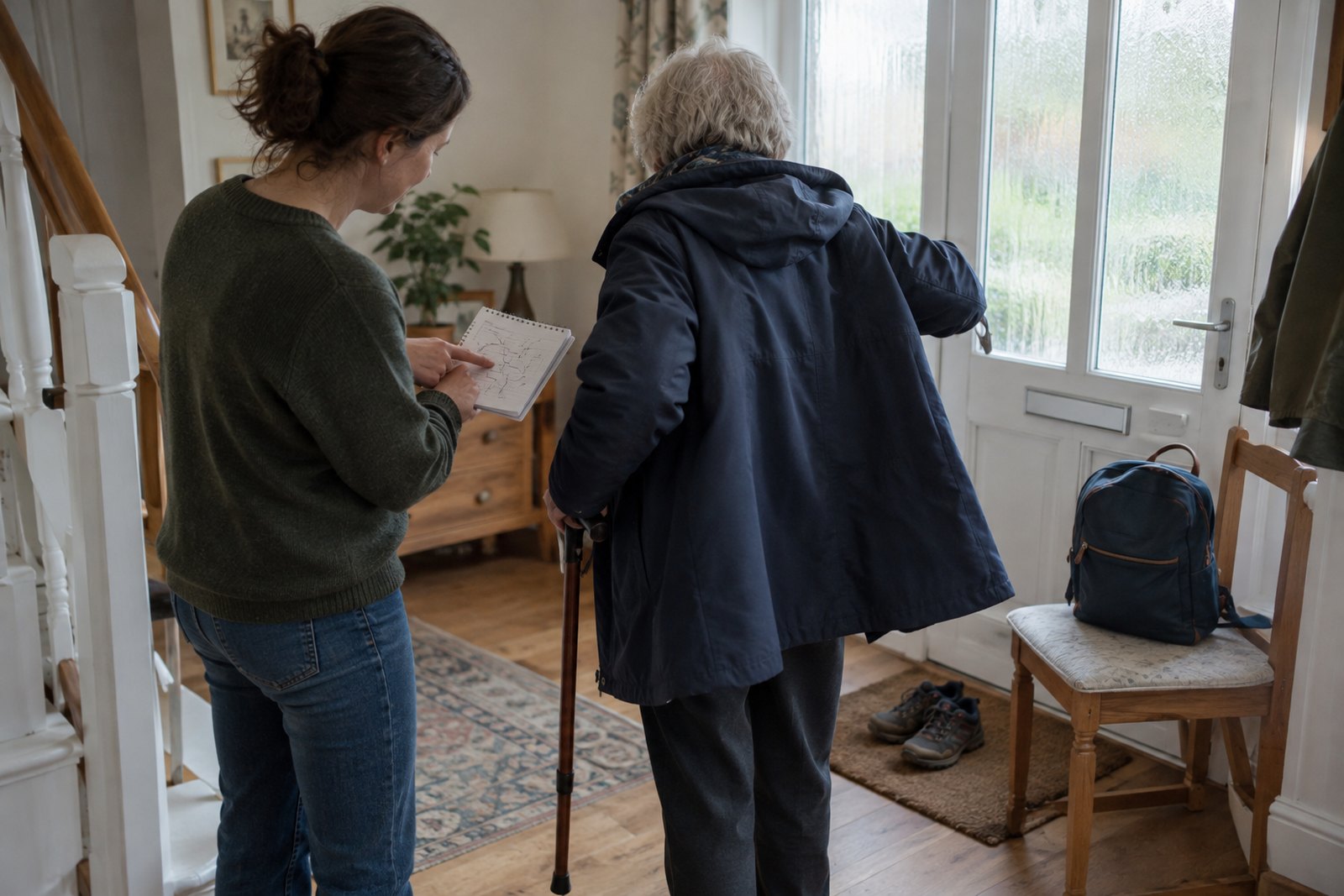
The PIP mobility component looks at two everyday problems: (1) planning and following journeys, and (2) moving around on foot. You can be awarded the standard or enhanced rate depending on which mobility descriptors best describe your day to day life.
What matters is not your diagnosis, or what you can do once on a very good day. It is whether you can do the activity reliably: safely, to an acceptable standard, as often as you reasonably need to, and in a reasonable time. This is where many claims succeed or fail, because the real issue is often pain, fatigue, breathlessness, dizziness, falls risk, overwhelm, or needing another person with you.
This article explains the two mobility activities in plain English, what the descriptors are getting at, and what evidence tends to be useful. If you live in Scotland, PIP is being replaced by Adult Disability Payment for many people, so check the current position on mygov.scot (rules and names differ).
what the PIP mobility component is actually measuring
PIP is about how your health condition or disability affects daily life. For mobility, the assessment is split into two separate activities:
- Planning and following journeys: can you work out and complete a journey outdoors?
- Moving around: can you stand and then move around (walk or move on your feet) and how far can you do it?
Each activity has a set of descriptors. You are treated as meeting the descriptor if it applies for the majority of the time (more on that below). The DWP then decides whether that leads to the standard or enhanced rate.
If you get the enhanced rate of the mobility component, it can open doors to other help, including the option to lease a car, scooter or powered wheelchair through the Motability Scheme (eligibility rules apply, so always check the current scheme guidance).
activity 1: planning and following journeys
This activity is about journeys outdoors. It can apply to physical, sensory, cognitive, learning disability and mental health reasons. It is not only about knowing where you are going. It is also about whether you can cope with the journey, stay safe, and get where you need to be without another person having to step in.
what the descriptors are getting at (in plain English)
The descriptors for this activity broadly range from "can plan and follow any journey unaided" through to "cannot undertake any journey because it would cause overwhelming psychological distress". In between are descriptors about needing:
- Prompting to be able to undertake a journey (for example, encouragement and reassurance due to anxiety or distress).
- Another person to accompany you (for example, because you might get lost, panic, become disorientated, or be at risk if something goes wrong).
- An orientation aid or assistance dog to help you navigate (for example, because of sensory impairment).
- Help with unfamiliar journeys but not familiar ones, or difficulty following the route of a familiar journey.
You do not have to be housebound for this to apply. Some people can go out, but only with another person, or only to one or two "safe" places at quiet times. Others can manage the journey itself but cannot deal with unexpected changes, diversions, crowds, or noise, and become unsafe without support.
real life examples that often matter
People often describe their difficulties too vaguely on the form, for example "I get anxious". It helps to be specific about what actually happens and what support is needed. Examples include:
- Overwhelming psychological distress: panic symptoms, shutdowns, or dissociation that mean you abandon journeys, cannot cross roads safely, or cannot use public transport.
- Getting lost or disorientated: even on familiar routes, you may not recognise where you are, forget why you are out, or be unable to problem solve if the route changes.
- Safety risks: stepping into the road, not noticing hazards, not being able to judge traffic speed, or being unable to ask for help appropriately.
- Sensory overload: noise, busy environments, lighting, crowds or unexpected touch can make it impossible to continue without another person guiding you to a quieter place.
If you only manage because somebody goes with you, say so clearly. "I can do it if my sister comes" is not the same as "I can do it unaided". Describe what your sister actually does, for example: keeping you calm, bringing you back if you try to leave, reminding you where you are, helping you manage tickets, or making sure you cross roads safely.
questions to help you describe your worst sticking points
- Can you go somewhere unfamiliar alone? If not, what goes wrong?
- Can you go somewhere familiar alone, at a normal time of day, not just at quiet times?
- What happens if a bus is cancelled, there is a diversion, your phone battery dies, or a place is closed?
- Do you avoid journeys because of distress? How often, and what do you miss as a result?
- Do you need someone with you to stay safe, not just for company?
If you can, include one or two short "last time this happened" examples. They are often more persuasive than general statements.
activity 2: moving around
This activity is about your physical ability to stand and then move around. It is not about whether you own a mobility aid. It is about what happens when you try to get from A to B on your feet, including pain, fatigue, balance, breathlessness, weakness, dizziness, or risk of falls.
what the descriptors are getting at (without a points table)
The moving around descriptors are mainly based on distance. They look at whether you can stand and then move different distances, and whether you need an aid or appliance (such as a stick or frame) to do it safely and repeatedly.
If you want the exact current wording and distances, check GOV.UK for the official descriptors, because they can be updated and you do not want to rely on an old screenshot.
how to think about distance in real life
Many people guess distances and accidentally undermine their own claim. It is worth being practical:
- Measure typical distances you walk: from your front door to the car, to the nearest bus stop, to your bin, around your local shop, from the disabled bay to the entrance.
- Include stops: if you can only do that distance with rests, say how many times you stop, how long you need, and what happens to your pain or breathlessness.
- Include the aftermath: if walking triggers a flare that wipes you out for the afternoon, or means you cannot cook later, that is part of "repeatedly".
Also be honest about variability. If you can walk further once a week but most days you cannot, it is the "most days" pattern that usually matters more than the one good day.
what "using an aid" really means
Some people worry that saying they use a stick, wheeled walker or wheelchair will count against them. In practice, for the moving around activity, PIP is trying to understand what you can do on your feet with any aids you reasonably need (it is not about how far you can travel in a wheelchair).
What matters is whether you can do it safely and repeatedly using that aid. For example, if you can only walk 20 metres with a stick before you have to stop, that is still limited. If you need a wheeled walker outdoors but cannot lift it in and out of a car, that is also relevant to real world mobility.
Do not say you use an aid if you do not. Equally, do not hide it if you do, especially if it is the reason you can leave the house at all.
include falls, near misses and fear of falling
Moving around is not just distance. Falls risk matters because it goes to safety. If you have fallen, had near misses, or avoid walking because you are frightened of falling, include that. Note:
- Where and when you fall (bathroom, steps, outdoors, at night).
- What caused it (dizziness, foot drop, pain, rushing to the toilet, uneven ground).
- What happened after (needed help up, injury, stopped going out alone).
If you started restricting your walking because you are trying to prevent falls, that does not mean you are "fine". It often means you are coping by avoiding risk.
the reliability rules: safely, acceptably, repeatedly, and in a reasonable time
People often lose PIP because they describe what is theoretically possible, not what is possible reliably. The reliability rules are meant to capture the "yes, but" reality.
safely
"Safely" includes risk of falls, getting lost, stepping into traffic, severe breathlessness, or symptoms that could cause harm. It also includes harm later, for example severe pain for hours after walking that you have to "push through" at the time.
to an acceptable standard
This means the activity is done properly, not just technically completed. If you can walk to the corner shop but you are limping heavily, needing to lean on walls, stopping frequently, or arriving in so much pain you cannot function afterwards, explain that.
repeatedly
"Repeatedly" is about whether you can do it as often as you need to in ordinary life. Being able to do one journey a week does not always mean you could do it every day to get to work, school runs, appointments, or to buy food.
This is where fatigue diaries, rest times, and "what you cannot do later" can be very helpful.
in a reasonable time
If an activity takes you so long that it becomes impractical, that matters. You do not need to provide stopwatch timings for everything, but you can compare: "It takes me so long to get from the car to the GP waiting room that I have to arrive very early and then sit to recover."
Keep it concrete and linked to consequences, such as missed appointments, needing wheelchair assistance in venues, or being unable to do anything else that day.
how often it has to happen: the "majority of days" rule
PIP is usually based on how you are for the majority of days. In general terms, that means if a difficulty applies on more than half the days, it should be treated as your normal level of function. If you have fluctuating symptoms, you can think in terms of a typical week or month and how many days are "bad", "middling" and "good".
This can be surprisingly hard if you are used to masking or pushing through. A useful approach is to describe:
- What you can do on a good day.
- What you can do on a bad day.
- How often each happens.
- What you do differently to cope (cancel plans, stay in, need someone with you, use a wheelchair).
If you are unsure about how the majority of days test is applied to your situation, it is worth getting advice before you send the form.
evidence that often helps (and what "good evidence" looks like)
PIP decisions are made on evidence, but "evidence" is not just scans and clinic letters. It is anything that helps someone understand your functioning day to day.
a simple diary of a typical week
A diary can be powerful because it shows patterns, not just isolated incidents. Keep it simple. A few bullet points per day is enough:
- How far you walked and what happened (rests, pain, breathlessness).
- Any falls or near falls, and what you did afterwards.
- Any journeys avoided, shortened, or only completed with another person.
- How long you needed to recover after going out.
If your condition fluctuates, do this for more than one week, or repeat it during a flare and a quieter spell.
specific examples beat general statements
Instead of "I get tired", try: "After walking from my front door to the car, I have to sit for 10 minutes before I can drive. If I do one trip to the supermarket, I cannot go out again that day and I need help with cooking."
falls, pain and fatigue after walking
If you have reported falls to your GP, physiotherapist, falls clinic, or hospital, that record may support your account. If you have not reported them, do not invent a paper trail. Just describe the falls and the impact, and consider speaking to your GP if falls are ongoing.
anxiety about journeys and needing someone with you
If you need another person, explain why and what they do. If you experience panic, distress, shutdowns, or disorientation, describe what it looks like from the outside. A short supporting statement from someone who sees it can help, especially if it includes examples.
other professionals' letters
Evidence from physiotherapy, mental health services, community teams, or specialist clinics can help if it describes function, not just a diagnosis. The most useful letters often include phrases like "needs supervision outdoors", "unsafe on stairs", "limited by fatigue", or "requires prompting".
If you are also claiming for daily living needs, you may find our guide useful: PIP daily living component: how occupational therapy evidence helps.
getting advice and challenging a decision
If you are filling in the form, preparing for an assessment, or thinking about a mandatory reconsideration or appeal, get advice early if you can. Many people start with Citizens Advice, because they can help you understand the descriptors and present your difficulties clearly.
If you challenge a decision, keep copies of everything you send and note dates. Focus on the descriptors and reliability. Try to avoid arguing in general terms like "they did not listen". Instead, show what they missed, with examples: "I cannot follow an unfamiliar journey safely without another person because I become disorientated and have walked into the road. This happened twice in March."
where an occupational therapist fits (and where they do not)
An occupational therapist (OT) looks at how health affects daily activities in real life. For PIP mobility, that often means practical evidence about journeys and moving around: what you can do, what happens when you try, what support you need, and how consistent it is.
A private occupational therapist visiting at home can assess functional mobility in your own environment, for example transfers, stairs, getting in and out of the front door, walking tolerance, pace, rests, fatigue afterwards, and how you manage with aids. For planning and following journeys, an OT can explore what happens before, during and after trips out, including cognitive demands and distress.
An OT cannot diagnose medical conditions and cannot decide your PIP award. The DWP makes the decision. For diagnosis, medication queries, or new symptoms (especially sudden weakness, chest pain, or fainting), call 999 or go to A&E if it could be an emergency, or contact NHS 111 or your GP for urgent advice.
If you want to understand what an OT assessment and report can look like, see what happens in a private OT assessment and what it costs.
Frequently asked questions
what is the difference between standard and enhanced PIP mobility?
Standard and enhanced are the two possible rates of the PIP mobility component. They depend on which mobility descriptors apply to you across the two mobility activities. If you qualify for the enhanced rate, you may also qualify for the Motability Scheme, depending on current eligibility rules.
do I have to be unable to walk to get PIP for moving around?
No. Many awards are about limited walking distance, needing frequent rests, severe pain or breathlessness, fatigue after walking, or being unsafe because of falls risk. The key is describing what happens when you try, and whether you can do it reliably.
what if I can do it once, but not repeatedly?
That is exactly what the reliability rules are there for. If you can manage one journey or one short walk but then need hours or days to recover, explain that clearly. A short diary can help show the pattern.
does anxiety count for the planning and following journeys activity?
It can. The activity includes mental health and neurodevelopmental reasons that make journeys unsafe or impossible, including overwhelming psychological distress. You will usually need to explain what happens, how often it happens, and what support you need to complete a journey safely.
should I put exact distances on my form?
If you can, yes, but only if they are realistic. People often overestimate. It is fine to measure common routes at home and in your community. If you cannot give a number, relate it to real places, rest breaks, and consequences, such as needing to sit down afterwards or being unable to go out again.
I live in Scotland. is this still PIP?
For many people in Scotland, PIP is being replaced by Adult Disability Payment. The names, process and responsible organisation differ, so check mygov.scot for the current rules for your situation. The general idea of explaining your day to day mobility, with examples and evidence, still applies.
Next steps
See our functional assessments and reports page, or home assessments, or current guide prices, and choose your area below.
Talk to an occupational therapist near you
This guide is general information. For advice about your own situation - or someone you look after - a local occupational therapist can visit you at home and see it for themselves.
Choose your area: