

Personal Injury Rehabilitation: Needs Assessments and Case Managers
By Mobile Occupational Therapist • 14 October 2026 • 11 min read
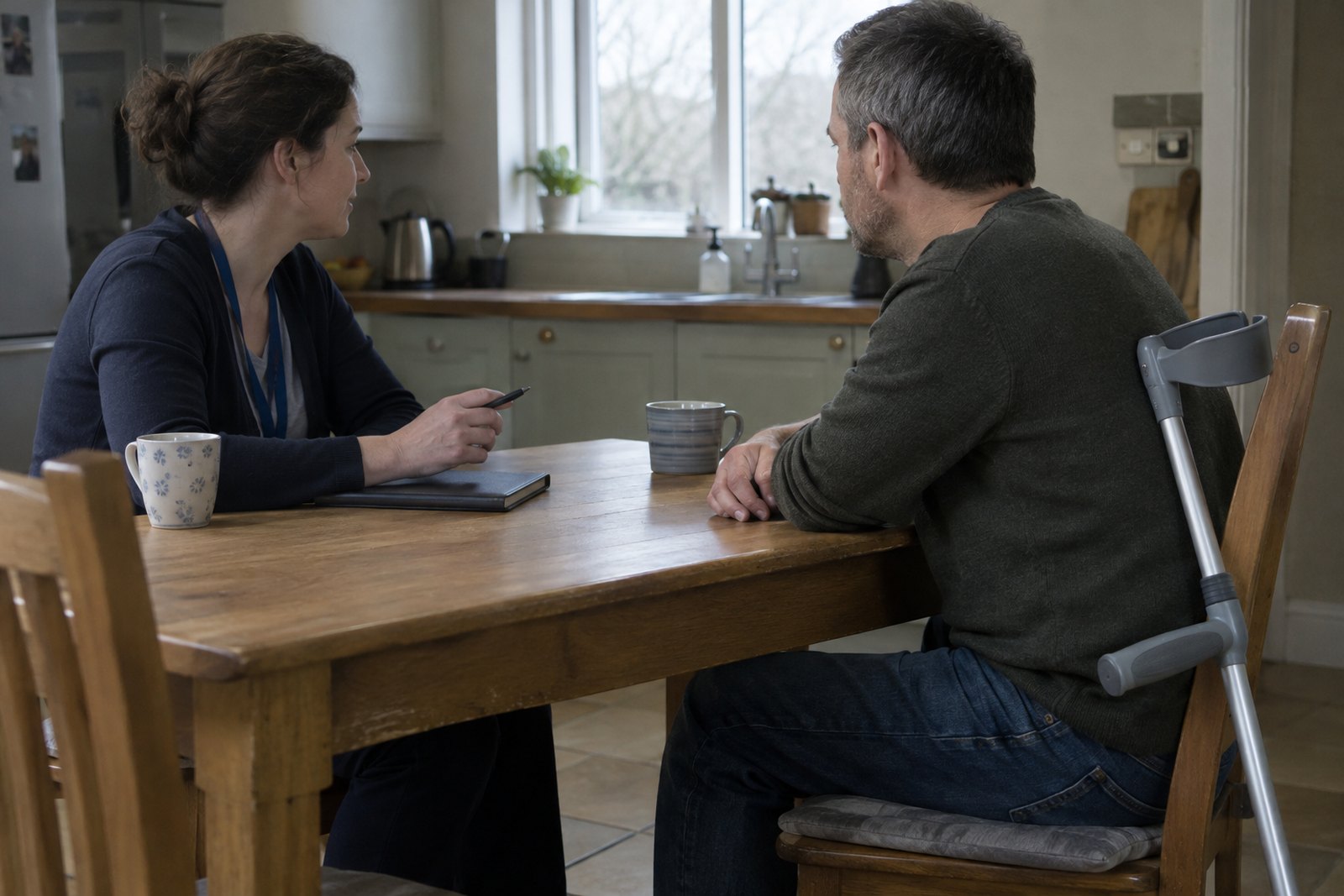
If you have been seriously injured because of someone else's fault and you are making a claim, rehabilitation does not have to wait until the claim is settled. Claims can take years. Recovery cannot. In the UK there is a voluntary code, the Rehabilitation Code, that encourages your solicitor and the other side's insurer to look at what you need now and to consider funding it early.
In practice the first step is usually an immediate needs assessment: a visit, often at home, from an independent clinician who looks at how you are managing and recommends what would help. That clinician is frequently a case manager, and many case managers are occupational therapists. If the recommendations are agreed, a case manager then organises the therapy, equipment and support. This article explains how that works in general terms. It is not legal advice. Your solicitor is the right person to tell you how any of it applies to your claim.
What personal injury rehabilitation actually means
Rehabilitation in a claim is not a separate kind of medicine. It is the same therapy, equipment and practical help you might get anywhere, organised and paid for in a different way. It can include:
- Physiotherapy to rebuild strength and movement.
- Occupational therapy to get daily life working again: washing, dressing, cooking, getting out, sleeping, managing fatigue, getting back to work or school.
- Psychological therapy for anxiety, low mood, flashbacks or the shock of what happened.
- Speech and language therapy after a brain injury affecting communication or swallowing.
- Equipment, from a shower chair to a wheelchair.
- Changes to your home, or help finding somewhere more suitable to live.
- Support workers or care, and support for your family.
- Help returning to work, including talking to your employer.
The point of doing this early is simple. People generally do better when help arrives while things are still changing, rather than after they have spent a year adapting to a house that does not work for them.
The Rehabilitation Code in plain English
The Rehabilitation Code is a voluntary agreement drawn up by people from both sides of personal injury work: claimant solicitors, insurers and rehabilitation providers. It is not a law, and nobody can be forced to follow it, but it is widely recognised and many insurers and solicitors sign up to its approach.
Broadly, it asks both sides to:
- Think about the injured person's rehabilitation needs from the very start of a claim.
- Arrange an assessment of immediate needs by someone suitably qualified and independent.
- Respond to the recommendations promptly and fund what is reasonable.
- Keep rehabilitation separate from the arguments about who is to blame and how much the claim is worth.
The code also recognises that not every injury needs the same response. A minor injury may only need a short assessment, sometimes by phone, while a serious injury such as a brain or spinal injury usually needs a face to face assessment and ongoing case management. Your solicitor can tell you which version applies and whether the insurer in your case has agreed to work under it.
What an immediate needs assessment is
An immediate needs assessment, often shortened to INA, is a report on what you need now to recover and cope. It is not a full picture of your future, and it is not a medical report for court. It is practical: what is getting in the way this week, and what would help.
Who does it
INAs are usually carried out by an experienced case manager or a clinician with a rehabilitation background. Many are occupational therapists, because OTs are trained to look at the whole of daily life rather than one body part. Others are nurses, physiotherapists, social workers or psychologists. For a brain injury, it should be someone with real experience of brain injury, because a lot of the difficulties are invisible.
What happens on the day
The visit is usually at home, or in hospital if you have not been discharged yet. The assessor will normally:
- Ask about the accident, your injuries and your treatment so far.
- Talk about what your life was like before: work, family, hobbies, who did what at home.
- Ask how you manage now with washing, dressing, toilet, meals, stairs, sleep, getting out and money.
- Ask about pain, fatigue, memory, mood and concentration.
- Look at your home: access, stairs, bathroom, bedroom.
- Talk to your family, because they often notice changes you do not.
The report then goes to your solicitor and the insurer with recommendations. These might be urgent equipment, a course of therapy, help at home, or a recommendation for ongoing case management.
How to prepare
- Write down a typical day, including the bad bits. People tend to describe their best day when a stranger asks.
- List everything that is harder than before, however small.
- Have your NHS letters and discharge papers to hand.
- Ask a family member to be there if you can, especially after a head injury.
- Note what you have already paid for, such as taxis, equipment or help.
What a case manager does
A case manager is the person who turns recommendations into reality and keeps them on track. Think of them as a project manager for your recovery, with a clinical background. A case manager typically:
- Sets goals with you, in your words, and reviews them regularly.
- Finds and instructs therapists and support workers.
- Arranges equipment and oversees home adaptations.
- Liaises with your NHS team, GP, employer, school or college.
- Supports your family, who are often exhausted.
- Reports on progress to your solicitor and, usually, to the insurer funding the work.
Case management is not a protected title. Anyone can call themselves a case manager, so it is worth checking that yours is registered with their own professional regulator, for example the Health and Care Professions Council for an occupational therapist.
Case managers after a brain injury
Brain injury is where case management matters most. Changes in memory, planning, fatigue, mood and behaviour can be harder to live with than a physical injury, and they are easily missed in a short appointment. A good brain injury case manager understands this and builds support around it. BABICM, the British Association of Brain Injury and Complex Case Management, is a professional association for case managers in this field and sets standards for its members, although membership is voluntary and it is not a regulator. If you are caring for someone after a brain injury, our guide to brain injury rehabilitation at home covers the day to day side.
How equipment, adaptations and therapy get paid for
There are two main routes, and your solicitor will explain which applies to you.
Direct funding under the Rehabilitation Code. The insurer agrees to pay for specific rehabilitation recommended in the INA or by the case manager, often paying providers directly.
Interim payments. These are payments made before the claim is settled, as an advance on your eventual compensation. They are usually only possible once the other side has admitted fault, or it is clear they are likely to be found responsible. They can be used for things like therapy, equipment, care, adaptations or a move to more suitable housing. They are normally deducted from the final settlement, so spending is worth planning carefully with your solicitor and case manager.
Occupational therapy assessments, equipment and home adaptations are commonly funded through one or both routes. For bigger changes such as a downstairs bathroom, an extension or rehousing, an insurer will usually want a clear clinical report setting out why it is needed and what alternatives were considered. Our guide to how an OT home adaptations assessment works explains what that looks like.
Your NHS care carries on
Making a claim does not take you out of the NHS. You remain entitled to NHS treatment, and private rehabilitation should sit alongside it, not replace it. Keep your NHS appointments, stay registered with your GP, and tell your case manager who is involved so they can coordinate rather than duplicate.
You can also still ask your council for a care needs assessment or equipment. Compensation can affect means-tested benefits and council-funded care, so ask your solicitor about this early, including whether something like a personal injury trust is appropriate.
If you or someone you care for has had a head injury and develops a worsening headache, repeated vomiting, unusual drowsiness, confusion, a seizure, or clear fluid from the ears or nose, call 999 or go to A&E. Do not wait for a case manager or a solicitor. For less urgent worries, speak to your GP or call NHS 111.
Independence: whose side is the clinician on?
This is the question families ask most, and a fair one. The insurer is often paying, so who does the case manager work for?
A treating case manager or therapist works for you. Their job is your recovery, and their professional duty is to you as their client, whoever pays the invoice. They should not be trying to keep costs down at the expense of your needs, and they should not be gathering evidence for either side. If you feel that is not happening, tell your solicitor.
This is different from an expert witness. Later in a claim, each side, or both jointly, may instruct experts such as a care expert or an occupational therapy expert to report to the court on your needs and costs. Under court rules, experts owe their overriding duty to the court, not to the person who pays them. They assess you but do not treat you. It helps to know which kind of professional is in your living room.
Where an occupational therapist fits (and where they do not)
Occupational therapists are well placed in personal injury work because their whole focus is daily life. An occupational therapist might carry out the INA, act as your case manager, or provide hands-on therapy. That can include:
- Working out what is making washing, dressing, cooking or sleeping hard, and fixing it.
- Recommending and fitting equipment, and teaching you and your family to use it safely.
- Assessing your home and specifying adaptations, or advising on whether a move is better.
- Fatigue management and pacing, and strategies for memory and planning after a brain injury.
- Helping you get back to work or study, including a phased return and adjustments.
- Supporting children back into school and play after an injury.
Occupational therapists do not lead on everything. A physiotherapist leads on exercise, walking and strength. A speech and language therapist leads on swallowing and communication. A neuropsychologist assesses thinking skills and emotional changes after a brain injury, and a psychologist treats trauma. Your GP and hospital consultants remain in charge of your medical care and medication. And none of them can give you legal advice: that is your solicitor's job.
If you are being offered rehabilitation and want to understand what a good OT looks like, our guide to choosing a private occupational therapist may help. Occupational therapists with experience of complex conditions are listed under neurological occupational therapy.
Frequently asked questions
Do I have to wait until my claim is settled to get rehabilitation?
No. The whole point of the Rehabilitation Code is to get help in place early, often while the claim is still at an early stage. Whether it happens in your case depends on the insurer agreeing, so ask your solicitor to raise rehabilitation at the start.
Who pays for the immediate needs assessment?
Where the code is followed, the insurer usually pays for the INA. Your solicitor can confirm the arrangement before anyone visits, so you are not left with a bill.
Can the insurer use what I say in the assessment against me?
The code is designed so that the INA report is used for rehabilitation, not as ammunition in the claim, and it is generally intended to be kept outside the legal arguments. The exact position depends on what has been agreed, so ask your solicitor before the visit if you are worried. Either way, be honest: underplaying problems helps nobody.
Can I change my case manager if it is not working?
Usually, yes. The relationship matters, and a case manager who does not understand your injury or your family will struggle to help. Talk to your solicitor, who can raise it with the insurer and agree a replacement.
Is a case manager the same as a social worker?
No. A council social worker assesses eligibility for council support. A case manager in a claim is privately funded and coordinates rehabilitation around your goals. Some case managers have a social work background, and the two can work together.
Can I get a private occupational therapy assessment without a claim?
Yes. Anyone can pay privately for an occupational therapist to visit and assess, and the report can still be useful later. If you are claiming, check with your solicitor first, as they may prefer the assessment to be arranged through the claim.
Next steps
If you need an independent assessment of daily living, equipment or adaptations, see our functional assessments and reports and home assessment pages, or current guide prices, and choose your area below.

Talk to an occupational therapist near you
This guide is general information. For advice about your own situation - or someone you look after - a local occupational therapist can visit you at home and see it for themselves.
Choose your area: