

Muscular Dystrophy Home Adaptations: Planning Ahead as a Family
By Mobile Occupational Therapist • 24 October 2026 • 12 min read
If someone in your family has muscular dystrophy, the most useful thing to know about home adaptations is this: the big changes take far longer to arrange than most people expect. A level access shower, a through-floor lift or a ground floor bedroom can take many months from first conversation to finished work, sometimes longer. So the families who find it least stressful are usually the ones who start thinking about the next stage while the current one is still working fine.
That does not mean planning for the worst or turning your home into a clinic. Muscular dystrophy is a group of conditions, not one, and how it affects each person varies a great deal, even within the same type. Planning ahead simply means keeping one eye on what might be useful in a year or two, so that when it is needed, it is already there. This guide covers the kinds of equipment and adaptations families commonly use, how grants and housing decisions fit in, school and transitions, managing energy, and who to ask for what.
Why planning ahead matters so much
There are two clocks running at once in most families. One is the condition itself, which is usually gradual and different for every person. The other is the system: assessments, funding applications, quotes, builders, landlord permissions. The second clock is often the slower one.
With children there is a third clock too. Children grow. A bathroom that works for a seven-year-old who can be helped in and out may not work for a teenager who is the size of an adult. Lifting that is manageable for a parent now may not be safe in a few years, for the parent or the child. Designing for the child you will have in five years, rather than the child in front of you today, saves doing the same work twice.
There is also the practical point that it is much easier to make decisions calmly, before you need something urgently. Choosing tiles for a wet room while everyone is coping is a very different experience from doing it after a fall.
The Disabled Facilities Grant and its timescales
In England and Wales, many larger adaptations are funded through a Disabled Facilities Grant (DFG) from the council, and in Northern Ireland through a DFG from the Northern Ireland Housing Executive. Scotland has a different system for adaptations, run through councils, so check your own council's website if you live there. For a disabled child in England, the parents' income is not usually means tested for a DFG, but there is an upper limit on the grant and rules vary between the nations, so check the current details on GOV.UK and with your council.
The process typically involves an occupational therapist assessment, drawings, quotes, the formal application and then the building work. The law gives councils up to six months to decide on a valid application, and the stages before that can take months on their own. Our guide to the Disabled Facilities Grant and how OT assessments support your application walks through each step. The short version: ask early, keep copies of everything, and do not wait until the current set-up has stopped working.
The kinds of equipment families commonly use
Every person's path is different, and many people never need everything below. But it helps to know roughly what exists, so you can recognise the right moment to ask. Think of these as broad groups rather than a timeline.
Small changes and support for walking and standing
Early on, the changes are often small. Grab rails by the toilet, bath and front door. A second banister on the stairs, so there is something to hold on both sides. Raising the height of a favourite chair or the bed so standing up takes less effort. A perching stool in the kitchen or bathroom. Keeping floors clear and well lit to reduce trips.
Getting up from the floor can become hard before other things do, so it is worth asking the physiotherapist or occupational therapist what to do if someone falls and cannot get up. One specific point: avoid lifting a child under the arms, because weak shoulder muscles can mean they slip through your hands. Ask for a safer method to be shown to you.
Stairs
Stairs are often the first big decision. A stairlift suits some people, but it needs the person to sit, balance and transfer on and off safely at both ends. For a child or adult who is likely to use a wheelchair more over time, families and occupational therapists often look at a through-floor lift, which takes a wheelchair between floors, or at moving the bedroom and bathroom downstairs. It is worth getting advice before buying a stairlift, because it can turn out to be a short-term answer to a long-term question.
Wheelchair access
Wheelchairs come through the NHS wheelchair service, usually via a referral from your neuromuscular team, GP or therapist. Many families start with a manual chair for longer distances and later move to a powered one. Powered chairs are heavy, wide and need somewhere to charge.
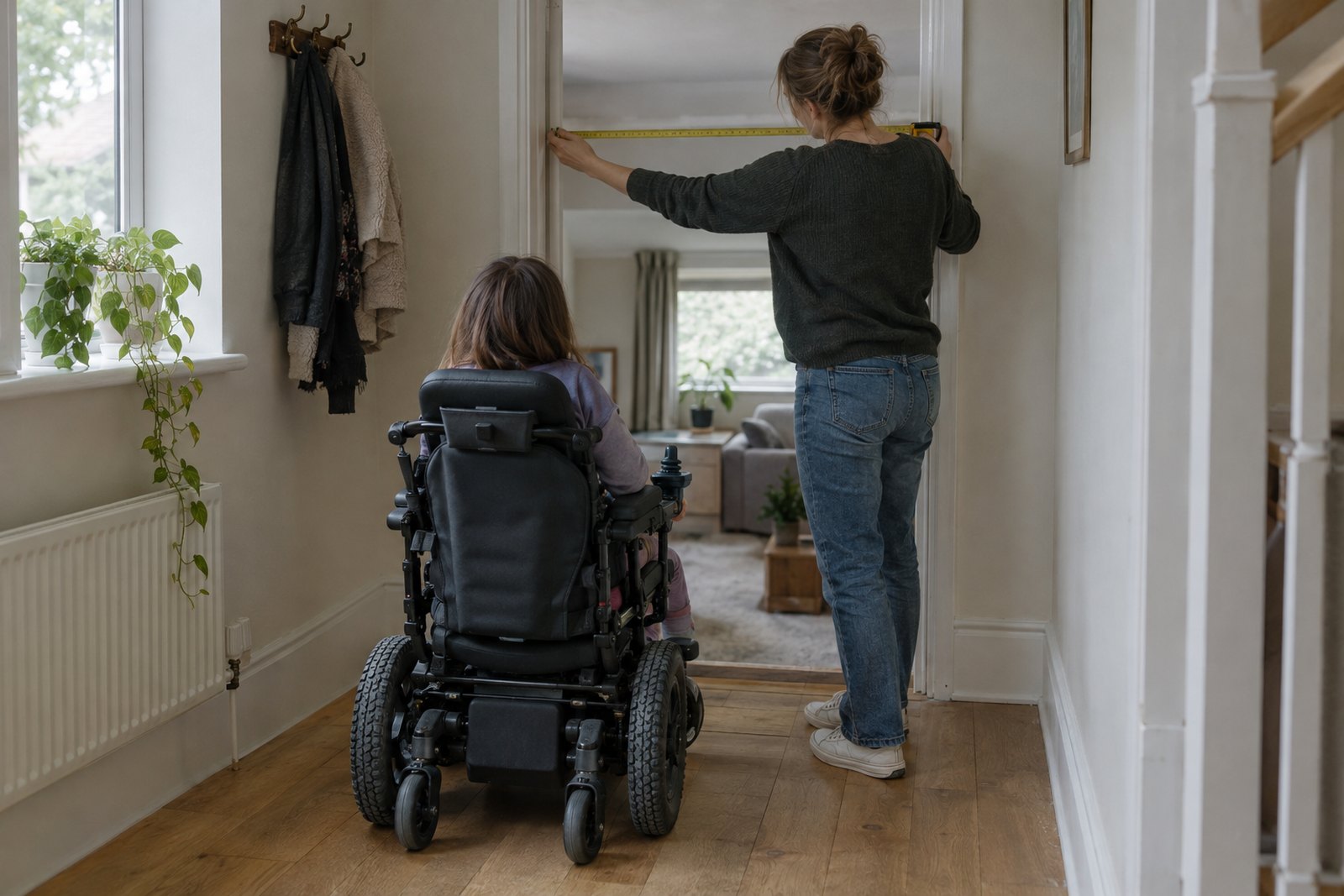
That has knock-on effects for the house: a ramp or level path to the front door, doorways wide enough to get through without scraping knuckles, room to turn in the hallway and bedroom, and a place to store and charge the chair. Measuring doorways and turning spaces now, even if a wheelchair is some way off, tells you a lot about whether your home can be adapted.
Bathrooms and toileting
Bathing is often where things get difficult soonest, because it combines bending, stepping, wet floors and lifting. Families commonly move from a bath board or bath seat to a level access shower or wet room, with a shower commode chair that can be wheeled over the toilet and into the shower. Some people find a wash and dry toilet gives back privacy. For children and young people, a height-adjustable changing bench or bath can protect a parent's back.
A bathroom designed with space for a wheelchair, a hoist and a helper is a much bigger job than a standard refit, so it is one of the most important things to plan early.
Hoists
When transfers become unsafe for the person or for whoever is helping, a hoist takes the lifting out of the equation. Mobile hoists are wheeled on the floor. Ceiling track hoists run on a rail and can be planned to go from bedroom to bathroom, which is often easier in a smaller home and is another reason to think about room layout early. Many people worry a hoist means giving up. In practice it often means less pain, fewer falls and more energy for the rest of the day. Our guide to hoists at home explains the types and why proper assessment and training matter.
Beds and nights
A profiling bed, with an adjustable mattress platform and height, can help with sitting up, turning and transfers. Some people need help turning at night, and good positioning and a suitable mattress help with comfort and protecting skin. Your neuromuscular team will be the people to talk to about anything to do with breathing or sleep quality, such as waking with headaches or feeling unusually tired in the mornings.
Adapt or move?
At some point most families ask whether the current home can work long term. There is no single right answer, but some questions help.
- Is there space on the ground floor for a bedroom and accessible bathroom, or room to extend?
- Can the front door be reached without steps, or with a ramp that fits the space and the slope?
- Are the doorways and hallways wide enough, or could they be widened without major structural work?
- Do you rent? Council and housing association tenants can usually get adaptations, but permission and process differ. Private tenants need the landlord's agreement.
- What else matters? School, family nearby, a support network you would lose by moving.
Sometimes adapting a house would cost more than the grant limit, take years, or still leave it cramped. In that case an occupational therapist's assessment can support an application for a more suitable property. Our guide to rehousing on medical grounds explains how housing priority works. If you are buying, have an accessible layout in mind before you view, not after.
School and transitions
School needs change over time too. A child may need a lift or ground floor classrooms, an accessible toilet with space for help, rest breaks, a laptop or other technology to reduce writing fatigue, seating that supports good posture, and adjustments for PE, trips and moving between lessons. In England, many children with muscular dystrophy have an Education, Health and Care Plan, and occupational therapy advice can go into it. Wales, Scotland and Northern Ireland have their own systems for additional support plans. Our guide to EHCPs and what an occupational therapy report adds explains how.
The move from primary to secondary school deserves planning a year or more ahead. Secondary schools are bigger, with more walking between rooms, heavier bags and less adult supervision at break. Visiting early, asking about lifts and toilets, and getting adjustments written into plans before September all help.
Later, the move from children's to adult services, usually discussed from around 14 onwards, brings changes in health teams, social care and education or work. Starting those conversations early means fewer gaps.
Fatigue and energy
Weak muscles tire more quickly, and pushing through often costs more later. Many families find it helps to think of energy as a budget for the day.
- Save energy for the things that matter most to the person, whether that is a friend's party, football with dad or a full school day.
- Use equipment for the routine parts so there is energy left for the enjoyable ones. A shower chair, a perching stool or a wheelchair for long distances can free up a lot.
- Plan the week so busy days are followed by quieter ones.
- Keep things within easy reach: drinks, the remote, school things, clothes for tomorrow.
Exercise and stretching in muscular dystrophy should be guided by your neuromuscular physiotherapist, who will know what is helpful and what is too much for that particular person.
The neuromuscular team
Most people with muscular dystrophy are seen by a specialist neuromuscular service. Depending on the type and the person, that might include a consultant, specialist nurses or care advisers, physiotherapists, occupational therapists, and heart and breathing specialists. Speech and language therapists may be involved where swallowing or speech is affected. Your GP stays important for everyday health and referrals.
The physiotherapist usually leads on stretching, splints, standing and staying mobile. The consultant and nurses lead on medical care. Muscular Dystrophy UK has information on care, support and specialist services, and is a good place to start if you are not sure who you should be seeing.
If someone has new or worsening breathlessness, frequent chest infections, morning headaches or unusual drowsiness, contact the neuromuscular team or GP promptly. If someone is struggling to breathe, call 999.
Where an occupational therapist fits
An occupational therapist looks at everyday life: washing, dressing, toileting, getting about the house, sleeping, school, play and work. For families living with muscular dystrophy, an occupational therapist can:
- assess the home now and think through what might be needed in a few years, so you are not adapting in small expensive steps
- recommend equipment and adaptations, and show you and the person how to use them safely
- support Disabled Facilities Grant applications and rehousing requests with clear written evidence
- advise school on seating, access, toileting and reducing fatigue
- help the person find ways to keep doing things themselves for as long as they want to
NHS and council occupational therapists do much of this work, and many families have one through the neuromuscular service or children's services. Waiting lists vary. Some families use a private occupational therapist visiting at home for a detailed long-term assessment or a report, alongside NHS care. Check with your council in advance whether it will accept a private report for a grant, as some insist on their own assessment.
An occupational therapist does not replace the physiotherapist for stretching and mobility, the consultant for medical decisions, or the wheelchair service for prescribing chairs. Good care comes from these people talking to each other.
Frequently asked questions
Can we get more than one Disabled Facilities Grant?
In many cases, yes. Needs change, and councils can consider further applications. Rules vary by council and nation, so ask your council about its policy. Planning one larger, well-designed adaptation is often better than several small ones.
How early should we start thinking about adaptations?
Earlier than feels necessary. Many families start asking questions when things are still going well, simply because the process is long. A conversation with an occupational therapist commits you to nothing and helps you understand your options.
Is a stairlift a good idea?
It depends on the person. Stairlifts need safe sitting and transferring at both ends. If a wheelchair is likely to be used more in future, a through-floor lift or ground floor living may last longer. Get advice before buying.
Who pays for wheelchairs?
The NHS wheelchair service assesses and provides wheelchairs for people with long-term mobility needs. You may be offered a personal wheelchair budget, which can sometimes be put towards a different chair. Your neuromuscular team or GP can refer you.
Will using equipment make muscles weaker faster?
This is a common worry. The balance between staying active and saving energy is something to discuss with your neuromuscular physiotherapist, who knows the person. Equipment is often what makes it possible to keep doing the things that matter.
Can a private occupational therapist help with a grant application?
A private occupational therapist can write a detailed assessment and recommendations, which many families find useful for planning. Whether the council will accept it for a grant varies, so ask the council first.
Next steps
If you want help thinking through what your home might need now and later, see our home adaptations page, or current guide prices, and choose your area below.

Talk to an occupational therapist near you
This guide is general information. For advice about your own situation - or someone you look after - a local occupational therapist can visit you at home and see it for themselves.
Choose your area: