

ME in Children: School Support, Pacing and Daily Life
By Mobile Occupational Therapist • 16 October 2026 • 13 min read
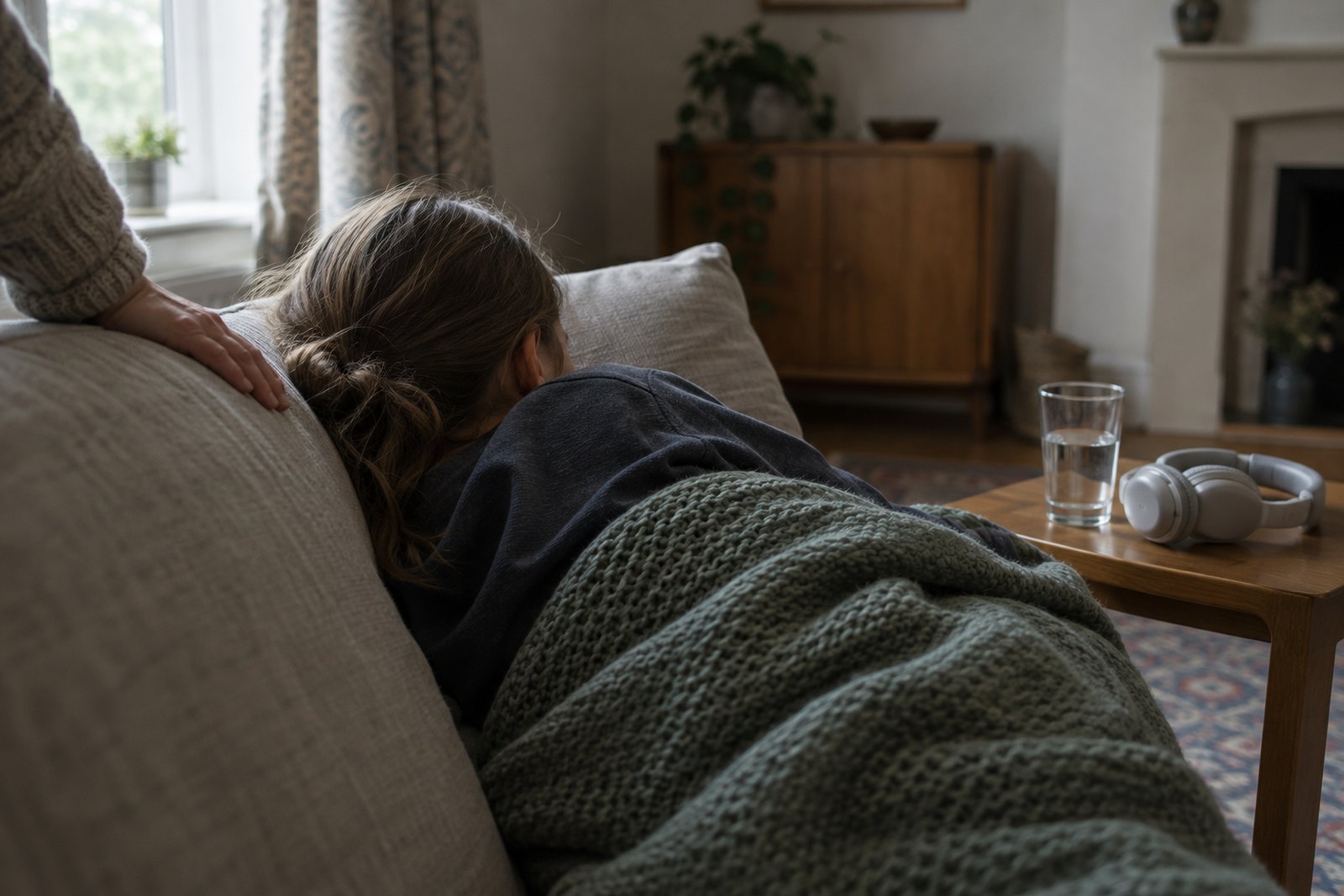
Yes, children and teenagers can have ME/CFS (myalgic encephalomyelitis, also called chronic fatigue syndrome). It is not ordinary tiredness and it is not laziness. The feature that sets it apart is that activity, whether physical, mental, social or emotional, can make symptoms much worse, often a day or two later, and rest does not fully put things right. Diagnosis usually starts with your GP, who will normally refer your child to a paediatrician to rule out other causes and confirm what is going on.
The national guidance, NICE guideline NG206, covers children and young people as well as adults. In plain terms it says: do not use graded exercise therapy, and do help the child manage their energy within their current limits. For school, that means adjustments such as a reduced timetable that is agreed in writing and reviewed regularly, somewhere to rest, home learning where needed and exam arrangements. This guide walks through each of those, plus the parts nobody hands you a leaflet for: friends, noise, and your own stamina.
What ME/CFS looks like in children
Every child is different, and ME/CFS ranges from mild (still at school, but dropping everything else to manage it) to severe (housebound or in bed most of the day). Common symptoms include:
- Fatigue that is out of proportion to what the child has done, and does not lift with a good night's sleep.
- Unrefreshing sleep, or a sleep pattern that has drifted badly, such as awake at night and asleep in the morning.
- Thinking difficulties, often called brain fog: losing words, struggling to follow a lesson, reading the same line over and over.
- Headaches, muscle or joint aches, sore throat, dizziness on standing, and feeling worse with light and noise.
The symptom that matters most
Doctors call it post-exertional malaise. Parents tend to call it the crash. Your child has a good morning, goes to a friend's birthday party, seems fine, and then two days later cannot get out of bed. The delay is what catches families out. It makes it look as if the crash came from nowhere, when it was actually the party, or the maths test, or the long car journey.
How it is diagnosed
There is no single blood test. A paediatrician will take a careful history, examine your child and arrange tests to rule out other conditions that can cause similar symptoms, such as thyroid problems, anaemia or coeliac disease. NICE sets out how long symptoms need to have lasted before ME/CFS is suspected and then diagnosed, with a shorter threshold for suspecting it in children than in adults. The exact wording is on the NICE NG206 page if you want to check where you are in the process. Some areas have a specialist NHS ME/CFS service for children; ask your paediatrician whether there is one near you.
What NICE says about managing it
NICE NG206 was published in 2021 and changed a lot. The key points for parents, in general terms:
- No graded exercise therapy. NICE says not to offer any programme based on fixed, steadily increasing amounts of exercise or activity. If anyone suggests your child should do a little more each week regardless of how they feel, that is not in line with the guidance.
- Energy management. The aim is to stay within the energy your child has now, so they avoid crashes, and only build up when their body allows it.
- Support, not cure. Talking therapy may be offered to help a child cope with living with a long-term condition, but not as a cure.
- A plan that includes school. The guidance expects health, education and family to work together.
Read the full guideline if you can. It is long, but the sections on children and on severe ME/CFS are worth having to hand at meetings.
Boom and bust: spotting it and stepping off
Boom and bust is the cycle most families fall into before anyone explains it. A good day arrives, your child understandably wants to catch up on everything they have missed, they overdo it, and then they crash for days. Repeat. Over months, the good days get rarer.
Signs of a boom
- A burst of energy that feels too good to waste.
- Staying up late because they finally feel awake.
- Agreeing to everything at once: school, a club and a sleepover in the same week.
- Pushing through early warning signs such as a headache, going pale, irritability or tearfulness.
Finding a baseline
A baseline is the amount your child can do on most days, including bad ones, without crashing. It is usually lower than you hope. Ways to find it:
- Keep a simple diary for two or three weeks. Note what they did, roughly how long for, how they slept and how they felt the next day and the day after. Rate energy out of ten if that helps.
- Look for the pattern. Which activities are followed by a crash? Often it is the ones that do not look tiring: a noisy lunch hall, a video call with five friends, an emotional conversation.
- Set the day's plan at the level of a bad day, not a good one. Spare energy on a good day goes into rest or something gentle, not catching up.
- Break things up. Twenty minutes of reading, then proper rest, is often better than an hour straight.
Proper rest means lying down with low stimulation, not scrolling a phone. That is a hard sell to a teenager, so negotiate: perhaps calm music or an audiobook with eyes closed. Our guide to fatigue management and pacing is written for adults but the principles of energy mapping translate well, and older teenagers may like to read it themselves.
A home routine that protects energy
Routine helps because it removes decisions, and decisions cost energy. It should be steady, not packed.
- Similar wake and sleep times every day, including weekends, as far as your child's body allows. If the sleep pattern has flipped, shift it slowly rather than all at once, and talk to your GP or paediatrician about sleep.
- Planned rests at set points, before tiredness hits, not after.
- Regular meals and drinks. Some children struggle with appetite or nausea; mention it to the doctor if weight is dropping.
- Make daily tasks cheaper. Sitting to shower or dress, a stool at the kitchen counter, clothes laid out the night before, a flask of drink by the bed. Small savings add up to energy for things that matter to your child.
- One enjoyable thing a day, however small. A life made only of rest and schoolwork is grim, and mood matters.
School support that actually works
Schools in England have a duty to support pupils with medical conditions, and many will draw up an individual healthcare plan. If your child cannot attend school because of their health, the local council has a duty to arrange suitable education. GOV.UK has statutory guidance on education for children with health needs who cannot attend school; check it for the current rules. Arrangements differ in Scotland, Wales and Northern Ireland, so check your nation's guidance.
A reduced timetable, in writing
A part-time or reduced timetable is often the first adjustment. Make sure it is:
- Agreed in writing, with the hours, the lessons and who to contact.
- Built on the baseline, not on what the school would like. Two lessons that go well beat a full morning followed by a week off.
- Reviewed on a set date. Reviews should consider increases, staying the same or reducing, depending on how your child is. No automatic step-ups.
- Focused on what matters to your child, which may be core subjects plus one they love, rather than whatever is left.
Rest spaces and the school day
Ask for a quiet place to lie or sit down, permission to leave lessons early to avoid busy corridors, a lift pass if there are stairs, a seat near the door, and reduced homework. A named member of staff your child can go to without explaining themselves each time makes a big difference.
Home learning and when school is not possible
For some children, especially those with severe ME/CFS, school is not realistic for a while. Options include work sent home, online lessons, home tuition arranged through the council, or a mix. Short sessions with breaks work best. Keep a link with the school community too, so your child is still part of it.
Exams
Rest breaks, a separate room, extra time, a reader or a scribe may all be possible, but they must be applied for in advance. See our guide to exam access arrangements. Talk to the school about whether your child should sit fewer subjects. Long exams can trigger a crash, so plan recovery time afterwards.
SEN support and EHCPs
If the school's usual adjustments are not enough, ask about SEN support. If needs are significant and long-lasting, you can ask the council for an Education, Health and Care needs assessment. Our guide to the EHCP process explains how it works and what professional reports can add.
Friends and social contact
Isolation is one of the hardest parts for children with ME/CFS, and seeing friends is also one of the most tiring things they do. The answer is not to stop, but to budget for it.
- Short visits, one friend at a time, at home where your child can lie down.
- Agree an exit signal in advance so they can end it without awkwardness.
- Messages and voice notes can be gentler than video calls.
- Ask the school to keep your child in the loop: class news, a card, a buddy who sends notes from lessons.
- Plan rest before and after any social event, and treat it as part of the day's energy, not a free extra.
Sensory load: light, noise and crowds
Many children with ME/CFS become sensitive to light, sound and touch, and processing busy surroundings drains energy fast. At home, try dimmer lighting, curtains or blinds that block light, a quiet room, and family agreement on TV volume. Ear defenders or earplugs and sunglasses can help on outings. At school, the canteen, assemblies and corridor changeovers are common triggers; ask for alternatives. In severe ME/CFS, even visitors and conversation can be too much, and keeping the environment very calm is part of care.
You matter too
Parenting a child with ME/CFS often means meetings, emails, disbelief from people who should know better, and watching your child miss out. It is exhausting. A few things help:
- In England, parent carers can ask the council for a parent carer's needs assessment.
- Keep a single folder of letters, plans and your diary notes. It saves energy at every meeting.
- Take someone with you to school meetings, even just to take notes.
- The charities Action for ME and The ME Association have information for families and young people, and can help you find others who understand.
When to get medical help quickly
ME/CFS should not explain every new symptom. See your GP if your child develops new or different symptoms, loses weight, or things are getting steadily worse. Call NHS 111 if you are worried and cannot reach the GP. Call 999 if your child is struggling to breathe, is very hard to wake, has a seizure or collapses. If your child has stopped eating or drinking, or talks about self-harm or not wanting to be alive, get urgent help through your GP, NHS 111 (choose the mental health option) or 999 in an emergency.
Where an occupational therapist fits
An occupational therapist looks at what your child needs and wants to do each day, and how to make that possible within their energy. Occupational therapists sometimes work within NHS ME/CFS teams, and a private occupational therapist visiting at home can also help. That might include:
- Working through an activity and energy diary with you and your child, and spotting hidden energy costs.
- Breaking tasks down and finding easier ways to wash, dress, eat and study.
- Suggesting equipment, such as a shower stool, perching stool or a wheelchair for longer outings so energy is saved for the thing your child actually wants to do.
- Looking at the school day and environment, and writing practical recommendations.
- Providing a report to support SEN support or an EHCP application. See our paediatric occupational therapy page.
What an occupational therapist does not do: diagnose ME/CFS (that is the paediatrician), prescribe treatment, or run graded exercise. Any occupational therapist or physiotherapist you work with should follow NICE NG206; it is reasonable to ask. If sleep, pain, dizziness or nutrition are big problems, the GP or paediatrician leads, and a dietitian may be needed. If your child is struggling with anxiety or low mood, ask your GP about children and young people's mental health services.
Frequently asked questions
Will my child recover from ME/CFS?
Some children improve a great deal over time, and some continue to have symptoms. Nobody can promise an outcome, and you should be wary of anyone who does. Avoiding repeated crashes gives your child the best chance of stability.
Should my child be doing exercise?
NICE advises against graded exercise therapy. Gentle movement within your child's limits, such as stretching or changing position in bed, may help with comfort and stiffness. Any physical activity plan should be personalised, flexible and reduced if symptoms worsen.
The school says my child is just anxious. What can I do?
Ask for a letter from the paediatrician confirming the diagnosis and the adjustments needed. Share the NICE guideline. Anxiety can sit alongside ME/CFS, but it does not explain post-exertional malaise. Put requests in writing and keep copies.
Is a reduced timetable the same as being off school?
No. Your child is still on roll and receiving education, just less of it in school. It should be agreed in writing, have a review date and not be used indefinitely without review.
Can we get help with exams if my child has missed lots of school?
Yes, exam access arrangements can include rest breaks, a separate room and other support. Applications go through the school and need to be made in good time, so raise it early.
Is ME/CFS a disability?
It can be, depending on its effect on daily life. Under the Equality Act 2010, a condition can count as a disability if it has a substantial and long-term effect on day-to-day activities. GOV.UK explains the definition if you want to check.
Next steps
See our paediatric occupational therapy and functional assessments and reports pages, or current guide prices, and choose your area below.
Talk to an occupational therapist near you
This guide is general information. For advice about your own situation - or someone you look after - a local occupational therapist can visit you at home and see it for themselves.
Choose your area: