

Mallet Finger: Splints, Recovery and What to Avoid
By Mobile Occupational Therapist • 18 September 2026 • 12 min read
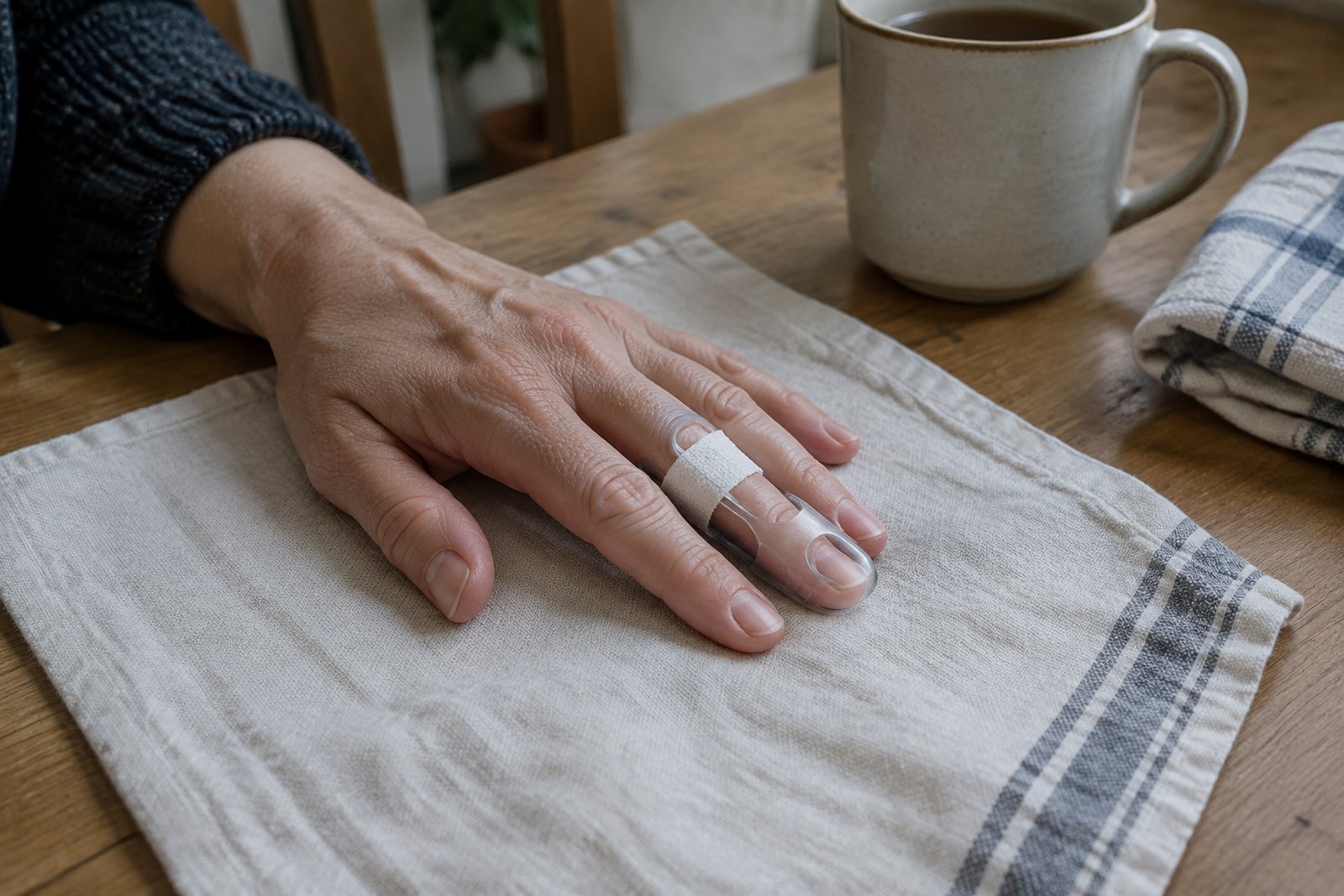
Mallet finger is when the end of a finger droops and you cannot straighten it on your own, usually after the tip has been knocked or bent sharply. A ball hitting an outstretched finger is the classic cause. Tucking in a sheet or pulling up a sock can do it too. The tendon that straightens the end joint has stretched, torn, or pulled away with a small flake of bone. You can still push the tip straight with your other hand, but it will not hold there by itself.
The usual treatment is a small splint that keeps the end joint straight, worn all day and all night, typically for several weeks, while the tendon heals. The one rule that matters more than anything else is simple: the fingertip must not bend at all during that time, not even for a second while you wash or change the splint. Get it checked promptly at a minor injuries unit, urgent treatment centre or your GP, and follow the clinic's instructions. Where they differ from anything written here, theirs win.
What mallet finger is, in plain terms
On the back of each finger runs a tendon that straightens it. It attaches near the base of the last bone, just behind the nail. If the fingertip is forced to bend while the tendon is pulling, the tendon can give way at that point. The end joint then sags into a bent position, a bit like a hammer head, which is where the name comes from.
There are two broad types:
- Tendon-only mallet finger, where the tendon itself has stretched or torn. An X-ray looks normal.
- Bony mallet finger, where the tendon has pulled off a small piece of bone with it. This shows on an X-ray, and the size and position of the fragment can affect treatment.
It often does not hurt much. Some people have a bit of swelling and soreness over the back of the joint for a day or two and assume it is just a jarred finger. That is why many people leave it, and why it is worth knowing that early splinting generally gives the best chance of a straight finger.
Get it assessed, and how quickly
If your fingertip droops and will not straighten on its own after an injury, get it looked at soon rather than waiting to see if it settles. A minor injuries unit or urgent treatment centre is usually the right place, and many will see you without a GP referral. Your GP or NHS 111 can tell you where to go locally. You may need an X-ray to check for a bone fragment and to make sure the joint is lined up.
When it needs more urgent attention
Go to A&E or an urgent treatment centre the same day if:
- there is an open cut over the joint, or bone is visible
- the nail is lifted, torn or there is a lot of blood under or around it, especially in a child
- the finger is badly crushed, misshapen, very swollen or the pain is severe
- the finger is numb, cold, pale or blue
Call 999 for any injury with heavy bleeding you cannot control. Children's finger injuries near the nail can involve the growth area of the bone and sometimes need a different approach, so do not treat a child's drooping fingertip as a wait-and-see problem.
How the splint works
The splint holds the end joint straight, or very slightly bent backwards, so the two ends of the tendon (or the bone fragment) sit together and can knit. Healing tendon is fragile. If the tip bends, the healing tissue can be pulled apart again. Many clinics will tell you that if this happens, the splinting period may need to start again from day one. That is the reason for all the fuss.
Splints vary. You might be given:
- a ready-made moulded plastic splint that slides over the fingertip like a thimble with an open back or side
- a custom splint made from heat-moulded plastic, shaped to your finger by a hand therapist
- a padded metal or foam strip taped along the front or back of the finger
In most cases the splint holds only the end joint. The middle joint and knuckle should still be free to bend, and keeping them moving helps stop them getting stiff. If your splint seems to stop the middle joint moving, ask the clinic whether that is intended.
How long you wear it
The splint is usually worn continuously for around six to eight weeks, sometimes longer, followed by a period of weaning. Your clinic will set the timescale for your injury and check progress, so treat any figure you read online, including this one, as a rough guide only. Write down the start date and the review appointment date and keep them somewhere obvious.
The one rule: never let the tip bend
Continuous means continuous. Not just in the day, not just when you remember. The danger moments are the ones that feel harmless: drying your hands, taking the splint off to check the skin, a quick wash, pulling on a jumper, rolling over in bed.
If you have been told to change or remove the splint
Some clinics teach you to take the splint off once a day to clean and air the skin. Others prefer you leave it alone. Only remove it if you have been shown how and told it is safe. If you do, use the flat-surface method:
- Sit at a table with a clean, dry towel laid flat.
- Rest your hand palm down on the table, so the injured finger lies flat and straight on the surface.
- Keep the fingertip pressed gently flat against the table the whole time. Gravity and the table do the work of holding it straight.
- Slide or unpeel the splint off without lifting the tip.
- Clean and dry the skin with a cloth while the finger stays flat. Check the skin (see below).
- Slide the splint back on, still keeping the tip flat, and re-secure it.
Some people find it easier to turn the hand palm up and keep the finger straight with the thumb of the other hand pressing it out flat. Whichever method your clinic teaches, the principle is the same: the tip is always supported straight. If the tip does bend by accident, put it straight again, put the splint back on and tell the clinic. Do not just carry on and hope.
Looking after your skin
Several weeks inside a plastic splint is hard on skin. Watch for:
- Soggy, white, wrinkled skin, from sweat or water trapped under the splint. Keep it dry, and dry the splint thoroughly after washing.
- Red or sore patches, especially on the back of the finger over the end joint, where the splint presses. A blister or broken skin here is a reason to call the clinic, as the splint may need adjusting.
- Tape problems, such as itchiness or rash where tape sits. Do not wrap tape tightly right round the finger.
- Signs the splint is too tight: tingling, numbness, the tip turning pale, blue or dusky, or throbbing that does not settle. Contact the clinic promptly, or NHS 111 out of hours.
Swelling is common in the first days. Keeping the hand raised, for example resting on a cushion at chest height, can help. Do not loosen or alter the splint yourself unless you have been told how.
Daily life in the splint
One splinted finger sounds trivial until you try to do up a bra, chop an onion or type an email. A bit of planning helps.
Washing and showering
- Keep the splint dry where you can. A disposable glove or a small plastic bag over the hand, sealed loosely at the wrist, works for showers. Keep the hand up out of the stream.
- Wash the other hand normally and the injured hand carefully, avoiding getting water inside the splint.
- If the splint gets wet, dry it using the flat-surface method above, only if you have been shown how. Otherwise pat dry and ask the clinic what to do.
- Washing hair one-handed is awkward. A shower head on a hose, or someone helping for a few weeks, may be easier.
Dressing
The tip of a splinted finger catches on everything: sleeves, tights, socks, waistbands. Feed the injured hand into sleeves first and lead with the whole hand in a loose fist so the splint does not snag. Looser clothes, pull-on trousers and slip-on shoes save effort. If buttons and zips are a struggle, simple aids such as button hooks and zip pullers can help in the short term. Our guide to button hooks, zip pullers and easier fastenings explains the options.
Typing, phones and work
- Type with the other fingers and keep the splinted finger lifted out of the way. It feels clumsy for a day or two, then mostly becomes normal.
- Voice dictation on a computer or phone takes the strain off for longer emails.
- Do not press keys or a phone screen hard with the splinted finger. Pressure on the tip is not usually the problem, but jarring it on a desk edge can dislodge the splint.
- If your job involves manual work, gripping tools, wet hands or contact sport, talk to your employer early. You may need different duties for a while, and your GP or the clinic can advise on a fit note if you cannot work.
In the kitchen and around the house
- Use the other hand for knives and let the injured hand steady things with the palm.
- Wear a glove for washing up, or leave it to someone else.
- Be careful with oven doors, car doors and drawers. A knock to the tip can bend the joint despite the splint if it shifts.
Sleeping
Bedding is a common cause of mallet finger and a common way to undo the treatment. Make sure the splint is securely fastened before bed. Some people find a loose cotton glove or a light dressing over the splint stops it catching on sheets.
Driving
Check with the clinic whether you can drive safely in the splint, and with your insurer. You must be in full control of the vehicle. If you are unsure, do not drive until you have asked.
Coming out of the splint: weaning
When the clinic is happy, you will usually be told to reduce splint wear gradually, often keeping it on at night or during risky activities for a further few weeks. Follow their schedule exactly. Common advice during this stage includes:
- avoiding forceful gripping, heavy lifting and sport until you are told otherwise
- starting gentle bending of the end joint only when advised, without forcing it
- putting the splint back on if the tip starts to droop again, and telling the clinic
The joint will probably feel stiff at first and the area over the back of the joint may stay a bit swollen or tender for a while. Some people are left with a slight droop even with good treatment. This often causes little trouble day to day, but mention it at your review.
When surgery is considered
Most mallet fingers are treated with a splint alone. Surgery may be considered if there is a large bone fragment, if the joint is not lined up properly on X-ray, or in some cases where splinting has not worked. The hand surgeon or clinic will discuss this with you.
Where an occupational therapist fits
Many hand therapists are occupational therapists, and some are physiotherapists, with extra training in hand and upper limb injuries. In hospital and NHS clinics, a hand therapist may make your custom splint, teach you how to change it, check your skin and guide you through weaning and exercises. If you have been referred, that service leads your care.
A private occupational therapist with hand therapy experience can help in some situations, for example if you are struggling with daily tasks one-handed, need practical advice on work or home routines, or have stiffness or loss of function once the splinting is finished. They should work alongside, not instead of, the clinic that diagnosed you. They will not replace an X-ray, a doctor's decision about surgery, or your clinic's splint plan. You can read more about hand therapy at home, our page on hand and upper limb injuries, and how the two professions differ in occupational therapist vs physiotherapist.
Frequently asked questions
Will mallet finger heal on its own without a splint?
Some fingers improve a little, but without splinting many are left with a permanent droop. That is why it is worth getting it checked and splinted promptly rather than waiting.
Is it too late if I injured it a few weeks ago?
Not necessarily. Splinting is sometimes still tried after a delay. Get it assessed anyway and let the clinic decide.
What happens if my fingertip bends while the splint is off?
Straighten it, put the splint back on and contact the clinic. Many clinics will advise restarting the splinting period, as the healing tendon may have been pulled apart.
Can I buy a mallet finger splint myself?
Ready-made splints are sold, but size and fit matter and you still need an assessment, possibly including an X-ray, to rule out a fracture or joint problem. Use the splint the clinic gives you.
Can I keep working or playing sport?
Desk work is often possible with some adjustments. Manual work, wet work and sport may need to pause. Ask the clinic what is safe for your injury.
Will my finger look normal afterwards?
Many do, but a small droop or bump over the joint can remain. It usually causes little problem with daily tasks. Raise any concerns at your review.
Next steps
If daily tasks are hard while your finger heals, or stiffness lingers afterwards, see our equipment and daily living aids page, or current guide prices, and choose your area below.

Talk to an occupational therapist near you
This guide is general information. For advice about your own situation - or someone you look after - a local occupational therapist can visit you at home and see it for themselves.
Choose your area: