

Living With a Prosthetic Leg at Home: Showers, Stairs and Daily Life
By Mobile Occupational Therapist • 30 October 2026 • 14 min read
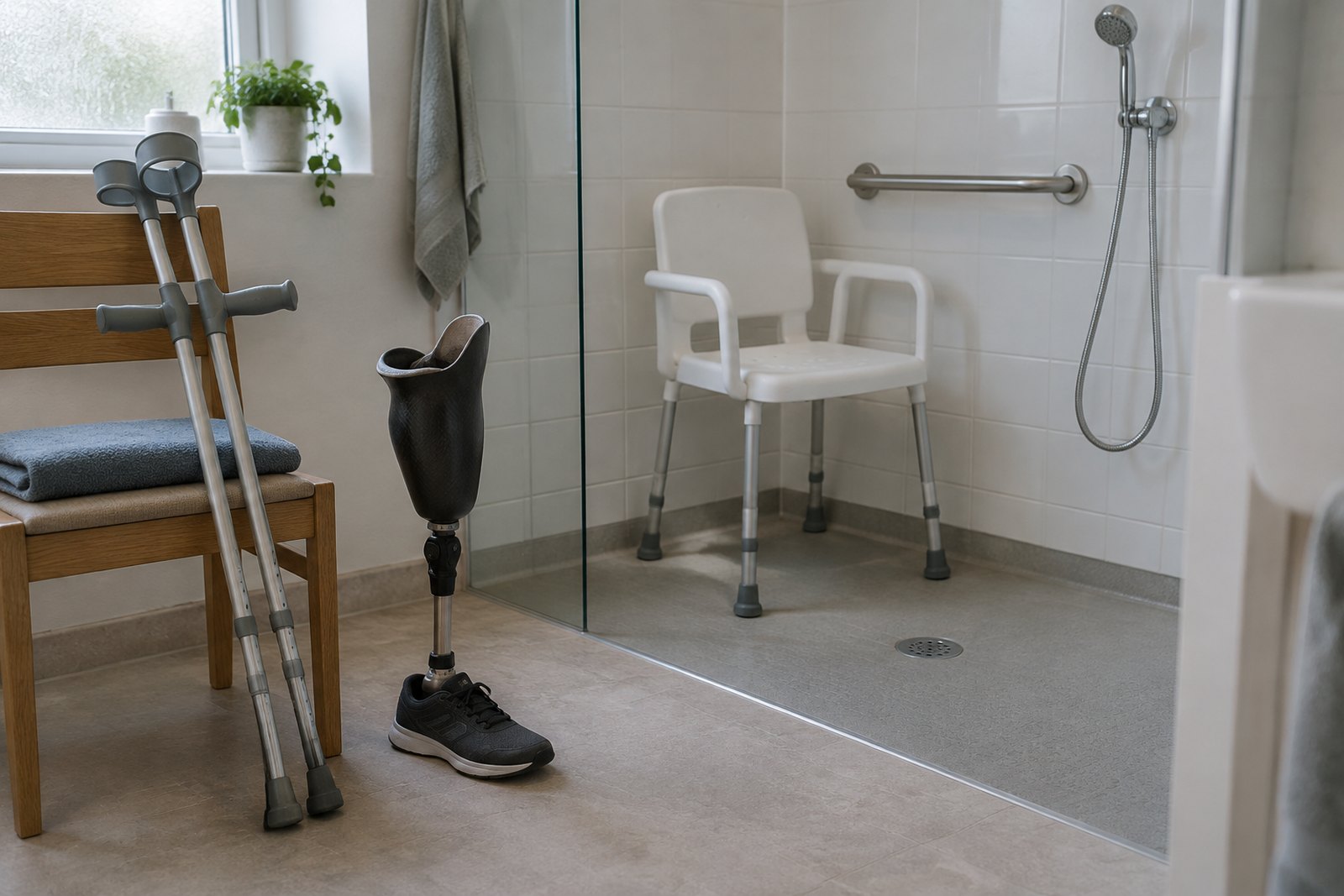
Living with a prosthetic leg at home is mostly about the hours when you are not walking on it. The limb centre team, including your prosthetist and physiotherapist, leads on prosthetic fitting and rehabilitation, including learning to walk. What they cannot do is follow you home and watch you shower, get to the toilet at 3am or carry a cup of tea across the kitchen. That is where much of the day-to-day difficulty, and many falls, can happen.
The short version: look after the skin of your residual limb every day, expect the fit to change through the day, set up the bathroom so you can wash sitting down without the limb, never hop to the toilet at night, use stairs exactly as you were trained, and contact the limb centre quickly if the limb stops fitting or the skin breaks down. The rest of this guide goes through each of those in practical detail, and explains where an occupational therapist fits in.
Putting the limb on and taking it off
Your prosthetist will show you the right method for your limb, and it is worth sticking to it exactly. Different sockets and suspension systems (a liner with a pin, a suction or vacuum system, a sleeve, a belt) go on in different ways, and doing it slightly wrong can rub, pinch or leave the limb loose.
A few things make it easier at home:
- Sit down to do it. A firm chair or the edge of the bed at a height where your feet are flat on the floor is safer than standing on one leg. Have the limb, liner and socks within reach before you start.
- Make sure the skin is completely dry. Putting a liner on damp skin after a wash is a common cause of rubbing and soreness. Give it time, or put the limb on later.
- Check the liner is on smoothly with no wrinkles or trapped air, as you were shown.
- Stand up with something to hold once it is on, and take a moment before walking.
- Keep a routine. Same place, same order, every day. It becomes quicker and you are less likely to miss a step when you are tired.
Taking it off is the reverse. Sit down first, and have your crutches, wheelchair or walking aid within reach before the limb comes off, not after.
Looking after your residual limb and skin
The skin on your residual limb is doing a job it was never designed for. It takes your weight inside a socket, often in warmth and sweat, for hours at a time. Small problems can become big ones quickly, especially if you have diabetes or circulation problems. Our guide to life after an amputation, including phantom limb pain covers the early weeks in more depth.
A daily skin routine
- Check the skin every day, morning and evening. Use a long-handled mirror for the back and underneath, or ask someone to look. You are looking for redness that does not fade within a short while of taking the limb off, blisters, cuts, rashes, swelling or any broken skin.
- Wash the residual limb with mild soap and water, rinse well and dry thoroughly, including any creases.
- Clean the liner and socket as your prosthetist advised. Liners usually need washing daily.
- Ask before using creams, lotions or shaving. Some products affect how the liner grips or can irritate skin. Your limb centre will tell you what is safe for your type of liner.
- Check your other foot too. If you have diabetes or vascular disease, your remaining foot is precious. Look at it daily and keep up with podiatry appointments.
Volume changes through the day
Residual limbs change size. In the first months after surgery they shrink a lot, which is why sockets are often replaced or adjusted. Even later on, the limb can change during a single day. It may shrink as you walk, swell in hot weather, after a salty meal, or if you have spent time sitting with it hanging down.
Most people manage this with prosthetic socks of different thicknesses, adding or removing them through the day so the socket stays snug. Your prosthetist will show you how. Carry spare socks when you go out. If you find yourself needing far more or fewer socks than usual, or no combination feels right, that is a sign to contact the limb centre rather than keep improvising.
Showering and bathing without the limb
Most everyday prosthetic legs are not designed to get wet, so washing usually means doing it without the limb. Some people later get a separate limb for water use through their limb centre, but plan on washing without one.
Standing on one leg on a wet floor is one of the riskiest things you can do. The aim is to wash sitting down.
Setting up the shower
- A shower chair or stool placed so you can sit before the water goes on. A chair with a back and arms gives more support than a stool. Our guide to choosing a safe shower stool or chair explains what to look for.
- Grab rails fixed securely to the wall where you sit down, stand up and turn. Towel rails, soap dishes and shower doors are not grab rails. See where grab rails go and what not to grab.
- A handheld shower head you can reach and control from sitting.
- A non-slip mat inside and outside the shower, if your floor is slippery.
- Everything within reach from the seat: soap, shampoo, a long-handled sponge, a towel.
- A plan for getting there. Many people take the limb off on a chair just outside the bathroom or beside the shower and use a wheelchair or crutches for the last few steps. Others take it off once sitting on the shower chair, if the space allows. Work out which is safer in your bathroom.
Baths
Getting in and out of a bath on one leg is hard. A bath board, which sits across the top of the bath so you can sit and swing your leg over, or a bath lift can make it possible, but they do not suit everyone. If you have a shower over the bath, a board may be the answer. If the bath is the only option and none of this feels safe, it is worth a proper look at the bathroom by an occupational therapist before you try.
Afterwards, dry the residual limb thoroughly before putting the liner back on. If in doubt, wait.
Night-time toilet trips
This is where falls happen. You wake up needing the toilet, you are half asleep, the limb is off, the room is dark, and the bathroom is only a few metres away. Hopping seems quicker than anything else.
Do not hop. Hopping on one leg is unstable, and falling onto your residual limb can damage the skin or a healing wound and set back your walking for weeks. Instead:
- Keep a wheelchair or crutches right next to the bed, positioned the same way every night, as your physiotherapist showed you.
- Consider a commode or urinal by the bed if the bathroom is a long way or you need to go often. It is not glamorous, but it is a lot better than a broken hip.
- Light the route. A bedside lamp you can reach without stretching, and plug-in or motion-sensor night lights along the way.
- Clear the floor of rugs, cables and clutter between bed and toilet.
- Sit on the edge of the bed for a moment before moving. Getting up suddenly can make you dizzy.
- Think about putting the limb on if that is what you have been taught and you have time. Some people do; others find it too slow at night.
If you live alone, a personal alarm you wear, including in bed and in the bathroom, is worth considering so you can call for help if you do fall.
Stairs and slopes
Use stairs exactly the way your physiotherapist taught you, and not before they have said you are ready. Many people are taught to lead with the sound leg going up and the prosthetic leg going down, holding a rail, but your method may be different depending on your limb, your strength and your stairs.
Things that help at home:
- Rails on both sides of the stairs if possible. A second banister makes a real difference.
- Good lighting at the top and bottom, with switches at both ends.
- Nothing left on the stairs. Ever.
- A plan for being upstairs without the limb, using only a method you have been shown and have practised safely, such as shuffling down on your bottom, or getting help if you are not sure.
- Not carrying things while using the stairs. A small bag over your shoulder, or a second set of essentials upstairs, keeps your hands free.
Slopes, kerbs, gravel and wet grass all need practice. Ask your physiotherapist to cover the ones you actually meet, such as a sloping drive or the ramp into your local shop. If you are struggling with stairs at home, a stairlift, moving the bedroom downstairs or other adaptations may be worth discussing.
Adapting your home
Plenty of people manage with very little changed. Others find their home has steps at the front door, a narrow bathroom, or a bedroom upstairs they cannot reach on a bad day. Common changes include:
- Grab rails and a second stair rail.
- A level-access shower instead of a bath.
- A ramp or half-steps at the entrance, with rails.
- Widening doors or moving furniture so a wheelchair fits through.
- A perching stool in the kitchen so you can work at the counter sitting down.
- A raised toilet seat or toilet frame.
In England and Wales, your local council adult social care team can assess for equipment and smaller adaptations (arrangements and terminology differ in Scotland and Northern Ireland). In England and Wales, larger work may be funded through a Disabled Facilities Grant; this is means tested for adults, is not means tested for children, and usually needs an occupational therapist assessment (different schemes apply in Scotland and Northern Ireland). Check your council's website for how to apply in your area.
Driving
Many people drive again with a prosthetic leg, often with adaptations. Whether you need to tell the DVLA depends on your circumstances, so check the current guidance on GOV.UK under driving with a medical condition or disability. You should also tell your car insurer about the amputation and any adaptations.
Common adaptations include an automatic gearbox, moving the accelerator to the left side for someone with a right leg amputation, or hand controls. A Driving Mobility centre can assess what you need and let you try adapted controls. Do not drive until your medical team agrees you are ready, and do not assume you can drive the same car in the same way as before.
Returning to work and sport
Returning to work often works best gradually. Talk to your employer early about a phased return, time for skin checks and sock changes, somewhere to sit, and reducing walking or standing if needed. Employers have a duty to make reasonable adjustments, and Access to Work may help pay for equipment or travel. Our guide to returning to work after long-term sickness has a step-by-step plan.
Sport is very possible, from walking and swimming to cycling and team sports. Ask your limb centre what your current limb can safely do, and whether an activity-specific limb is an option. The Limbless Association is a good place to find peer support and people who have done it before.
Warning signs: when to get help
Contact your limb centre promptly if:
- The limb suddenly fits badly, feels loose or tight, or you cannot get comfortable with any combination of socks.
- You get new pain in the socket, or start limping or walking differently.
- Any part of the limb is damaged, cracked, noisy or behaving oddly.
Stop wearing the limb and contact your GP or NHS 111 the same day if:
- The skin breaks down, blisters, bleeds or a wound opens.
- The residual limb is red, hot, swollen or more painful than usual.
- There is discharge, a bad smell, or a wound that is not healing.
Call 999 if you feel very unwell with a high or very low temperature, confusion, fast breathing or mottled skin, as these can be signs of sepsis. Also call 999 after a fall if you cannot get up, are badly hurt or have hit your head.
Do not pad a socket yourself or carry on wearing a limb that is hurting. It usually makes things worse.
Where an occupational therapist fits
Your limb centre team leads on the limb itself. The prosthetist makes and adjusts the socket. The physiotherapist teaches walking, stairs and balance. Nurses, your GP and the limb centre team deal with wounds and infection, and medication advice, including for phantom limb pain, may come from your GP, the rehabilitation consultant and or a pain service. An occupational therapist does not replace any of them.
What an occupational therapist does is look at how you manage everyday life at home, with and without the limb. That can include:
- Assessing the bathroom and recommending the right shower chair, rails or bath equipment for your space.
- Planning a safe night-time route to the toilet, and whether a commode or urinal would help.
- Checking wheelchair access around the home and where furniture needs to move.
- Working out how to manage kitchen tasks, carrying and housework safely.
- Helping with routines, fatigue and pacing as you build up wearing time.
- Recommending adaptations and, where appropriate, writing a report that may support a grant application or inform a council assessment (the council will usually still need to complete its own assessment).
- Supporting a return to work, hobbies or getting out and about.
You may see an NHS or council occupational therapist after hospital, though waits for later help vary. A private occupational therapist visiting at home can carry out a home assessment focused on exactly the problems you are facing.
Frequently asked questions
Can I wear my prosthetic leg in the shower?
Usually not. Many everyday prosthetic legs and some suspension systems are not designed for use in water, and getting them wet can damage components or make the limb unsafe to use. Plan to shower sitting down without the limb. Some people can get a separate water safe limb, but NHS provision varies, so ask your limb centre if this matters to you.
Should I sleep with my prosthetic leg on?
Generally no. The skin needs time out of the socket to recover. Follow your limb centre's advice, which may include wearing a shrinker sock at night in the early months. Keep crutches or a wheelchair by the bed for getting up in the night.
Is a below knee prosthetic easier to use than an above knee one?
Many people with a below knee amputation find walking takes less effort, because they keep their own knee. An above knee limb includes a prosthetic knee, which takes more learning and energy. But everyone is different, and your health, strength and the reason for the amputation matter as much as the level.
How long does it take to get used to a prosthetic leg?
It varies a great deal from person to person. You will usually build up wearing time gradually, starting with short periods, as your limb centre advises. Expect changes to the socket in the first months as your residual limb shrinks and settles.
Will I still need a wheelchair?
Most people keep a wheelchair or crutches for times without the limb: night-time, washing, when the skin is sore or while the limb is being repaired. Wheelchairs for long-term use are usually provided through the NHS wheelchair service after a referral.
Can I drive with a prosthetic leg?
Many people do, often with adaptations such as an automatic gearbox or a left-foot accelerator. Check GOV.UK for whether you need to tell the DVLA, tell your insurer, and consider an assessment at a Driving Mobility centre.
Next steps
If the bathroom, stairs or night-time routine are what worry you most, a home visit can sort out a lot of it in one go. See our home adaptations page, or current guide prices, and choose your area below.

Talk to an occupational therapist near you
This guide is general information. For advice about your own situation - or someone you look after - a local occupational therapist can visit you at home and see it for themselves.
Choose your area: