

After an Amputation: Phantom Limb Pain, Home and Daily Life
By Mobile Occupational Therapist • 2 October 2026 • 13 min read
If you have had a leg or arm amputated, or someone you love has, the first weeks at home tend to throw up the same questions. Why does a foot that is no longer there still hurt? How do you get to the toilet at night? Will the house ever work again? The short answers: phantom sensations and phantom limb pain are common and real, they are not in your head, and there are treatments your medical team can offer. Most homes can be made to work, often with simple changes first and bigger adaptations later.
Life after amputation is a process, not an event. The hospital stay is the start. The real rehabilitation happens at home, at the limb centre and in the ordinary business of washing, dressing, cooking and getting out of the door. This guide covers the practical side: setting up the house, looking after your residual limb (often still called the stump), phantom limb pain, the risk of falls at night, prosthetic rehabilitation, the emotional side, and where an occupational therapist fits.
Phantom limb pain and phantom sensations
Most people who lose a limb feel it afterwards. It might be an itch in toes that are not there, a sense that the hand is clenched, tingling, warmth, or the feeling that the leg is still lying on the bed. These are phantom sensations, and they are usually harmless, if strange.
Phantom limb pain is different. It can be shooting, stabbing, burning, cramping or crushing, and it can come in short bursts or last for long stretches. Its causes are not fully understood, but it is thought to involve changes in the nerves, spinal cord and brain, which still hold a map of the missing limb. It is not imagined, and it is not a sign that you are coping badly.
It is also separate from residual limb pain, which is pain in the part of the limb that remains, perhaps from the wound, a nerve, a badly fitting socket or a skin problem. Tell your team which kind you have, because the treatment is different.
What your team may offer
Treatment is led by your doctors, your limb centre and sometimes a pain clinic. Depending on your situation, they may suggest:
- Medicines prescribed by your doctor. Do not start, stop or change these without talking to them.
- Gentle massage, tapping or touching of the residual limb to help desensitise it, once the wound has healed and you have been shown how.
- A TENS machine, which uses small electrical pulses on the skin, if your team thinks it is suitable.
- Mirror therapy, where a mirror makes it look as though the missing limb is there and moving. This should be taught by a trained therapist first, because it can stir up strong feelings and is not right for everyone.
- Psychological approaches for managing long-term pain, which are about coping with pain, not about it being imaginary.
Things people often find help day to day
- Keeping a simple diary of when the pain comes, to spot triggers such as tiredness, cold, stress or a full bladder.
- Wearing your shrinker sock or prosthesis as advised, since some people find this settles phantom feelings.
- Gently moving or tensing the residual limb, or imagining moving the missing one.
- Warmth, distraction and pacing your day so you are not running on empty.
If pain is stopping you sleeping, eating or getting on with life, go back to your GP or limb centre. You do not have to wait for your next appointment.
Looking after your residual limb
Your residual limb has a lot of work ahead of it, especially if you go on to use a prosthesis. Skin problems are one of the commonest reasons people have to stop wearing a limb for a while, so a few minutes a day is well spent.
- Check the skin every day. Use a long-handled mirror, or ask someone to look at the bits you cannot see. Look for redness that does not fade, blisters, broken skin, swelling, or any change in colour.
- Wash it daily with mild soap and water, rinse well and dry thoroughly, especially in creases. Washing at night means the skin is dry by morning.
- Do not put creams or lotions on unless your team has suggested them, as they can soften the skin under a socket.
- Wear your shrinker sock or compression exactly as shown, and keep it clean.
- Keep the joint straight when you rest. After a below-knee amputation, do not rest with a pillow under the knee or sit for hours with the knee bent. After an above-knee amputation, spend time lying flat and avoid propping the residual limb up on pillows. Joints that stiffen in a bent position make walking with a prosthesis much harder.
- Check your other foot too, particularly if your amputation was due to diabetes or circulation problems. The remaining foot now does far more work.
Contact your GP, district nurse or call NHS 111 if the wound becomes redder, hotter, more swollen or more painful, starts to leak, smells, or reopens. Call 999 if you feel very unwell, confused, very breathless or cold and clammy, as these can be signs of a serious infection.
Setting up your home
Many people come home using a wheelchair, at least for a while, even if a prosthesis is planned. A home that worked on two feet can suddenly feel full of obstacles. Start with what matters most: getting in and out, getting to the toilet, washing, sleeping and getting food.
Getting around in a wheelchair
- Clear a route through the rooms you use. Rugs, trailing flexes and furniture corners are the usual culprits.
- Check door widths and thresholds. Small threshold ramps can help with lips between rooms. Front and back steps may need a ramp, temporary at first.
- Think about turning space in the hall, bathroom and kitchen.
- If you have stairs and no downstairs toilet, living on one floor for a while may be the sensible short-term answer. It is not a failure, it is a plan.
If you need a wheelchair longer term, it is usually provided through the local NHS wheelchair service. Our guide to NHS wheelchair services explains how referral works. A good cushion matters as much as the chair, especially if you will sit for long periods. See wheelchair cushions and preventing pressure sores.
Bed height and transfers
Moving between bed, wheelchair, toilet and chair is where much of the effort goes. Transfers are easiest when surfaces are level, so the bed height should be close to the height of the wheelchair seat with its cushion. Beds that are too low can be raised; beds that are too high can sometimes be lowered or swapped.
Many people with a leg amputation learn to use a transfer board to slide across from one surface to another. It needs teaching, and the board must be the right length for the gap. Our guide to transfer boards walks through how they are used. Always put the wheelchair brakes on first, and take the armrest off on the side you are moving towards if your chair allows it.
The bathroom
- A toilet frame or rails beside the toilet give something solid to push from.
- A raised toilet seat may help if the toilet is lower than your wheelchair seat.
- A commode by the bed can make nights far safer in the early weeks.
- For washing, a shower chair or stool in a level-access shower is usually safer than getting in and out of a bath. Getting over the side of a bath on one leg is risky and should be assessed, not guessed at.
- Do not wear your prosthesis in the shower unless it is designed for water. Many people shower seated with the prosthesis off.
Longer term, some people need a wet room, a ramp, a stairlift or a through-floor lift. If you own your home or rent, you may be able to apply to your council for a Disabled Facilities Grant (in England, Wales and Northern Ireland; Scotland has a different scheme), which is means tested for adults and normally involves an occupational therapist's assessment.
After an upper limb amputation
Losing an arm or hand changes almost every task, from cutting food to doing up a bra. The answers are often a mix of new techniques and simple equipment: non-slip matting to hold a plate or bowl still, a spiked chopping board, a rocker knife, elastic laces, easy fastenings, a long-handled sponge, an electric toothbrush, and setting up the kitchen so the things you use most are within easy reach on your stronger side. Your other arm will be doing more, so pacing and avoiding strain matter.
Falls at night: the one to plan for
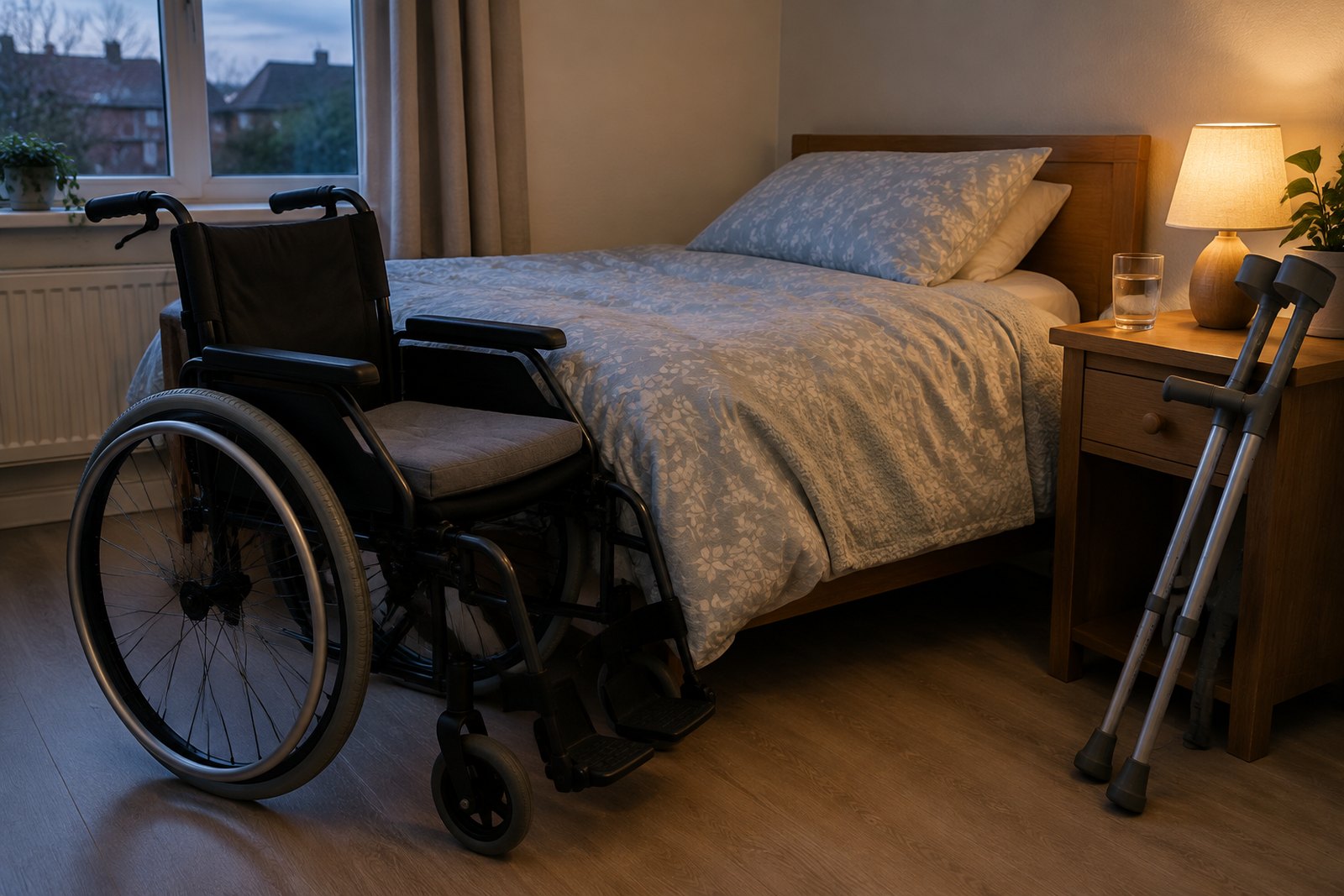
One of the commonest falls after a leg amputation happens like this. You wake in the night needing the toilet, still half asleep, and your brain tells you both legs are there. You stand up and go straight down. Phantom sensations make this more likely, not less.
- Keep your wheelchair right by the bed, angled for transfer, with the brakes on, or keep crutches or a frame within arm's reach if you have been shown how to use them.
- Have a lamp or touch light you can switch on before you move.
- Sit on the edge of the bed for a moment and look down before you do anything.
- Consider a commode or urinal at the bedside so the night trip is shorter.
- Keep a phone within reach, and think about a personal alarm if you live alone.
If you do fall and are hurt, cannot get up, or have hit your head, call for help rather than struggling. Call 999 if you think something is broken or you are badly injured.
Prosthetic rehabilitation and limb centres
Prosthetic limbs in England are provided through NHS limb centres (sometimes called prosthetic or disablement services centres), with similar services in Scotland, Wales and Northern Ireland. Your hospital team usually makes the referral. Not everyone is suited to a prosthesis, and that depends on things like your general health, your other leg, your heart and lungs, and your own goals. Some people decide a wheelchair suits them better, which is a perfectly good choice.
At the limb centre you are likely to meet a prosthetist, who makes and fits the limb, and a physiotherapist, who leads on walking and balance. Some centres also have occupational therapists, psychologists and doctors. Your residual limb needs to heal and settle in shape before a limb is cast, and the shape keeps changing for months, so expect several fittings and adjustments. If your socket rubs, pinches or feels loose, tell the limb centre rather than putting up with it.
The emotional side
People talk a lot about the physical recovery and much less about the grief. It is common to feel shock, anger, relief (if you had been in pain for a long time), worry about money and work, and real sadness about your body and your plans. Some people feel fine for weeks and then hit a wall. Partners and family go through their own version.
Things that help: talking to people who have been there, which is where the Limbless Association and limb centre peer groups come in; telling your GP if your mood stays low; and NHS talking therapies, which in England you can usually refer yourself to (elsewhere in the UK, ask your GP about local psychological services). If you ever feel you cannot keep yourself safe, call 999, go to A&E, or call Samaritans on 116 123 at any time.
Getting out and driving
Many people drive again after an amputation, often with adaptations such as moving the accelerator to the other side, hand controls, or an automatic gearbox. Check GOV.UK for whether you need to tell the DVLA about your condition, tell your insurer, and consider an assessment at a driving mobility centre before you get back behind the wheel.
Where an occupational therapist fits
An occupational therapist focuses on everyday life: getting in and out of bed, washing, dressing, toileting, cooking, getting out of the house and back to work or hobbies. After an amputation, an occupational therapist can:
- Assess your home and recommend practical changes, from bed height and rail positions to ramps and bathroom alterations.
- Teach safe transfers and work out which equipment suits you and your space.
- Help with one-handed techniques and equipment after an upper limb amputation.
- Help you pace your day, manage fatigue and build routines that work.
- Write reports to support a Disabled Facilities Grant, a housing move, benefits claims or a return to work.
In the NHS, a hospital occupational therapist often sees you before discharge, and council occupational therapists handle major adaptations. Waits for council assessments vary, which is why some people choose a private occupational therapist visiting at home, either while waiting or for a more detailed report.
Be clear about who leads what. Your prosthetist leads on the limb and socket. Your physiotherapist leads on walking, balance and exercise. Your GP or consultant leads on pain medicines, wound problems and your general health. A psychologist may help with adjustment and long-term pain. An occupational therapist works alongside them, not instead of them.
Frequently asked questions
Is phantom limb pain normal?
Yes. Feeling the missing limb is very common after amputation, and many people also have phantom pain at some point. It is real pain caused by the nerves and brain, not something you are imagining. Tell your team about it so they can help.
Will phantom limb pain go away?
For many people it becomes less frequent or less intense over time, but it varies a lot from person to person. If it is not easing or is getting worse, ask your GP or limb centre about treatment options or a referral to a pain service.
How soon can I get a prosthetic limb?
It depends on how quickly your wound heals, how your residual limb settles and your general health. Your hospital team or limb centre will guide timings. Expect the first limb to be adjusted several times as your residual limb changes shape.
Will the council pay for a ramp or wet room?
Possibly. Councils can provide some minor adaptations and may fund bigger work through a Disabled Facilities Grant, which is means tested. Contact your council's adult social care team to ask for an assessment, and check the rules on GOV.UK.
Can I still have a bath after a leg amputation?
Some people can, with the right equipment and technique, but getting over the bath side on one leg carries a real risk of falling. Many people find a seated shower safer. Have it assessed before you try.
Do I need to tell the DVLA?
You may need to, depending on your situation and the type of licence you hold. Check the current guidance on GOV.UK, and tell your insurer about any adaptations to your car.
Next steps
If the house is not working, an assessment is a sensible place to start. See our home adaptations page, or current guide prices, and choose your area below.

Talk to an occupational therapist near you
This guide is general information. For advice about your own situation - or someone you look after - a local occupational therapist can visit you at home and see it for themselves.
Choose your area: